

Environmental compliance issues are more complex than ever. SCS’s Tracer Environmental Division has expertise in all aspects of environmental management, safety and risk analysis, and compliance. SCS Tracer’s Risk Management team focuses on compliance related to risk and process safety-based EPA and OSHA regulations. SCS also provides expertise with state-specific programs such as the California Accidental Release Prevention (CalARP) Program and Nevada’s Chemical Accident Prevention Program (CAPP).
Our specialized practice provides advanced  environmental and engineering services regarding risk management and safety to both government and industry clients. SCS staff have expertise in all aspects of compiling Process Safety Management (PSM) and Risk Management Plans (RMP) or GDC documentation, such as piping and instrumentation diagram preparation, mechanical and compliance audits, process hazard analysis, and off-site consequence analysis and modeling.
 Our Risk Management and Safety Group offers a comprehensive set of technical capabilities, including:

SCS understands that project delays can translate into significant and unexpected operating costs. We offer proven fast-track techniques to respond rapidly to our clients’ needs and to ensure that technical objectives are completed on schedule and within budget.
To better serve the unique needs of our clients, we employ experienced staff with backgrounds in oil, petrochemical/chemical industries, aerospace, and manufacturing companies. Tracer’s service professionals are strategically located across the nation and perform the calibration in a wide range of ammonia refrigeration industries such as dairy, food, and beverages; ice arenas and ice manufacturing; cold storage warehouses; and for facilities using ammonia for metal/tooling heat treating, and fossil fuel plants with NOx systems. As an added service, we can provide consultation on your ammonia detection system based on the IIAR 2-2014 Standard and Recognized And Generally Accepted Good Engineering Practices (RAGAGEP).
SCS conducts a variety of audits to evaluate facility compliance with current environmental and safety regulations. In particular, EPA’s Risk Management Program regulation and OSHA’s Process Safety Management standard require that facilities conduct compliance audits every three years to ensure the programs’ effectiveness.
An audit can verify that the training program is complete and that employees are being trained by reviewing employee records. SCS uses the American Institute of Chemical Engineers, “Guidelines for Auditing Process Safety Management Systems.” , Four essential tasks determine the effectiveness of a facility’s programs:
This audit process can be applied to EPA’s Risk Management Program and OSHA’s Process Safety Management Program as well as OSHA’s safety requirements included in Section 1910 (Cal-OSHA Title 8) such as Confined Spaces, Respirator Protection, Injury Illness and Prevention Program, Forklift Safety, Ladder Safety, Means of Egress, etc.
SCS Engineers can prepare a Process Hazard Analysis (PHA) for your facility, to serve as the basis for many decisions and procedures associated with an effective risk and safety program. A PHA is a systematic effort to determine potential hazards and develop mitigation solutions, including equipment and procedural modifications, and training. An effective PHA analyzes potential consequences associated with a release of hazardous materials including fires, explosions, and exposure to toxic materials.
SCS recommends that a facility conduct a Hazard and Operability Study (HAZOP), based on the American Institute of Chemical Engineers (AIChE) HAZOP Guide Word method as described in their publication, “Guidelines for Hazard Evaluation Procedures,” along with a “What-If” Walkthrough analysis. Our experience shows that the HAZOP combined with a walkthrough prevents overlooking operator hazards. The walkthrough, following the design analysis, enables incorporating human factors such as lighting, accessibility, and overall working conditions into the analysis, which are entered into the Log Tables during the actual study.
OSHA requires certain facilities to comply with its Process Safety Management (PSM) regulations. California (Cal/OSHA) has an equivalent program. SCS prepares complete Process Safety Management Programs for facilities that store or use regulated hazardous materials over the threshold amounts.
OSHA developed the PSM standard to prevent or minimize the consequences of catastrophic releases of toxic, reactive, flammable, or explosive chemicals. SCS uses facility documentation, procedures, and interviews with personnel to complete drafts of the fourteen prescribed PSM sections, prepared according to facility specifications. After the facility review, we develop the final documentation for the facility.
SCS can prepare piping and instrumentation diagrams (P&IDs) which can be used for the Hazard and Operability Study or the Process Safety Information requirement within the PSM regulation. The P&IDs outline all equipment, valves, and level controls within the hazardous material system at the facility. The P&IDs also frequently show the valve numbers used within the operating procedures. For an overall understanding of the hazardous material system, we develop a process flow diagram.
The Risk Team at SCS Tracer have all attended the Ammonia Safety Training Institute (ASTI) 32-Hour Emergency Response and Planning Training. Our backgrounds and training include:
The Clean Air Act Amendments of 1990 contain a provision for evaluating the potential public impact of an accidental release of acutely toxic, flammable, and explosive materials from industrial facilities. The EPA finalized regulations to implement this provision by requiring the preparation of a Risk Management Plan (RMP) for all facilities that store or utilize regulated substances in quantities that exceed the threshold quantity for specific materials.
SCS has extensive experience in the development of Risk Management Programs addressing Clean Air Act services (40 CFR Part 68), Chemical Accident Prevention Provisions. We have developed hundreds of plans for a variety of different types of industries, and we conduct the required ongoing maintenance and five-year revalidations and updates. We also prepare submittals and program documentation for new facilities wishing to use listed substances.
SCS professionals work with your facility staff evaluating your environmental programs as they relate to local, state, and federal regulations. An environmental compliance audit will note observed deficiencies and make recommended corrective actions.
SCS prepares atmospheric dispersion modeling studies for risk assessments or possible release scenarios developed during the facility’s Hazard and Operability
Study. Modeling studies evaluate the impact of various release scenarios on local air quality. Release scenarios consist of one or more sources located in flat or complex terrain. Our engineers conduct the analyses using the dispersion models (Gaussian, numerical, statistical, or empirical) that best suit each scenario. For improved accuracy, SCS develops proprietary models according to the specific needs and modeling conditions of our clients (e.g., neutral, buoyant, dense gas, etc.). SCS also validates dispersion models using specially developed techniques involving tracer gas sciences.
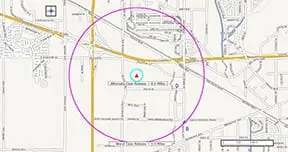
To display the impacts simulated by the dispersion models, SCS overlays “isopleths” (contours of constant values) onto digitized maps. Our process ensures the accuracy of the results and reduces overall project costs. As shown here, a footprint of an ammonia release is superimposed over the area surrounding a subject facility.
SCS conducts PSM/RMP training, including outlining the responsibilities of the various PSM/RMP team members such as maintenance, safety, management, environmental, and facilities personnel. Our training covers:
SCS has a diverse staff of well-qualified engineers, scientists, and technicians who can provide practical, cost-effective solutions to your complex regulatory problems.
Ammonia Refrigeration The SCS Tracer Environmental supports ammonia-refrigerated warehouses and manufacturing facilities throughout the United States. Our cumulative experience with ammonia-refrigerated facilities spans in excess of 100 years and includes … Continue reading Ammonia Refrigeration
Environmental Management Plans and Systems An Environmental Management System (EMS) is a set of practices and procedures that help a company reduce environmental impacts while increasing operating efficiency and addressing … Continue reading Environmental Management Plans and Systems
Industrial Refrigeration Training, Custom, PSM, RMP, GDC, HAZMAT For additional information or answers about the SCS Industrial Refrigeration Training, custom classes, PSM, RMP, GDC, and HAZMAT Training listed here, or … Continue reading Industrial Refrigeration Training


