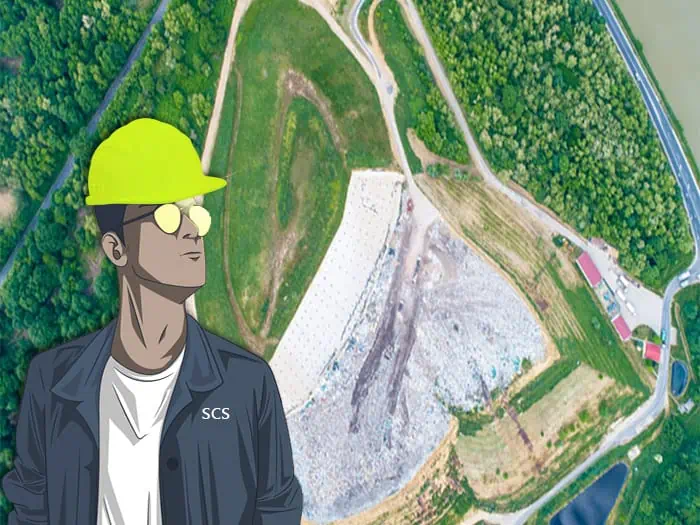
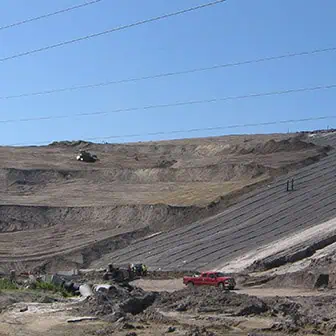
Landfills are located on properties with different geometric shapes and angles, including concave side slopes. The landfill boundary is decided by considering many different conditions that may exist at the property, such as wetlands, flood plains, soft foundation areas, protected plant species, navigable waters of the United States, creeks, utility easements, roads’ right-of-way, gas line easements, water districts, distance from nearby airports, etc. Following careful review of all conditions, a landfill boundary is selected that meets all regulatory requirements, with the understanding that a permitting process must be followed if the selected landfill footprint encroaches on any protected areas.
The landfill footprint polygon would be best if its interior angles were less than 180 degrees. Interior angles greater than 180° make the exterior angle less than 180°. An exterior angle less than 180 degrees forms a concave surface, as shaped by the landfill slopes above ground. Concave surfaces are such that the length of contours representing equal elevations within the surface increases with increasing landfill height. This generates a convergence phenomenon in the final cover drainage layer, potentially causing complex problems for the operator. Special designs seem necessary to address the following two issues commonly observed with concave surfaces.
The concave surface directs water within the final cover drainage layer toward the centerline of the concave surface. The centerline of the concave surface may be a straight line if the two halves of the concave surface are perfectly symmetric; otherwise, the centerline may deviate from a straight line. Water flowing toward the centerline of the concave surface converges within the void space of the final cover drainage layer. The rapid convergence of flow rapidly increases the hydraulic head of water within the drainage layer and often overwhelms its capacity to maintain that head within the drainage layer thickness.
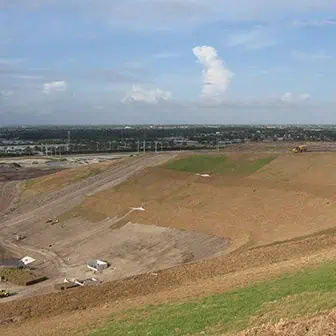
The special design must prevent the growth of a liquid head and prevent saturation of the overlying soil layer. The most critical part of the system lies along the centerline of the concave surface, the convergence line. A drain system consisting of a pipe wrapped in gravel and geotextile can be that special design along the concave surface centerline. The drain system along the concave surface centerline collects water that exceeds the drainage layer thickness and conveys it through the pipe to the toe of the slope for discharge into the perimeter ditch. This process prevents the drainage layer from overlying the soil layer from becoming saturated with excess water, which can cause instability. A lack of a drainpipe causes the overlying soil to become saturated, and water seeps out of the soil layer toward the top surface of the final cover. Eventually, a stream of water flowing down the slope along the concave surface centerline forms, causing soil erosion along its path and slope instability.
The shape of the concave surface determines whether a single drainpipe or multiple pipes are needed to address the issue effectively. The surface shape also determines whether the single pipe angle should change midway down the slope to align with the most critical pathway for the convergence line.
Partial closure of the concave surface may require extending the drainpipe to the top boundary of the partial closure, then extending it during the higher-level partial closure. Otherwise, the drainpipe may be terminated short of the full length of the convergence line, depending on whether the drainage layer thickness can withstand the liquid head forming above the termination end of the drainpipe. Engineers should analyze the drainage and conveyance capacities to define a termination point for the drainpipe.
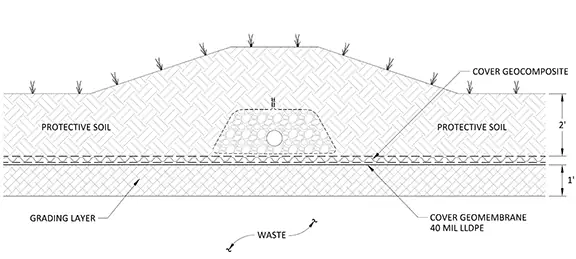 At the bottom of the slope, the water in the drainpipe may be released directly to the landfill perimeter ditch or to the drainage layer drain system at the toe of the landfill slope. An engineer’s careful attention is required to evaluate these options, as the water in the drainpipe along the concave surface centerline is expected to be high-energy, with significant velocities, given the connections near the slope bottom.
About the Author: Dr. Ali Khatami
Additional Resources:
Corporate Headquarters