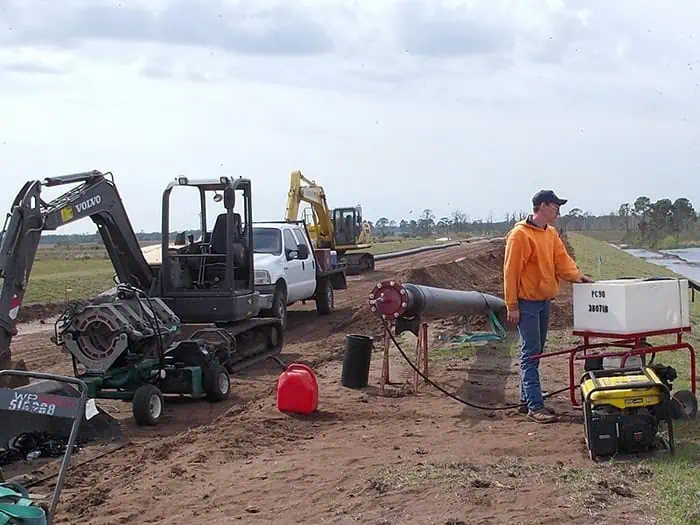
High-density polyethylene (HDPE) pipes are among the most commonly used pipes in the landfill industry. HDPE pipes are used as high-pressure carriers for leachate, gas condensate, compressed air, etc. HDPE pipes are also used in landfill gas collection systems, where they operate under vacuum. This blog article by Dr. Ali Khatami explains the precautions taken and why they help ensure the weld integrity in landfills.
Pipe Fabrication and Testing
HDPE pipes are shipped to a landfill construction site in pipe segments. The pipe segments are welded together to create pipe lengths to the specified application in the construction plans. Pipe segments are connected using butt fusion machines. HDPE pipes of any length and diameter can be fabricated in the field by using these machines. The fabricated pipes are commonly tested to verify the integrity of the butt fusion welds, making sure the welds do not leak.
Pipe Pressure Testing
Engineers specify pressure testing of HDPE pipes by identifying the required test pressure, the test duration, and the allowable pressure drop at test completion. The test pressure may vary from one pipe application to another. For example, the specified test pressure may be 1.5 to 2 times the maximum service pressure in a leachate force main pipe. In contrast, in pipes used in landfill gas collection systems under vacuum, the specified test pressure may be lower. Test duration may range from 1 to a few hours, and the allowable pressure drop may range from 0 to a percentage of the initial pressure.
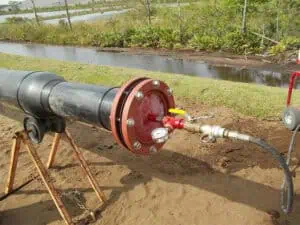
It is generally recommended to use incompressible fluids (water) for testing pipes at high pressures. The pipe needs to be prepared with blind flanges on either end with special connections. The special connection at the liquid feeding end may include a feed pipe connected to the blind flange to allow water to enter the pipe interior, a pressure gauge indicating pressure inside the pipe, and a valve. A special connection at the pipe’s other end, such as a valve, allows water out of the pipe at test completion. Engineers check the specified pressure against the pipe assembly pressure rating. The specified pressure must be less than the pipe assembly pressure rating; otherwise, the pipe assembly may fail during the test. If couplings are included in the pipe assembly, the pressure rating of the coupling may govern the specified test pressure.
Double-Cased Piping Testing
Pressure testing of double-cased pipes falls under a special category. For discussion purposes, the inside pipe is referred to as the ”carrier” pipe, and the outside pipe is referred to as the “casing pipe in these discussions. The pressure testing of the carrier pipe follows the single pipe testing protocol. The casing pipe pressure testing is more complicated. HDPE pipes are generally strong against outward pressures (internal high pressures); however, they are not as strong under inward pressures or vacuum conditions. Engineers must be aware of the internal (inward) pressure rating of HDPE pipes when preparing specifications for pressure testing. If the casing pipe pressure testing is performed with the unpressurized carrier pipe inside the casing pipe, the high pressures inside the casing pipe (outside the carrier pipe) may exceed the inward pressure rating of the carrier pipe, causing carrier pipe wall buckling without the involved parties becoming aware of it. The solution to the issue is to pressurize the carrier pipe while the casing pipe goes under pressure testing. It is recommended to pressurize the carrier pipe to 5 psi below the casing pipe test pressure. That setup will apply 5 psi of inward pressure on the carrier pipe, which is within the safe zone for all standard-diameter ratio (SDR) pipes.
About the Author: Dr. Ali Khatami
Additional Resources: