SCS Engineers helps industrial, commercial, and institutional clients comply with the Clean Air Act (CAA). We determine how the rules and regulations affect your operations, and we develop practical strategies to meet the requirements. We provide industry-specific, proven approaches to assessing and maintaining compliance, and our strong relationships with agencies provide the expertise required to obtain and maintain the appropriate industrial air compliance program.
Our Industrial Air Permitting services include:
Nonattainment New Source Review (NNSR) Permitting
SCS offers various services for federal, state, and local new source review (NSR) construction permitting programs, including in areas designated as nonattainment for the National Ambient Air Quality Standards (NAAQS), such as Los Angeles, California, and Houston, Texas. Our NNSR services include:
Prevention of Significant Deterioration (PSD) Permitting
SCS also offers various services associated with federal and state prevention of significant deterioration (PSD) permitting. Our PSD services include:
State and Local Permitting
Our state and local industrial air permitting services encompass permitting applicability reviews for facility expansions and new construction, as well as the preparation and submittal of applicable permit applications. SCS has experience completing permit-to-construct/permit-to-operate applications for submittal to state and local air pollution control agencies and air regulators in all 50 states and U.S. territories.
Title V Permitting
SCS is among the nation’s leading practitioners of Title V compliance services. Because of our expertise in understanding, interpreting, and complying with Title V requirements at the federal, state, and local levels, SCS has been involved with Title V permitting projects for numerous sites throughout the U.S., including more than 200 industrial facilities.
The SCS approach to compliance with the Title V Operating Permit Program, as set forth in Part 70 of the Code of Federal Regulations (CFR), is to first determine whether a Title V Permit is required. In many instances, a synthetic minor permit is a viable option (for small to mid-size industrial operations). If a synthetic minor permit is determined to be appropriate, SCS can perform all functions related to the preparation of this permit application. If a Title V Permit is necessary, SCS provides turnkey pre- and post-permit application services, including:
Best Available Control Technology (BACT) Evaluations
SCS prepares BACT, a case-by-case emissions control requirement under the PDF permitting program, for many of our clients. It applies to new major sources or major modifications at existing facilities, and it is also a requirement of various agencies for minor sources. Conducting a BACT evaluation determines the most effective and feasible emissions control option for a specific pollutant and source type, accounting for energy, environmental, and economic impacts. The evaluation typically follows a top-down process:
BACT chooses the most effective, practical way to reduce pollution and often sets an example for other facilities.
Emission Offset Determinations
SCS assists our industrial air quality clients by performing an emission offset determination to identify whether a new or modified facility will increase air pollution exceeding regulatory limits. If it does, the facility may need to reduce emissions elsewhere (offsets) to balance the increase. This process ensures that overall air quality is maintained while allowing for new or expanded operations. SCS can assist in determining if offsets are needed, finding ways to require or eliminate the offset burden, and, if necessary, help our clients secure ERC to meet offset requirements.
Permit Appeals/Negotiations
Industrial air permits contain conditions that a facility must satisfy to comply. SCS assists our clients in negotiating these permits by reviewing draft permits, providing comments to the air agency, suggesting alternative permit conditions, and attending meetings with agencies. Situations can arise, however, where a facility disagrees with a permit condition and must file a formal appeal with the applicable regulatory agency. Situations can also arise in which a facility cannot comply with a permit condition or regulatory requirement.
A facility must file for a formal variance issued by the applicable agency in these cases. Our experts can prepare appeals or variances to address each compliance situation. Notably, under Title V, non-compliance can lead to civil suits and federal enforcement actions. We help our clients implement non-compliance response strategies based on any situation.
Permitting Strategy and Applicability Reviews
SCS evaluates facilities for permitting applicability. A permitting applicability review is an evaluation to determine whether a facility or project needs air quality permits, and, if so, what type(s). It considers the type and amount of emissions, the equipment or processes involved, and applicable local, state, and federal regulations. The benefit is to help facilities stay compliant and avoid penalties by identifying and obtaining all required permits before construction or operation begins.
 Air Dispersion Modeling
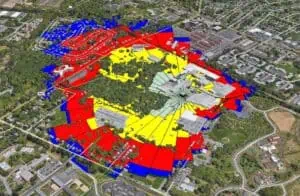
SCS prepares atmospheric dispersion modeling studies for air permit applications, health risk assessments, and, when requested by clients, for other reasons. Modeling studies evaluate the impact of various release scenarios on local air quality. Our teams conduct the analyses using the dispersion models (Gaussian, numerical, statistical, or empirical) that best suit each scenario. Our expertise includes extensive modeling experience with AERMOD, CALPUFF, AERSCREEN, and various other refined and screening models. To improve accuracy, SCS develops proprietary models tailored to our clients’ specific needs and modeling conditions (e.g., neutral, buoyant, dense gas). SCS also validates dispersion models using specialized techniques that incorporate tracer gas science and air monitoring studies.
National Environmental Policy Act (NEPA)/California Environmental Quality Act (CEQA) Analyses
SCS supports industrial projects requiring NEPA and CEQA review for air quality and GHG issues. SCS brings deep expertise in navigating NEPA and CEQA requirements—helping industrial clients efficiently manage environmental review processes while aligning with project timelines and regulatory expectations. NEPA/CEQA analyses are conducted at three levels, depending on the potential environmental impact of a proposed project:
–Categorical Exclusion (CATEX): For actions with no significant environmental effects. Under CEQA, this is a categorical exemption.
–Environmental Assessment (EA): A brief study determines if a full environmental impact statement (EIS) is necessary. Called an initial study under CEQA, if the study is sufficient, it can support a finding of no significant impact (FONSI) under NEPA or negative declaration (ND) or mitigated ND (MND) under CEQA.
–Environmental Impact Statement (EIS): Major federal actions likely to result in significant environmental impacts require a comprehensive and detailed review. Under CEQA, this is an environmental impact report (EIR) that considers air, water, land, cultural resources, wildlife, and public health, and often involves coordination with other agencies and the public.
NEPA/CEQA do not dictate specific outcomes but consider environmental concerns relevant in federal or state decisions. As part of our air quality practice, SCS commonly prepares various air quality impact analysis (AQIA) studies addressing air quality, GHG emissions, odor, health risks, and related impacts from construction and operational activities.
Air Toxics Risk Assessment (ATRA)
SCS conducts air toxic risk assessment (ATRA) for our clients. An ATRA is a process evaluating the potential health risks from exposure to toxic air pollutants released by a facility. It examines the amount of a chemical released, its movement through the air, and potential exposure pathways for people. The assessment considers both short-term (acute) and long-term (chronic) effects on nearby communities.
The outcome is to determine whether emissions could pose a significant health risk and identify ways to reduce exposure. This assists regulators and companies in making informed decisions that protect public health. SCS has completed ATRAs for our clients for permitting projects, to meet state/ local air toxics regulations, to justify a reduction in emissions controls, in support of NEPA/CEQA work, and to achieve risk reductions required by regulatory requirements.