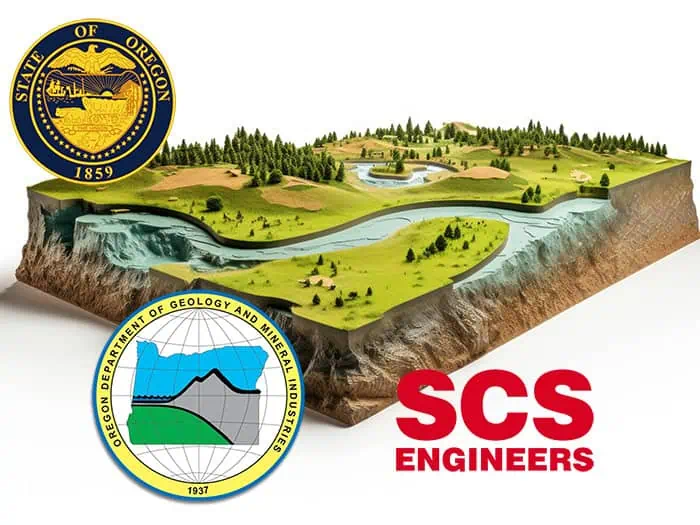
SCS Engineers is supporting the Oregon Department of Geology and Mineral Industries (DOGAMI) in advancing its Carbon Storage Site Characterization Program through stratigraphic well drilling services in the Lower Umatilla Basin in Morrow County, Oregon.
The program will help DOGAMI develop the high-quality subsurface data needed to evaluate the Columbia River Basalt Group as a potential, safe, long-term carbon dioxide storage resource. By combining drilling, physical sampling, wireline geophysical evaluation, and hydraulic and reservoir testing into one coordinated field effort, SCS will help DOGAMI characterize geologic conditions, assess reservoir behavior, and strengthen the scientific foundation for the technical viability of carbon storage.
This research and evaluation work supports Oregon’s broader decarbonization goals by generating data to inform environmental protection, permitting pathways, regulatory planning, and future carbon capture and storage decisions. SCS’s integrated approach provides full service, experienced drilling oversight, and a field program designed to reduce execution risk under complex basalt drilling conditions. The project preserves flexibility for future subsurface monitoring while supporting the responsible management of Oregon’s natural resources.
The SCS approach supports a safe, efficient, and well-documented characterization program, providing Oregon with the information needed for confident decision-making and public transparency. SCS’s work aligns with the state’s technical, programmatic, and regulatory goals. The project will help DOGAMI advance from geologic investigation to a clearer understanding of whether Oregon’s basalt formations can support long-term, science-based carbon storage solutions.
“SCS is honored to support DOGAMI in this important effort to understand better Oregon’s subsurface geology and its potential role in responsible, long-term carbon storage,” said SCS Project Advisor Tara Gross. “This work reflects the kind of science-based collaboration needed to help public agencies evaluate emerging decarbonization solutions with confidence, transparency, and care for natural resources.”
Additional Resources:
Capturing carbon dioxide and injecting it into a Class VI well for permanent geologic carbon sequestration, or CO2 storage, is a practice that industry leaders use to decarbonize manufacturing processes. Manufacturers use CO2 storage to reduce their greenhouse gas emissions and carbon footprint. There has been an uptick in proposed projects, both commercial hub-scale and single emitter-affiliated scale, particularly within the last year. The catalyst for the uptick in proposed projects is primarily the associated financial incentives, including federal tax credits and grant monies.
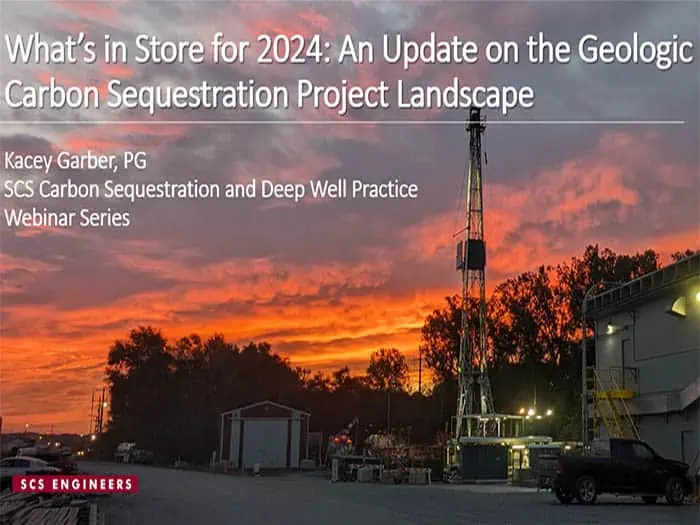
In this educational webinar, Professional Geologist Kacey Garber describes what manufacturers interested in geologic CO2 storage can expect the project landscape to look like in 2024. The video includes a discussion of the following:
Understanding the current project landscape and how and when future project opportunities might evolve is important for manufacturers considering the geologic storage of their CO2 stream, whether through a larger commercial hub or a smaller on-site project.
Additional Resources:

About the Presenter: Kacey Garber is a professional geologist experienced as a groundwater project manager for active and closed industrial client sites. Her responsibilities include groundwater monitoring and statistical analyses; reports and permit applications; designing sampling and analysis plans; special groundwater studies; and conducting groundwater well construction planning and design. She has also been involved in PFAS work groups and publishes on the topics of UIC and geologic carbon sequestration.
Corporate Headquarters