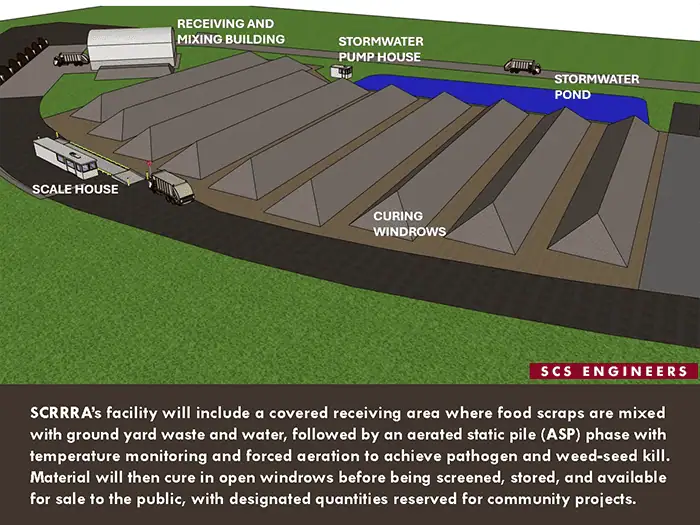
The Southeastern Connecticut Regional Resources Recovery Authority (SCRRRA) announced it will begin construction this month on the region’s first commercial-scale food waste composting facility. The facility will divert organics from the solid waste stream and convert them into nutrient-rich compost for local farms, gardens, and community projects.
The goal is to provide Southeastern Connecticut with the infrastructure to divert 13,000 tons of organics and food waste from the solid waste stream and process them into nutrient-rich compost for the local community. The new facility, with all its community and environmental benefits, is expected to be operational in December 2026.
Following pilot testing, permitting, and facility design, SCRRRA is now beginning construction of its composting facility on approximately eight acres in Preston, Connecticut. The facility uses a hybrid system that combines aerated static pile (ASP) processing with open windrows to create a cost-effective, scalable solution for receiving and processing food scraps mixed with ground yard waste from municipal transfer stations.
Project highlights
“Connecticut is facing a critical shortfall in solid waste disposal capacity. We are currently shipping 40% of our waste out of state at great cost, both financially and environmentally. We are desperately short of disposal infrastructure. This facility will provide needed relief for the southeast region, recycling what would be waste into a valuable, environmentally friendly product that will benefit all our communities,” said SCRRRA Executive Director, David Aldridge.
SCRRRA continues to work in collaboration with local governments and public works departments in its 12 member municipalities, along with engineering consultant SCS Engineers, including Greg McCarron, PE (USCC Certified Composting Professional and SCS national expert on organics management projects).
The facility will be funded, in part, by the Connecticut Department of Energy and Environmental Protection through its inaugural Materials Management Infrastructure (MMI) Grant Program. Funding will also be provided by the U.S. Department of Agriculture (USDA) and its Composting and Food Waste Reduction (CFWR) program.
Links to Additional Resources:
The Composting Consortium, an industry collaboration managed by Closed Loop Partners’ Center for the Circular Economy, released new resources that Greg McCarron of SCS Engineers recommends to municipalities looking to start or enhance a composting program. A blueprint, “How Organics Diversion Can Help Achieve Zero Waste Goals,” offers a clear and actionable framework, including:
Policy and Program Expansion for Diverting Food Waste: This section dives deeply into effective strategies for policy development. It explores methods to incentivize resident and business participation while outlining pathways to maximize food waste diversion from landfills.
Setting Up Programs and Infrastructure: This section provides a clear roadmap for establishing new organics programs. It details best practices for collection methods, explores various processing options (composting facilities, anaerobic digestion), and offers guidance on navigating the critical process of contracting with composters.
Communication with Program Participants: This section provides a comprehensive communications toolkit. It outlines strategies for educating participants on proper sorting techniques, maximizing program participation, and fostering long-term program success.
The site also includes platforms and programs that you may find useful and help connect you with other city officials and leaders nationwide to share and discuss best practices in starting and expanding organics programs & composting infrastructure.
These free, non-commercial resources will help you appreciate and understand applying the science and practice of composting and what is critical to a successful site, design, permit, and manage municipal composting programs that support circularity and operational efficiencies – creating value for all stakeholders. Many municipalities are interested in growing their programs to help the environment and provide a useful byproduct by reducing the amount of waste being hauled away and ultimately placed in landfills.
More Composting Educational Resources:
Corporate Headquarters