See SCS Engineers Sustainable Materials Management Services
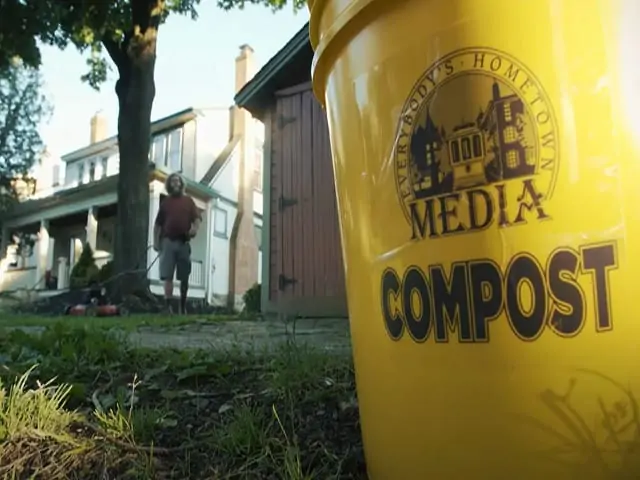
Media Borough, Pennsylvania’s Food Compost Program uses a witty video encouraging participation in its organic waste diversion and composting program. We had to share – not only is it fun – it works!
The Borough launched its pilot program to gauge the feasibility of adding food scrap collection to its current recycling efforts. This month the program is available to all residents. The food scrap collection program provides residents the opportunity to separate food from the rest of their household waste for collection and composting at a local compost farm.
Media Borough estimates it has 70% recycling participation in the community – that’s an impressive number. Its current recycling and yard waste programs divert close to 30% of residential solid waste from landfills and incinerators. Adding a food scrap collection program can reduce residential waste by another 30% and create compost.
The Borough’s Public Works website explains the reasons why organic matter, matters.
Thank you to this Pennsylvania community and its Public Works department for helping to sustain future generations with their reduce, reuse, and recycling actions. We hope by sharing their video and results, we’ll see greater participation in communities nationwide.

Achieving Florida’s 75% Recycling Goal presents unique challenges and opportunities for policymakers and professional staff. Across the country, local governments who had become accustomed to receiving operational cost offsets from their recyclable materials are now paying higher fees to continue their recycling programs. Renewable News covers how Leon County and the city of Tallahassee are managing both through their partnership.
They are uncovering opportunities to improve upon current operations, including but not limited to potential changes to facilities, infrastructure, programs, and partnerships. New opportunities are helping both develop long-term policy strategies and recommendations to continue a financially viable recycling program and meet goals.
Read and share the article here.
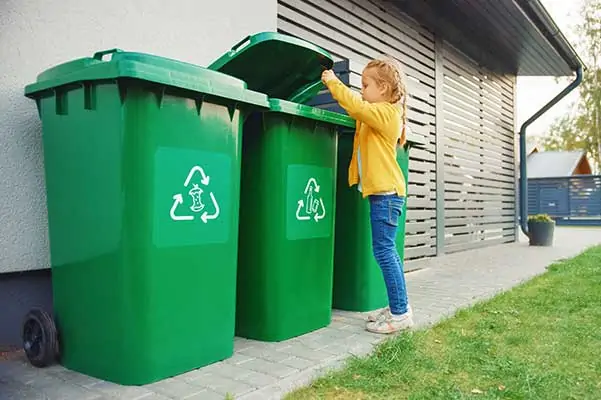
We all enjoy a success story, especially when it comes to reducing contamination in recyclable materials. Congratulations to the city and citizens for their Clean/Green campaign with its many benefits. Bill Bensing, Director of Public Services in Kirkwood, takes us through his journey in this timely APWA Reporter article.
Additional Resources:
As it does nationwide, Florida’s aspirational 75% recycling goal presents unique challenges and opportunities. Specifically, Florida municipal policymakers and professional staff are wrestling with contamination and changing global commodity markets that affect the financial viability of their recycling programs…
The Wisconsin Department of Natural Resources – WDNR is performing a waste sort to determine what’s in the trash going into Wisconsin’s landfills. During the waste audit, the team will collect at least 200 samples of waste from 12 waste disposal sites across the state for eight weeks. It’s a dirty …
Cities have begun to “right-size” their recycling systems by evaluating the usage of community recycling containers and reducing/redistributing containers to maximize the quantity of recyclables each site receives. Communities are evaluating curbside recycling programs to increase efficiency, and decreasing contamination is a priority…
California’s SB 1383, the Short-Lived Climate Pollutants Act, sets a statewide goal for reducing organic waste to landfills of 50 percent by 2020, and 75 percent by 2025. Included in SB 1383 is a goal to recover 20 percent of edible food waste for human consumption.
Meeting these requirements, particularly the recovery of edible food, is not as straightforward as it might seem. For example, it is difficult to accurately identify edible food from other waste once it’s in the waste stream.
“We can estimate the amount of edible food during waste characterizations, but we find working directly with businesses to identify the edible food they can make available and in what quantities is a more holistic approach,” said Tracie Bills, SMM Northern California Director. “We assist businesses with identifying edible food recovery partners with reputable community programs to distribute food to people in need.”
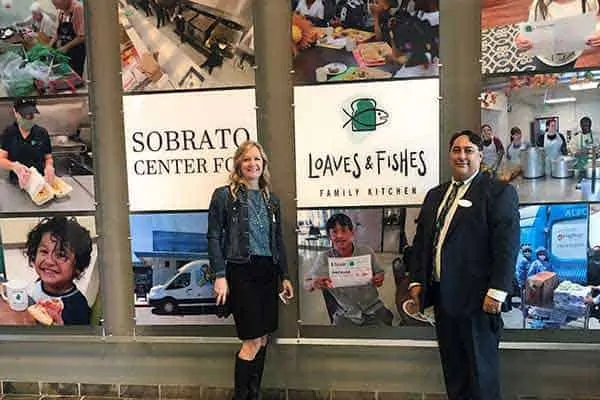
SCS Engineers partners with Loaves & Fishes Family Kitchen in San Jose to create a sustainable solution that could become a model for how municipalities can meet the 20-percent food recovery requirement.
Loaves & Fishes is a non-profit organization with roots going back 40 years. It’s grown from a simple soup kitchen to one of the leading providers of meals in Santa Clara and San Mateo Counties. The organization recently opened its new location in San Jose.
“Last year, we served more than 1 million meals, almost twice as many as just a couple of years ago,” said Mauricio Cordova, Loaves & Fishes’ COO. “With the help of local restaurants, grocery stores, and others, we’re able to use the food they can’t use to feed residents in need. In our new building, we expect to increase capacity to 10,000 meals per day.”
“Creating these partnerships isn’t part of our typical scope of work,” adds Bills. “But it’s important to go beyond simply identifying edible food. As we work with potential contributors and partners, we’re able to create a sustainable network that achieves a common goal.”
Says Cordova, “Through our A La Carte Food Recovery program, we can help companies divert perfectly safe and usable food away from composting and landfills, and re-distribute them in the form of meals to our most vulnerable neighbors. The all-around win is that people in dire need of food assistance – compounded by the impact of Covid-19 – can receive healthy, nutritious food, and companies lessen their food waste levels and greenhouse gas emissions.”
Loaves & Fishes has recovered more than 1 million pounds of edible groceries and reduced greenhouse gas emissions by 1,058 metric tons.
Learn more about sustainable materials management.
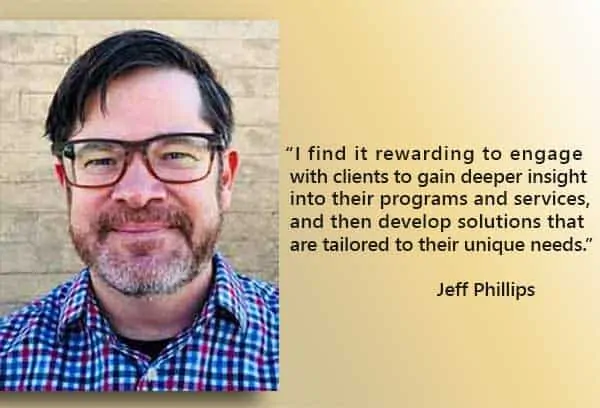
SCS Engineers welcomes Project Manager Jeff Phillips to the Clive, Iowa office. Jeff works with a growing number of solid waste management clients interested in integrating sustainable materials management into their solid waste master plans. The practice is widely known as Integrated Solid Waste Management, ISWM.
Jeff Phillips comes to SCS with over two decades of designing and implementing ISWM programs. His expertise includes a comprehensive list of individual tasks and services, including facilitating strategic planning and consensus-building sessions, performing waste and recycling industry market analyses, developing and presenting comprehensive financial plans to solid waste agencies, identifying, authoring, and managing federal and state grants. He also designs, performs, manages waste characterization analyses, authors and produces videos for training and education purposes, and is involved in community outreach events for solid waste agencies, city councils, and the public.
“Jeff provides innovative approaches to develop and strengthen programs and operations in Iowa,” said Christine Collier, senior project manager. “He fits right into our SCS philosophy of ensuring client success.”
Jeff is an active member of the Solid Waste Association of North America and the Iowa Society of Solid Waste Operations, where he previously served on the Board of Directors and Conference Planning Committee. He earned a Bachelor of Arts, Geography, and Environmental Studies from the University of Iowa.
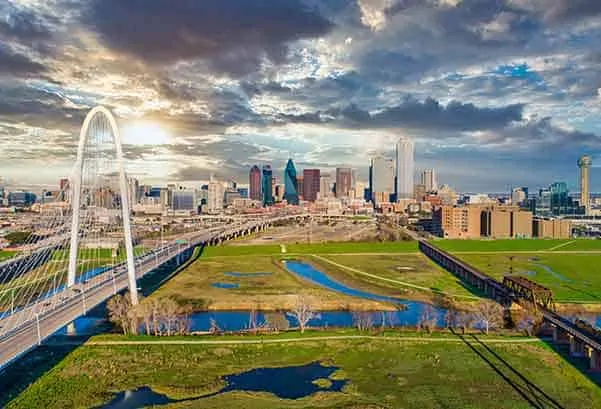
The Dallas City Council recently authorized a three-year service contract, with two one-year renewal options, for environmental monitoring and engineering consulting services supporting Dallas’s Department of Sanitation Services. SCS Engineers will use its integrated specialized practices to support the City’s McCommas Bluff Sanitary Landfill, Bachman Transfer Station, Fair Oaks Transfer Station, and Southwest Transfer Station.
Vice President Ryan Kuntz, P.E., the team’s principal consulting engineer, said, “SCS is privileged that the City of Dallas entrusts us to partner with the City’s staff to maintain the landfill and the transfer stations’ safe and efficient operations. The Department of Sanitation Services support the citizens and the environment; we’re honored to be of assistance.”
Landfills are extraordinarily complex systems integrating liquids and gas management systems, and the City’s McCommas Bluff Landfill is one of the largest landfills in the State of Texas. Transfer stations also require expertise in technical and regulatory issues for successful operation.
The City finds it cost-effective to employ an engineering firm, such as SCS, that specializes in solid waste engineering. SCS enhances environmental services with its specialized in-house practices, providing comprehensive capabilities and advanced technologies that improve efficiency and help control costs.
SCS Engineers will provide monitoring and engineering support staff from the firm’s Bedford, Texas office, along with the help of our minority/women-owned business partners. The SCS Bedford team’s professionals and field technicians are experienced and knowledgeable of regional and local geology, regulatory policies, and technical challenges.
SCS Engineers’ environmental solutions and technology are a direct result of our experience and dedication to solid waste management and other industries responsible for safeguarding the environment. For more information about SCS, please watch our 50th Anniversary video.
As reported in the July 29, 2020, digital news by Environmental Business International
Electronic waste represents billions in lost value
A record 53.6 million metric tonnes (Mt) of electronic waste was generated worldwide in 2019, up 21% in five years, according to the UN’s Global E-waste Monitor 2020. Only 17.4% of 2019’s e-waste was collected and recycled, meaning gold, silver, copper, platinum and other recoverable materials conservatively valued at $57 billion were mostly dumped or burned rather than being collected for treatment and reuse. The report predicts global e-waste will reach 74 Mt by 2030, making e-waste the world’s fastest-growing domestic waste stream. Global E-waste Statistics Partnership is a collaboration between UN University, International Telecommunication Union, International Solid Waste Assn. and the UN Environment Programme.
What can consumers do to help protect human health and the environment?
We can’t simply toss phones and electronics into our trash or recycling bins at home. To protect our health, water resources, and our communities we can reuse many of our devices and electronics. Try these; the links help you find local resources.
Discarded products with a battery or plug such as computers and mobile phones are electronic waste or (e-waste). Toxic and hazardous substances such as mercury, brominated flame retardants (BFR), or chlorofluorocarbons (CFCs) are found in many types of electronic equipment and pose a severe risk to human health and the environment if not handled in an environmentally sound manner.
While most electronics are not designed or assembled with recycling in mind, separate collection and recycling of e-waste can be economically viable for products containing high concentrations and contents of precious metals. Cell phones and computers contain base materials such as gold.
Recycling programs are often confronted with the costs of recycling vs material recovery markets, and because the recovery of some materials is especially challenging. Within the paradigm of a circular economy, the mining of e-waste can be considered an important source of secondary raw materials.
Thanks for helping us keep our communities safer!
For community recycling and reuse program development visit our Sustainable Materials Management website.
SCS Engineers is known for sharing best practices, and now we’re expanding our video library online in the SCS Learning Center. Our first video is for Solid Waste Managers and Departments struggling to keep their programs funded, especially recycling.
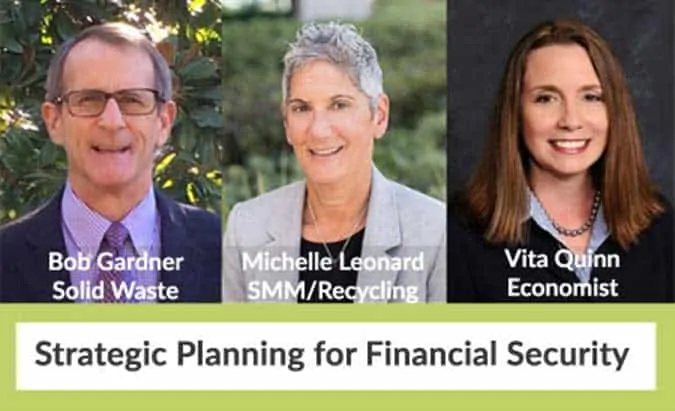
Strategic Planning for Financial Security is an educational video providing insight into the relationship between solid waste strategic planning and financial security. Less than 30-minutes and available for association events with Q&A.
The video discusses strategies that are useful when developing a business case analysis for SMM, recycling, or composting programs. The process also helps you identify opportunities to increase efficiency and reduce operating costs; design a Capital Plan and secure support for rate increases.
Moderated by Bob Gardner, Michelle Leonard starts with an overview of the effect of the pandemic on recycling programs, state regulatory policy, and funding challenges.
Vita Quinn presents a financial modeling scenario employing financial modeling and solid waste facility software packages to help decision-makers visualize the impact of various alternatives on the planning process. The model is helpful when planning scenarios for budgeting and testing alternative outcomes regarding future solid waste policies, strategies, and funding.
The model is especially useful for cost-benefit analysis of alternatives, fine-tuning strategies as more detailed information and data become available, or when revenue streams or funding levels change following natural disasters, pandemics, market swings, or economic downturns.
SCS Management Services® offers financial sustainability with preventative solutions and long-term financial management plans to public agencies facing environmental and market challenges, shifting regulations, and those aiming for new clean energy goals. Utilities and public-sector organizations provide life-sustaining services to their citizens and communities; providing these services while managing budget constraints; reporting, compliance, and operational challenges; and maintaining affordable rates. We support agencies and companies responsible for managing solid waste, stormwater, wastewater, brownfields-remediation, and energy programs that require integrated skill-sets and financial sustainability for optimal value.
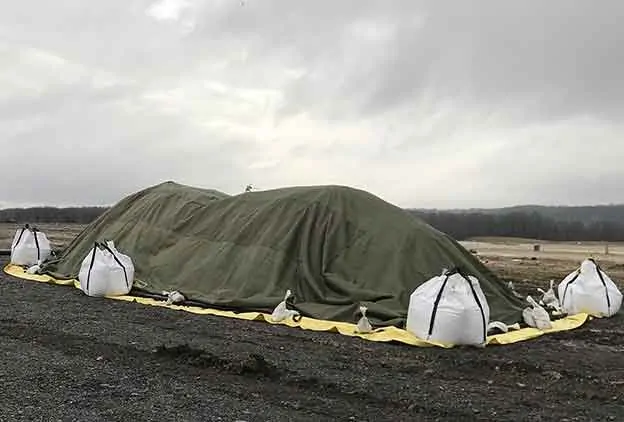
SCS Engineers launched a successful new program enabling waste managers and facilities to pilot test Aerated Static Pile (ASP) composting before making a capital investment. There is a high interest in organic materials management (e.g., composting, anaerobic digestion), driven by state and local regulations for diversion of organics from disposal facilities and the desire to reduce carbon emissions.
The organic fraction of any waste stream is successfully compostable, including materials, such as food scraps, yard trimmings, food processing by-products, and biosolids. The organic fraction of the municipal waste stream, which includes food scraps, is about 30 percent by weight, so it is possible to divert a significant amount from landfilling. SCS helps waste managers evaluate their organic waste streams and whether composting is a viable solution for their circumstances. ASP composting is often the preferred method because it is fast, cost-efficient, and controls odors and emissions effectively.
SCS owns a covered ASP compost system that is mobile and can be set-up on sites within an area of 50 feet by 100 feet, or less. In the covered ASP compost system, process and odor control is pro-active with a shorter composting period. A pilot test allows waste managers to assess composting and to see if it is the right fit for their situation. The ASP system processes material batches in two months. Additional batches or “recipes” can test in 2-month intervals.
SCS’ services include the setup and operation of the mobile ASP system. The system can compost up to 50 tons of targeted material per batch. SCS provides all equipment and consulting services, along with the test reports with the process and lab data. The resulting report and data are useful information to supplement a feasibility study (e.g., the quality of the end-products for sale or community use).
Greg McCarron of SCS Engineers comments, “Virtually every town can develop and support a compost program that is locally based and directly beneficial to their community. Our mobile ASP system can provide proof of concept for our clients and the information that allows managers to make informed decisions.”
Covered ASP Pilot Program details.
An American Public Works Association (APWA) publication,
No single waste management approach is suitable for managing all materials and MSW streams in all circumstances. The USEPA hierarchy places emphasis on reducing,
reusing, and recycling as key to sustainable materials management. Citizens and elected officials are often surprised how technically complex solid waste management is, and once aware of the basics they better understand the associated costs. Responsible Solid Waste Management with colorful infographics and easy-to-grasp explanations, helps readers understand solid waste management from beginning to end.
The concept of integrated solid waste management is increasingly being used by states and local governments as they plan for the future. This management practice includes the source reduction of certain MSW streams and the recovery of generated waste for recycling or composting. It also includes environmentally sound management through combustion with energy recovery and landfilling practices that meet current standards or newly emerging waste conversion technologies.
Available on the APWA website or reach Michelle Leonard (co-author) or an MSW engineer nearby contacting SCS Engineers at .
Learn more about Sustainable Materials Management here.
Corporate Headquarters