A New Reality for Existing Buildings
For decades, energy efficiency policies focused primarily on new construction. Existing buildings (especially older buildings) account for a large share of greenhouse gas emissions in the urban setting. Building Performance Standards (BPS) are state- and locally driven regulations that require owners of existing buildings to meet measurable energy or emissions performance targets over time—not just report data, but also achieve energy-efficiency objectives.
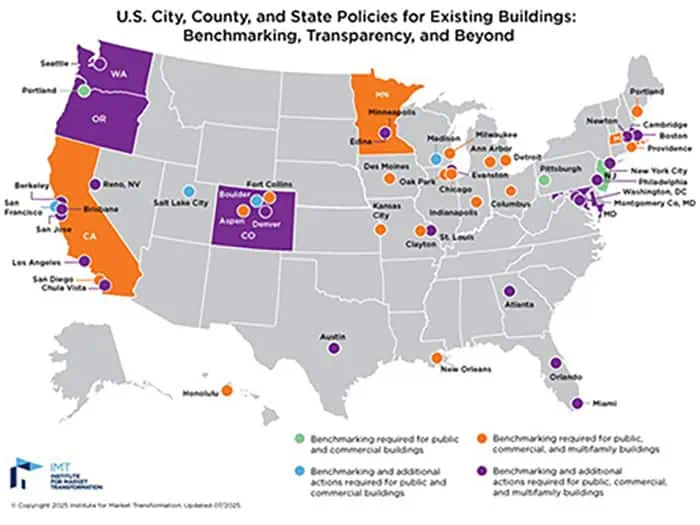
Since 2019, BPS policies have expanded rapidly across the United States, as shown in the map above (Courtesy of IMT). What began as voluntary benchmarking programs has evolved into mandatory, enforceable requirements with escalating targets and financial penalties for non‑compliance. More than 50 U.S. cities and several states have now adopted or committed to BPS policies, fundamentally changing the risk profile of owning and operating commercial real estate.
For building owners—especially those with portfolios spanning multiple jurisdictions—the challenge is clear: how do you comply without overspending, disrupting operations, or getting caught off guard by penalties and rushed retrofits?
What Are Building Performance Standards—and Where Do They Apply?
Building Performance Standards set minimum performance thresholds for energy use or greenhouse gas emissions. These thresholds typically tighten over time, pushing buildings toward deep efficiency improvements and, in many cases, long‑term decarbonization goals.
Today, BPS requirements exist at both the state and municipal levels, including:
The key takeaway for owners is simple: BPS policies are becoming the baseline expectation for building performance nationwide, not an exception.
What Is Required of a Building Owner?
While details vary by jurisdiction, most BPS programs require owners to:
Failure to comply is no longer symbolic. Penalties are real and material, often including:
For large buildings or portfolios, these fines can quickly reach six or seven figures annually, turning energy performance into a balance‑sheet issue—not just a sustainability goal.
Competitive Advantage From Regulatory Burden
Forward‑thinking owners are reframing BPS from a compliance obligation into a strategic asset—those who act early gain flexibility, optionality, and financial upside. Key benefits include:
Lower Operating Costs
Targeted HVAC, lighting, controls, and envelope improvements routinely deliver 15–30% annual energy savings, reduce maintenance, and improve system reliability.
Stronger Asset Value
High‑performance buildings command:
Risk Mitigation
Early action avoids:
Health, Comfort, and Productivity
Improved ventilation, moisture control, and thermal comfort reduce absenteeism and enhance occupant performance—often the largest “hidden” financial upside for commercial tenants.
What This Means for Portfolio Managers
For owners and asset managers with buildings across multiple BPS jurisdictions, the challenge isn’t just compliance—it’s coordination.
A fragmented, city‑by‑city response leads to:
A portfolio‑level strategy, on the other hand, allows owners to:
This is where experienced advisors add the most value—helping owners see the full portfolio picture, not just the next deadline.
How Building Owners Can Capitalize on BPS Requirements
Successful owners are taking a phased, data‑driven approach:
Many jurisdictions now support this approach through Building Performance Hubs, utility programs, and technical assistance to lower upfront costs and reduce execution risk.
Funding the Path to Compliance
Compliance does not have to mean self‑funding every upgrade. Owners can leverage:
When coordinated correctly, these tools can significantly reduce—or even eliminate—the net cost of compliance.
Conclusion: The Cost of Waiting Is Higher Than the Cost of Acting
Building Performance Standards mark a permanent shift from voluntary sustainability to mandatory performance. For building owners, the question is no longer if action is required, but how and when.
Owners who act early gain control over costs, timelines, and outcomes. Those who delay risk fines, rushed decisions, and stranded assets. In a market where regulations are tightening and capital is increasingly performance‑driven, energy performance is now a core business strategy.
The smartest owners aren’t just complying, they’re using BPS as a lever to protect asset value, improve cash flow, and future‑proof their portfolios.
Look for an independent engineering consultant such as SCS Engineers with no financial interest in equipment sales, construction, or energy performance contracts. Your consultant’s expertise and vendor agnosticism provide objective, more valuable recommendations to owners selecting implementation strategies. Find a qualified engineering consultant near you.
To learn more about running facilities more efficiently and maximizing energy and water conservation, please visit our Facility Energy Management page.
 About our Author: Doug Latulippe is a Project Director and one of our National Experts on Energy Management. He is responsible for work related to SCS’s air quality, greenhouse gas (GHG), and sustainability initiatives for public and private commercial businesses, industrial facility owners, real estate clients, utilities, and renewable energy project developers. Reach out to Doug on LinkedIn.
Doug’s experience includes managing energy portfolios, including capital and operating budget development, power generation, demand-side project and program development, bill management and reporting, and utility incentive program management. He also performed energy audits and GHG reporting for Fortune 500 companies.
As part of his power generation experience, he patented a solid-fuel gasification system designed for environmental mitigation and pollution control. The USEPA has recognized Doug for his extensive work with the ENERGY STAR program.
Doug is speaking at the A&WMA conference, Data Center Insights and Innovation, on Tuesday, March 24, 2026. Check out his session with David Greene at 11:40 am – 12:00 pm entitled The Data Center and Its Critical Role for Sustainability.
Corporate Headquarters