As demand for securing domestic sources of critical minerals grows, mapping and quantifying their geologic sources is more important than ever. These critical minerals often escaped notice during historical exploration because attention was focused on commodity metals (e.g., gold, silver, copper), and their concentrations are often significantly lower than those of the precious metals. Exploratory drilling can help significantly close the gap in critical mineral data scarcity across the nation, reducing risk from both technoeconomic and environmental standpoints.
Let’s look at a project in Missouri. The Missouri Geological Survey has expanded its efforts to better understand the subsurface geology as it evaluates formations that may contain rare-earth elements and other strategic resources. These broader state efforts reflect a growing nationwide focus on geologic mapping, core preservation, and resource evaluation to find and quantify critical minerals in the U.S.
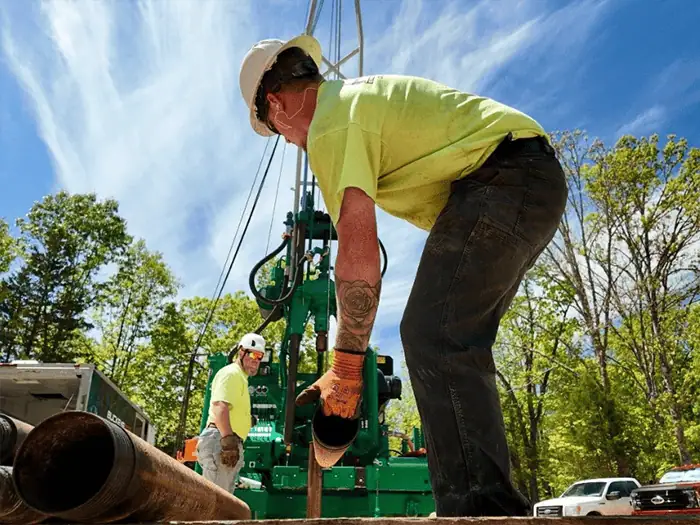
Our SCS Critical Minerals team, along with HAD, Inc. drillers, recently supported one of these efforts through deep bedrock coring designed to collect high-quality, continuous core for geologic characterization, resource assessment, and long-term archival use. The work included coordinating safe drilling operations, overseeing continuous core recovery, and supporting lithologic logging and field documentation.
The SCS team helps extract reliable subsurface data from deep bedrock intervals, including dolomitic units and underlying Precambrian formations, strengthening our understanding of mineralization potential and the geology of the Viburnum Trend. Data from this drill core will help to identify what critical minerals may be present, how they occur, and in what concentrations– all of which are essential to evaluate their potential for recovery and utilization.
The Missouri Geological Survey will analyze each core for critical mineral and rare-earth element concentrations using a suite of analytical tools, including x-ray fluorescence (XRF) scanning and other geochemical characterization methods. These data will help researchers better understand what elements are present, how concentrations vary with depth and geology, and how mineralization occurs within the subsurface.
Projects like this highlight the value of integrating drilling, coordination, geologic interpretation, and resource-focused evaluation into a single, well-executed field program that can be recreated across the U.S. As public and private stakeholders invest in domestic critical minerals and energy transition initiatives, we support efforts to turn subsurface data into actionable information to determine resource value and profitable extraction techniques while meeting rigorous mining regulations for environmental protection.
Mining is one of the most highly regulated and environmentally sensitive industries in the U.S. At the same time, federal and state priorities emphasize the strategic importance of domestic rare earth element and critical mineral production, both from conventional and, increasingly, unconventional resources. Learn more here, or contact one of our National Experts!
Corporate Headquarters