Need a review of your report? Or support to prepare it? Feel free to reach out to us. We are happy to have a chat with you!
Today, Oct. 15, the U.S. Environmental Protection Agency (EPA) released 2023 greenhouse gas data collected under the EPA’s Greenhouse Gas Reporting Program. In 2023, reported direct emissions of greenhouse gases from large stationary sources, representing approximately 50% of total U.S. emissions, were down by approximately 4% from 2022. From 2011 to 2023, total reported GHG emissions from large facilities decreased by approximately 22%, driven by a decrease in power plant emissions. This decline occurred even though, after 2016, the program began tracking additional sources.
As directed by Congress, EPA collects annual, facility-level emissions data from major industrial sources, including power plants, oil and gas production, iron and steel mills, and landfills. GHGRP also collects activity data from upstream fossil fuel and industrial gas suppliers. More than 8,100 direct emitters and suppliers report GHG data to GHGRP. Data reported from both direct emitters and upstream suppliers combined cover 85% to 90% of total U.S. GHG emissions. A complete accounting of total U.S. GHG emissions across all sectors of the economy using national-level data is available through a separate EPA report, the Inventory of U.S. Greenhouse Gas Emissions and Sinks.
The data show that in 2023:
The reporting year 2023 Greenhouse Gas Reporting Program Data still needs to reflect the impact of several rules EPA issued in 2024 to tackle methane emissions from the oil and gas sector and improve data quality. According to EPA these actions include standards to reduce methane and other harmful air pollution from new and existing oil and natural gas operations; a final rule under the Greenhouse Gas Reporting Program to strengthen, expand, and update methane emissions reporting requirements for oil and gas operations to help close the perceived gap between observed and reported emissions; and other amendments to the Greenhouse Gas Reporting Program data.
Resources for Greenhouse Gas Reporting:
Protect Our Environment and Controlling Climate Change
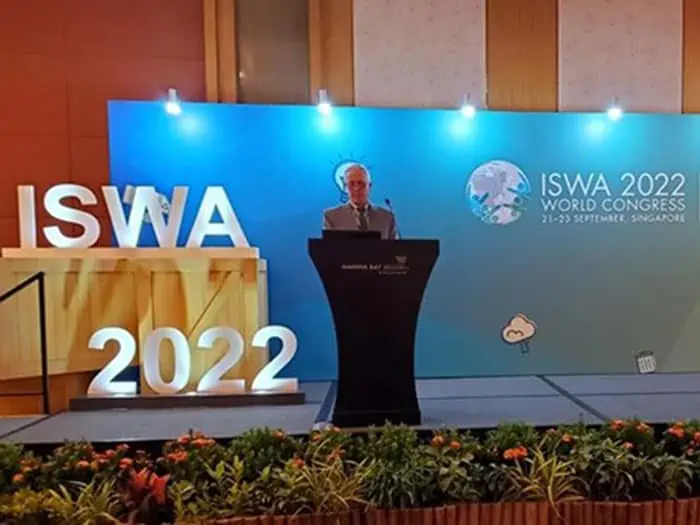
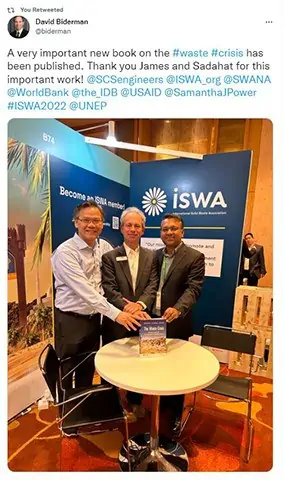 The ISWA World Congress attracted 1,200 participants this year despite the pandemic and received major coverage in the news while heating up social media channels. The Business Times Singapore published an 8-page supplement and a feature article about James Law and his views as Chair of the ISWA Landfill Group on what we, as individuals and communities, can do to protect our environment.
Featured speakers included Alex Stege and his Solid Waste Emissions Estimation Tool (SWEET) used in a project in Tyre Caza, Lebanon. SWEET allows solid waste planners to compare emissions from implementing different programs and quantify the effectiveness of available waste management options in reducing emissions of GHGs and air pollutants.
Alex presented during the Waste Management In An Era Of New Energy track. His discussion covered Evaluating the Energy Potential of 16 Landfill Gas to Energy Projects in China to be financed by the International Finance Corporation (IFC). There are 24 landfill gas-to-energy projects in China, including ten sites already under operation. In 2021, IFC hired SCS Engineers to evaluate the NCWI estimates and prepare a report providing independent LFG generation and recovery projections for the 16 landfills. The project developer (NCWI) provided IFC with waste data and LFG generation and recovery projections for 16 of their project site landfills from the report indicating a sufficient supply of recoverable LFG to support their planned facility capacities.
SCS Engineers was asked to comment to the NWRA and SWANA industry groups in their October 6 letter to U.S. Environmental Protection Agency on the proposed new EPA rule changes for GHG reporting. SCS’s deep expertise and knowledge of GHG monitoring and reporting, especially GHG rule k values, help inform the revisions and determinations for data elements under the Greenhouse Gas Reporting Rule. Ref. Docket ID No. EPA-HQ-OAR-2019-0424.
It is wonderful to see ISWA and SWANA in leadership roles to help us meet a global challenge!
Article published in the January 2020 edition of Waste Advantage Magazine.
At the Federal level, GHG emission reporting has become part of the standard regulatory requirements; however, on the west coast, GHG programs continue to develop and evolve from reporting to reduction programs beyond federal requirements. Solid waste facilities can be impacted by all of these reporting mechanisms directly as a landfill located in the state in question, opting in for C&T as part of the LCFS in California, or in limbo, as the courts work out the legality of Washington’s Clean Air Act. More stringent federal GHG requirements are unlikely with the current administration, however, that could change with the 2020 election. In general, GHG rules and legislation keep developing and updating to account for and reduce GHG emissions.
Read, share, or download the full article here.
 Cassandra Drotman Farrant is Project Manager with SCS Engineers. She has nine years of experience in environmental consulting, specializing in environmental assessment and greenhouse gas (GHG) verification. Cassandra has participated in many GHG verification projects throughout the U.S. and has completed approximately 70 Phase I Environmental Assessments (ESAs) in California, Oregon, and Washington. Phase I projects included research and review of geologic and hydrogeologic conditions at project sites and in the surrounding areas and evaluating the potential for soil and groundwater contamination from on and offsite sources. Cassandra has completed emissions estimates and inventories and has prepared numerous permit-to-construct/operate permit applications. She prepares compliance reports, which includes reviewing and maintaining records and regulatory deadlines.
SCS Engineers provides engineering, consulting, operations and monitoring services to report and reduce greenhouse gas emissions. Select a service category to learn more.
Our latest SCS Technical Bulletin summarizes the EPA federal mandatory greenhouse gas (GHG) reporting program (GHGRP) into two pages of the most vital information. The new reporting requirements for Subparts HH and A discussed in our bulletin are effective January 1, 2017.
Remaining updates will be phased in from 2017 to 2019. These updates include, but are not limited to, revisions to the reporting regulation for all reporters including Subpart A Administrative Requirements, Subpart C Stationary Combustion Sources, and Subpart HH Municipal Solid Waste Landfills the three most common reporting sectors for MSW landfills. SCS Engineers will continue to post timely information, resources, and presentations to keep you well informed.
Use our resources for guidance or to answer questions.
Share, read, or print the Technical Bulletin
Greenhouse Gas Service Information
Corporate Headquarters