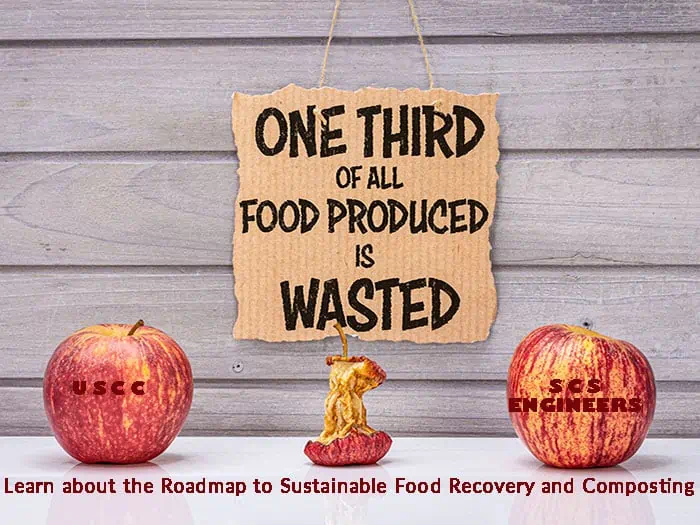
Applying the Lessons Learned – 1383 Compliance to your composting and food recovery planning can help make your program more sustainable.
SCS Engineers developed an SB 1383 Roadmap, which we customized for each municipality. The Roadmap outlines the requirements of SB 1383 by topic and by the responsible party. The Roadmap helped municipalities to plan for SB 1383 compliance, including a schedule for implementation, monitoring, reporting, and enforcement. Because SB 1383 is not only the responsibility of the Solid Waste Department, the Roadmap outlines the responsibilities of other municipal departments, including Administration, Finance, Purchasing, Fleet, Parks, etc.
SB 1383 requires the completion of capacity studies for organic waste recycling and edible food recovery. The Organic Waste Recycling capacity planning includes collecting data on the amount of organic waste (in tons) that will be disposed of, the amounts in tons of existing organic waste recycling infrastructure, both within and outside the county, that is available, and the amount of new or expanded capacity that will be needed to process the organic waste identified as being disposed of.
For the edible food recovery capacity planning, the counties had to estimate the amount of edible food that would be disposed of by commercial edible food generators, the existing capacity for food recovery organizations available in the County, the proposed or expanded food recovery organization that will be used to recover the edible food generated, and the new or expanded capacity that is necessary to recover the edible food that is generated.
It is a challenge for municipalities to meet these requirements, but feasible and sustainable using the SB 1383 Roadmap. Learn more on Wednesday, January 25, 2023, at the USCC Compost 2023 conference. During Session D1, the California Track Regulatory Trends and Experience at 8:15 – 9:45 am, Srividhya Viswanathan and Michelle Leonard discuss the Lessons Learned – 1383 Compliance, much of which is applicable for many evolving programs nationwide.
The world’s largest composting event, USCC Compost 2023, Jan 24-27 in Ontario, California, is the premiere professional meeting for composting, organics recycling, and related topics. SCS Engineers is sponsoring the State Chapter track, including the Networking Soiree on January 26.
Featured this year during Concurrent Session D1 California Track Regulatory Trends and Experience, on Wednesday, January 25 at 8:15 – 9:45 am is
Lessons Learned –1383 Compliancewith Srividhya Viswanathan. Vidhya and Michelle Leonard will illustrate SCS Engineers’ comprehensive planning process and tool, including a timeline, to achieve SB 1383 compliance. SB 1383 requires California to massively increase organic waste collection and recycling infrastructure in under ten years. The regulation requires a collective effort from entities, including jurisdictions, haulers, recyclers, and businesses, who will need to fund significant capital investments.
Find Additional Resources Below:
Compare and Contract Composting Systems VIDEO: Greg McCarron and Vidhya discuss managing tons of food scraps and other organic materials using different compost approaches. This forum is a resource for landfills, Solid Waste Departments, municipalities, and agencies working toward achieving waste diversion goals and lowering carbon footprints.
Composting Pilot Program: evaluate your organic waste streams and whether composting is a viable solution for your waste management program. The SCS pilot program includes everything you need to test before you invest.
Making Composting Work in High-Population Spaces: Managing hefty organic waste streams and associated costs while reaching lofty sustainability goals are among urban jurisdictions’ toughest pursuits. Some municipal solid waste operators set up local compost sites to help achieve these ambitions. They are finding other benefits along the way—from new, valuable products with a strong, local market to a way to …
California’s first fully solar-powered compost facility shines brightly: Republic Services’ Otay Compost Facility at the Chula Vista, California, Otay Landfill is open for business. The compost facility helps communities in San Diego County meet the requirements of California’s SB1383 law mandating the diversion of organic waste from landfills. The composting facility designed by SCS Engineers in collaboration with Sustainable Generation operates 100% on solar power …
Senate Bill-1383 is California legislation establishing aggressive organics recycling targets. Other states are establishing their own goals, some with enforcement components. It is up to municipalities to secure processing capacity and to implement comprehensive organics diversion programs to meet these goals.
Tracie Onstad Bills and Lisa Coelho, both with SCS Engineers, explain how one solid waste authority known as RecycleSmart, is proactively seeking to tackle the tough questions pertaining to new regulation compliance. RecycleSmart’s stance is proactive, they began to research and review their organics programs last year and have been working simultaneously during the formation of the regulations. By doing so, they have given themselves time to establish a direction for compliance and time to provide the public outreach and education necessary for a smooth transition.
Read “Shifting Focus,” an article published in Waste Today detailing the Central Contra Costa Solid Waste Authority’s study and six integrated programs that will provide the direction they need to help six Northern California municipalities make the right infrastructure and programmatic investments to attain the goals.
Tracie Onstad Bills and Lisa Coelho are the Northern California director and sustainable materials management specialist, respectively, for SCS Engineers. Please feel free to contact us if you have comments or questions about organics program planning and management at .
You are about to leave the SCS Engineers’ website and be directed to an external third-party site, ICIMS. SCS is not responsible for the collection and use of information on the ICIMS site, which is governed by its own privacy practices, not this Notice. We encourage you to review their privacy notices for additional information. Do you want to continue?
To provide the best experiences, we use technologies like cookies to store and/or access device information. Consenting to these technologies will allow us to process data such as browsing behavior or unique IDs on this site. Not consenting or withdrawing consent, may adversely affect certain features and functions.
✕
We use cookies and similar technologies for the following purposes:
Cookie usage
We use cookies to ensure the basic functionalities of the website and to enhance your online experience.
You can choose for each category to opt-in/out whenever you want.
Functional
Always active
The technical storage or access is strictly necessary for the legitimate purpose of enabling the use of a specific service explicitly requested by the subscriber or user, or for the sole purpose of carrying out the transmission of a communication over an electronic communications network.
Statistics
The technical storage or access that is used for statistical and/or tracking purposes.The technical storage or access that is used exclusively for anonymous statistical purposes. Without a subpoena, voluntary compliance on the part of your Internet Service Provider, or additional records from a third party, information stored or retrieved for this purpose alone cannot usually be used to identify you.
Marketing
The technical storage or access is required to create user profiles to send advertising, or to track the user on a website or across several websites for similar marketing purposes.