
Soil health is a cornerstone of sustainable agriculture, and the USDA’s Natural Resources Conservation Service is taking steps to support it through Conservation Practice Standard Code 336. This initiative, part of the Environmental Quality Incentives Program (EQIP), offers financial incentives to land managers who apply soil carbon amendments, such as compost, biochar, and blended materials, to improve soil quality and sequester carbon. For compost and biochar producers, this program could be a significant driver of demand for compost and biochar products that meet USDA standards for soil carbon amendments.
Why Soil Carbon Amendments Matter
The USDA’s Code 336 program enhances soil organic matter, increases carbon sequestration and soil carbon stocks, improves soil aggregate stability, and supports healthy soil ecosystems. These benefits contribute to long-term agricultural productivity and align with broader climate resilience goals.
Reimbursement Rates and Financial Incentives
Reimbursement rates vary by state and are higher for historically underserved (HU) land managers. EQIP covers the cost of purchasing, transporting, and applying soil carbon amendments. For example, in Massachusetts, reimbursement for 100% biochar is $211.37 per cubic yard, while HU land managers receive $253.64. Blended compost/biochar options and small-area applications are also eligible, with rates adjusted accordingly.
Here’s a snapshot of some Massachusetts EQIP rates:
| Component |
Unit |
Standard Rate |
HU Rate |
| 100% Biochar | CuYd |
$211.37 |
$253.64 |
| 20% Biochar / 80% Compost | CuYd |
$105.91 |
$127.09 |
| Compost Off-site by Volume | CuYd |
70.02 |
84.02 |
Eligible Land Types in USDA EQIP Code 336
The program applies to a wide range of land uses, including:
Landowners are responsible for planning and implementing the amendment applications, including securing necessary permits. EQIP may also reimburse planning and testing costs, provided the soil at the proposed site is evaluated and found to need amendment.
Standards for Compost and Biochar in USDA EQIP Code 336
To qualify for reimbursement, amendments must meet specific criteria, including:
Compost Requirements
Biochar Requirements
Conclusions About USDA EQIP Code 336
The USDA’s EQIP Code 336 program offers a valuable opportunity for land managers to enhance soil health while receiving financial support. By encouraging the use of compost and biochar, the program promotes sustainable agriculture and helps build a robust market for carbon-based soil amendments.
For compost and biochar producers, this program could be a significant driver of demand for products and support environmentally beneficial practices across many land uses.
Additional Resources:
This blog summarizes USDA Natural Resources Conservation Service (NRCS) Code 336, which addresses Soil Carbon Amendments as a Conservation Practice Standard, part of the USDA Environmental Quality Incentives Program (EQIP), which provides monetary incentives to improve, among other things, soil quality. Soil carbon amendments include compost, biochar, and other carbon-based materials.
The program is potentially beneficial to compost and biochar facilities (public or private) as the USDA payments include an amount for purchasing finished compost or biochar, which would provide revenue to the facility owner. The payment schedules vary by state. For example, Delaware’s material purchase rates are $26.10 per CY for compost and $201.87 per CY for biochar.
Short History of the Amendments
Introduced in December 2019, Code 808 is an interim standard with the purposes of:
It lists suitable criteria for applicable amendments and guidance for planning a carbon soil amendment. Twenty-nine states adopted code 808.
Code 336 was introduced in November 2022 as the final standard for soil carbon amendments, with minor changes from Code 808. Its purposes are to:
The main changes that Code 336 implements are quality standards for evaluating soil for amendment and the carbon amendments that need application to the soil.
Eligible Areas
Areas to which this practice applies, if organic carbon amendments will improve soil conditions:
Landowners or operators are responsible for planning, designing, and implementing carbon amendment applications, including acquiring all permits or approvals. The application and approval process varies by state and may be subject to local regulations.
Soil Criteria
Per Code 336, before carbon amendment application, evaluate all soil for:
When conservation objectives are required, evaluate the soil for:
Soil Carbon Amendments Criteria
Code 808 Compost Requirements:
Code 336 Compost Requirements:
Code 336 Biochar Requirements:
Produced compost should be by controlled aerobic, biological decomposition of biodegradable feedstocks and should have the US Composting Council’s Seal of Testing Assurance Program (STA) or meet the Table 2 criteria.
Compost can be combined with other regionally appropriate soil carbon amendments, such as biochar, wood chips, sawdust, or pulverized paper, to meet the soil’s specific needs. Identify contaminants by testing any soil amendments. Remove contaminants such as glass, metal fragments, film plastic, hard plastic, and sharps before submitting the compost application.
Produce biochar by heating biomass to a temperature above 350 °C under controlled and limited oxygen concentrations to prevent combustion (i.e., pyrolysis or gasification). It should have the International Biochar Initiative (IBI) Certified biochar seal or meet the criteria in Table 3.
Payment Rate Tables (CT, DE, and FL Examples)
| Delaware Soil Carbon Amendment (Code 336) EQIP Payments | ||
| Component | Unit | Unit Cost |
| 100% Biochar | Ac | $780.55 |
| HU-100% Biochar | Ac | $936.66 |
| 20% Biochar/80% Compost | Ac | $492.40 |
| HU-20% Biochar/80% Compost | Ac | $590.87 |
| 40% Biochar/60% Compost | Ac | $570.46 |
| HU-40% Biochar/60% Compost | Ac | $684.51 |
| 60% Biochar/40% Compost | Ac | $648.51 |
| HU-60% Biochar/40% Compost | Ac | $778.22 |
| 80% Biochar/20% Compost | Ac | $726.57 |
| HU-80% Biochar/20% Compost | Ac | $871.89 |
| Compost – Off Site | Ac | $219.05 |
| HU-Compost – Off Site | Ac | $262.86 |
| Compost – On Site | Ac | $105.59 |
| HU-Compost – On Site | Ac | $126.71 |
| Compost – Small Areas | kSqFt | $40.48 |
| HU-Compost – Small Areas | kSqFt | $48.57 |
| Compost + Biochar – Small Areas | kSqFt | $48.68 |
| HU-Compost + Biochar – Small Areas | kSqFt | $58.42 |
| Other Carbon Amendment | Ac | $840.51 |
| HU-Other Carbon Amendment | Ac | $1,008.62 |
HU = “Historically Underserved” Farmers and Ranchers
| Florida Soil Carbon Amendment (Code 336) EQIP Payments | ||
| Component | Unit | Unit Cost |
| 100% Biochar | Ac | $761.21 |
| HU-100% Biochar | Ac | $913.45 |
| 20% Biochar-80% Compost | Ac | $473.51 |
| HU-20% Biochar-80% Compost | Ac | $568.21 |
| 40% Biochar-60% Compost | Ac | $551.57 |
| HU-40% Biochar-60% Compost | Ac | $661.88 |
| 60% Biochar-40% Compost | Ac | $629.63 |
| HU-60% Biochar-40% Compost | Ac | $755.56 |
| 80% Biochar-20% Compost | Ac | $707.69 |
| HU-80% Biochar-20% Compost | Ac | $849.23 |
| Compost – Off Site | Ac | $201.96 |
| HU-Compost – Off Site | Ac | $242.36 |
| Compost – On Site | Ac | $90.26 |
| HU-Compost – On Site | Ac | $108.31 |
| Compost – Small Areas | kSqFt | $38.79 |
| HU-Compost – Small Areas | kSqFt | $46.55 |
| Compost + Biochar – Small Areas | kSqFt | $47.00 |
| HU-Compost + Biochar – Small Areas | kSqFt | $56.40 |
| Other Carbon Amendment | Ac | $716.59 |
| HU-Other Carbon Amendment | Ac | $859.91 |
| Connecticut Soil Carbon Amendment (Code 336) EQIP Payments | ||
| Component | Unit | Unit Cost |
| 100% Biochar | Ac | $772.23 |
| HU-100% Biochar | Ac | $926.68 |
| 100% Biochar cu. yd. | CuYd | $213.69 |
| HU-100% Biochar cu. yd. | CuYd | $256.43 |
| 20% Biochar-80% Compost by Volume | CuYd | $108.23 |
| HU-20% Biochar-80% Compost by Volume | CuYd | $129.88 |
| 20% Biochar-80% Compost | Ac | $480.67 |
| HU-20% Biochar-80% Compost | Ac | $576.80 |
| 40% Biochar-60% Compost by Volume | CuYd | $134.60 |
| HU-40% Biochar-60% Compost by Volume | CuYd | $161.52 |
| 40% Biochar-60% Compost | Ac | $558.73 |
| HU-40% Biochar-60% Compost | Ac | $670.47 |
| 60% Biochar-40% Compost by Volume | CuYd | $160.96 |
| HU-60% Biochar-40% Compost by Volume | CuYd | $193.15 |
| 60% Biochar-40% Compost | Ac | $636.79 |
| HU-60% Biochar-40% Compost | Ac | $764.14 |
| 80% Biochar-20% Compost by Volume | CuYd | $187.33 |
| HU-80% Biochar-20% Compost by Volume | CuYd | $224.79 |
| 80% Biochar-20% Compost | Ac | $714.85 |
| HU-80% Biochar-20% Compost | Ac | $857.81 |
| Compost – Off Site | Ac | $210.23 |
| HU-Compost – Off Site | Ac | $252.27 |
| Compost – On Site | Ac | $91.33 |
| HU-Compost – On Site | Ac | $109.59 |
| Compost – Small Areas | kSqFt | $43.62 |
| HU-Compost – Small Areas | kSqFt | $52.34 |
| Compost + Biochar – Small Areas | kSqFt | $51.82 |
| HU-Compost + Biochar – Small Areas | kSqFt | $62.19 |
| Compost Off-site by Volume | CuYd | $72.32 |
| HU- Compost Off-site by Volume | CuYd | $86.79 |
| HU-Other Carbon Amendment | Ac | $730.39 |
| Other Carbon Amendment | Ac | $876.47 |
Find additional state payment tables at https://www.nrcs.usda.gov/getting-assistance/payment-schedules.
Code 336 Implementation
Not all state offices have adopted NRCS Code 336, but the figure below by the US Biochar Initiative shows adoption at the close of 2023. (https://biochar-us.org/code336).
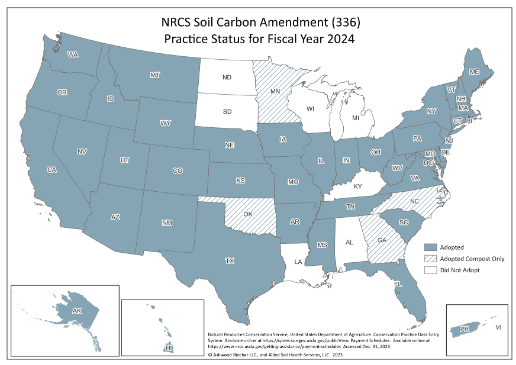
Discussion of the state-by-state adoption of NRCS Code 336 is in the BioCycle article States Should Adopt NRCS Soil Conservation Standard Code.
Code 336 pricing for compost appears to provide reasonable funding to offset material purchase, transport, application, and technical services. However, Code 336 pricing for biochar does not provide enough funds to subsidize the purchase of biochar in most markets fully. Further, additional costs remain for biochar transport, application, or technical services.
Table 1. Soil requirements under NRCS Code 336 (2022).
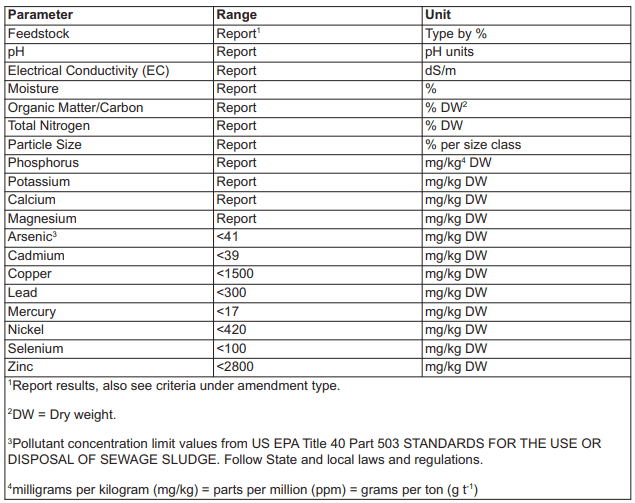
Table 2. Compost requirements under NRCS Code 336 (2022).
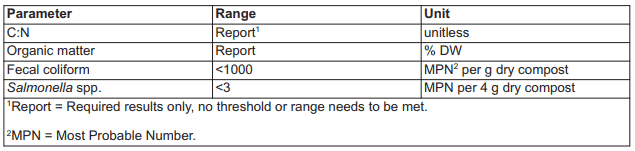
Table 3. Parameters for Biochar Amendments
| Parameter | Range | Unit |
| Total Ash | Report | % of total mass, dry basis |
| Liming equivalent | Report | % CaCO3 |
| Organic Carbon (Corg) | >10 | % DW |
| H:Corg | <0.7 | Molar ratio |
| Chromium | <1200 | mg per kg DW |
Additional Resources:
Corporate Headquarters