Cooling systems are essential to preserving reliable data center operations, but they can require significant amounts of electricity and water, particularly at large facilities. In some regions, competition for available water resources and limitations on existing infrastructure are creating additional challenges for developers. As a result, the industry is increasingly exploring alternative cooling technologies that can reduce operating costs, conserve water, and provide sustained reliability.
Flooded underground mines, once considered liabilities, may afford valuable hydro-geothermal infrastructure and sustainable liquid cooling for the rapidly expanding data center industry. With a specialized technical evaluation, these sites could provide an alternative cooling solution while creating new opportunities for mine owners and surrounding communities.
Extracting New Value from Existing Resources for Data Centers
This latent resource constitutes a vast network found throughout the United States. Many former coal, limestone, and other underground mining operations are naturally flooded after mining activities cease. These “wet” mines can contain substantial volumes of groundwater, or pools, that maintain relatively stable temperatures throughout the year.
By using engineered heat exchange systems, data centers may be able to transfer excess heat into underground mine pools rather than relying entirely on conventional cooling towers or mechanical refrigeration. Depending on site conditions and system design, this approach could reduce freshwater consumption, lower energy requirements, and provide a beneficial use for existing underground infrastructure that might otherwise remain unused.
The concept is already gaining attention. Iron Mountain’s underground data center facility in Pennsylvania shows the potential of using underground water resources to support data center cooling, while projects in Virginia are evaluating the feasibility of using flooded coal mines as thermal resources for proposed data center developments.
Innovative applications, such as Iron Mountain, highlight an emerging opportunity to repurpose former mining operations to support modern infrastructure. However, not every flooded mine will be suitable.
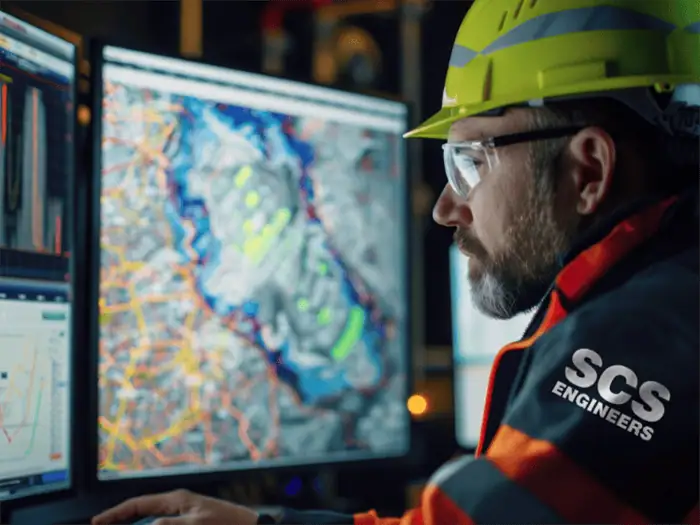
Environmental engineers and hydrogeologists, like SCS, evaluate factors such as groundwater availability, mine geometry, water chemistry, hydraulic connectivity, geological stability, and the surrounding rock and groundwater system’s ability to absorb and dissipate heat. Understanding these underground conditions is critical to determining whether flooded mines can provide a technically feasible, economically practical, and sustainable cooling solution.
Evaluating Mine Water Cooling Potential
SCS Engineers’ mining team is uniquely positioned to help municipalities, data center developers, mine owners, and energy providers assess these opportunities. Our experience in mining, geology, hydrogeology, subsurface characterization, groundwater modeling, drilling, and water management enables us to support investigating projects from initial feasibility through implementation.
Professionals at SCS Engineers recommend starting with an evaluation that covers:
To assess the potential of this sustainable solution, the evaluation results provide detailed intelligence on underground conditions, available water, and long-term thermal performance, which is essential to guide decision-making and infrastructure investment.
Additional Mining and Data Center Resources:
Corporate Headquarters