I spent the day at the New Jersey Department of Environmental Protection/Air & Waste Management Association (NJDEP/AWMA) Regulatory Update Conference, and it was a great reminder of how quickly things are shifting in New Jersey’s air regulatory world. Hearing directly from NJDEP leadership about upcoming changes in environmental justice, air toxics, greenhouse gas (GHG) programs, and permitting really helped connect the dots with what we’re seeing in the field.
A lot of what NJDEP emphasized lined up with the challenges I’m seeing firsthand with clients across the nation— the need for cleaner data, better documentation, and early conversations with state environmental departments before projects get too far along. These small steps make a big difference in keeping permit reviews on track.
Technical Takeaways from the Regulatory Update Conference
This year’s NJDEP/AWMA conference provided a clear picture of where New Jersey’s air programs are heading and how those changes will affect industrial and manufacturing facilities across the State. What stood out most is how closely the NJDEP themes align with the real-world challenges we’re helping clients navigate in NJ and other states right now.
Data Quality and Permit Readiness
NJDEP stressed the importance of complete, defensible emission data. This is something we talk about often with clients, because a single inconsistent number can hold up an entire project. Stronger front-end preparation — especially around emission factors, process descriptions, and modeling inputs — is quickly becoming the expectation rather than a best practice.
Air Toxics and Cumulative Impact Methods
The Environmental Department previewed updates to air toxics screening tools and how cumulative impacts will be factored into more reviews. For facilities with multiple sources or complex operations, this means more attention to stack parameters, speciation, and short-term concentration drivers. Our team at SCS has been leaning into this trend, helping clients get ahead of the more technical evaluations on the horizon.
Modeling and Monitoring Direction
New Jersey, Texas, and California are moving toward more refined modeling guidance — especially around near-source impacts, downwash, and mobile-source interactions. NJDEP’s expanded community monitoring network will also feed into future reviews. This shift underscores the need for high-quality modeling and clear documentation that can withstand scrutiny.
Climate and GHG Regulatory Direction
NJDEP made it clear that industrial GHG reporting, methane tracking, and long-range decarbonization planning will play a larger role moving forward. Again, a theme we’re seeing in other states and localities. We’re already supporting clients in building internal carbon inventories and preparing for the next phase of regulatory expectations.
Environmental Justice as a Key Factor in Regulatory Decisions
EJ is now a core part of New Jersey’s regulatory process. Facilities in or near EJ areas will need to be ready for additional analyses, documentation, and community-focused review steps. This is an area where SCS brings significant practical insight — helping facilities navigate technical requirements while maintaining constructive communication with regulators and communities.
AWMA continues to be an important part of my professional life, and it’s a big reason SCS stays plugged into the conversations that shape environmental policy in the region and nationwide. Always a good experience reconnecting with colleagues and coming away with new insights to bring back to our team and clients.
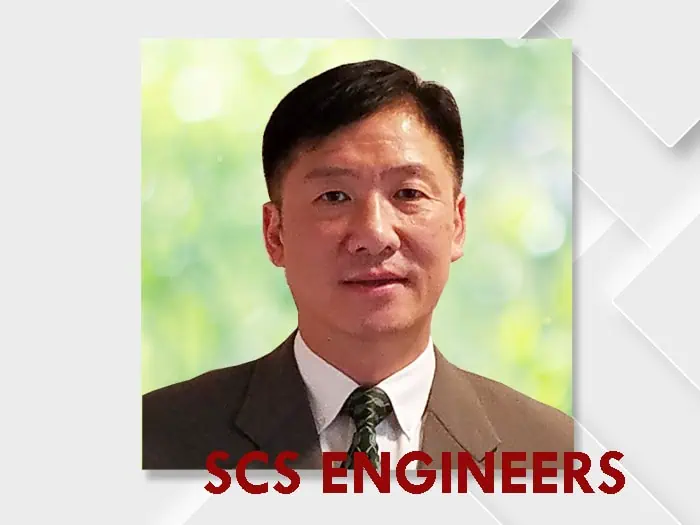
Meet our Author: John Tsun, National Practice Leader – Industrial Clean Air Act Services, SCS Engineers.
Additional Resources:
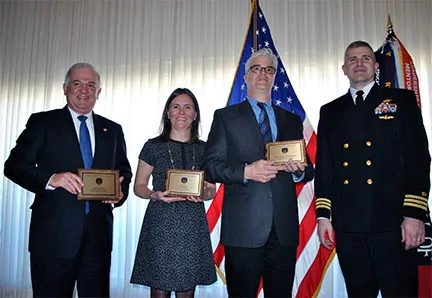
The Society of American Military Engineers recognized SCS Engineers for their 15 years of service and volunteer support at the District of Columbia post this month. The award was presented by Commander Craig Clutts of the US Navy, the Outgoing DC Post President.
On hand to receive the award for SCS was John Tabella, PG, LEED AP®, National Expert for Environmental Due Diligence and for Federal Services; Heather Blake (pictured), Federal Marketing Coordinator, and Dave Hostetter, PE, LEED AP®, and CEM at SCS Engineers.
SCS Engineers has a very long track record of solving environmental and energy management, solid waste, hazardous waste, water, and air compliance challenges. Approaches we pioneered include risk-based cleanups, voluntary cleanups, accelerated investigations, presumptive and sustainable remedies, environmental management systems, energy systems, and waste minimization. These approaches are at the forefront of local and Federal environmental and energy programs today.
SCS provides professional engineering and scientific services with a focus on environmental protection and conservation of resources. Our clients come back because we find practical approaches to even the most complex environmental challenges.
Corporate Headquarters