environmental justice
August 26, 2025
Join SCS Engineers at ABA SEER’s 33rd Fall Conference at Crystal Gateway Marriott October 22-24, 2025. Leaders from government, industry, academia, and the community unpack the most pressing developments shaping environmental, energy, and resources law and policy in 2025.
Across two days of sessions, panels will explore:
-
Impacts of recent Supreme Court decisions
-
State and local leadership on climate, environmental justice, and the energy transition
-
Navigating divergent ESG requirements across jurisdictions
-
Legal complexities of PFAS in biosolids
-
Ethics in environmental marketing and disclosures
Whether you’re a seasoned practitioner or early in your career, this conference offers timely insights and invaluable networking during a period of rapid change. Connect with SCS Engineers on-site to discuss practical strategies and solutions for your projects. Register now!
June 30, 2025

This 2025 National Brownfields Training Conference session explores the transformative role of Geographic Information Systems (GIS) in managing and communicating the complexities of brownfield projects. Kayla Ouellette delves into how GIS technology can be leveraged to enhance project planning, data management, and stakeholder engagement. Key topics she covers include an overview of the GIS environment, access to GIS software, and practical applications including site selection and ranking, demographic analysis, data management, and community outreach.
Kayla emphasizes the importance of starting with the end in mind, ensuring that GIS solutions are tailored to meet specific project needs and reporting requirements from the very beginning. By utilizing GIS, project teams will improve accuracy, efficiency, and communication, ultimately leading to more successful brownfield redevelopment efforts.
Learning Objectives of Transforming Brownfield Redevelopment with GIS:
- Understand how GIS technology can enhance project planning, data management, and stakeholder engagement in brownfield projects.
- The importance of starting with the end in mind to ensure that the GIS solutions you are tailoring meet specific project needs and reporting requirements from the beginning, ultimately improving accuracy, efficiency, and communication in brownfield redevelopment efforts.
 Kayla Ouellette is a GIS Manager at SCS Engineers. Kayla has over 10 years of experience creating innovative GIS workflows for environmental and solid waste projects. She is responsible for managing SCS’s GIS teams, providing internal training for staff, and collaborating with others across the company to implement GIS solutions for their projects. Kayla enjoys educating others on the applications of GIS and has presented at Florida SWANA, Florida Brownfields Association, and American Association of Geographers. She has a Master’s Degree in Environmental Science and Policy from the University of South Florida and resides in St Petersburg, FL.
Learn more about the 2025 National Brownfields Conference and brownfields funding:
- 2025 National Brownfields Conference
- Strategically Using Multiple Funding Sources for Brownfields
- Contact Kayla Ouellette
November 7, 2024
August 16, 2024
Join SCS Engineers at the 2024 Illinois Manufacturers’ Association Environment & Energy Conference. The event will be held October 22 at the Tinley Park Convention Center in Tinley Park, IL. This event is great for Illinois manufacturers to gain critical insights from state environmental and energy experts. Designed for CEOs, plant managers, safety officers, legal teams, and environmental professionals, this one-day program will delve into compliance, regulations, permitting, sustainability, and future legislative developments. Attendees will hear directly from state officials, regulators, and industry leaders on the most pressing environmental and energy-related issues.
As a proud Lunch Sponsor, SCS Engineers invites you to visit our booth to discuss your environmental compliance challenges and explore solutions tailored to your upcoming needs. Don’t miss this opportunity to connect with our experts on site! Register today.
September 19, 2023
About CALRC
It’s time for the California Land Recycling Conference (CALRC) in Carson, California, September 26-28. The Center for Creative Land Recycling (CCLR) is hosting the conference, and this year’s event theme is “People, Partnerships, Progress.”
SCS Engineers is exceptionally proud of our relationship with CCLR and of our clients who are winning Phoenix, EBJ, and other awards for their valuable contributions to their communities across all 50 states.
Environmental Justice
Achieving environmental justice means taking a sustainable, holistic approach to site remediation and land recycling. One that meets each party’s social, environmental, and economic goals. These experts can help; they’ve been in the business of sustainability for decades and are always open to knowledge sharing about funding, permitting, and remediation processes that will keep your project on track.
Headline Presentations
 Should it Stay or Should it Go? In-situ vs. Ex-situ Solutions with Michael McLaughlin of SCS Engineers, Senior Vice President of Environmental Services and National Specialist on Brownfields & Landfill Redevelopment
Tuesday, September 26th at 3:15 PM in the Community Hall Section A
With numerous approaches and examples of pilot studies, innovative technologies, and work done to execute alternatives to excavation, this session will help you overcome the practical challenges of sustainable remediation. With an overview of conducting pilot tests and examples of innovative technologies, this session will help project managers and site owners take the next steps in bringing sustainable solutions to clean up contaminated sites and answer the question, can in-situ technologies be used to avoid costly excavation and disposal?
 Getting to the Finish Line: Navigating Projects Through the Water Board Process with Jim Ritchie, Vice President, SCS Engineers.
Wednesday, September 27th at 10:30 am in the Community Hall Section A
We aim to get your remediation or brownfields project done sustainably, meeting economic and environmental goals such as the mission of the Water Boards to preserve the quality of California’s water resources and drinking water to protect the environment, public health, and beneficial uses. Join Jim and company to learn the best practices.
Gather more information or register for CALRC.
September 5, 2023
It’s time for the California Land Recycling Conference (CALRC) in Carson, California, September 26-28. The Center for Creative Land Recycling (CCLR) is hosting the conference, and this year’s event theme is “People, Partnerships, Progress.” SCS Engineers is a Visionary Sponsor and will have our experts presenting at the conference and discussing best practices for those in California and nationwide. Please stop by our booth to discuss the various land recycling possibilities for your site, funding, and permitting.
We are exceptionally proud of our relationship with CCLR and our clients who are winning Phoenix, EBJ, and other awards for their valuable contributions to their communities across all 50 states.
Achieving environmental justice means taking a sustainable, holistic approach to site remediation and land recycling. One that meets each party’s social, environmental, and economic goals. These experts can help; they’ve been in the business of sustainability for decades and are always open to knowledge sharing about funding, permitting, and remediation processes that will keep your project on track.
Should it Stay or Should it Go? In-situ vs. Ex-situ Solutions with Michael McLaughlin of SCS Engineers, Senior Vice President of Environmental Services and National Specialist on Brownfields & Landfill Redevelopment
Tuesday, September 26th at 3:15 PM in the Community Hall Section A
With numerous approaches and examples of pilot studies, innovative technologies, and work done to execute alternatives to excavation, this session will help you overcome the practical challenges of sustainable remediation. With an overview of conducting pilot tests and examples of innovative technologies, this session will help project managers and site owners take the next steps in bringing sustainable solutions to clean up contaminated sites and answer the question, can in-situ technologies be used to avoid costly excavation and disposal?
Getting to the Finish Line: Navigating Projects Through the Water Board Process with Jim Ritchie, Vice President, SCS Engineers.
Wednesday, September 27th at 10:30 am in the Community Hall Section A
We aim to get your remediation or brownfields project done sustainably, meeting economic and environmental goals such as the mission of the Water Boards to preserve the quality of California’s water resources and drinking water to protect the environment, public health, and beneficial uses. Join Jim and company to learn the best practices.
Get more information or register for the California Land Recycling Conference.
August 30, 2023
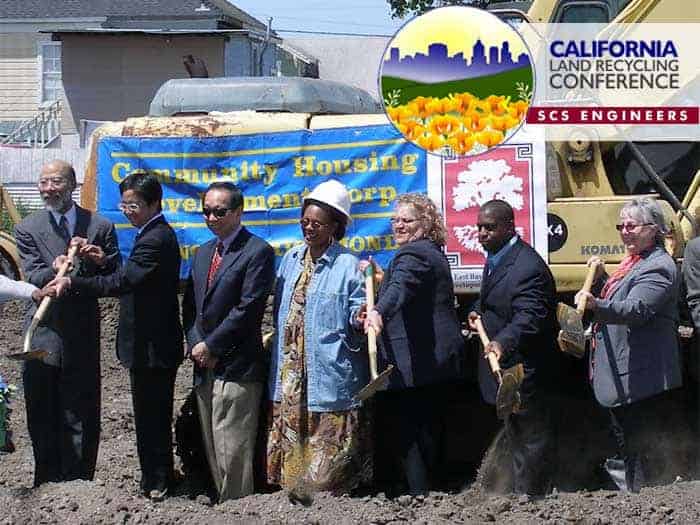
This year’s National Brownfields Conference in Detroit, Michigan, was notable. The evening before the conference began, the United States Environmental Protection Agency (USEPA) hosted an ‘Environmental Justice’ caucus in which over 150 people from both the public and private sectors came together to learn more about what Environmental Justice is and how it informs our work in economic development efforts.
USEPA defines Environmental Justice (often called ‘EJ’) as “the fair treatment and meaningful involvement of all people regardless of race, color, national origin, or income, with respect to the development, implementation, and enforcement of environmental laws, regulations, and policies.” We’ll achieve this goal when everyone enjoys the same degree of protection from environmental and health hazards and equal access to the decision-making process to have a healthy environment to live, learn, and work.
Distilled to its core, EJ is a call to action for all individuals and entities engaged in helping sustain and grow their communities. It posits that multiple demographics (including but not limited to people of color, inhabitants of rural areas, and people with less access to education and well-paying jobs) are disproportionately subject to harmful impacts from exposure to toxins and pollutants. Accordingly, it is incumbent upon those engaged with those populations to pay heed to find ways to mitigate or reduce those exposures.
EPA formally established the Office of Environmental Justice and External Civil Rights on October 6, 2022, and since that time, has engaged over 200 people across the agency to perform tasks specifically addressing EJ, including “processing grant applications from communities with environmental justice concerns, reaching out to residents to understand their concerns, and enforcing civil rights.” The EPA also established the Environmental Justice Thriving Communities Grantmaking (EJ TCGM) program in direct response to two Executive Orders issued by the Biden administration (EO 14008 and 13985) and will soon award ~$550 million to 11 distinct entities (which must be community-based nonprofits or partnerships between community-based nonprofits and either Tribal government or institutions of higher education) to spearhead more inclusive and easily accessible resources/support for communities seeking EPA funding to address EJ concerns.
EPA also established 16 technical assistance centers across the nation under the EJ Thriving Communities Technical Assistance Centers Program (EJ TCTAC), aimed at “providing technical assistance, training, and related support to communities with environmental justice concerns and their partners. The services provided will include training and assistance on writing grant proposals, navigating federal systems such as Grants.gov and SAM.gov, effectively managing grant funds, community engagement, meeting facilitation, and translation and interpretation services for limited English-speaking participants.”
Furthermore, the 2022 Inflation Reduction Act created the Environmental and Climate Justice Block Grant program in section 138 of the Clean Air Act (CAA). It provided EPA with $2.8 billion in grant funding for the program for projects to benefit communities with environmental justice concerns.
All told billions of dollars are currently available to communities that seek to spur environmental cleanup and revitalization efforts. SCS specializes in helping communities connect with this funding (even providing in-house Brownfields grant writing services) and has a proven track record of forming successful partnerships which result in timely and meaningful rejuvenation projects.
Two of the projects SCS teamed on this past year are awardees of the EPA’s prestigious 2023 Phoenix Award. The first of such projects, performed in EPA Region 6, involved the restoration of the historic First National Bank Building in downtown Oklahoma City, OK. This project created a mixed-use space, including apartments in the heart of the bustling business district, to help revive a struggling downtown and create jobs for residents. The second project, performed in EPA Region 9, provided affordable housing in San Diego, CA, and included upgrades to storm drains, water and sewer lines, underground powerlines, and streetscape improvements, significantly enhancing area infrastructure.
In both these projects and countless other projects performed under federal and state Brownfields programs, SCS is a trusted partner providing technical expertise and conscientious approaches to community engagement and planning that align with EJ protocols. SCS is a Foundational Member and Advisor of the Center for Creative Land Recycling (CCLR), which aims to turn abandoned land into thriving spaces that serve communities meaningfully.
This year’s Brownfields Conference theme was “Sustainable Communities Start Here,” in sync with SCS’s long culture and mission of achieving sustainability through holistic processes. The most successful remediation projects are when all stakeholders have a voice and redevelopment efforts are thoughtfully, creatively, and deliberately planned and implemented.
Additional Resources:
- 2023 California Land Recycling Conference
- 2023 Phoenix Awardees – SCS Engineers Supported Clients in Regions 6 and 9
- Brownfields and Voluntary Remediation
- SBA Alert: Lender and Development Company Loan Due Diligence – SOP 50 10 7 Effective August 1, 2023
 About the Author: Rachel McShane, LEP, has over 15 years of experience in environmental due diligence projects (Phase I, II and III Environmental Site Assessments) as well as Brownfields redevelopment, risk-based corrective action, and remediation projects. She is also familiar with National Environmental Policy Act (NEPA) environmental assessments, vapor investigations and mitigation, radon, asbestos, and lead based paint surveys, and leachate monitoring/solid waste management. You may reach her at or via LinkedIn.
May 15, 2023

Environmental justice is integrated into State and Federal environmental agency policy-making, thus impacting inspections and enforcement across the nation. While specifics are evolving quickly in each state, staying abreast of these basic requirements for the key environmental permits and plans listed here is best, especially if you have multiple facilities in multiple states.
- Air Permitting
- Waste Management
- National Pollutant Discharge Elimination System (NPDES)
- Spill Prevention, Controls, and Countermeasures (SPCC) Plan
- Tier 2 Reporting
- Toxic Release Inventory (TRI) Reporting
We recommend this quick read to run through a checklist to decide if your facility is ready or may need an internal audit. For this article, we’re using Illinois and standard Federal requirements.
Read Environmental Justice: Preparing for IEPA or USEPA Inspection here.
Being well-prepared for an inspection saves time and expense but will also support your company’s relationship with the regulatory agency and promote better outcomes and reduced risk of enforcement actions.
Deficiencies noted during an inspection can be a catalyst for additional inspections among non-EJ-located facilities.
Manufacturers in environmental justice areas denoted within each state can prepare for regulatory review and inspection by conducting internal or external audits of key environmental permits and plans to evaluate compliance with state and local regulations.
Additional Information:
- EJ Grants, Funding, and Technical Assistance
- EJSCREEN
- EPA American Rescue Plan (ARP) Funding
December 5, 2022
Illinois EPA Environmental Justice Procedures
The Illinois EPA Bureau of Air recently implemented more stringent procedures for securing an air permit for a new emissions source or emissions unit when the operations are located in, or within a mile of, an Environmental Justice area. How long the new procedures will remain in effect is not known, but any increase in air emissions will subject the project to more extensive review by the Illinois EPA and possibly the United States Environmental Protection Agency (USEPA) Region V, which could extend the permit application review by a substantial amount of time. Depending on the location of the source, the type and amount of the pollutant(s) being emitted, and the amount of interest or objection by interested parties, there is also a chance that the permit may not be approved. Interested parties include, but are not limited to, local activists, local government agencies, neighboring citizens, and other entities with an interest in Environmental Justice (EJ).
Assuming a permit with a net increase in emissions is approved, it will likely include the following elements.
- Additional and more frequent emissions unit monitoring requirements.
- Add-on air pollution control devices may have more frequent rounds of stack testing requirements.
- Air dispersion modeling may be necessary to demonstrate that the local community is not exposed to toxic or hazardous constituents or other pollutants above established regulatory “fenceline” thresholds.
Illinois EPA is recommending that a company seeking to construct and operate a new or modified source, or add a new emissions unit to an existing source, identify ways within the plant to lower air emissions of the applicable air contaminant(s) such that the project will not result in a net emissions increase. Illinois EPA is not expecting a source to conduct a formal netting exercise, but instead suggests considering product substitutions such as alternative cleaning solutions with low or no volatile organic material (VOM) or hazardous air pollutants (HAPs); for instance, a mixture of acetone and water, or detergents. Other approaches may include the installation of add-on pollution control equipment, use of cleaning solutions with low vapor pressures which evaporate more slowly, capturing some of the VOM in shop towels and cleaning rags rather than emitting them to the atmosphere, installation of recovery equipment (e.g., distillation equipment), and considering other raw material substitutions or equipment replacements.
When an air permit application is submitted to the Illinois EPA for a proposed project that does not result in a net emissions increase, the application will be processed by the permitting department, and then a draft permit will be forwarded to the EJ group at Illinois EPA. The EJ group will forward a copy of the draft permit to interested parties specific to that EJ area. If no comments are received within two weeks, the permitting group will issue a draft permit to the permittee for review and comments. Any substantive comments received from interested parties will be addressed by the Illinois EPA, and this process could cause delays, particularly if a public hearing is requested and granted.
Environmental Justice Background
The USEPA defines environmental justice as “the fair treatment and meaningful involvement of all people regardless of race, color, national origin, or income, with respect to the development, implementation, and enforcement of environmental laws, regulations, and policies.” Environmental justice was originally established by Title VI of the Civil Rights Act of 1964, which prohibits recipients of federal financial assistance (states, grantees, etc.) from discriminating against these populations in any program or activity. The scope of Title VI was expanded by Executive Order 12898 by President Clinton on February 11, 1994. Executive Order 12898 was issued to direct federal agencies to incorporate achieving EJ into their mission, and to identify and address, as appropriate, disproportionally high adverse human health and environmental effects of their programs, policies, and activities on minority and low-income populations. More recently, President Biden issued Executive Order 14008 Tackling the Climate Crisis at Home and Abroad on January 27, 2021.
- Executive Order 14008 formalizes President Biden’s commitment to make EJ a part of the mission of every agency by directing federal agencies to develop programs, policies, and activities to address the disproportionate health, environmental, economic, and climate impacts on disadvantaged communities. In addition, the Order established a White House EJ Interagency Council and a White House EJ Advisory Council.
- The order creates a government-wide Justice40 Initiative with the goal of delivering 40 percent of the overall benefits of relevant federal investments to disadvantaged communities and tracks performance toward that goal through the establishment of an EJ Scorecard.
- The order initiates the development of a Climate and EJ Screening Tool, building off USEPA’s EJSCREEN, to identify disadvantaged communities, support the Justice40 Initiative, and inform equitable decision making across the federal government.
Illinois EPA has adopted policies and procedures to conform to Title VI of the Act and Executive Orders 12898 and 14008. According to Illinois EPA, “environmental justice is the protection of the health of the people of Illinois and its environment, equity in the administration of the State’s environmental programs, and the provision of adequate opportunities for meaningful involvement of all people with respect to the development, implementation, and enforcement of environmental laws, regulations, and policies.”
EJ areas in Illinois are derived from US Census Block Groups where the population consists of a substantial amount of minorities and/or the area is heavily populated by persons and families living below the poverty line. Further information on how EJ areas are established can be found at Illinois EPA EJ Start (arcgis.com), which also includes a map identifying all EJ areas in the state.
 About the Author: Ann O’Brien is a Project Manager at SCS Engineers with 33 years of experience in the printing industry. She assists companies with air, water, and waste management; EPCRA; environmental compliance audits; and Phase I Environmental Site Assessments.
For more information or assistance with identifying ways to lower air emissions or help with maneuvering through the air permitting process at Illinois EPA, contact Ann O’Brien () in Chicago, IL, or Cheryl Moran () in Milwaukee, WI. For assitance in other states please contact .
March 28, 2022

Save the Date for Land Recycling!
Seize the opportunity to meet with colleagues working to reuse, rebuild, and revitalize communities through land recycling! This June, the Center for Creative Land Recycling (CCLR), U.S. EPA Region 9, and the CA Department of Toxic Substances Control’s (DTSC) Office of Brownfields will host the third California Land Recycling Conference (CALRC) in person in Carson, CA. The Conference offers an exciting space to learn, connect, and be inspired.
CALRC will focus on the most timely issues unique to California and resonate with the national big-picture, including affordable housing, vapor intrusion, funding, and equitable development. As evidenced by the Bipartisan Infrastructure Law (BIL), Build Back Better, and other federal and state revitalization priorities, we see historic investment in brownfields, climate, and economic revitalization. And California is leading the charge.
Come reuse, rebuild, and revitalize! Save the date for June 21-23, 2022, in Carson, CA!