
Landfills do not stand still. Waste placement changes site conditions every day; infrastructure ages; regulations evolve; and nearby communities expect operators to manage odors, emissions, traffic, and long-term site performance responsibly. Without a clear master plan, landfill owners can find themselves reacting to urgent problems instead of making phased, cost-effective decisions.
That is why landfill master planning is more than an engineering exercise. It is a business discipline. A strong plan brings together airspace management, cell development, permitting, stormwater, leachate, landfill gas systems, closure and post-closure obligations, capital planning, and operations into one practical roadmap.
What a Master Plan Helps Operators See
The value of master planning starts with visibility. Operators need to know how much airspace remains, when the next cell must be designed and permitted, whether existing infrastructure can support future filling, and how regulatory requirements may affect near- and long-term spending. When that information is organized in one place, decision-makers can plan ahead rather than scramble when capacity, compliance, or equipment issues become urgent.
The same discipline applies to landfill gas systems. Gas collection infrastructure must keep pace with waste placement, settlement, liquids, flare capacity, energy recovery opportunities, and changing emissions rules. A landfill gas master plan helps answer a simple but important question: will the system be ready for the next decade?
Planning Turns Risk into Action
The best plans do not sit on a shelf. They help landfill teams prioritize projects, sequence capital investments, anticipate permitting timelines, and coordinate engineering with daily operations. They also support a clearer financial strategy for closure, post-closure care, equipment replacement, regulatory compliance, odor control, emissions management, and community relations.
For owners and operators, the takeaway is straightforward: proactive planning protects site life, reduces surprises, and gives teams more control over technical, regulatory, and financial decisions. The earlier planning begins—and the more consistently it is updated—the better prepared a site will be for what comes next.
Read the Full Article
For a deeper look at landfill master planning, landfill gas system planning, modeling, liquids management, flares, permitting, and long-term budgeting, read the full article “Why Landfill Master Planning Is Essential for Long-Term Site Performance” and explore the related solid waste planning resources below.
Additional Solid Waste and Landfill Master Planning Resources:
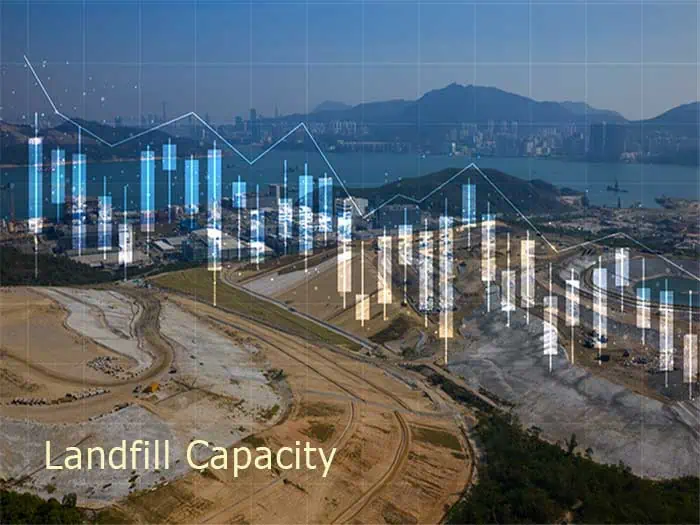
By preparing site life calculations with knowledge of multiple approaches, we can proactively position solid waste systems to meet future needs. However, the simplest approach is often the most prudent when every variable is unknown.
The growing Florida population has greatly pressured all public infrastructure, including waste disposal services. Planning for these adjusted growth trends is paramount to a successful system that provides the community with essential services. By preparing site life calculations with knowledge of multiple approaches, we can proactively position solid waste systems to meet future needs. Don’t overlook having a thorough understanding of current disposal trends and airspace utilization as the starting point for planning the future success of a solid waste system.
In their Florida SWANA presentation, Kollan Spradlin and Fauve Herron focus on using three different landfill site life calculation methods that they have previously used to assess the remaining life of Florida landfills.
Two of the three calculation methods will use service area population projections to model future waste disposal. They will also discuss a third model that does not utilize population projections — The Remaining Capacity Method. Originally developed by SCS Engineers’ founder Bob Stearns, The Remaining Capacity Method relies on past tonnage and volume utilization data to forecast the future date at which available remaining volume will be depleted.
Their Site Life Calculations presentation will cover data requirements, the drawbacks and advantages of each method, the identification of errors, and model implications.
Presenters from the ENR-Ranked No.1 Firm for Solid Waste Management:
Kollan Spradlin, PE, CHMM and Fauve Herron, EIT
While not a new concept, the authors examine the advantages and disadvantage of landfill mining as metropolitan areas grow larger and nearer to landfills, and as the landfills are filling up faster despite recycling programs.
Read or share the article by SCS Engineers’ Bruce Clark, Alyson Dagly, and Marc Rogoff here.
Landfill Services and Remediation Services at SCS Engineers
Corporate Headquarters