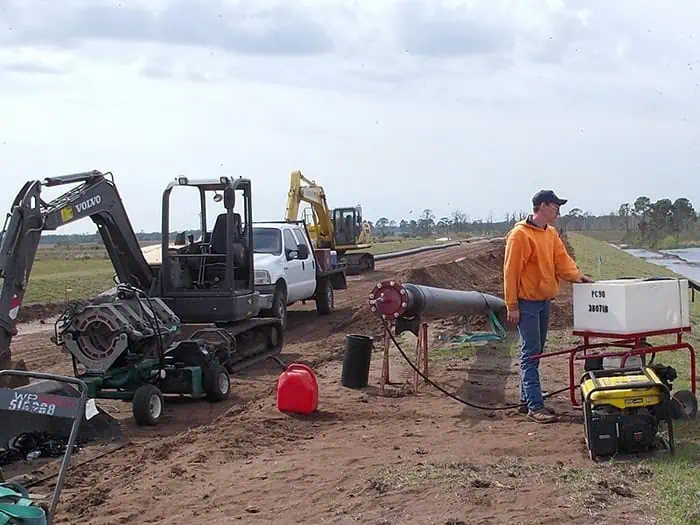
High-density polyethylene (HDPE) pipes are among the most commonly used pipes in the landfill industry. HDPE pipes are used as high-pressure carriers for leachate, gas condensate, compressed air, etc. HDPE pipes are also used in landfill gas collection systems, where they operate under vacuum. This blog article by Dr. Ali Khatami explains the precautions taken and why they help ensure the weld integrity in landfills.
Pipe Fabrication and Testing
HDPE pipes are shipped to a landfill construction site in pipe segments. The pipe segments are welded together to create pipe lengths to the specified application in the construction plans. Pipe segments are connected using butt fusion machines. HDPE pipes of any length and diameter can be fabricated in the field by using these machines. The fabricated pipes are commonly tested to verify the integrity of the butt fusion welds, making sure the welds do not leak.
Pipe Pressure Testing
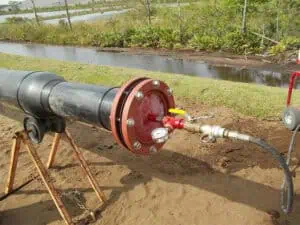
Engineers specify pressure testing of HDPE pipes by identifying the required test pressure, the test duration, and the allowable pressure drop at test completion. The test pressure may vary from one pipe application to another. For example, the specified test pressure may be 1.5 to 2 times the maximum service pressure in a leachate force main pipe. In contrast, in pipes used in landfill gas collection systems under vacuum, the specified test pressure may be lower. Test duration may range from 1 to a few hours, and the allowable pressure drop may range from 0 to a percentage of the initial pressure.
It is generally recommended to use incompressible fluids (water) for testing pipes at high pressures. The pipe needs to be prepared with blind flanges on either end with special connections. The special connection at the liquid feeding end may include a feed pipe connected to the blind flange to allow water to enter the pipe interior, a pressure gauge indicating pressure inside the pipe, and a valve. A special connection at the pipe’s other end, such as a valve, allows water out of the pipe at test completion. Engineers check the specified pressure against the pipe assembly pressure rating. The specified pressure must be less than the pipe assembly pressure rating; otherwise, the pipe assembly may fail during the test. If couplings are included in the pipe assembly, the pressure rating of the coupling may govern the specified test pressure.
Double-Cased Piping Testing
Pressure testing of double-cased pipes falls under a special category. For discussion purposes, the inside pipe is referred to as the ”carrier” pipe, and the outside pipe is referred to as the “casing pipe in these discussions. The pressure testing of the carrier pipe follows the single pipe testing protocol. The casing pipe pressure testing is more complicated. HDPE pipes are generally strong against outward pressures (internal high pressures); however, they are not as strong under inward pressures or vacuum conditions. Engineers must be aware of the internal (inward) pressure rating of HDPE pipes when preparing specifications for pressure testing. If the casing pipe pressure testing is performed with the unpressurized carrier pipe inside the casing pipe, the high pressures inside the casing pipe (outside the carrier pipe) may exceed the inward pressure rating of the carrier pipe, causing carrier pipe wall buckling without the involved parties becoming aware of it. The solution to the issue is to pressurize the carrier pipe while the casing pipe goes under pressure testing. It is recommended to pressurize the carrier pipe to 5 psi below the casing pipe test pressure. That setup will apply 5 psi of inward pressure on the carrier pipe, which is within the safe zone for all standard-diameter ratio (SDR) pipes.
About the Author: Dr. Ali Khatami
Additional Resources:
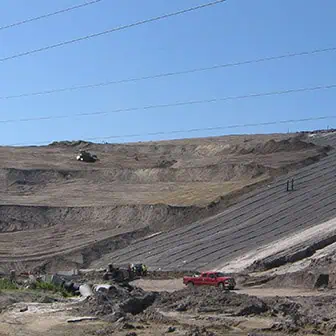
Landfills are located on properties with different geometric shapes and angles, including concave side slopes. The landfill boundary is decided by considering many different conditions that may exist at the property, such as wetlands, flood plains, soft foundation areas, protected plant species, navigable waters of the United States, creeks, utility easements, roads’ right-of-way, gas line easements, water districts, distance from nearby airports, etc. Following careful review of all conditions, a landfill boundary is selected that meets all regulatory requirements, with the understanding that a permitting process must be followed if the selected landfill footprint encroaches on any protected areas.
The landfill footprint polygon would be best if its interior angles were less than 180 degrees. Interior angles greater than 180° make the exterior angle less than 180°. An exterior angle less than 180 degrees forms a concave surface, as shaped by the landfill slopes above ground. Concave surfaces are such that the length of contours representing equal elevations within the surface increases with increasing landfill height. This generates a convergence phenomenon in the final cover drainage layer, potentially causing complex problems for the operator. Special designs seem necessary to address the following two issues commonly observed with concave surfaces.
The concave surface directs water within the final cover drainage layer toward the centerline of the concave surface. The centerline of the concave surface may be a straight line if the two halves of the concave surface are perfectly symmetric; otherwise, the centerline may deviate from a straight line. Water flowing toward the centerline of the concave surface converges within the void space of the final cover drainage layer. The rapid convergence of flow rapidly increases the hydraulic head of water within the drainage layer and often overwhelms its capacity to maintain that head within the drainage layer thickness.
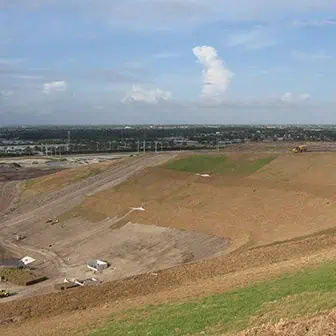
The special design must prevent the growth of a liquid head and prevent saturation of the overlying soil layer. The most critical part of the system lies along the centerline of the concave surface, the convergence line. A drain system consisting of a pipe wrapped in gravel and geotextile can be that special design along the concave surface centerline. The drain system along the concave surface centerline collects water that exceeds the drainage layer thickness and conveys it through the pipe to the toe of the slope for discharge into the perimeter ditch. This process prevents the drainage layer from overlying the soil layer from becoming saturated with excess water, which can cause instability. A lack of a drainpipe causes the overlying soil to become saturated, and water seeps out of the soil layer toward the top surface of the final cover. Eventually, a stream of water flowing down the slope along the concave surface centerline forms, causing soil erosion along its path and slope instability.
The shape of the concave surface determines whether a single drainpipe or multiple pipes are needed to address the issue effectively. The surface shape also determines whether the single pipe angle should change midway down the slope to align with the most critical pathway for the convergence line.
Partial closure of the concave surface may require extending the drainpipe to the top boundary of the partial closure, then extending it during the higher-level partial closure. Otherwise, the drainpipe may be terminated short of the full length of the convergence line, depending on whether the drainage layer thickness can withstand the liquid head forming above the termination end of the drainpipe. Engineers should analyze the drainage and conveyance capacities to define a termination point for the drainpipe.
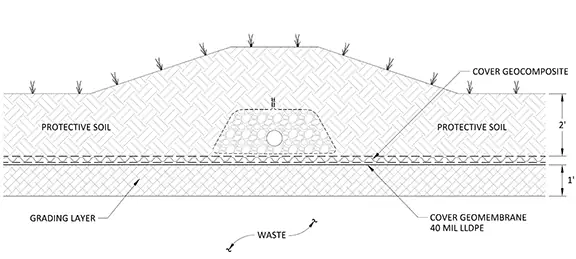 At the bottom of the slope, the water in the drainpipe may be released directly to the landfill perimeter ditch or to the drainage layer drain system at the toe of the landfill slope. An engineer’s careful attention is required to evaluate these options, as the water in the drainpipe along the concave surface centerline is expected to be high-energy, with significant velocities, given the connections near the slope bottom.
About the Author: Dr. Ali Khatami
Additional Resources:
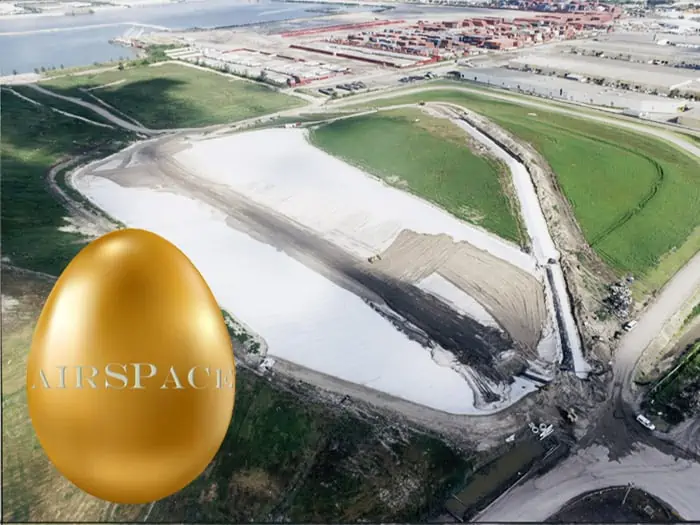
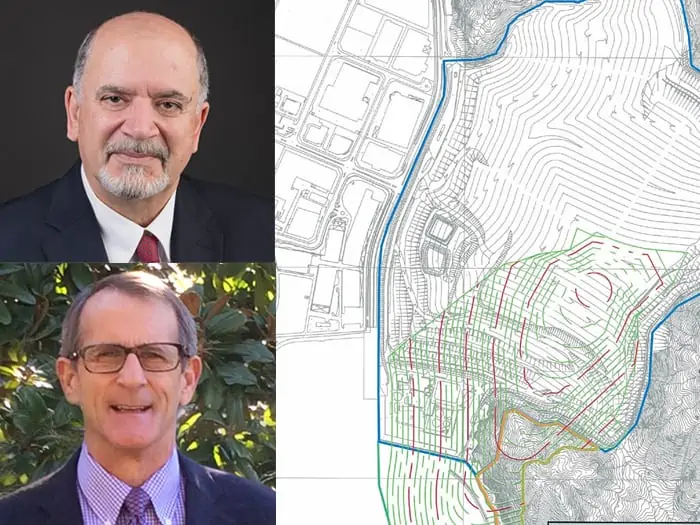
Christian Collins, the Deputy Director of Utilities for Manatee County, and Shane Fischer, P.E., of SCS Engineers, take readers through a pressing problem in many communities and regions – dwindling landfill airspace. As populations continue to grow and citizen consumption increases, the amount of waste surges, pushing landfills to their limits sooner than anticipated.
The co-authors guide us through the options a Florida landfill considers and the successful solution they ultimately implemented, doubling the life of the existing landfill’s footprint. This inspiring case study, originally published in Talking Trash, is now shared with our landfill clients, demonstrating that effective landfill management is achievable.
About the Authors:
Christian Collins is the Deputy Director of Utilities for Manatee County, with more than 30 years of expertise in wastewater and water plant operations, design and construction, reclaimed and biosolids management, solid waste facility operation and maintenance, and leading large teams, licensed in water and wastewater operations.
Shane Fischer, P.E., is a Vice President of SCS Engineers. He has more than 25 years of diverse experience designing and permitting civil engineering and solid waste management projects from the initial concept, construction, and operations.
Additional Landfill Airspace Resources:
Join SCS Engineers professionals at the SWANA Florida chapter’s Summer Conference and Hinkley Center Research Forum, July 23-25 in Daytona Beach, FL.
Don’t miss this opportunity to network with some of the best minds in the solid waste industry at this important solid waste conference and tradeshow in the southeast, while earning continuing education hours and enjoying beautiful and exciting Daytona Beach.
The program committee is developing an interesting and educational agenda about the latest developments in the solid waste industry. The conference will explore important topics, such as solid waste management, rate analyses, recycling, zero waste, landfill design & operations, waste-to-energy conversion technologies, disaster debris management, and more!
Several SCS Engineers professionals are presenting at the conference, including
Click for more conference details and registration information.
We hope to see you there!
Hear from SCS Engineers experts at the ninth Global Waste Management Symposium in Indian Wells, California, February 25-28, 2024. SCS is also is a Silver Sponsor of the conference.
The GWMS serves as a forum to discuss applied and fundamental research, case studies and policy analysis on solid waste and materials management. The community of researchers, engineers, designers, academicians, students, facility owners and operators, regulators and policymakers will participate.
Numerous SCS Engineers experts will be on hand to discuss your solid waste management challenges, and several are presenting at the symposium, including:
The Environmental Research & Education Foundation (EREF) is a strategic partner of the symposium.
Click here for schedule, registration, and other conference details
Hope to see you there!
The trend to go larger necessitates more landfill design sophistication and master planning to recoup the growing capital investment upfront. During this month’s SCS Engineers webinar and open forum, our panel will discuss landfill design, focusing on optimizing your site layout and maximizing air space – a landfill’s golden egg.
Live on Thursday, September 29, 2022
2:00 pm Eastern Time for 1 hour
This educational, non-commercial webinar with a Q&A forum throughout is free and open to all who want to learn more about landfill design. We recommend this month’s discussion for landfill owners/operators, solid waste planners, environmental engineers, municipalities, and environmental agency staff.
Certificates of Attendance are available for attendees who registered on Zoom and attended the live session.
Today’s modern landfills offset inflation and labor costs through transformative reduction, recycling, and reuse programs while turning methane into renewable energy. Advanced remote monitoring and control technology and data capture provide many efficiencies and insight to landfill operators and owners running larger and larger collections of plants and facilities on their landfills.
The trend to go larger necessitates more landfill design sophistication and master planning to recoup the growing capital investment upfront. During this month’s SCS Engineers webinar and open forum, our panel will discuss landfill design, focusing on optimizing your site layout and maximizing air space – a landfill’s golden egg.
Live on Thursday, September 29, 2022
2:00 pm Eastern Time for 1 hour
This educational, non-commercial webinar with a Q&A forum throughout is free and open to all who want to learn more about landfill design. We recommend this month’s discussion for landfill owners/operators, solid waste planners, environmental engineers, municipalities, and environmental agency staff.
Certificates of Attendance are available for attendees who registered on Zoom and attended the live session.
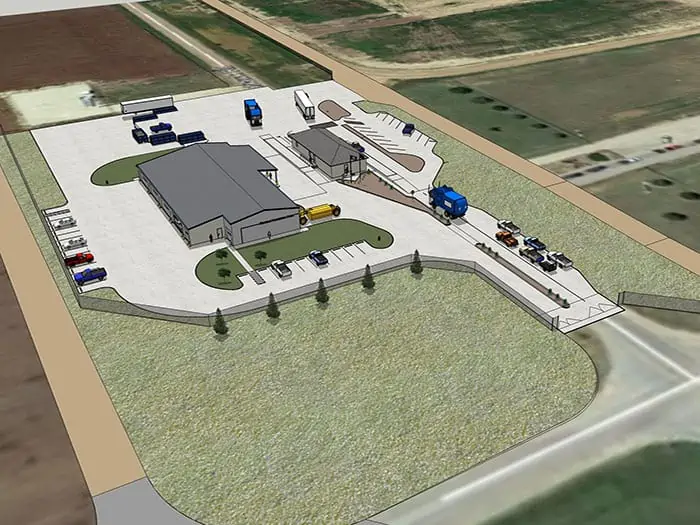
The Reno County Board of Commissioners approved contracting with SCS Engineers to support the County’s Solid Waste Department through 2024. SCS will provide environmental engineering, consulting, and field services for the Reno County Municipal Solid Waste Facilities for the next three years. The contract approval directly resulted from the firm’s experience, expertise, and long-standing relationship with Reno County.
SCS has a history of providing compliance, planning, and engineering services to Reno County. The firm helps the County continually comply with the Kansas Department of Health and Environment (KDHE) and other agency regulations. Compliance activities throughout the year include groundwater and leachate sampling, laboratory analyses, permit renewals, air permitting, and associated report preparation in accordance with Kansas Administrative Regulations.
Landfills contain complex systems to protect the health of nearby communities and the environment. The County uses SCS professionals’ expertise and proprietary software for air quality and gas collection and control systems (GCCS) operations, monitoring, and maintenance (OMM). Reno County relies on SCS to maintain these systems and keep them in compliance to focus on their other operations.
These preventative services keep the landfills fully compliant with state and federal regulatory requirements while aligned with the County’s system performance goals and anticipated operational and maintenance activities.
In 2021 the U.S. Environmental Protection Agency (EPA) changed legislation regulating landfills, specifically the New Source Performance Standards (NSPS) and other air quality regulations. These changes significantly increased the monitoring, record-keeping, data management, and reporting tasks for many landfills across the nation, including the Reno County Facility. SCS has helped Reno County navigate these changes and will continue to facilitate changes as the County looks to expand its landfill in the future. Combined with the supply chain and labor shortages, the Solid Waste Department is securing its essential services from disruptions.
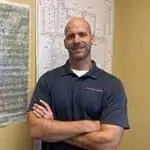
Project Director Steve Linehan said, “SCS is privileged that Reno County entrusts us to partner with them to maintain the landfills’ safe and efficient operations. The Solid Waste Department supports the citizens and the environment; we’re honored to help.”
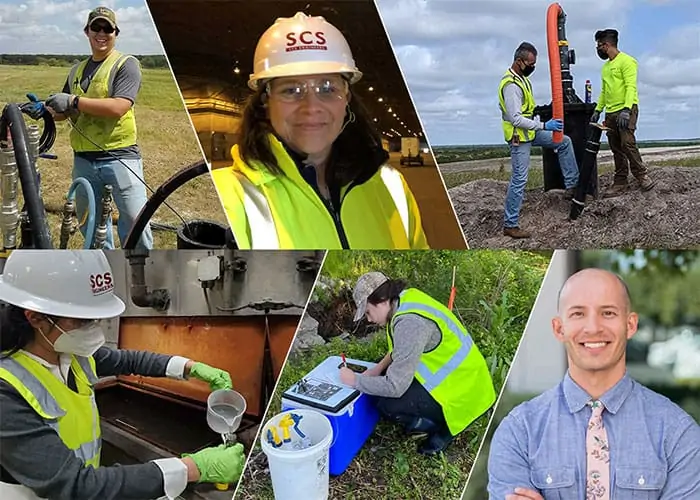
Here at SCS, we work for developers, industry, and manufacturers to help them run cleaner, safer, and more efficiently. This PBS video provides insight into how SCS brings value to the waste industry, our clients, and, most importantly, our communities.
You may ask yourself, don’t pig farms create pollution? Yes, but even that waste is reusable!
Did you know the food you buy in the grocery is supported by our environmental experts? Learn more about SCS’s environmental engineers and consultants who bring contaminated properties back to life, lower and capture greenhouse gases for fuels and renewable energy, and make possible a brighter future.
If you are interested in becoming an SCS Engineers employee-owner, watch our comprehensive video to see the breadth of services our teams offer.
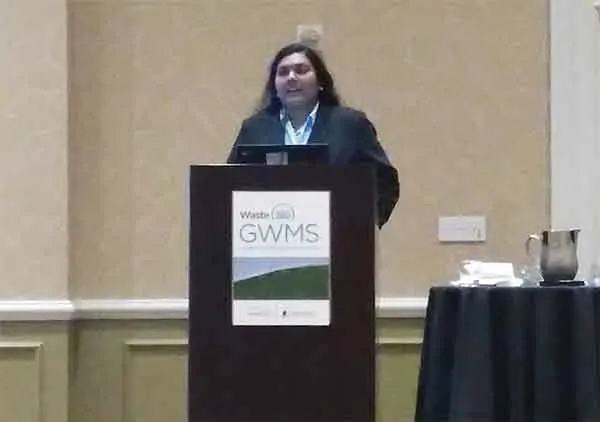
Not too long ago, SCSer Gomathy Radhakrishna Iyer thought she’d become a mechanical engineer but decided to go down another path at her father’s coaxing, and she’s never looked back. Today she is a Civil & Environmental Engineering Ph.D. and has become deeply entrenched in the world of landfills—human-made formations that she calls “beautiful.”
Dr. Iyer’s work spans research and engineering projects in landfill gas emissions reduction, landfill design, and leachate management. She’s also keeping up with PFAS to be ready for what may lie ahead around these emerging contaminants. “What I’m most into these days is researching and helping clients select leachate treatment systems and doing landfill expansion designs. It’s so mentally rewarding when you find solutions for the client’s problems. They are happy, and you are happy,” says the SCS staff professional.
She is known by more than her work family. Gomathy is a published researcher and speaker, most recently presenting at the Global Waste Management Symposium in February 2020. Her presentation covered one of her pet topics, her Ph.D. focus: using grass clippings and biosolids as biocovers to remove methane from landfills.
Pre-COVID, she spent many of her days in the field. Lately, she spends a little more time anchored to her computer in her home office. There she typically works on a few spreadsheets at a time, maybe as part of a gas emissions report, a stability analysis, or settlement analysis. Then she shifts her focus to her design drawings. Dr. Iyer still manages to break away to put on her PPE – her hardhat, safety vest, and steel-toed boots. She happily drives off in a company truck to the landfill, lugging field parameter testing probes and a 10-pound ISCO to collect leachate samples; or do other fieldwork like locating LFG wells and pipes or other features that help her design.
In the summers, it gets scorching hot. And the winters can be bone-chilling cold, especially for a woman who spent most of her life in India, where she was born and raised. In her last years there, she studied the transport of heavy metals through groundwater. Then, it was on to the University of Texas, Arlington, where she earned her Ph.D. and became set on finding work at SCS, coming on board in 2019.
Among her earliest challenges was communication. “Sometimes I would be in a meeting or having lunch with my colleagues, and they would bring up baseball or other games or a Netflix series. They were new concepts to me, and I couldn’t relate. While I speak English, I was unacquainted with the vernacular. I was like, what is Super Bowl? I thought maybe it was something very big that people eat from,” she recalls. That does not stop a researcher.
Finding a way to become better acclimated became a project of sorts. She started spending weekend downtime in front of the TV to learn about these American pastimes. Baseball still isn’t her first love, but she’s happy to say, “In 2019, I went to my first Washington Nationals game with a big group from SCS, and I had at least some knowledge of what was going on.”
The ambitious civil engineer has pushed past another on-the-job challenge—one brought on by the impulse to know every detail she can nail down before setting to work. “Since I’m from a research background, I tend to dig to the very bottom to try and know the problem completely. Sometimes it’s a good thing. But I’ve had to be conscious of time constraints, gain an understanding of the minimum required to do the job well, and move on,” she says.
What first brought her to the United States was her husband, Ramesh Padmanabhan. He was working on a Ph.D. at the University of Texas at Dallas while she was studying in India, so the relationship truly began as a long-distance one. They got to know each other through a combination of old-world traditions and 21st Century channels. “Ours was an arranged marriage. Our parents introduced us, and for the first year, we met up and talked on SKYPE,” Dr. Iyer recollects. He’s a molecular and cell biologist and sometimes her consultant too.
“In my job, I need to know the biology and chemistry of microbes as they are responsible for breaking down waste, and he is my encyclopedia. I don’t have to Google as much when he’s around.” She adds: “I can’t complete my story without talking about my brother who has given me unconditional support and career advising through my life. These two men are pillars of my life.”
As a woman civil engineer who’s all about waste, she’s in the minority, but she doesn’t feel as if she is because women are moving into waste engineering. She’s one of four women on an eight-person team, who she says is “like my family. And my supervisor is a great supporter of women in STEM (science technology, engineering, and math).”
She hears from many newly degreed civil engineers, including “young ladies” with questions about waste management. They read blogs about her work that originated on SCS’s website and are on social media. “These graduates want to take their career to the next level, and they have a lot of questions about how to start solving waste issues,” she says. She tells them that solid waste management is one of the best and most stable industries they can choose and that the pandemic has driven that point home. “We are reminded through COVID that waste management is an essential business, and there will always be jobs to support it,” she says.
What Dr. Iyer loves most about her job is what she and her team imagine and draft in drawings, keeps developing, and in time, is built. “It’s like giving birth to a baby. Very exciting,” she says. Her groundwater contamination remediation work got her interested in PFAS, even before she finished her studies. “I had a lab mate in school who did PFAS research. That got me curious about these emerging contaminants. I’ve stayed vigilant to keep up with what’s happening with regulations and treatment options under research. If regulations now under consideration are implemented, our clients will have to start thinking more proactively about addressing PFAS. So, we need to learn more on a holistic level about what these contaminants can do and the best way to treat them.”
She tells the story of how her venture into civil engineering started with her father. “He wanted to be a civil engineer himself but was the eighth son, so his parents couldn’t afford tuition, and in India, you don’t go to college once you are grown with a family,” she explains. He wanted his daughter, already drawn to engineering, to pursue what had been his dream and said he thought it would suit her better than the direction she was leaning. “Had I studied mechanical engineering as I’d been thinking of doing, I would not have come into waste.” She is happy with where she’s landed.
“When you work all day and still are not tired –you still enjoy it and are happy to contribute to something good—that’s how you know it’s the right fit.”
Corporate Headquarters