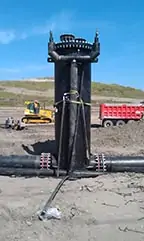
 Lessons learned from previously constructed gas collection and control systems teach solid waste professionals valuable lessons about designing for long-term survivability and reducing the maintenance cost of gas system components. The location impacts operating and maintenance costs for various components of gas collection and control systems such as condensate force main, condensate sumps, force main for well liquids, air lines to pumps in gas wells, and gas headers long into the future. As often as possible, design the gas header in the landfill perimeter berm along with the condensate sumps. Landfill perimeter berms constructed in an engineered manner with well- compacted soils and a well-defined geometry provide a long-term cost-effective alternative to earlier designs outside the berm.
For many years, gas headers were designed and constructed outside of the landfill perimeter berm, on the landfill surface. Of course, landfill surface changes as waste elevation increases over time, resulting in many gas headers that now may be 30 feet or more below the current waste surface. Deeply buried gas headers are unreliable at best, and the operator loses access to them as soon as 20 feet of waste covers the header.
Collapsed gas headers buried deep in waste are an expensive challenge when operating a large number of gas wells connected to the gas header, and could cause serious compliance issues. Upon discovery of a collapsed buried gas header, installing a new header is a lengthy process with significant costs, not to mention the hurdles the operator will have to jump addressing noncompliance with their state agency.
The benefits of placing gas headers in the landfill perimeter are:
Since the condensate force main follows the gas header in the perimeter berm to flow to a tank or discharge point, there are additional maintenance benefits.
By continuing to design gas header construction on landfill slopes, all of the components end up on the landfill slope as well. You can imagine what type of complications the landfill operator will face since all of these components are in areas vulnerable to erosion, settlement, future filling or future construction. Additionally, any maintenance requiring digging and re-piping necessitates placing equipment on the landfill slope and disturbing the landfill slope surface for an extended period.
For more information about these benefits and more, please refer to the MSW Magazine article series Considerations for the Piping Network, the author, or contact SCS Engineers at .
 About the Author: Ali Khatami, Ph.D., PE, LEP, CGC, is a Project Director and a Vice President of SCS Engineers. He is also our National Expert for Landfill Design and Construction Quality Assurance. He has nearly 40 years of research and professional experience in mechanical, structural, and civil engineering.
Learn more at Landfill Engineering
Corporate Headquarters