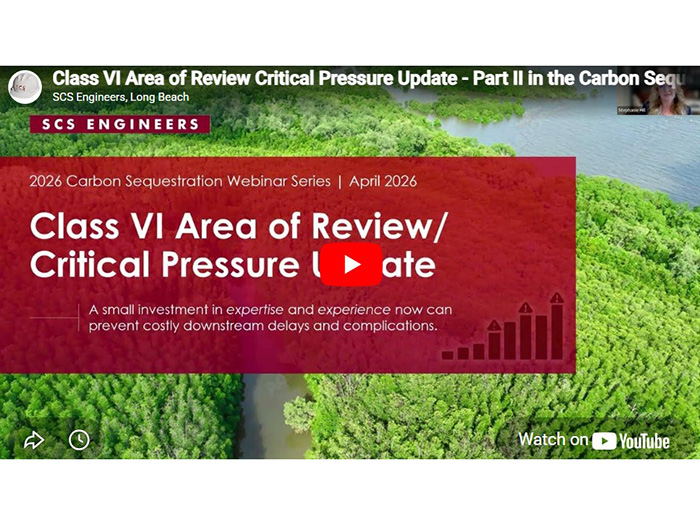
 This educational webinar explores how critical pressure informs the definition and refinement of a carbon sequestration project’s Area of Review (AoR) under the Class VI permitting framework. The SCS experts explain why some developers are re-evaluating AoR assumptions, how injection-driven pressure propagation can dominate AoR extent, and why project-specific geology (including fluid salinity and basin structure) can make simplified approaches overly conservative, rather than safer.
In this 17-minute session, we compare calculation approaches (Methods 2, 2A, and 3) and emphasize that early, iterative AoR work can reduce regulatory, cost, and public-trust risks.
AoR must account for both plume extent and pressure effects: Beyond the supercritical CO2 plume, pressurization and project critical pressure determine where fluids could migrate upward through improperly plugged/abandoned wells and potentially endanger underground sources of drinking water (USDWs).
Pressure front propagation is often the controlling factor: Pressure can propagate faster and farther than the mobile plume, and may be altered by geologic structures (e.g., faults).
Fluid salinity and density matter: Higher salinity increases fluid density and generally requires more induced pressure to drive vertical migration; real-world salinity profiles can be non-linear and project-specific.
Method selection depends on data and realism: Method 2 is simple but can yield unrealistic outcomes (e.g., zero/negative critical pressure). Method 2A uses a more detailed equation-of-state approach. Method 3 incorporates risk-based computational modeling of flow through a hypothetical, poorly-plugged well and can better handle complex cases.
Timing and iteration reduce downstream costs: Investing early and periodically re-evaluating AOR assumptions improves defensibility and can avoid costly changes after permitting.
Transparency supports outreach: The AoR process and re-evaluations (including public comment opportunities) can be communicated in plain language to build public confidence in drinking water protection.
Dr. Hostetler will present “A Computational Modeling Approach to Critical Pressure Calculations for Class VI Area of Review Delineation” [Thursday, September 14, 10:30 – Noon, Session Class VI UIC] at the Groundwater Protection Council 2023 Annual Forum in Tampa.
Presentation Category: Carbon Capture and Underground Storage
Subsurface pressure increases as supercritical carbon dioxide is injected into a deep saline reservoir beneath a confining zone. If the pressure buildup is great enough, brine could be lifted upward from the injection zone through an inadequately plugged or abandoned well that penetrates the confining zone. This could result in the endangerment of an underground source of drinking water (USDW). A Class VI Injection Permit requires a delineation of the Area of Review (AoR). The AoR is the superposition of the area of the buoyant supercritical plume itself, together with the area over which the pressure front is large enough to potentially endanger a USDW through some conduit. The USEPA Class VI Guidance offers several approaches to calculating critical pressure. Some of these methods are based on concepts of changes in potential energy in artificial penetration and are very easy to implement. Unfortunately, they are simplified models and are also very conservative. The USEPA Guidance also allows for the computation of the critical pressure by computational modeling. We present a computational modeling approach that is more mechanistic, explicitly addresses uncertainty, can be updated as additional testing and monitoring data become available, and provides a more authentic representation of the critical pressure and hence, the AoR.
 Dr. Hostetler has nearly four decades of experience as a geochemist and hydrogeologist. His expertise focuses on subsurface multiphase flow modeling, groundwater flow and transport modeling, and reactive solute transport modeling. Dr. Hostetler is an SCS Engineer’s Deep Well Initiative and Class VI Permit Team member. Charles Hostetler has a BS in Geosciences and a Ph.D. in Planetary Sciences from the University of Arizona.
Find out more:
SCS Engineers Senior Project Advisor, Dr. Charles Hostetler will be a presenter at the Groundwater Protection Council’s Annual Forum, September 12-14, in Tampa, Florida.

This year, the GWPC is celebrating 40 years of progress and innovation in groundwater conservation and protection! For four decades the GWPC has worked with its member states to ensure the protection and conservation of groundwater resources for all beneficial uses. This special 40th anniversary conference brings together the best and brightest in the field to discuss the latest research, innovations, and advancements in groundwater science, regulation and management.
Corporate Headquarters