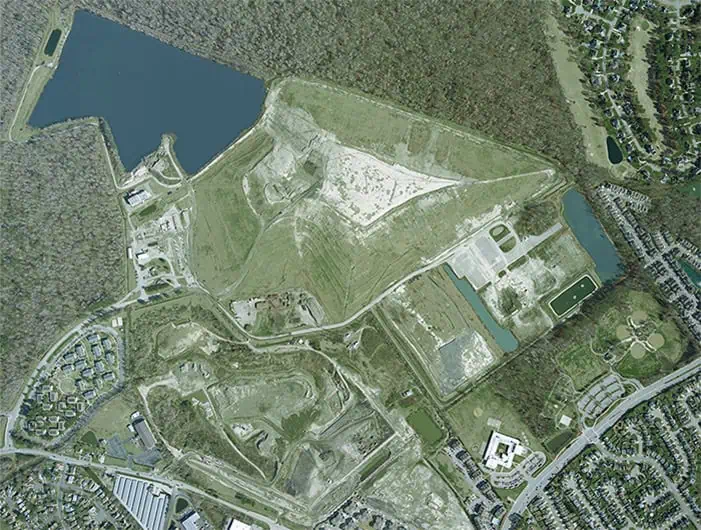
This SCS Engineers blog provides a summary guide on landfill gas collection and control systems (GCCS), focusing on design, construction, operation, and maintenance of landfill gas (LFG) infrastructure. It covers essential components such as LFG headers, condensate management, isolation valves, and quality assurance processes, emphasizing regulatory compliance, safety, and optimization of gas recovery. We provide links to the details below, and our professional staff are always ready to answer questions.
Landfill Gas Collection and Control System (GCCS) Overview
The GCCS is a critical component of landfills that accept organic matter, designed to control odors and landfill gas (LFG) emissions to protect human health and the environment. Over four decades, GCCS has evolved from passive venting to sophisticated piping systems with specialized components for handling gas, liquids, and condensate flow within the piping network.
Primary Vacuum Conveyance Line
LFG headers serve as primary vacuum conveyance lines from blower skids to LFG wells inside the landfill. Maintaining the integrity of these headers is vital to avoid system shutdowns that could disrupt gas-to-energy operations, cause financial losses, and lead to air quality and odor issues, especially in urban areas. The headers are activated from the first day of GCCS operation and expand as the landfill grows.
Conveying Condensate: Slope and Gravity
As LFG cools, water vapor condenses inside the piping system, creating condensate that must be effectively removed to prevent blockages and flow interruptions. The system’s design ensures gravity-driven condensate flow toward collection points by maintaining positive pipe slopes—any dips or improper slopes risk hydraulic blockages and reduced gas extraction efficiency.
Isolation Valves on LFG Header Inside Waste Boundary
Isolation valves are installed within the piping network to isolate segments for maintenance without shutting down the entire system. They also facilitate cost-effective expansion by allowing new sections to connect without impacting existing operations.
LFG Header Crossing an Anchor Trench
LFG headers sometimes cross the landfill lining system anchor trench at the perimeter. Positioning headers in contact with the anchor trench can complicate final cover construction, potentially causing weak points and gas leaks. A recommended minimum clearance of three feet between the anchor trench and the LFG header bottom allows proper welding of geomembranes and system integrity.
Condensate Sumps Inside Landfills
Condensate sumps are placed at low points in the piping network, often inside the landfill footprint, where the LFG header follows a serpentine path. These sumps are vulnerable to damage from landfill settlement and may require vertical extension during landfill closure, causing operational interruptions. Designers are advised to locate sump tops above future final cover elevations and provide access for maintenance until closure.
Condensate Force Main Inside Landfills
Condensate collected in sumps is pumped via electric or pneumatic pumps into force mains that discharge to leachate systems or storage tanks outside the landfill. Force mains buried deep in waste must be structurally designed to withstand waste loads and avoid contact with the lining system anchor trench to prevent costly geomembrane welding issues.
Pneumatic Pumps Inside the Landfill
Pneumatic pumps require compressed air lines extending from compressors outside the landfill to power condensate sump pumps and liquid-removal pumps in LFG wells. These air lines must be designed to withstand compressive waste loads and avoid interference with the lining system anchor trench to maintain final cover integrity.
Collapsing LFG Header Buried Deep in Waste
In older, large landfills, multiple layers of LFG headers may exist vertically buried in waste. These headers can collapse under waste surcharge loads, reducing vacuum effectiveness. To compensate, new headers at higher elevations are added, creating a layering effect without waste extraction.
LFG Header Above the Final Cover Geomembrane
Constructing LFG headers above the final cover geomembrane provides maintenance access without disturbing the cover. However, it requires careful design to avoid conflicts with surface water management structures such as downchute pipes. Depressing down chute pipes and geomembranes at crossing points ensures proper condensate flow and water drainage [19] [20].
Benefits of Placing the LFG Header Outside the Waste Boundary
Locating the LFG header and condensate sumps in the landfill perimeter berm during cell construction offers multiple benefits:
Construction Quality Assurance (CQA) Services
CQA ensures GCCS construction complies with design intent, allows field adjustments, and documents construction events. It involves site familiarization, pre-construction meetings covering project scope, safety, permits, and coordination among all stakeholders. Regular progress meetings monitor work status and address issues. CQA personnel verify well locations before drilling and oversee safe drilling operations with odor control and fall protection measures.
Landfill Gas Collection and Control System Operation, Maintenance, and Monitoring (OMM)
OMM programs optimize gas recovery and compliance by implementing durable, beyond-compliance practices. Safety plans tailored to site-specific hazards are critical, including evacuation procedures and hazard communication. Monitoring plans review historical data, permits, and manufacturer recommendations to develop clear procedures and schedules. Wellfield tuning stabilizes the vacuum and addresses maintenance issues such as air leaks, surging, and liquid blockages. Compliance management involves tracking exceedances, reporting, and maintaining regulatory relationships.
Wellfield Tuning and Maintenance Details
In conclusion, SCS Engineers emphasizes careful GCCS design that considers final cover construction, recommends placing LFG headers in perimeter berms for operational advantages, and details CQA and OMM best practices to ensure system integrity, safety, and optimized landfill gas recovery throughout the landfill life.
Take a deep dive into these landfill topics, plus using LFG as a renewable energy source, and greenhouse gas reporting.
Please read the SCS Engineers’ series of landfill articles and resources published and available on our website:
About the Co-Authors: Sr. Vice President Ali Khatami, Ph.D., PE, LEP, CGC; Sr. Vice President Srividhya Viswanathan, PE; and National OM&M Compliance Manager David Fisher. Contact our authors or a landfill, LFG, and GCCS expert near you.