Most agencies conduct an annual rate study to evaluate the cost of providing solid waste, recycling, and composting curbside collection services. The study is used to develop recommended rates for these services for each new fiscal year, and to maintain uniform services with a variety of service level options throughout the community. Further, competition from private haulers requires municipal providers of solid waste services to look for ways to enhance revenues by expanding services such as commercial collection, utilizing roll-off pickups, and recycling services. Addressing long-term maintenance and vehicle replacement is complex and risky without a long-term financial plan.
I recommend a proactive approach to engineer, manage, and design a strategic, sustainable and detailed approach to long-term financial planning. A detailed approach provides the flexibility to establish fair, equitable, and effective solid waste system rates while enabling a decision-maker to compare and contrast alternative strategies which address these key issues:
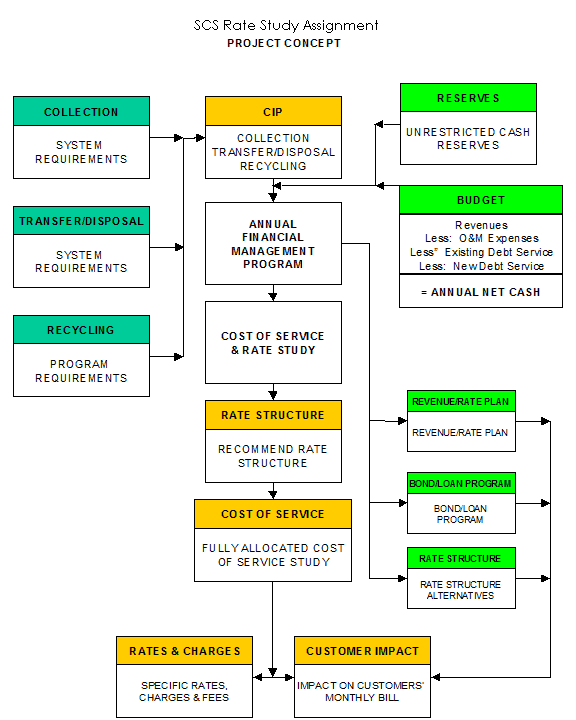
A rate study, if conducted appropriately, can help provide the agency with a long-range financial business plan. Each rate study requires a task plan and a project concept (pictured below), and to manage the following:
In short, the rate study provides a deeper understanding of what rates should be and allocates costs appropriately to various functional areas of an operation. Also, it is used by SCS clients to estimate year-by-year what is possible using various scenarios. For example, a municipality would like to buy 5 new collection vehicles or expand their landfill or recycling center. A rate study allows the decision-maker to assess the impact of the purchase on the current budget; then determine if enough surpluses will remain at a specific point during the fiscal year to purchase, or if a rate adjustment is necessary how much to adjust the rates.