A New Reality for Existing Buildings
For decades, energy efficiency policies focused primarily on new construction. Existing buildings (especially older buildings) account for a large share of greenhouse gas emissions in the urban setting. Building Performance Standards (BPS) are state- and locally driven regulations that require owners of existing buildings to meet measurable energy or emissions performance targets over time—not just report data, but also achieve energy-efficiency objectives.
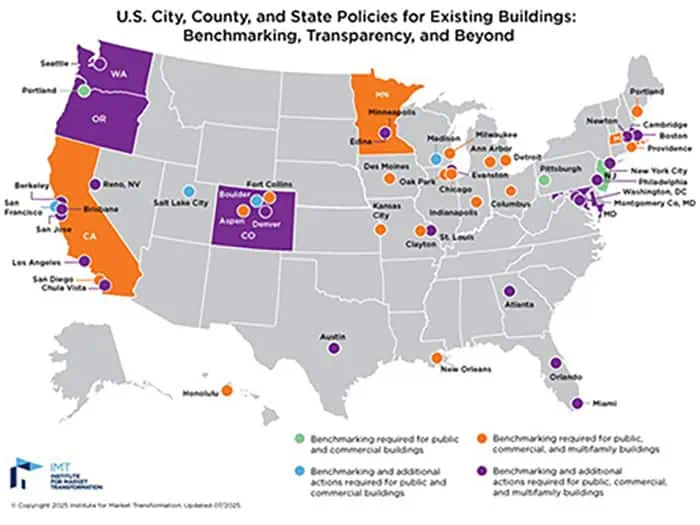
Since 2019, BPS policies have expanded rapidly across the United States, as shown in the map above (Courtesy of IMT). What began as voluntary benchmarking programs has evolved into mandatory, enforceable requirements with escalating targets and financial penalties for non‑compliance. More than 50 U.S. cities and several states have now adopted or committed to BPS policies, fundamentally changing the risk profile of owning and operating commercial real estate.
For building owners—especially those with portfolios spanning multiple jurisdictions—the challenge is clear: how do you comply without overspending, disrupting operations, or getting caught off guard by penalties and rushed retrofits?
What Are Building Performance Standards—and Where Do They Apply?
Building Performance Standards set minimum performance thresholds for energy use or greenhouse gas emissions. These thresholds typically tighten over time, pushing buildings toward deep efficiency improvements and, in many cases, long‑term decarbonization goals.
Today, BPS requirements exist at both the state and municipal levels, including:
The key takeaway for owners is simple: BPS policies are becoming the baseline expectation for building performance nationwide, not an exception.
What Is Required of a Building Owner?
While details vary by jurisdiction, most BPS programs require owners to:
Failure to comply is no longer symbolic. Penalties are real and material, often including:
For large buildings or portfolios, these fines can quickly reach six or seven figures annually, turning energy performance into a balance‑sheet issue—not just a sustainability goal.
Competitive Advantage From Regulatory Burden
Forward‑thinking owners are reframing BPS from a compliance obligation into a strategic asset—those who act early gain flexibility, optionality, and financial upside. Key benefits include:
Lower Operating Costs
Targeted HVAC, lighting, controls, and envelope improvements routinely deliver 15–30% annual energy savings, reduce maintenance, and improve system reliability.
Stronger Asset Value
High‑performance buildings command:
Risk Mitigation
Early action avoids:
Health, Comfort, and Productivity
Improved ventilation, moisture control, and thermal comfort reduce absenteeism and enhance occupant performance—often the largest “hidden” financial upside for commercial tenants.
What This Means for Portfolio Managers
For owners and asset managers with buildings across multiple BPS jurisdictions, the challenge isn’t just compliance—it’s coordination.
A fragmented, city‑by‑city response leads to:
A portfolio‑level strategy, on the other hand, allows owners to:
This is where experienced advisors add the most value—helping owners see the full portfolio picture, not just the next deadline.
How Building Owners Can Capitalize on BPS Requirements
Successful owners are taking a phased, data‑driven approach:
Many jurisdictions now support this approach through Building Performance Hubs, utility programs, and technical assistance to lower upfront costs and reduce execution risk.
Funding the Path to Compliance
Compliance does not have to mean self‑funding every upgrade. Owners can leverage:
When coordinated correctly, these tools can significantly reduce—or even eliminate—the net cost of compliance.
Conclusion: The Cost of Waiting Is Higher Than the Cost of Acting
Building Performance Standards mark a permanent shift from voluntary sustainability to mandatory performance. For building owners, the question is no longer if action is required, but how and when.
Owners who act early gain control over costs, timelines, and outcomes. Those who delay risk fines, rushed decisions, and stranded assets. In a market where regulations are tightening and capital is increasingly performance‑driven, energy performance is now a core business strategy.
The smartest owners aren’t just complying, they’re using BPS as a lever to protect asset value, improve cash flow, and future‑proof their portfolios.
Look for an independent engineering consultant such as SCS Engineers with no financial interest in equipment sales, construction, or energy performance contracts. Your consultant’s expertise and vendor agnosticism provide objective, more valuable recommendations to owners selecting implementation strategies. Find a qualified engineering consultant near you.
To learn more about running facilities more efficiently and maximizing energy and water conservation, please visit our Facility Energy Management page.

Discover Why Retro-Commissioning is the Key to Sustainable Facility Performance
What Is Retro-Commissioning (RCx)?
Retro-commissioning is a systematic process for evaluating and optimizing the performance of existing buildings and their systems. Unlike initial commissioning, which is performed during new building construction, RCx focuses on improving existing equipment and systems in facilities that have been in use for some time. The goal is to ensure that the building continues to meet the needs of its occupants and operates as efficiently as possible.
Why Is RCx Needed?
Over time, buildings often stray from their original design intent due to changes in usage, aging equipment, and evolving operational requirements. This can lead to inefficient energy consumption, increased utility costs, and discomfort for occupants.
RCx addresses these issues by identifying operational problems, optimizing control strategies, and restoring peak performance, often with a quick payback period, making it a cost-effective choice for facility managers and owners.
Why Is RCx Often Overlooked?
Despite its proven benefits, RCx is frequently neglected. Many facility managers and owners focus on new construction or renovations, overlooking the potential hidden within their current assets.
Limited awareness, budget constraints, and misconceptions about RCx’s complexity can prevent organizations from pursuing these projects. RCx is typically cost-effective, with minimal disruption and often pays for itself in less than two years, reassuring facility managers and owners of its practicality.
When RCx Is Right for You?
Energy Consumption Has Increased
When evaluating energy use, look for gradual drifts or sudden changes. Year-over-year increases of 10% or more suggest operational issues RCx can resolve.
On the other hand, acute changes are marked by a sharp spike in energy consumption, which may then level off or continue to rise. These abrupt increases are usually easier to notice because they stand out more than gradual trends. Acute changes typically indicate that a major piece of equipment, such as a chiller or air handling unit, has suddenly begun operating differently. The root cause may be straightforward or require detailed investigation. What’s clear from such a dramatic rise in energy costs is that immediate attention is needed.
Multiple Operator Overrides
For most buildings, a building automation system (BAS) has been installed to provide a control scheme for the many components of a mechanical system responsible for building climate control and, in some cases, lighting systems. When a facility is newly built and properly commissioned, these controls should be operating efficiently.
However, over time, equipment performance can decline: dampers may break, sensors can drift out of calibration, and complaints from occupants about uncomfortable temperatures or unpleasant odors can surface.
Operations and Maintenance teams, already stretched thin managing a variety of urgent issues, rarely have the capacity to investigate the underlying causes in depth. So when a tenant calls, frustrated that a conference room is sweltering during a crucial meeting, the likely response is to override the setpoint. This quick fix ensures the room cools down, keeps the tenant satisfied, and allows the staff to move on to the many other tasks demanding their attention. However, the additional energy consumed will become noticeable over time.
Equipment Has Useful Life
One of the goals of RCx is to optimize building system performance and lower energy use by fine-tuning control sequences, operational routines, and maintenance practices—without incurring major costs for equipment replacement. For RCx to be effective, the existing equipment must be operating near its original design specifications. However, all equipment ages, and even well-maintained systems will eventually degrade to less-than-ideal performance. If the equipment is so worn out that it can no longer fulfill its intended purpose, there’s little that RCx can do to restore its performance.
For example, an HVAC condensing unit that’s been in service for three decades, with corroded coils and a persistent inability to maintain proper refrigerant temperatures even at full capacity. In such cases, the unit has surpassed its expected useful life, and replacement is likely the only way to achieve the desired comfort and efficiency, followed by commissioning of the new equipment to ensure optimal operation.
Conversely, if your system is only five years old and physically sound but is struggling to meet cooling demands or is running inefficiently, an RCx specialist can help diagnose and resolve the underlying issues, restoring the system’s performance.
The Benefits of RCx
RCx is more than just a maintenance strategy—it’s a proactive approach to unlocking long-term value in existing buildings. The numbers show: substantial savings, improved comfort, and a rapid return on investment make RCx a smart, sustainable choice for any facility owner looking to unlock their building’s performance.
Who Provides RCx Services?
While HVAC maintenance companies can offer some RCx services, choosing specialized energy engineering firms, mechanical contractors, or controls companies ensures effective results and gives facility managers and owners confidence in the process.
Selecting an RCx Provider: Building owners should look for businesses with proven experience in similar facility types and a track record of successful RCx projects. It is wise to request references, review case studies, and ensure the firm follows industry standards such as those set by ASHRAE or the Building Commissioning Association. Owners may also consider issuing a request for proposals (RFP) to compare qualifications, methodologies, and pricing among several firms before making a selection.
Additional Resources:
 About the Author. Tony Kriel is a Professional Engineer (PE) and LEED Accredited Professional (BD+C and O+M) with a Bachelor of Science in Mechanical Engineering from the University of Wisconsin, Madison. He serves as SCS Engineers’ National Expert on Facility Energy Management, with decades of consulting experience specializing in commissioning (Cx), retro-commissioning (RCx), ASHRAE Level I-III energy audits, and greenhouse gas/carbon-reduction services. Tony manages multiple large-scale projects exceeding 1 million square feet and works with diverse clients across the industrial, commercial, military, federal, state, municipal, and solid waste sectors. He has implemented and managed commissioning processes for various buildings, providing both fundamental and enhanced commissioning services aligned with the US Green Building Council’s LEED program. Feel free to contact our Author, Tony Kriel, with any questions or use LinkedIn.
Florida’s stormwater regulations have undergone significant changes, impacting how we assess water quality and manage stormwater systems. It began with Senate Bill 7040, known as the Statewide Stormwater Rule Ratification Bill, which was signed into law on June 28, 2024.
The legislation establishes minimum stormwater treatment performance standards, requiring new development, including redevelopment over one acre, to reduce total phosphorus by 80% and total nitrogen by 55% to improve water quality. For project design, it mandates cost estimates for the annual operation and maintenance of stormwater management systems and establishes criteria for qualified stormwater inspectors.
The central component of the updated regulations is the concept of net improvement. According to Florida Administrative Code R. 62-330.301(2), net improvement refers to the enhancement of water quality through the implementation of onsite mitigation measures. These measures can include changes in land use or the implementation of stormwater Best Management Practices (BMPs). The goal is to demonstrate that the proposed activity will result in a net improvement of the nutrient parameters regulated by the state, specifically Total Nitrogen (TN), Total Phosphorus (TP), and Total Suspended Solids (TSS).
In practice, net improvement can be achieved through enhanced BMPs such as increased retention volume, nutrient-reducing media, biofiltration systems, or other onsite measures that provide additional pollutant removal capacity. Tools such as BMPTrains, or equivalent modeling or manual calculations, may be used to support net improvement evaluations.
Before the 2024 rule change, only projects discharging directly or indirectly to impaired water bodies were required to demonstrate net improvement for TN and TP. Following the ratification of Senate Bill 7040, this requirement now applies to all sites, regardless of the impairment status of the receiving water body, and includes TSS as an additional parameter. Net improvement must be demonstrated using the more protective of the two approaches: a pre- versus post-development runoff analysis for TN, TP, and TSS, or a nutrient reduction efficiency method that specifies required reduction percentages for each parameter.
The Statewide Stormwater Rule also introduced more rigorous operation and maintenance requirements for stormwater management systems. Entities responsible for these systems must now submit a cost estimate for perpetual operation and maintenance, along with a financial capability certification, as part of the Environmental Resource Permit (ERP) application package. In addition, the updated rule mandates the development of a comprehensive operations and maintenance plan that outlines procedures to ensure long-term system functionality and continued compliance with water quality standards. These requirements ensure that stormwater systems remain functional throughout their lifespans, rather than meeting performance targets only at construction.
The new rule also requires that stormwater management system inspections be conducted, certified, and submitted by a qualified inspector. To meet this requirement, the inspector must either be a registered professional, work under the supervision of one with proper documentation, or have completed training within the past five years that covered key topics such as reading construction plans, understanding traditional and non-traditional BMPs, identifying system failures, and performing inspections in compliance with applicable regulatory standards. As part of the certification process, the qualified inspector must also submit a Stormwater Facility Inspection Checklist.
The stormwater rules do not apply retroactively to existing site developments with valid, unexpired conceptual, general, or Individual ERPs issued before the effective date of June 28, 2024. Existing developments are not required to retrofit their stormwater management systems unless a major modification is proposed. Minor modifications remain subject to the original permitting rules, provided they do not result in significant impacts on water resources. To qualify for this grandfathering provision, applicants must demonstrate that the proposed changes will not affect treatment, attenuation, or discharge functions; increase off-site discharge or environmental impacts; or reduce retention/detention capacity, flood-control elevations, or pollution-removal efficiency. Additional grandfathering provisions for public transportation projects, projects submitted to local government agencies, projects involving ecosystem management agreements, and Developments of Regional Impact, defined as developments that substantially affect the health, safety, or welfare of citizens in multiple counties, are outlined in Section 3.1.2 of the ERP Applicant’s Handbook, Volume I, effective June 28, 2024.
The new net improvement requirements established by the Statewide Stormwater Rule took effect on June 28, 2024, making the implementation date December 28, 2025. ERP applications that are deemed complete before this deadline are exempt from these updated standards. In contrast, other components of the rule took effect immediately on June 28, 2024, including the requirements for operation and maintenance plans, long-term cost estimates, and system inspections. The qualified inspector provisions, which outline specific credentials and training standards for inspectors, became effective one year later, on June 28, 2025.
Understanding these requirements early in project planning is critical, as incorporating net improvement strategies and O&M obligations upfront can prevent costly redesigns later in the permitting process. By staying informed and adapting to the new regulations, we can ensure that our projects do not adversely impact Florida’s water quality or environmental health.
About the Authors:
Mike Radford, P.E., is a licensed Professional Engineer with nearly two decades of experience specializing in landfill and solid waste design, stormwater management, and construction oversight. He has served as Project Manager and Engineer of Record for numerous landfill projects, including cell design, expansions, closures, and methane gas management systems.
Sara Perez Lopez, Staff Professional, provides engineering support for landfill design, permitting, and reporting in the southeastern U.S. Sara’s experience includes preparing Environmental Resource Permit applications for landfill expansions and renewable natural gas facilities, conducting NPDES inspections, and performing Title V visible emissions testing for landfill gas flares. Her experience includes working with the Florida Department of Environmental Protection and the Southwest Florida Water Management District, regulating wetland dredging, filling, and stormwater runoff activities.
Additional Stormwater Resources:

Updated Arsenic Toxicity Values Have Implications for Soil Cleanup in Florida
In 2024, SCS Engineers published an article about the ongoing update to the U.S. EPA’s Integrated Risk Information System (IRIS) Program toxicological review of inorganic arsenic. The update included proposed changes to the oral cancer slope factor (CSFo) and the oral reference dose (RfDo). In January 2025, the final IRIS Toxicological Review of Inorganic Arsenic was released.
The final review proposes a combined oral cancer slope factor (CSFo) of 32 (mg/kg·day)⁻¹, which accounts for both lung and bladder cancer risks. This replaces the previous CSFo of 1.5 (mg/kg·day)⁻¹, a significant increase in assumed potency compared to earlier assessments.
The updated, more conservative CSFo for arsenic will substantially lower allowable soil concentrations. Specifically, the residential soil cleanup target level (SCTL) decreases from 2.1 mg/kg to 0.1 mg/kg, and the commercial/industrial SCTL decreases from 12 mg/kg to 0.6 mg/kg, assuming all other input parameters remain the same. Note that there will be no direct change to the arsenic groundwater cleanup target level (GCTL), as Florida uses the drinking water standard under Rule 62-550 FAC as the GCTL.
Most residential sites already require background studies because it is often infeasible to meet the current residential SCTL of 2.1 mg/kg. Moving forward, background studies will also be important for commercial/industrial sites, which could affect project planning and site management.
Even though the updated CSFO has not yet been incorporated into the current Florida soil standards, staying aware of state and county regulatory changes is critical for anyone involved in property transactions. For buyers, this means that potential environmental liabilities could increase if cleanup standards change. For sellers, understanding potential changes in SCTLs can help them proactively address environmental issues and avoid delays in property sales or redevelopment. Completing remediation under the current rules can reassure buyers and streamline the transaction.
Changes in SCTLs don’t just affect compliance; they also influence risk assessments, remediation strategies, and resource allocation. For clients with pending transactions or redevelopment plans, this knowledge helps you make decisions proactively, saving time, money, and effort and reducing regulatory uncertainty. By keeping track of regulatory updates and understanding how SCTLs might change, we as consultants can guide our clients, both buyers and sellers, to protect themselves, plan, and ensure smoother property transactions.
The following links will direct you to the proposed toxicological review and additional resources:
 Anabel Rodriguez-Garcia is an environmental scientist with a decade of experience in the sustainable management of soil, including heavy metal contamination, and in organic fertilizers, as well as in the physical, chemical, and biological characterization of soils, including sample collection and documentation. She serves SCS clients as a senior project professional and is particularly valuable for environmental site assessments. She has worked on projects for government agencies, including the Florida Department of Transportation and Miami-Dade County Regulatory and Economic Resources; public utilities; and private-sector clients.
 Lisa L. Smith has three decades of experience across a variety of roles in environmental science. Lisa serves SCS clients as a senior technical advisor and expert in risk-based corrective action (RBCA). She has worked as an environmental regulator at the Miami-Dade County Department of Environmental Resources Management (DERM), a risk assessor at a national environmental consulting firm, and a research chemist at the University of Florida.
SCS Engineers presents an overview of a live webinar titled “Phased by Design: Aligning Data, Dollars, and Decisions in Planning,” which focuses on a case study from the City of High Point, North Carolina. The webinar demonstrates how a phased, financially grounded procurement process can lead to more targeted, practical, and cost-effective outcomes in waste management planning, with broader applications for municipalities and utilities.
The City of High Point adopted a phased approach, sequencing its planning process first to diagnose financial and operational challenges, which then inform subsequent decisions, resulting in a more focused scope and budget. This contrasts with traditional broad RFPs, which often yield generic, overly comprehensive proposals.
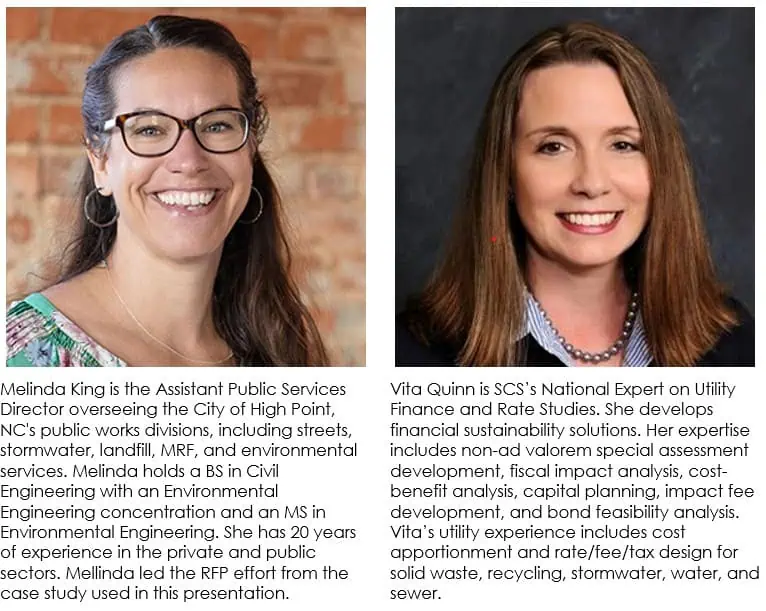
The webinar features Melinda King, Assistant Public Works Director of High Point, NC, who has extensive experience managing public works divisions, including landfill and environmental services. Melinda led the RFP effort in the case study. Vita Quinn, a national expert on utility finance and rate studies at SCS, also presents, sharing expertise on financial sustainability solutions and utility rate design across various services, including solid waste and recycling.
Procurement teams often create RFPs under time pressure, without close collaboration with the utility or the department that needs the project. This can lead consultants to respond to poorly defined scopes, resulting in expensive and broad plans that are difficult to implement. A phased approach begins with procurement and realistic expectations, enabling more precise consultant bids, sharper solutions, and easier plan execution.
While the case study centers on solid waste management, the phased procurement process applies to any business, municipality, utility, or public works department seeking improved planning and procurement outcomes.
Attendees will learn how to:
Participants will gain a repeatable procurement framework that integrates financial analysis, operational feasibility, and long-term strategy into a phased project roadmap. They will also better understand how to structure scopes that protect budgets while attracting innovative consultant solutions.
The webinar encourages questions during and after the session and offers certificates of attendance on request for the live session. For those unable to attend live, a recording is available upon RSVP.
Phased by Design, our first 2026 live webinar, unpacks a real case study from the City of High Point, North Carolina, showing how a phased, financially grounded procurement process can produce more targeted, practical, and cost-effective outcomes for solid waste management planning.
Rather than relying on broad RFPs that result in generic, full-scope proposals, the City intentionally sequenced its planning process to diagnose financial and operational challenges up front. That first phase informed every decision that followed, allowing for a more focused scope and budget.
Hear directly from Melinda King, Assistant Public Works Director, High Point, NC, and Vita Quinn, SCS’s National Expert on Utility Finance and Rate Studies, as they translate lessons from solid waste into a broader City procurement strategy.
Why This Matters
Procurement teams often write an RFP because it’s on the annual calendar, and there may be pressure to move quickly. But they don’t always work alongside the utility or department that needs the project. Consultants then respond to what’s written in the RFP. If the scope wasn’t written to address the issues, the proposal won’t address them either, resulting in plans that are broader than required, more expensive than necessary, and harder to implement. A targeted phased approach starts with procurement and sets realistic expectations for project elements and the timeline to project success. Consultants bid more specifically, solutions get sharper, and the final plan is easier to execute.
Who Should Attend or Watch?
The case study is based on a solid waste management plan, but the process can apply to any business, municipality, utility, or public works department.
What You Will Learn
How to consider underlying financial and operational drivers before releasing your initial RFP, so your procurement is informed, not speculative. How to scope feasibility and risk early through a feasibility analysis phase, reducing cost exposure and improving bidder differentiation.
How a phased implementation design logically sequences deliverables so each step earns its scope from the one before it.
How tailored procurement can help reduce planning costs and provide a clearer path to implementation.
You’ll Walk Away With
A repeatable procurement framework that integrates financial analysis, operational feasibility, and long-term strategy into a phased project roadmap.
A clearer understanding of how to structure scopes that protect your budget while still attracting innovative and differentiated consultant solutions.
As with all SCS Client Webinars, we’re here to answer your questions throughout the forum and afterward. As always, SCS Engineers does not share or sell your contact information. For those joining the live webinar, we will provide a Certificate of Attendance upon request.

Navigating environmental permitting for new construction or expansion projects can be daunting. The process is filled with regulatory hurdles, stakeholder concerns, and the ever-present risk of costly delays. Drawing from the expertise of Sara Rains a senior project manager at SCS Engineers, here’s a practical guide to help you avoid common pitfalls and achieve smooth compliance.
Start with Strategic Planning
The foundation of successful permitting is built early in the process, through thorough planning. Before breaking ground, conduct comprehensive environmental assessments—think Phase I & II Environmental Site Assessments, hazardous material surveys, and Operations & Maintenance plans. These steps help identify potential issues before they become roadblocks.
Pro Tip:
Use a management of change process to document every modification—whether it is new construction, a physical upgrade, or a chemical change. This ensures you are not blindsided by regulatory requirements later.
Know Your Permit Types
For example, in Missouri, projects typically require several permits. These permit requirements commonly apply to other states as well.
Identifying the right permits early is critical; missing one can halt your project in its tracks.
Engage Early and Communicate Often
One of the most overlooked strategies is early engagement with regulatory agencies and stakeholders. Reach out to agencies such as the Missouri Department of Natural Resources (Missouri DNR), the Environmental Protection Agency (EPA), the Occupational Safety and Health Administration (OSHA), and local city or county authorities as soon as possible. Open, transparent communication builds trust and helps resolve issues before they escalate.
Stakeholder Map:
Manage Timelines and Expectations
Permitting timelines can vary widely depending on project complexity and agency workload. Set realistic schedules and clearly communicate expectations to all parties. This prevents unpleasant surprises and keeps your project moving forward.
Avoid Common Pitfalls
Many projects stumble over the same hurdles:
Compliance Is a Continuous Journey
After you secure your permits, the real work begins. Continuous compliance monitoring, accurate reporting, and diligent recordkeeping are non-negotiable. Neglecting these can lead to fines, delays, or even shutdowns.
Best Practices for Success
Final Thoughts
Environmental permitting doesn’t have to be a headache. With careful planning, early engagement, and a commitment to compliance, you can avoid common pitfalls and keep your project on track. For more guidance, reach out to experts like Sara Rains on LinkedIn.
Have questions or want to share your own permitting experiences? Drop them in the comments or contact us at SCS Engineers.

As an employee-owned environmental consulting and construction firm, SCS Engineers supports the communities we live and work in year-round. But we all want to be doing something extra during the holidays.
In 2024, SCS donated to 43 local registered IRS 501(c)(3) charities during the holidays, positively impacting over 90,000 people! Our Corporate program has proven to be successful, so we plan to grow it this year.
In addition to supporting this year’s annual SCS Young Professional Group’s holiday fundraising, we plan to send significant donations to the four charities below that align with the environmental nature of our business and do so much for others. We will continue funding the Robert Stearns SWANA and the Environmental Research & Education Fund Scholarships.
These charities rely on consistent donations from patrons like SCS and you. We thank them all for their continuing humanitarian work. As always, we will continue to donate year round to the Red Cross and World Central Kitchen in support of people impacted by natural disasters worldwide.
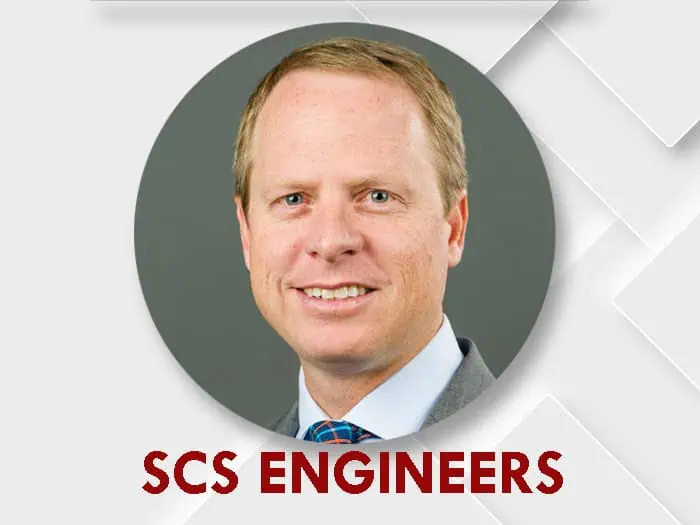
During the October 2025 Committee Week in Atlanta, Georgia, ASTM International named Justin Rauzon to be the Recording Secretary Officer based on his technical and management experience with investigations at industrial, commercial, landfill, greenfield, and residential properties, combined with his extensive experience with environmental laws and regulations in the U.S. and Mexico. At SCS Engineers, he guides clients through complex real estate and redevelopment projects, emphasizing sustainable and defensible outcomes.
What is the ASTM Committee E50?
The ASTM Committee E50 is the main technical committee that develops voluntary consensus standards for environmental assessment, risk management, and corrective action. The E1527 Standard for Phase I Environmental Site Assessments (Phase I ESAs) is a critical standard in use nationwide for conducting environmental due diligence in commercial real estate transactions. It supports compliance with the U.S. Environmental Protection Agency’s All Appropriate Inquiries rule under the Comprehensive Environmental Response, Compensation, and Liability Act and related laws.
The E1527 Standard is updated typically every five to seven years, and the next round of updates kicks off in January 2026. Given the significant impact that standards like E1527 have on real estate transactions and risk management, a meticulous and reliable recordkeeper is vital for the integrity of the committee’s work. As Recording Secretary, Mr. Rauzon will support the documentation and coordination of subcommittee activities, including standards updates, meeting summaries, and procedural communications among ASTM committee members.
Due Diligence and Environmental Experience and Expertise
Justin Rauzon is SCS Engineers’ national expert on environmental due diligence and is experienced in all aspects of environmental services. He has a diverse background in biological and environmental sciences, and regularly performs environmental assessments and compliance audits at sites in the U.S. and Latin America. He completed ASTM Officer Training in West Conshohocken, Pennsylvania, in September 2024. His appointment reflects his deep expertise in environmental assessment practices and his longstanding commitment to maintaining high environmental quality and risk management standards.
“I’m honored to be part of the next standard update. Contributing to the next round of discussions and revisions to such an important standard is humbling and rewarding. I was pleased that my colleague, Megan Husic, will join me at ASTM Committee Week as an ASTM Emerging Professional. I look forward to working jointly with her and the other officers on the 1527 Committee,” said Mr. Rauzon.
If you’d like to contact Mr. Rauzon, please visit SCS Engineers or say hello on LinkedIn.
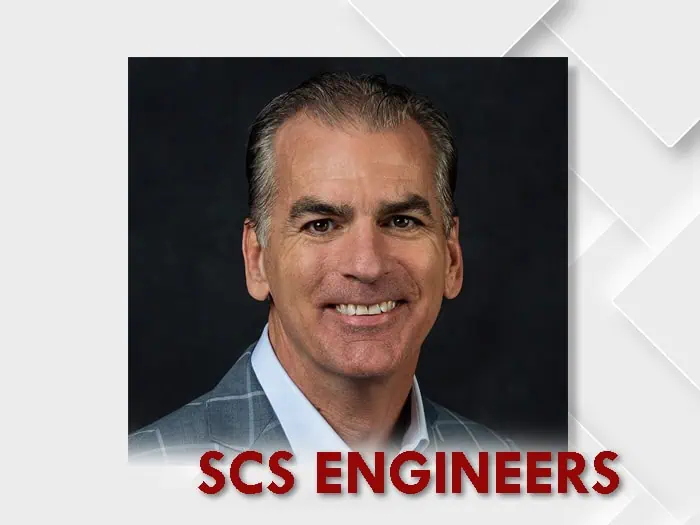
SCS Engineers announces the promotion of Eric Williams as the firm’s new National Director of Brownfields Redevelopment. Eric has over three decades of experience providing a full range of environmental services, focusing on brownfield redevelopment. His career includes experience with large environmental consulting firms, helping a specialty lender build a national footprint for brownfield funding, and running his own companies that exclusively developed environmentally challenged properties. His expertise spans various industries, including local government, commercial businesses, heavy industry, landfills, and mined land restoration.
As a thought-leader, Eric puts his expertise to work – investigation and cleanup, environmental liability management, real estate transactional functions, project entitlements, and funding. His multifaceted skill set helps our clients, from identifying environmental liabilities before buying or selling to addressing contaminants cost-consciously, and restoring the land’s health and value, states Senior Vice President and National Environmental Market Leader Michael Miller.
Eric has developed deep expertise in brownfield project funding. Currently, EPA and state brownfield grants support many projects in the U.S. The 2025 EPA brownfield grants were awarded to recipients earlier this year, and EPA will open applications for the next round of brownfield grants sometime in the next couple of weeks, but it will be even more competitive than ever as the Bipartisan Infrastructure Law dollars will no longer fund these programs.
As Eric Williams put it in his 2025 National Brownfields Training Conference Workshop called “Stack & Sequence”:
Brownfield projects require multiple capital sources to succeed; the more difficult the project, the more capital sources. We must build funding strategies that include various brownfield capital sources, ranging from brownfield-specific funding to traditional redevelopment financing and more creative sources. A deeper dive shows how sources can be integrated and stacked, then used sequentially for the various stages of redevelopment to be combined with private investment.
To learn more about Brownfields, please visit the SCS Engineers’ website to find educational materials or contact the firm’s experts. You may also reach Eric Williams on LinkedIn.
Corporate Headquarters