The U.S. Environmental Protection Agency (EPA) has identified 1, 2, 3 – Trichloropropane (TCP), which does not occur naturally in the environment, as an emerging chemical of concern that can threaten drinking water supplies. It states that TCP is a persistent pollutant in groundwater and has classified it as “likely to be carcinogenic to humans.” California State Water Board member Steven Moore called TCP an “insidious chemical” because it persists in the environment, sinks in water and is harmful in even tiny doses. Currently, there is no federal maximum contamination level (MCL) for TCP; however, there is a federal non-enforceable health-based screening level of 0.00075 ug/L.
Since 2012, TCP has been on the emerging Contaminant Candidate List (CCL), which is a watch list of unregulated contaminants that are known to, or anticipated to, occur in public water systems and may require regulation under the Safe Drinking Water Act (SDWA). The EPA has required, under the Unregulated Contaminant Monitoring Rule (UCMR), that large water systems test for TCP every five years with a minimum reporting level of 0.03 μg/L. This rule allows for the EPA to monitor contaminants suspected to be in drinking water that are unregulated under the SDWA. As a result of the testing, TCP has been identified across the US in drinking water sources. Currently, there is no federal maximum contamination level (MCL) for TCP; there is a federal non-enforceable health-based screening level of 0.00075 ug/L.
The author continues the paper with an examination of what TCP is and how it impacts our environment and our health. She then discusses regulatory policies and how California’s mandatory TCP standard could be a blueprint for other state water agencies currently investigating how to enhance their own drinking water protections from emerging contaminants.
Lyn covers some of the legal aspects, risks to businesses, detection, and treatment options to conclude her white paper. She also provides plenty of resources to start the journey toward sustainable treatment solutions that communities can afford.
 About the Author: Lynleigh Love is a Senior Project Geologist with SCS Engineers. She has been a professional geologist for more than 22 years with extensive technical expertise in environmental assessment, remediation, and regulatory compliance. Her experience includes groundwater/soil vapor monitoring, excavation work plans, and remedial action plans.
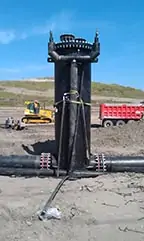 Lessons learned from previously constructed gas collection and control systems teach solid waste professionals valuable lessons about designing for long-term survivability and reducing the maintenance cost of gas system components. The location impacts operating and maintenance costs for various components of gas collection and control systems such as condensate force main, condensate sumps, force main for well liquids, air lines to pumps in gas wells, and gas headers long into the future. As often as possible, design the gas header in the landfill perimeter berm along with the condensate sumps. Landfill perimeter berms constructed in an engineered manner with well- compacted soils and a well-defined geometry provide a long-term cost-effective alternative to earlier designs outside the berm.
For many years, gas headers were designed and constructed outside of the landfill perimeter berm, on the landfill surface. Of course, landfill surface changes as waste elevation increases over time, resulting in many gas headers that now may be 30 feet or more below the current waste surface. Deeply buried gas headers are unreliable at best, and the operator loses access to them as soon as 20 feet of waste covers the header.
Collapsed gas headers buried deep in waste are an expensive challenge when operating a large number of gas wells connected to the gas header, and could cause serious compliance issues. Upon discovery of a collapsed buried gas header, installing a new header is a lengthy process with significant costs, not to mention the hurdles the operator will have to jump addressing noncompliance with their state agency.
The benefits of placing gas headers in the landfill perimeter are:
Since the condensate force main follows the gas header in the perimeter berm to flow to a tank or discharge point, there are additional maintenance benefits.
By continuing to design gas header construction on landfill slopes, all of the components end up on the landfill slope as well. You can imagine what type of complications the landfill operator will face since all of these components are in areas vulnerable to erosion, settlement, future filling or future construction. Additionally, any maintenance requiring digging and re-piping necessitates placing equipment on the landfill slope and disturbing the landfill slope surface for an extended period.
For more information about these benefits and more, please refer to the MSW Magazine article series Considerations for the Piping Network, the author, or contact SCS Engineers at .
 About the Author: Ali Khatami, Ph.D., PE, LEP, CGC, is a Project Director and a Vice President of SCS Engineers. He is also our National Expert for Landfill Design and Construction Quality Assurance. He has nearly 40 years of research and professional experience in mechanical, structural, and civil engineering.
Learn more at Landfill Engineering
PFAS are also key components in aqueous film-forming foam (AFFF), which is used to fight petroleum-based fires at aviation and manufacturing facilities. For decades, AFFF containing PFAS has been used extensively at airports throughout the world to protect the safety of passengers, crew, and others. The FAA requires that commercial airports train with, calibrate equipment with, and use the best performing AFFF fire suppression systems. AFFF is required to be used at airports and must be certified to meet strict performance specifications, including those mandated by the U.S. Department of Defense Military Specifications.
Lynleigh Love and Chris Crosby of SCS Engineers discuss the risks and issues with PFAS-based firefighting foam used at airports. The authors cover the regulatory climate, contamination investigations, operational and environmental management and litigation, along with alternatives to using traditional AFFF. There are some possible alternatives that can mitigate health risks in your community.
Read this article to help inform your mitigation plan and strategies to minimize risk.
Article published in the January 2020 edition of Waste Advantage Magazine.
At the Federal level, GHG emission reporting has become part of the standard regulatory requirements; however, on the west coast, GHG programs continue to develop and evolve from reporting to reduction programs beyond federal requirements. Solid waste facilities can be impacted by all of these reporting mechanisms directly as a landfill located in the state in question, opting in for C&T as part of the LCFS in California, or in limbo, as the courts work out the legality of Washington’s Clean Air Act. More stringent federal GHG requirements are unlikely with the current administration, however, that could change with the 2020 election. In general, GHG rules and legislation keep developing and updating to account for and reduce GHG emissions.
Read, share, or download the full article here.
 Cassandra Drotman Farrant is Project Manager with SCS Engineers. She has nine years of experience in environmental consulting, specializing in environmental assessment and greenhouse gas (GHG) verification. Cassandra has participated in many GHG verification projects throughout the U.S. and has completed approximately 70 Phase I Environmental Assessments (ESAs) in California, Oregon, and Washington. Phase I projects included research and review of geologic and hydrogeologic conditions at project sites and in the surrounding areas and evaluating the potential for soil and groundwater contamination from on and offsite sources. Cassandra has completed emissions estimates and inventories and has prepared numerous permit-to-construct/operate permit applications. She prepares compliance reports, which includes reviewing and maintaining records and regulatory deadlines.
SCS Engineers provides engineering, consulting, operations and monitoring services to report and reduce greenhouse gas emissions. Select a service category to learn more.
Reprint of USEPA Press Release dated today.
WASHINGTON (Dec. 19, 2019) — Today, the U.S. Environmental Protection Agency (EPA) took another key step in implementing the agency’s PFAS Action Plan by announcing a new validated method for testing per- and polyfluoroalkyl substances (PFAS) in drinking water. This new validated test method complements other actions the agency is taking under the Action Plan to help communities address PFAS nationwide.
“EPA’s important scientific advancement makes it possible for both government and private laboratories to effectively measure more PFAS chemicals in drinking water than ever before,” said EPA Administrator Andrew Wheeler. “We can now measure 29 chemicals, marking a critical step in implementing the agency’s PFAS Action Plan—the most comprehensive cross-agency plan ever to address an emerging chemical of concern.”
EPA’s new validated Method 533 focuses on “short chain” PFAS, those PFAS with carbon chain lengths of four to 12. Method 533 complements EPA Method 537.1 and can be used to test for 11 additional PFAS.
Method 533 accomplishes a key milestone in the EPA PFAS Action Plan by meeting the agency’s commitment to develop new validated methods to accurately test for additional PFAS in drinking water. Method 533 also incorporates an analytical technique called isotope dilution, which can minimize sample matrix interference and improve data quality.
Voting for the Old Dominion Chapter’s 2020-2021 Board of Directors ended December 13, 2019. After tallying the votes, the following professionals were elected as new Directors, including:
Congratulations!
Ryan Duckett is a Project Professional working out of SCS’s Midlothian, Virginia office. He is responsible for Sustainable Materials Management, or SMM, solid waste facilities and municipal planning solutions. Ryan also supports environmental engineering projects related to permitting, compliance, regulatory reporting, landfill gas modeling, construction quality assurance (CQA), and pollutant emission inventories at solid waste management facilities. Ryan is an active member of the SCS Engineers Young Professional Program that connects our young professionals with others providing community support, altruistic efforts, mentoring, networking, and social activities.
Virginia’s Solid Waste Association of North America (SWANA) organization works to advance environmentally and economically sound municipal solid waste management in Virginia. The “Old Dominion” Chapter as it is known consists of over 300 professionals actively working in the solid waste field throughout the Commonwealth. The membership represents the largest cross-section of solid waste managers, operators, and consultants in Virginia.
The Chapter seeks to foster networking and cooperation among solid waste professionals, including regulators and provides educational opportunities to enhance members’ expertise in the solid waste management field. Members carry out a variety of activities and programs to establish innovative research programs in the publics’ interest, scholarships and technical assistance. Learn more about membership on their website – http://www.swanava.org/.
On behalf of Fiberight, Coastal Resources of Maine, and its project partners at Municipal Review Committee (MRC), SCS Engineers is excited to announce that as of Nov. 1, 2019, commercial operations have begun at the Hampden, Maine advanced solid waste recycling and processing facility.
To achieve commercial operations, the facility began accepting waste in April 2019 and has undergone an extensive ramp-up and commissioning process to integrate the various components of the first of its kind waste recycling and processing facility contracted to accept and process municipal solid waste and recycling from the MRC’s 115 member communities. The facility will begin to offer disposal options to non-MRC communities and independent commercial waste haulers in the region as well.
The new advanced solid waste recycling and processing plant boasts a seven-step next-generation recycling technology that recovers valuable materials from everyday household waste and processes them into value-added products. The facility is the first to integrate separate technologies into one integrated system to process household waste, optimize material recovery, and provide recycling and processing solutions under one roof.
Fiberight spokesperson Shelby Wright stated, “Coastal Resources of Maine is highly efficient and is well-suited to meet the long-term waste processing and recycling needs of our communities in addition to offering valuable feedstock for the fuel and fiber markets in the region.”
With the busy holiday season upon us, Americans are purchasing millions of presents on-line and at stores, and USEPA’s recent announcement that it will be issuing national recycling goals next year, the timing couldn’t be better.
REPRINT OF USEPA PRESS RELEASE
EPA Moves Forward on Key Drinking Water Priority Under PFAS Action Plan
WASHINGTON (Dec. 4, 2019) — Yesterday, the U.S. Environmental Protection Agency (EPA) sent the proposed regulatory determination for perfluorooctanesulfonic acid (PFOS) and perfluorooctanoic acid (PFOA) in drinking water to the Office of Management and Budget for interagency review. This step is an important part of EPA’s extensive efforts under the PFAS Action Plan to help communities address per- and polyfluoroalkyl substances (PFAS) nationwide.
“Under President Trump, EPA is continuing to aggressively implement our PFAS Action Plan – the most comprehensive cross-agency plan ever to address an emerging chemical,” said EPA Administrator Andrew Wheeler. “With today’s action, EPA is following through on its commitment in the Action Plan to evaluate PFOA and PFOS under the Safe Drinking Water Act.”
The action will provide proposed determinations for at least five contaminants listed on the fourth Contaminant Candidate List (CCL4), including PFOA and PFOS, in compliance with Safe Drinking Water Act requirements.
Background
The Safe Drinking Water Act establishes robust scientific and public participation processes that guide EPA’s development of regulations for unregulated contaminants that may present a risk to public health. Every five years, EPA must publish a list of contaminants, known as the Contaminant Candidate List or CCL, that are known or anticipated to occur in public water systems and are not currently subject to EPA drinking water regulations. EPA publishes draft CCLs for public comment and considers those prior to issuing final lists.
After issuing the final CCL, EPA determines whether or not to regulate five or more contaminants on the CCL through a process known as a Regulatory Determination. EPA publishes preliminary regulatory determinations for public comment and considers those comments prior to making final regulatory determinations. If EPA makes a positive regulatory determination for any contaminant, it will begin the process to establish a national primary drinking water regulation for that contaminant.
For more information: www.epa.gov/ccl
Background on the PFAS Action Plan
PFAS are a large group of man-made chemicals used in consumer products and industrial processes. In use since the 1940s, PFAS are resistant to heat, oils, stains, grease, and water—properties which contribute to their persistence in the environment.
The agency’s PFAS Action Plan is the first multi-media, multi-program, national research, management and risk communication plan to address a challenge like PFAS. The plan responds to the extensive public input the agency received during the PFAS National Leadership Summit, multiple community engagements, and through the public docket. The PFAS Action Plan outlines the tools EPA is developing to assist states, tribes, and communities in addressing PFAS.
EPA is taking the following highlighted actions:
Highlighted Action: Drinking Water
Highlighted Action: Cleanup
Highlighted Action: Monitoring
Highlighted Action: Toxics
Highlighted Action: Surface Water Protection
Highlighted Action: Biosolids
Highlighted Action: Research
The agency is also validating analytical methods for surface water, ground water, wastewater, soils, sediments and biosolids; developing new methods to test for PFAS in air and emissions; and improving laboratory methods to discover unknown PFAS.
Highlighted Action: Enforcement
Highlighted Action: Risk Communications
For more information, article, and treatment options visit SCS Engineers.
SCS Tracer Environmental has a diverse staff of instructors who provide practical, cost-effective ammonia refrigeration training and certification review courses. Training can be provided on-site, at our new training classroom in Oakdale, Minnesota, or at one of our nationwide sessions. Our training programs incorporate RETA, IIAR, manufacturers, field materials, facility-specific standard operating procedures, and/or piping and instrumentation diagrams.
Ammonia Refrigeration Operator Training Programs use the applicable RETA Industrial Refrigeration (IR) 1 & 2 manuals, which participants keep at the conclusion of the classes. These intensive four-day classes are provided in locations across the nation (convenient for attendees to participate locally) or in our new Minnesota classroom.
Operator I: This course is based on the materials in RETA IR-1 Course and is designed as an entry-level training program for a refrigeration operator, manager, and/or safety personnel with limited refrigeration training, or experienced operators who have never received the basic fundamentals of refrigeration principles. Operator I training is also offered in Spanish.
Operator II: This course is based on the material in RETA IR-2 Course and is designed for a refrigeration operator, manager, and/or safety personnel who have successfully completed the Operator I class and have a desire to further their knowledge in industrial refrigeration systems and principles using ammonia as a refrigerant.
PSM/RMP Introduction Training Class uses ammonia refrigeration-focused material specific to your PSM/RMP program and facility, RETA, IIAR, manufacturers, and field materials, as well as facility-specific standard operating procedures. We highlight the responsibilities of the various PSM/RMP Team Members that may include, but not be limited to, maintenance, safety, management, environmental, and/or facilities personnel:
PSM/RMP Advanced Training Class is geared for experienced PSM Program Managers, Plant Managers, ammonia refrigeration facility compliance personnel, and safety-EHS staff who want a detailed review of the more complex regulatory requirements included in the PSM and RMP regulations. The class focuses on the complex details of the following elements: Process Safety Information (RAGAGEP), Standard Operating Procedures, Management of Change (Project planning through Pre Startup Safety Review (PSSR)), and Mechanical Integrity.
RETA CARO/CIRO Review Classes are intensive training designed for operators who are pursuing their RETA CARO or CIRO certification. Each course includes a review of the pertinent materials. During Day 2, participants receive a voucher to take the RETA Practice Test, a $60 value. Our instructors use the practice test results to customize the curriculum on Day 3 to focus on the more difficult concepts.
Wednesday, December 11, 10:45 am – 11:45 am, Room 403A
Track 2: Financing Options, Real Estate, & Economic Development
 This interactive panel will discuss the nexus between brownfields development and affordable housing and will explore various policy, funding and incentive programs that have been successfully deployed in the US, including a forgivable loan and grant program in California, with an emphasis on creating affordable housing. A case study focused on Comm 22, an award-winning affordable housing project complements the policy and funding conversation. Dan Johnson, Evans Paull, and Jeff Williams share the complexities of tax credit based affordable housing finance of a 200 unit affordable housing and brownfield redevelopment project and the role that brownfields funding played. The premise is that if early-stage project funding were more widely available, combined with informed policy and regulatory approach, that the housing stock in California and elsewhere could be expanded, possibly significantly.
4:30 pm – 6:00 pm, Exhibit Hall, West Hall A
 Jim Ritchie and Amy Dzialowski present on the City of West Sacramento and the SCS Brownfields Toolbox that helps take advantage of economy of scale to improve both cost and schedule outcomes, and can result in better buy-in from regulatory agencies, due to an emphasis on an overall vision rather than just a transactional approach. Flexibility is another key concept for reuse planning and as a tool for brownfields sites. SCS demonstrates their expansive experience with an array of brownfields tools including, grant funding and leverage, environmental insurance, and other risk-shifting tools such as “CLRRA” agreements.
 At the SCS booth 417, meet Mike McLaughlin, SCS Engineers’ Senior Vice President of Environmental Services and a National Specialist on Brownfields & Landfill Redevelopment and Electric Utilities. He is a licensed engineer and attorney with over 30 years of professional experience providing advice on environmental matters. He is an expert on environmental compliance, remediation, and allocation of response costs.
Mr. McLaughlin advises developers, contractors, lenders and land development professionals on the technical and regulatory requirements for construction on Brownfields’ sites nationwide. His combined engineering and legal background provides an unusual perspective on land development where hazardous wastes or other environmental challenges are present. Redevelopment of closed landfills is an area of special interest; he worked on his first such project in 1976.
Mr. McLaughlin has worked at some three dozen Superfund National Priorities List sites in 17 states, and on scores of regulatory compliance, voluntary cleanup, and remediation projects for commercial, industrial, municipal, and military clients.
Thursday, December 12, 3:30 pm – 4:45 pm, Room 411
Track 1: Sustainability, Livability, Resiliency

This 75-minute clinic provides a fun and engaging hands-on experience that will inspire you to tackle the challenges of stormwater flooding using GSI on brownfields. Experts, including Jonathan Meronek, will explain the applications, techniques, and benefits of using GSI on any project site, including the challenges of implementing GSI on Brownfield Sites. During the guided exercise, participants will break into small think tanks, and each think tank will have an opportunity to design their own solution. Come to this session to soak up information on techniques and strategies for integrating GSI into your community’s overall planning efforts.
Corporate Headquarters