It’s not just that we like wine and happen to live and work in every wine producing region of the U.S.; SCS Engineers understands the need for clean water resources and how important they are to the wine industry and for agriculture in general. SCS helps wineries face an array of environmental and regulatory challenges including:
SCS is pleased to announce we are the newest member of WIN, the Wine Industry Network.

SCS Engineers offers sustainable environmental solutions to businesses with environmental challenges. SCS provides these services to private and public sector clients through a network of nationwide offices. For more information about SCS, please visit our website at www.scsengineers.com, or contact us at .
SCS Engineers has published two Technical Bulletins summarizing the O&G NSPS final rule and outlining the new LDAR requirements. The two Bulletins explain the modification of how oil and gas sources will be permitted under the Clean Air Act and the new requirements to reduce methane leaks from new oil and gas facilities consistent with the EPA’s New Source Performance Standards.
Reference the U.S. Environmental Protection Agency (EPA) new source performance standards for Crude Oil and Natural Gas Production, Transmission and Distribution (O&G NSPS), which includes amendments to 40 CFR Part 60, Subpart OOOO and a new Subpart OOOOa. Subpart OOOOa will apply to facilities constructed, modified or reconstructed after September 18, 2015.
Click to read or share the Technical Bulletins:
https://www.epa.gov/controlling-air-pollution-oil-and-natural-gas-industry
Pat Sullivan, REPA, CPP, BCES
(916) 361-1297
Jeff Marshall, PE, SCS Engineers will be presenting the topic of Hydrogen Sulfide Issues at CCR and MSW Co-Disposal Sites during the EREF and NWRA sponsored Coal Ash Management Forum in July.
The co-disposal of municipal solid waste and coal combustion residuals – particularly flue gas desulfurization (FGD) material – poses a significant concern regarding the generation of hydrogen sulfide gas. Hydrogen sulfide has an exceptionally low odor threshold, and can pose serious health concerns at higher concentrations. This presentation will identify the biological, chemical and physical conditions necessary for FGD decomposition and hydrogen sulfide generation. Recommendations for reducing the potential for FGD decomposition at co-disposal facilities will be presented. Technologies for the removal and treatment of hydrogen sulfide from landfill gas will also be addressed.
Jeff Marshall, PE, is a Vice President of SCS Engineers and the Practice Leader for Environmental Services in the Mid-Atlantic region. He also serves as the SCS National Expert for Innovative Technologies. He has a diversified background in environmental engineering and management, with emphasis on the chemical and human health aspects of hazardous materials and wastes. Mr. Marshall’s experience with hydrogen sulfide, odors, sulfate decomposition in landfills, and ash issues includes scores of projects dating back to the 1980s.
SCS Coal Combustion Residual Services
Question: I have a small oxidation event at my landfill and am continually testing for carbon monoxide (CO) in the surrounding landfill gas (LFG) extraction wells. Using colorimetric tubes, I am monitoring the readings which range from 5-10 parts per million (ppm). Is there an accepted standard for background carbon monoxide in LFG? Moreover, how much inaccuracy is expected using the colorimetric tube testing?
Answer: Carbon monoxide (CO) can be found in small quantities even when there is no landfill fire. If your concern is landfill fire, most reputable resources state that a landfill fire generates readings of at least 100 ppm CO and more typically in the 500-1000 ppm range with 1000 ppm a reliable indicator that a landfill fire event may be present.
CO readings on colorimetric tubes are inherently less accurate and tend to run higher than laboratory results. Colorimetric tubes do provide value as a real-time indicator versus subsequent lab results, and can be used as an index reading, calibrated by lab results later. If you’ve had a landfill fire event before, with CO levels greater than 100 ppm, the lab confirmed 5-10 ppm CO could be residual left over from the earlier event.
Although some people believe that the presence of CO at almost any level is an indicator of landfill fire, recent laboratory tests show that CO can be generated at values up to and over 1000 ppm by elevating refuse temperatures without the presence of combustion (fire). Other tests have shown that high values of CO are found in some landfills with no current landfill fire and no indication of a past landfill fire. This information supports that it is possible that Elevated Temperature (ET) Landfills can have CO levels over 1000 ppm CO without the presence of combustion or landfill fire.
In the end, CO can be an indicator of landfill fire, but not always, as described here. Low methane, high carbon dioxide, and even landfill temperatures above 131 degrees F may or may not be indicators of past or current landfill fire. Physical indicators of a landfill fire may include rapid settlement in a localized area, cracks and fissures, smoke and flame, melted landfill gas system components, and char on the inside of LFG headers and blower/flare station components such as a flame arrester. However, most of these indicators can occur at ET landfills as well without the presence of fire or combustion.
A professional landfill gas engineer is needed to assess these conditions as a whole, and make a judgment on the underlying driver, condition, and resolution.
Have a question for our SCS Professional Engineers or Field Staff? Just ask here.
Landfill and Landfill Gas Services at SCS Engineers.
This innovative sustainable materials management approach involves strategically picking up loads from businesses that generate similar types of discards. The linked article discusses the approach of following simple procedures governing selective routing in the commercial space.
Using a phased methodology, it is possible to turn a high-disposal garbage collection system into a high-diversion recycling system, without incurring additional costs or losing collection revenue. Dumpsters behind shopping plazas and other sites can become opportunities at the center of a thriving materials recovery program.
About the Authors:
Richard Gertman is the owner of For Sustainability Too in San Jose, CA.
Tracie Onstad Bills has been in the Environmental and Resource Material Management Field for over 20 years. Her expertise revolves around commercial recycling technical assistance, environmental purchasing, large venue and event zero waste programs, research and sustainability planning, garbage hauler franchise compliance and review, construction and demolition program / ordinance analysis and writing, climate inventory compilation, research and feasibility studies to help clients with comprehensive waste prevention and zero waste programs. Ms. Bills has a BA in Environmental Science from San Jose State University, is a CRRA Board member and belongs to the SWANA Gold Rush Chapter, National Recycling Coalition and the Northern California Recycling Association. Contact Tracie here.
East Alton Defense Area Rehabilitation Project Receives Illinois Governor’s Affordable Housing Champion Award. SCS Engineers provides environmental services that help move redevelopment project forward. – Congratulations RISE!

Mark Stroker, Director of Real Estate Development, RISE St. Louis, informed the SCS Engineers team about the honor, saying he felt “a great deal of pride and appreciation that Emerald Ridge was selected by IHDA [Illinois Housing Development Authority] as the Champion’s Award winner for excellence in affordable housing development for 2016.”
Mr. Stroker went on to tell the SCS team that, “It is an extraordinary honor and represents a long and collaborative effort… This was a tough project and wouldn’t have been possible without all of your help.” He attended the Illinois Governor’s Conference in late March 2016, where he accepted the award and discussed the project with conference attendees.
In his notification to Mr. Stroker about the award, Benjamin Fenton, IHDA’s Housing Coordination Services Manager, explained that three nominees are chosen for this award every year for distinguished developments, initiatives, or programs in affordable housing. The nominees stand out for their commitment to serving the Annual Comprehensive Housing Plan focus areas and one or more of the State’s Priority Populations, and for having positive impacts on the community in which they are located.
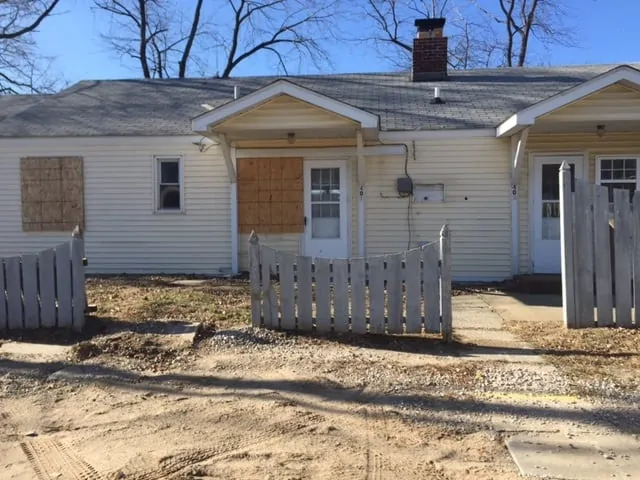
Before it was redeveloped, The Emerald Ridge Development was known as the “Defense Area,” and it consisted of 18 one- and two-story multi-family buildings containing approximately 80 apartments. The Defense Area was built by the Federal government as temporary housing in the early 1940’s to accommodate workers at the nearby Olin ammunition plant during the war effort. After the war, these barracks-style buildings were not dismantled as originally planned but were sold off to private owners. Over the years, they were re-sold multiple times, and the condition of most of the buildings became more and more deteriorated, in addition to being constructed with asbestos-containing materials and lead-based paints.
Residents were temporarily relocated, and the old buildings were demolished and replaced with 46 newly constructed, high-efficiency single-family homes. The residents who lived in the area when the redevelopment project commenced were given the opportunity to rent homes in the new development, and some accepted. The rechristened Emerald Ridge Development is located in the Village of East Alton, Illinois, and the new single-family homes are affordable to families earning 60% of the Area Median Income, which includes nearly two-thirds of the residents of East Alton.
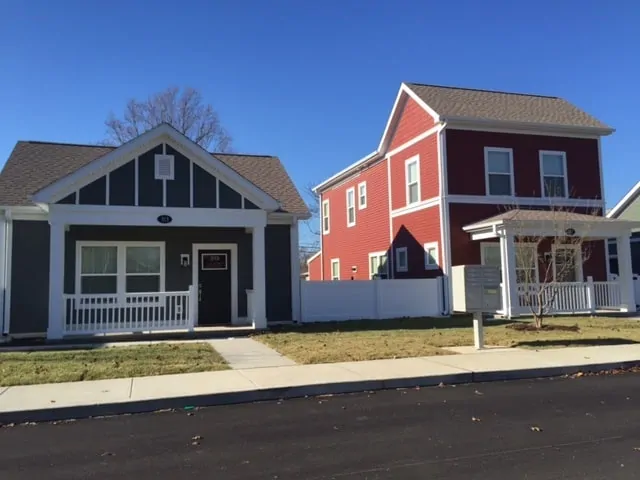
Services that SCS Engineers provided at the site included lead and asbestos abatement sampling and specifications, asbestos abatement management, subsurface investigation for a Phase II ESA, NESHAP demolition inspections, and two Phase I ESAs to assess the property for potential environmental impairments, to satisfy IHDA requirements, and to satisfy the CERCLA requirements to qualify for landowner liability protection.
Stephanie Hill, SCS Project Director, said: “I am honored to be part of the RISE team that brought so much value to the community.” Ms. Hill offered special thanks to Randy Homburg, SCS Geologist and Project Manager, for his work on this redevelopment project, and to the other SCS team members who performed the environmental site assessments.
The drainage layers of landfill final covers normally go through a rigorous flow capacity evaluation. This evaluation is necessary to ensure that the volume of water reaching the drainage layer due to percolation of precipitation water through the final cover upper soil layer will not overwhelm the drainage layer in its flow path. If the flow volume in the geocomposite drainage layer is greater than the capacity of the drainage layer, water will exit the geocomposite and enter the overlying soil. The water entering the soil layer can easily saturate the lower portion of the soil layer, which will affect the stability of the slope. The geocomposite should always be designed to have a flow capacity greater than the flow rate of water running through it.
Concave areas of a landfill slope experience flow patterns quite different from slopes that go straight down. Slopes with concaved geometry have an unequal crest and toe lines – the toe line being smaller than the crest line. As a result, the width of the concaved slope decreases as the distance from the crest line increases in the downward direction. The narrowest width of the concaved slope is at the toe of the slope. The drainage layer on the slope experiences the same width change from the crest line to the toe line. This means that the overall width of the channels that carry water within the geocomposite drainage layer decreases toward the toe line, and, therefore, the depth of water in the channels increases. This phenomenon is referred to as flow convergence, and the convergence is toward the vertical centerline of the concaved slope. The flow convergence may be significant enough to increase the water depth in the geocomposite in the vicinity of the vertical centerline of the slope to greater than the thickness of the geocomposite. That, in turn, forces water out of the geocomposite and into the overlying soil, which may result in slope stability problems.
To complement the geocomposite flow capacity along the vertical centerline of the concaved slope in order to accommodate the higher water flow rates in the system, a pipe-gravel-geotextile (a burrito) may be constructed along the vertical centerline of the slope. The burrito, which would be positioned directly over the geocomposite drainage layer, increases the flow capacity of the system at and in the vicinity of the vertical centerline of the concaved slope. The burrito will receive water from the geocomposite where the water depth exceeds the geocomposite thickness. The burrito will be connected to the toe drain system at the toe of the slope, and water in the burrito will be discharged to the toe drain. The water in the toe drain, in turn, leaves the final cover through lateral drain pipes at regular intervals.
It should be noted that not every concaved slope requires a burrito. Some concaved slopes may be fairly wide, and the convergence of water inside the geocomposite may not be significant enough to cause the depth of water to exceed the geocomposite thickness. But, if the concavity of the slope is significant, a severe convergence of water in the geocomposite drainage layer is more likely. In that case, a burrito along the vertical centerline of the concaved slope is highly recommended.
A cautionary construction related note seems to be appropriate at this point. During construction, extra care should be taken to ensure that all geocomposite panels within the boundary of the concaved slope run such that the machine direction of the panels follows a path from the top toward the bottom of the slope. If some geocomposite panels are installed with the machine direction running across the slope width, significant turbulence in the flow will be created at the point where panels running in one direction transition to the panels running in the other direction. The turbulence will reduce the flow capacity of the geocomposite.
If you are planning to install a final cover over a portion of the slope that has concaved geometry and you want your final cover design to properly address flow volumes in the geocomposite drainage layer, please contact us. SCS Engineers has extensive experience with these types of circumstances, and we will gladly review your case and make recommendations. Learn more here.
If you have comments or questions about this article, please contact Dr. Ali Khatami.
Ali Khatami, Ph.D., PE, LEP, CGC, is a Project Director and a Vice President of SCS Engineers. He is also our National Expert for Landfill Design and Construction Quality Assurance. He has nearly 40 years of research and professional experience in mechanical, structural, and civil engineering.
Dr. Khatami has acquired extensive experience and knowledge in the areas of geology, hydrogeology, hydrology, hydraulics, construction methods, material science, construction quality assurance (CQA), and stability of earth systems. Dr. Khatami has applied this experience in the siting of numerous landfills and the remediation of hazardous waste contaminated sites.
Dr. Khatami has been involved in the design and permitting of civil and environmental projects such as surface water management systems, drainage structures, municipal solid waste landfills, hazardous solid waste landfills, low-level radioactive waste landfills, leachate and wastewater conveyance and treatment systems. He is also involved in the design of gas management systems, hazardous waste impoundments, storage tank systems, waste tire processing facilities, composting facilities, material recovery facilities, landfill gas collection and disposal systems, leachate evaporator systems, and liquid impoundment floating covers.
An SCS Engineers Technical Bulletin will be released early in the week.
The U.S. Environmental Protection Agency issued limits on methane emissions from oil and gas wells that are more stringent than those it proposed last year. The final regulations released on Thursday, May 12, 2016, will add hundreds of millions in additional costs per year; at least 25 percent higher than the preliminary version published in August 2015.
EPA Administrator Gina McCarthy told reporters on a conference call that the mandates, applying immediately to new and modified wells, are a “critical first step in tackling methane emissions from existing oil and gas sources.”
Under the rule, companies must upgrade pumps and compressors while expanding the use of “green completion” technology meant to capture the surge of gas that can spring out of newly fracked wells. Such green completion techniques have been required for new and modified natural gas wells since 2015, but Thursday’s rule would broaden the requirement to oil wells too.
Take me to the EPA summaries. Click on the information sheets listed below:
“Our clients enable SCS to build, grow, and sustain an engineering firm dedicated to solving environmental challenges,” said Jim Walsh, President and CEO of SCS. “We sincerely thank our friends, colleagues and, in particular, our clients for helping us achieve a highly regarded ranking each year.”
Firms are ranked in terms of revenue by Engineering News-Record magazine (ENR), as reported in the May 2, 2016, issue of the “ENR Top 500 Design Firms Sourcebook.” SCS has made the Top 500 list since its publication in 2002 and has ranked in the top 100 of that list since 2008.
When sorted by firm type, SCS Engineers is ranked the second largest environmental engineering firm (ENV) and is ranked in the “Top 20 Sewerage and Solid Waste” service firms in the nation. SCS has made this top 20 list since 2002.
Later in the year, ENR will publish additional resources and lists, including the “Top 200 Environmental Firms” issue, typically published in the month of August.
Learn more about our latest innovation, SCSeTools
Penton’s Waste360 Unveils the Next Generation of Leaders in the Waste and Recycling Space Award
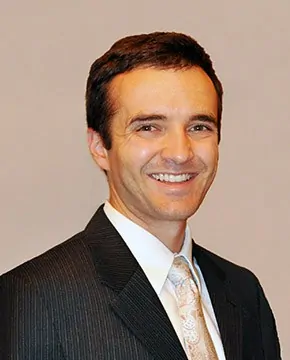
The Waste360 “40 Under 40” awards program recognizes inspiring and innovative professionals under the age of 40 whose work in the waste, recycling, and organics industry has made a significant contribution to the industry. Dave Hostetter focuses on designing landfill gas systems and landfill gas flare systems. Although still considered a young professional himself, he serves as a mentor to other engineers, providing guidance with hands-on design as well as professional guidance.
Dave is a LEED® Accredited Professional (LEED AP) and a Certified Energy Manager (CEM). He brings to SCS Engineers an abundance of expertise and fresh ideas. Dave has a keen eye for troubleshooting and diagnosing control system issues. He serves SCS clients wholeheartedly and goes out of his way to provide assistance as well as the expertise needed to make their day-to-day operations run as smoothly as possible. Dave has participated in a multitude of landfill gas and leachate system designs, including designs for blower and flare stations, wellfields, gas conveyance piping, leachate pumping systems, and groundwater extraction systems. His vast and varying experience, honest and hard-working approach to projects, and his positive attitude make him a respected resource within the firm.
Dave lives the SCS mission, and clients trust him for his honest and comprehensive approach to their challenges. Dave takes ownership of his work and puts in the time and effort to deliver excellent results and maintain a great relationship with his clients. “Dave Hostetter sets the example of how an honorable, dynamic, and experienced engineer should act at SCS,” said Paul Mandeville, Senior Vice President and Director of SCS’s offices on the east coast. “Dave serves as a model of what young professionals and students should strive to become in their professional and personal careers; we are very proud of him.”
Please join SCS in congratulating Dave Hostetter on his recent recognition by Waste360.
Corporate Headquarters