Similar processing sites could be sited and operated across New York City. Organics comprise 31% of New York City’s waste stream, and a significant portion can be composted locally and returned to the environment to support green spaces. Decentralized community compost operations are part of the solution to recycling food scraps and diverting this material from landfills. Medium-sized community composting sites can exist in dense urban settings because they are neighborhood assets, as education centers, green spaces, and compost sources for community greening projects. With well-designed systems and appropriately-scaled equipment, they can be managed so that no odor or pest issues are created. These sites reduce carting distances and serve as an impetus for changing local land management practices by making high quality compost abundantly available.
Most of us are familiar with small-scale backyard composting and with large-scale yard waste composting on bigger sites, typically outside of urban areas, using open windrows. But did you know there’s a lot of room between those scenarios to compost small to medium amounts of organics on limited land and/or in a more urban environment?
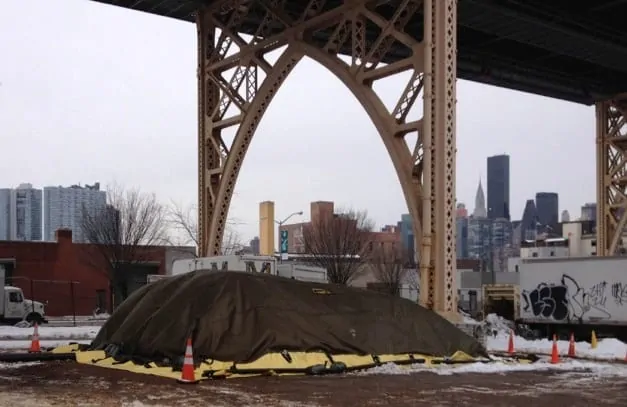
The NYC Compost Project Hosted by Big Reuse is one example. This urban food scrap compost facility, funded by the New York City Department of Sanitation, is tucked under the Queensboro Bridge. It uses a covered aerated static pile (ASP) system with the GORE® Cover System technology. The cover controls odors and vectors, and the aeration system and semipermeable membrane cover provide the needed air flow to support composting. The current system processes 400-500 tons of food waste annually, with plans to double that capacity on a new 1/3-acre site, designed by SCS (construction is scheduled for Summer 2017).
For a slightly larger site with a few acres available for compost facility layout, a hybrid approach may be the best bet to balance the needs for odor control, compost quality, and cost control. A hybrid approach may include an aerated static pile system as Phase 1 of the composting process, followed by open windrow processing as Phase 2. The aerated static pile provides a superior process and odor control during the critical initial weeks, while the windrows provide more cost-effective management through the completion of the composting process. A hybrid design proposed by SCS for a city in the Northeast can process about 4,000 tons of food waste plus 6,000 cubic yards of yard debris annually on a 2-acre site, with an estimated processing time of 4 to 5 months per batch.
In Wisconsin, compost facilities are regulated under NR 502; however, facilities processing less than 20,000 cubic yards of yard waste or less than 5,000 cubic yards of source-separated organics are exempt from many of the code requirements. Check out our compost reference Composting Exemption Reference List for details.
Suggested Contacts
Contact the author, Sherren Clark, PE, PG, for programs in the Upper-Midwest, or Greg McCarron, PE, about programs in the Northeast.
Contact to speak with a professional in your state about getting started.
Suggested Resources
U.S. Composting Council website
SCS Engineers Organics Management and Composting site
State agencies such as the Department of Natural Resources, Pollution Control, or Environmental Protection are usually excellent sources of information.
By following the simple procedures governing selective routing in the commercial space, it is possible to turn a high disposal garbage collection system into a high diversion recycling system, without incurring additional costs or losing collection revenue. Read more…
Tracie Onstad Bills of SCS Engineers and Richard Gertman of For Sustainability Too explain the steps for commercial-stream routing and management of commercial recyclables with remarkable results in their Resource Recycling article published in June 2016.
Questions? Ask Tracie, she writes a blog series about recycling.
SCS Engineers’ Tracie Onstad Bills and Leslie Lukacs were both selected to receive the California Resource Recovery Association’s (CRRA) prestigious Service Award this year. According to CRRA Executive Director, John H. Dane, the award recognizes “exceptional individual service to the organization and a contribution of time or resources beyond expectations.” That sounds like an SCSer alright.
Tracie Bills is SCS’s Sustainable Materials Management Director and is based in our Pleasanton, CA, location. She has been on the CRRA board for 10 years and has served in several leadership positions within the organization, including as its President for three years. Her expertise revolves around commercial recycling technical assistance, environmental purchasing, large venue and event zero waste programs, research and sustainability planning, garbage hauler franchise compliance and review, construction and demolition program / ordinance analysis and writing, climate inventory compilation, research and feasibility studies to help clients with comprehensive waste prevention and zero waste programs.
Leslie Lukacs serves as a Sustainable Materials Management Specialist in our Santa Rosa, CA, office. She has been on the CRRA board for 12 years and also served in a variety of leadership positions. She also founded CRRA’s Green Initiatives for Venues and Events technical council and was an instructor for CRRA’s Resource Management Certification Program for 5 years. Leslie specializes in the design and implementation of sustainable materials management and zero waste programs and is a pioneer in the greening of venues and events throughout the nation. Her extensive expertise in the logistics of zero waste, recycling, and composting programs, such as outreach management, business assistance, master planning, waste audits and characterization studies, extended producer responsibility ordinance preparation and implementation, compliance, grant writing, and administration are all key to successful long-term programs.
Both women were selected by the CRRA Board of Directors to be the 2016 recipients of the Service Award. The awards will be presented at the organization’s Annual Conference Awards Ceremony on August 9 in Sacramento.
CRRA is California’s statewide recycling association. It is the oldest and one of the largest non-profit recycling organizations in the U.S. CRRA is dedicated to achieving environmental sustainability in and beyond the state through Zero Waste strategies including product stewardship, waste prevention, reuse, recycling and composting. The organization provides its members with resources to advance local, regional and statewide waste reduction efforts which result in critical environmental and climate protection outcomes. Members represent all aspects of California’s reduce-reuse-recycle-compost economy and work for cities, counties, municipal districts, and businesses as well as hauling companies, material processors, non-profit organizations, state agencies, and allied professionals.
The Solid Waste Association of North America (SWANA) Applied Research Foundation released a report concluding that: a significant amount of additional food waste processing capacity will be required to achieve national, state, provincial, and local food waste diversion goals. The report also emphasizes the need for local decision-making in selecting and implementing those food waste diversion programs.
…a significant amount of additional food waste processing capacity will be required to achieve national, state, provincial, and local food waste diversion goals. The report also emphasizes the need for local decision-making in selecting and implementing those food waste diversion programs.
The report goes on to say that interest in recovering food waste from municipal solid waste is growing to meet goals established by the U.S. Environmental Protection Agency and U.S. Department of Agriculture, but many major metropolitan areas lack the infrastructure to manage the ability to meet the established goals. Two examples were cited:
Several states, including Massachusetts and Connecticut, condition their food waste diversion requirements on the ability of generators to access adequate capacity within a certain distance.
Speaking as SWANA’s Executive Director and CEO David Biderman stated:
We believe that Americans need to rethink how food is handled before it is considered waste, to divert it into programs to feed people, and to find other productive uses for food as food. Once it becomes waste, however, municipal decision-makers, working with their processing partners, need to determine how to best manage the material.
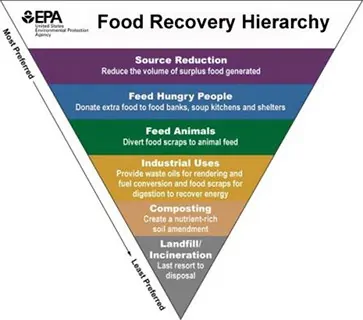
The SWANA report focuses on the effects of food recovery at the two lowest tiers of the hierarchy – composting and landfilling/incineration. The report concludes that food waste diverted from landfill operations has the potential to be processed at composting facilities. Then, going on to say that anaerobic digestion (AD) and co-digestion at wastewater treatment facilities are also likely destinations for diverted food waste.
Jeremy O’Brien, Director of the Applied Research Foundation, noted:
The food recovery hierarchy does not apply universally; an analysis of greenhouse gas impacts based on local data and conditions is needed to identify the best food scraps management options for a specific community.
The report encourages solid waste managers to perform a life cycle analysis of economic and environmental costs and benefits based on local needs, system capabilities, and data to identify the most effective ways to manage food waste at the local level.
SCS Engineers and SWANA are both long-time advocates for local decision-making in establishing programs to collect and manage municipal solid waste.
Related articles:
A Florida county conducts a pilot project to gauge its ability to manage yard trimmings
and biosolids using internal resources – and to confirm marketability of the finished
compost.
Read the Biocycle article by Beth Schinella and Bruce Clark
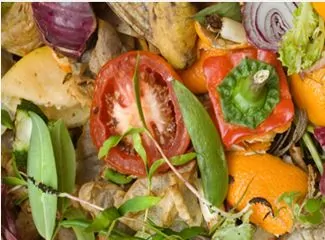 Organic materials management is of high interest in our industry. This interest is being driven by state and city regulations and other government policies for diversion of organics from disposal facilities. Five states have food waste disposal bans, including Massachusetts, California, Vermont, Connecticut and Rhode Island, which are in various stages of implementation. Some cities have food waste disposal bans, including San Francisco, Seattle, Portland (Oregon), and Austin. Many states and government agencies have organic diversion policies and goals; e.g., USEPA has a 50 percent reduction goal for food waste sent to landfills, nationwide, by 2030.
SCS is helping public and private entities evaluate their organic waste streams and the applicability of established and emerging technologies (e.g., composting, anaerobic digestion) to their specific communities and circumstances. Current and recent project examples include the following:

SCS is actively pursuing work in the organics materials management sector and has a staff devoted to staying current with the latest trends and technologies. SCS can evaluate, design, permit, construct and operate organics facilities, using varying technologies. Compost technologies that SCS is considering for implementation include:
Anaerobic digestion (AD) technologies that SCS is considering for implementation include high solids (dry) or low solids (wet) systems. High solids/dry systems are applicable for food and yard waste. Dry systems for food and yard waste generally use tunnels, which are gas-tight, concrete, garage-like chambers and are loaded using front-end loaders. Low solids/wet systems are applicable for manure, sludges, and liquid industrial waste. Wet systems generally use vessels, which are mixed and are fed using pumps.
Learn more about these SCS services.
Corporate Headquarters