Updated Chromium Toxicity Values and Implications for Soil Cleanup in Florida
Where Does Chromium Come From?
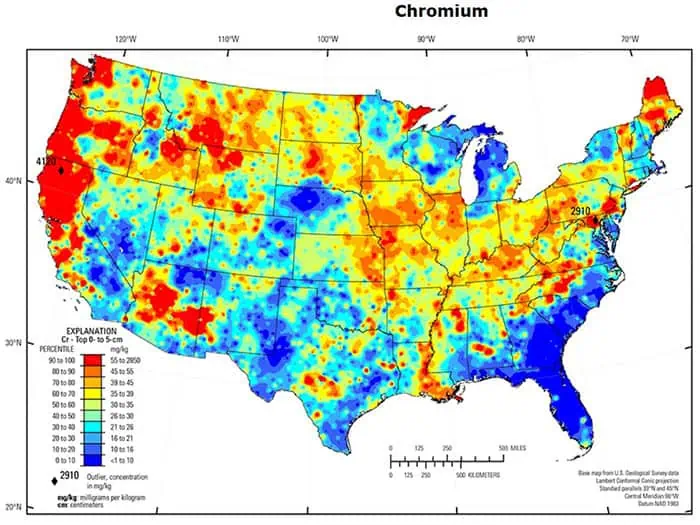
Chromium (Cr) occurs in the Florida environment due to a combination of natural conditions and historical land-use practices. In Florida, chromium is most commonly encountered in agricultural areas because phosphate-based fertilizers are derived from locally mined phosphate rock that naturally contains trace metals, including chromium. Chromium is also associated with solid-waste landfills and filled areas, such as lakefills and reclaimed lands, where materials, including construction debris, treated wood, metals, pigments, plastics, urban fill, and dredged sediments, may contribute chromium to soil and groundwater. In addition, chromium may be present in composts and biosolid-based fertilizers derived from municipal biosolids and organic waste, which are commonly used in Florida landscaping and agricultural applications. Historical use of certain pesticides and herbicides may also represent a minor source of chromium as an impurity in older metal-based formulations.
How is Chromium Regulated in Soil?
In the environment, chromium occurs in two primary oxidation forms: Cr III, which is more stable and less toxic, and Cr VI, which is more mobile and more toxic and is known to be a human carcinogen. While Florida has soil cleanup target levels (SCTLs) for both Cr III and Cr VI, Cr VI is typically used for risk evaluation because it is more conservative. Therefore, Cr VI is used as the default risk driver unless site-specific data demonstrate that chromium is predominantly present in the Cr III form.
In 1998, the U.S. EPA’s Integrated Risk Information System (IRIS) classified Cr VI as a “known human carcinogen by the inhalation route of exposure” based on strong evidence linking inhaled Cr VI to lung cancer in humans. More recently, in August 2024, the EPA released an updated toxicological review for Cr VI, including proposed changes to key toxicity factors.
These toxicity values are widely used by federal, state, and local agencies to develop environmental cleanup standards. In Florida, for example, both the State of Florida and Miami-Dade County rely on IRIS values to set soil cleanup target levels (SCTLs), as outlined in Chapter 62-777, Florida Administrative Code (FAC), and Chapter 24-44(2), Code of Miami-Dade County. If the updated toxicity values are adopted, cleanup standards for chromium will decrease significantly.
What Has Changed?
Two key changes to the toxicity factors include the following:
The updated IRIS assessment proposes an oral CSFo of 0.27 (mg/kg·day)⁻¹, (lifetime exposure, with Age-Dependent Adjustment Factors (ADAF) applied) and an IUR of 0.018 µg/m³ (also ADAF-adjusted). These toxicity factors would be used for land uses that involve childhood exposure (e.g., residential areas, parks). Additionally, the update proposes adult-based values, specifically an oral CSF₀ of 0.16 (mg/kg·day)⁻¹, and an IUR of 0.011 µg/m³. These adult-based values can be used for exposure scenarios that do not include early life (<16 years of age, e.g., commercial/industrial).
Using the updated IURs and oral CSFo, we recalculated the Florida SCTLs; the resulting SCTLs are substantially lower than the current SCTLs:
For comparison, the above estimates assume that all input parameters remain unchanged. However, several exposure parameters, such as body weight, exposure duration, ingestion rate, and the calculated dermal cancer slope factor (based on the adopted oral cancer slope factor), have already been updated by the state. When those updated parameters are applied, the residential SCTL is 4.0 mg/kg, which remains significantly below the current standard.
What Does this Change Mean?
Because of the lower cleanup standards, background studies will be important for both residential and commercial/ industrial sites. Stricter cleanup levels may require engineering or institutional controls, such as deed restrictions or limits on property use, to manage concentrations that cannot be attributed to background conditions.
Although the updates to Chapter 62-777, FAC, and Chapter 24-44 of the Code of Miami-Dade County have not yet reflected the latest CSFO and IUF, it remains crucial to monitor both state and county regulatory changes. Staying up to date allows us and our clients to plan.
Knowing this in advance can make a real difference. For example, if a client has a pending transaction or redevelopment plan, understanding potential changes in cleanup standards can help them expedite efforts to address environmental concerns under current rules, rather than face delays or stricter requirements later.
Beyond transactional planning, this knowledge is also essential for environmental risk assessments. Changes in SCTLs can influence decisions about remediation strategies and resource allocation. In other words, staying informed isn’t just about compliance; it’s about making smarter, proactive decisions that save time, money, and effort in the long run.
The following links will direct you to the proposed toxicological review and additional resources:
 Anabel Rodriguez-Garcia is an environmental scientist with a decade of experience in the sustainable management of soil, heavy metal contamination in soils and organic fertilizers, and in the physical, chemical, and biological characterization of soils, including sample collection and documentation. She serves SCS clients as a senior project professional and is particularly valuable for environmental site assessments. She has worked on projects for government agencies, including the Florida Department of Transportation and Miami-Dade County Regulatory and Economic Resources; public utilities; and the private sector.
 Lisa L. Smith has three decades of experience across a variety of roles in environmental science. Lisa serves SCS clients as a senior technical advisor and expert in risk-based corrective action (RBCA). She has worked as an environmental regulator at the Miami-Dade County Department of Environmental Resources Management (DERM), a risk assessor at a national environmental consulting firm, and a research chemist at the University of Florida.
SCS’s Green Street Blog Series: Part III
In our Green Street blog series, as we step through a successful redevelopment project called Green Street, we help identify and avoid potential environmental issues and sometimes surprises such as underground storage tanks.
As Green Street will breathe new life into the cultural arts scene, creating a vibrant community hub for all to enjoy, there can be a surprise during excavation, even with well-planned and implemented due diligence.
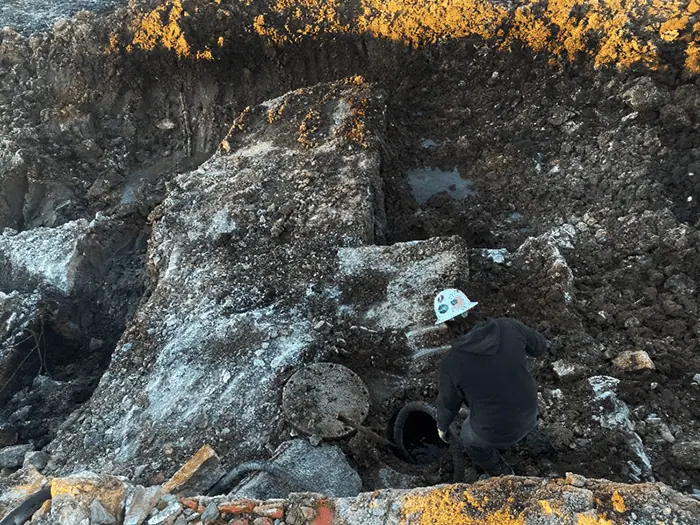
Despite conducting an onsite assessment, historical use assessment, and research before excavation begins, there still can be a deeply buried surprise. In the case of Green Street, an old tank under the former icehouse was discovered beneath 6″ of concrete. Unfortunately, it was not in any historical records since the tank was unregistered. Fortunately, it did not stop the excavation work for long.
Pausing work in the tank’s vicinity enabled SCS to inspect the tank and collect samples of the tank’s contents while continuing work in all other site areas. Based on the analytical results of the sampling and examination, SCS determined that it was an old oil-heating tank likely used to heat the icehouse. Following safety protocols, removing the tank contents comes first, followed by the tank.
Although heating oil tanks are unregulated by the Missouri Department of Natural Resources Underground Storage Tanks Section, SCS completed a tank closure soil sampling under the Missouri Risk-Based Corrective Action requirements for unregistered underground petroleum storage tanks. Then, soil excavation removes minimally impacted soil directly under the tank, which testing confirms there is no possibility of petroleum-impacted soil remaining.
One of the key aspects of remediation project support is having access to as-needed assistance. Brownfield and any remediation project will have some risks, but quickly minimizing and addressing challenges is critical. Look for full-service environmental engineers and consultants with construction experience. These firms take a holistic approach to projects and have a deep bench of professionals to call upon if and when needed.
Because these firms understand project needs throughout the life cycle. They can help clients make better decisions along the journey to completion and minimize timing risks related to environmental conditions and risks around zoning for intended future use, permitting, and environmental insurance and funding.
We reveal another discovery onsite in Part IV of the Green Street series on February 3rd – this one is wonderful!
Additional Resources:
 About the Author: Michael (Mike) Dustman is experienced in environmental project management, remedial design activities, building inspection, site assessments, and field training. He possesses an in-depth knowledge of relevant and applicable Federal, State, and local environmental laws and protocols. Mike has served numerous local agencies and private clients, including the USEPA Region 4 Superfund Technical Assessment and Response Team. Mike is a certified asbestos project designer, management planner, and building inspector, a certified air sample professional, and a certified lead-based paint inspector and lead risk assessor.
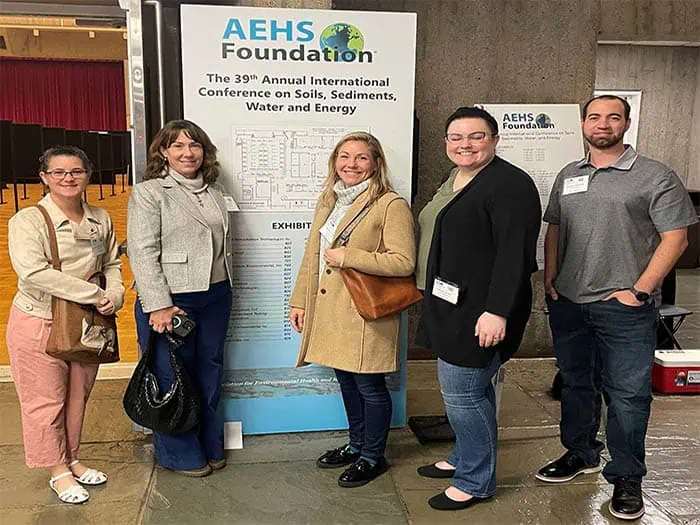
The Association for Environmental Health and Soils (AEHS) is hosting the 40th Annual International (East Coast) Conference on Soils, Sediments, Water, and Energy in Amherst, Massachusetts from October 21 to 24, 2024. This AEHS conference integrates a variety of topics for the environmental science community and regulators. It offers an opportunity to stay updated on recent techniques and technologies for addressing environmental issues and solutions. SCS Engineers technical advisors and environmental professionals are attending the 2024 AEHS conference and are available to answer and discuss solutions for the covered topics.
PFAS
Per- and polyfluoroalkyl substances, called PFAS, is a major topic covered during the sessions. Three workshops and several presentation sessions are addressing various aspects of PFAS challenges. Sessions will cover an overview of methods and materials for field sampling activities and published sampling protocols, guidance, and procedures. They will also address various analytical methods for evaluating PFAS in drinking water, wastewater, solids, and biosolids, as well as the best practices for field collection and the available analytical methods and their applicability.
PFAS Treatment
Another significant topic will be PFAS treatment and remediation. One session covers an innovative approach combining foam fractionation with supercritical water oxidation to eliminate PFAS from various waste streams. Destructive technologies, including electrical discharge plasma treatment, thermal destruction, enhanced oxidation, and sonolysis, have shifted from the laboratory bench to the field. Therefore, one of the presentations will cover the various mechanisms used to destroy PFAS, compare early performance data to determine effectiveness and highlight successes and obstacles that may occur as these technologies move from pilot scale to full-scale implementation.
Metals Remediation and VOCs
Other topics include metals remediation, such as an in-situ chemical fixation process that co-precipitates arsenic via the formation of an iron-arsenic oxyhydroxide complex, and the remediation of lithium, molybdenum, boron, and arsenic at coal combustion residual sites. The investigation and remediation of chlorinated volatile organic compounds (cVOCs) will also be discussed in various sessions, covering the use of real-time 3-dimensional data visualization and analysis during a high-resolution site characterization, investigation using the membrane interface hydraulic profiling tool for the delineation of cVOCs and remediation using emulsified zero-valent iron for direct source mass destruction.
Regulations and Adapting Technologies for Emerging Contaminants
Other topics include bioremediation, vapor intrusion, statistics, sustainable remediation tools, climate change and resiliency, managing environmental data, in-situ remediation, and environmental security. The event dedicates one session to emerging environmental contaminants in drinking water, such as microplastics, nanomaterials, and PFAS. This session will also discuss the current status of United States regulations and provide a forecast of the potential trajectory of regulations and the corresponding legal landscape over the next one to two years.
AEHS also organizes a similar West Coast conference. The West Coast 34th Annual International Conference on Soil, Water, Energy, and Air Conference will be held March 17-20, 2025, in San Diego, California.
Additional Resources:

Statistics is the science of learning from data and using the results in many industries for various purposes. As environmental consultants, we use statistics primarily to help clients meet regulatory requirements because statistical analyses can provide valuable insights and guidance, potentially saving our clients’ money and time.
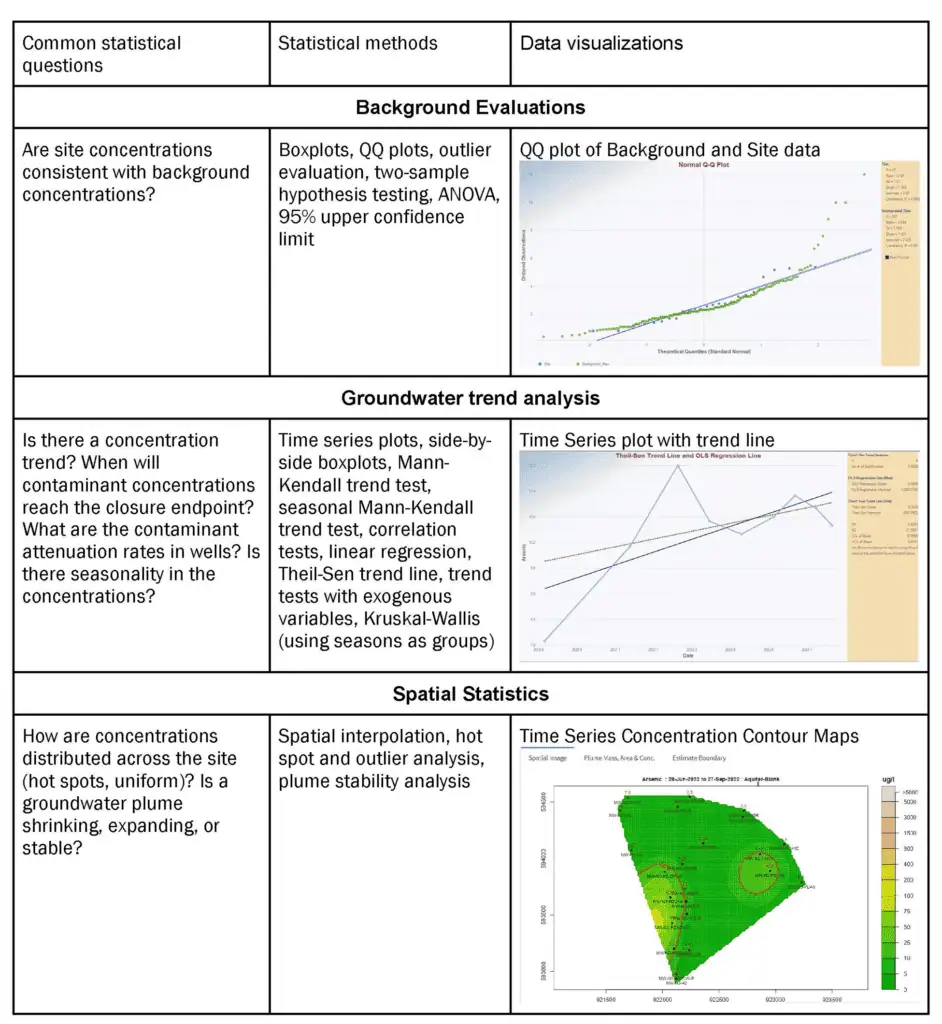
Various statistical methods can help streamline assessment and remediation concerning contaminated site cleanup, ultimately facilitating site closure. Statistical analysis can help to answer some important questions that arise throughout the life cycle of a project. The table below summarizes some common statistical questions, statistical methods, and data visualizations (statistical questions modified from ITRC, 2013*).
Statistics is one tool for solving client problems in combination with other methods. However, it is important to note that the output of a statistical analysis is only as good as the input, meaning that the collection of quality field samples and adherence to relevant standard operating procedures are crucial to the quality of statistical analysis.
In conclusion, while statistical analysis is a powerful tool for addressing client environmental issues, its effectiveness depends heavily on the accuracy of data collection and strict adherence to established protocols, ensuring reliable and meaningful results for our clients.
SCS has successfully implemented each of these methods on project sites. Future blogs will describe specific methodologies and processes with actual case studies useful for addressing the following,
Background Studies: after calculating the appropriate background level or establishing a background data set, that level or data set could support the removal of a particular contaminant from further consideration or serve as the remediation objective.
Groundwater trend analysis: to evaluate whether groundwater concentrations are increasing, decreasing, or stable/no trend, which could support the completion of long-term groundwater monitoring. This approach can also help estimate the time to attain cleanup goals.
Spatial Statistics: use several methods to evaluate spatial hot spots and outliers, groundwater plume stability, and groundwater concentration or elevation gradients, which can aid in evaluating areas of high concentrations requiring further evaluation.
*Interstate Technology & Regulatory Council (ITRC) Framework for Developing Quality ITRC Technical and Regulatory Guidance Documents, Revised December 2013
Additional Site Assessment and Remediation Resources:

SOP, Version 50 10 7 for the Small Business Administration’s Standard Operating Procedures for Lender and Development Company Loan Programs effective on August 1, 2023.
On May 10, 2023, the United States Small Business Administration (US SBA) issued a long-anticipated informational notice regarding implementing their newest Standard Operating Procedures (SOP) under Lender and Development Company Loan Programs. According to this notice, the new SOP, Version 50 10 7, goes into effect on August 1, 2023. All lenders, certified development companies (CDCs), SBA employees, and applicants/borrowers of 504 and 7(a) loans will be subject to the changes therein at that time.
Today’s SCS blog provides critical guidance to entities needing environmental due diligence or other services under the auspices of US SBA programs.
The environmental policies of the SOP are contained within Chapter 5, Section E of the new SOP. One highlighted change from the previous version (10 5 6) is that these policies apply “only to real estate acquired, refinanced, or improved by the loan proceeds” and do not apply to collateral. For the commercial real estate subject to the program, the following summarizes the basic requirements:
The SBA SOP also has specific requirements for “Special Use Facilities,” which differ from other property types. The three categories of Special Use Facilities include child-occupied, dry cleaners, and gas stations. Of the three, the new version of the SOP contains a point of clarification pursuant to child-occupied facilities. It now explicitly specifies that all such facilities constructed before 1978 must undergo a Lead Risk Assessment (RA) and test all taps, water fountains, and spigots for lead in drinking water. The RA should be conducted within one calendar year of submission to SBA for approval and follow US Department of Housing and Urban Development (HUD) Guidelines.
As always, SCS aims to make the process of securing both conventional and SBA loans as painless as possible. Rest assured that we fully understand the program’s intricacies and are well-positioned to assist you with environmental requirements related to this program.
 Meet Author Rachel McShane
Additional Resources:
Brownfield Properties: The Ins and Outs of Due Diligence and Investment
Author Megan Hente discusses the importance of environmental due diligence for purchasing brownfield properties. Brownfields offer opportunities to redevelop…
Will EPA’s Proposed Designation of PFOA and PFOS Impact Real Estate?
Jeffrey D. Marshall, PE, and Michael J. Miller, CHMM, discuss environmental due diligence and how the proposed CERCLA rule could impact the number of recognized environmental conditions…
Environmental Due Diligence and All Appropriate Inquiries
Today’s commercial real estate transactions must consider environmental issues. Complex laws can impose significant environmental liabilities on…

SCS Engineers welcomes two experienced environmental consulting professionals to our St. Louis regional office.
Susan Robertson, MBA, is Senior Project Manager. Robertson’s comprehensive environmental due diligence and remedial work rejuvenates prime commercial properties back to health while supporting municipal and private industries’ plans for economic redevelopment.
In the environmental industry for nearly 20 years, Susan has worked on a wide range of consulting projects, including environmental due diligence Phase I and Phase II Environmental Site Assessments. She performs Indoor Air Quality and radon assessments, lead-based paint, and asbestos inspections.
Susan is known for her Brownfield-Voluntary Cleanup Program work under the Missouri Department of Natural Resources¹, Illinois EPA Tiered Approach to Corrective Action, and Missouri Risk-Based Corrective Action risk assessments and historic preservation projects under the Missouri Department of Economic Development².
Julia Hunter is an SCS Project Professional. Julia has five years of experience in environmental consulting, primarily performing environmental due diligence for commercial and telecommunications clients nationwide. She has a Master of Science in Environmental Geoscience from St. Louis University.
Hunter uses the highest standards of care in her due diligence and building sciences investigations, analyzing the data to determine if a property is feasible for its proposed use and future requirements to speed the closure process and ensure no surprises.
“The service these two women perform for our clients is strategic and comprehensive,” states Rachel McShane, SCS – St. Louis project director. “The results of their work help determine the true value of a property before purchase, and if there are any environmental or health concerns, how to remediate them.”
Additional Resources:

Environmental due diligence is a form of proactive environmental risk management typically conducted before purchasing, selling, or leasing a property or business. Due diligence investigations can help prevent costly environmental liabilities by identifying them early in the transaction, thereby protecting all parties’ interests. There is an increased opportunity for significant cost-savings when the hired consultant accounts for tangential aspects during their investigation.
Environmental due diligence encompasses tangential aspects that are not the primary focus of the investigation. Aspects such as these may indirectly impact the environmental risks or liabilities associated with the property or business or the transaction’s overall feasibility or value.
Tangential Aspects of Environmental Assessment: A Case Study
A major oil company requested environmental due diligence for a large property acquisition. The property acquisition was part of a larger company acquisition and involved hundreds of oil and gas well locations, facilities, tanks, and equipment. It was necessary to modify the Phase I assessment for the work. Of the hundreds of well locations, 50 were chosen for Phase I work and field verification. According to the consultants, any environmental liabilities exceeding $2 million must be identified during this evaluation. Phase I examined the locations of wells for potential environmental liabilities, such as petroleum releases, but did not examine the wells themselves. Even though the consultants were experts in evaluating the condition of oil and gas wells, the oil company addressed this aspect of the investigation in-house. The company did not consider the tangential legal implications, liability for plugging costs, potential impacts on property value, and potential penalties for non-compliance with regulations.
Many wells excluded from the consultants’ due diligence were over 50 years old and out of operation. The company’s in-house investigators did not perform a field review. The result was an underestimation of the number of wells that required plugging and their associated costs. The estimate for plugging a well was between $20,000 and $30,000 per well. The plugging costs for this transaction were much higher, ranging from $80,000 to $120,000 per well, resulting in a $42 million increase. The oil company made a mistake in thinking the plugging costs were insignificant. Environmental due diligence should always include tangential factors.
Additional examples of tangential aspects of environmental due diligence might include the following:
The information obtained during or upon completing an investigation can inform negotiations and contractual arrangements between the parties involved in the transaction. Environmental consultants could spot some issues big enough to kill a deal. Other issues may allow buyers to adjust the purchase price or negotiate an indemnity to shift financial responsibility for environmental risk. It may also be possible to purchase environmental insurance for sufficient financial protection.
The specific steps involved in environmental due diligence depend on the type and scope of the transaction, as well as any applicable regulations or guidelines. Consult an experienced environmental professional to ensure that your due diligence process meets all your needs and requirements. Find out more about SCS’s environmental due diligence services.
Introduction
Contamination at thousands of shopping centers across California from previous business operations presents problems for property owners who wish to continue commercial use, redevelop, and maintain property value. Commercial property remediation targets returning these buildings and land to predevelopment conditions, presenting opportunities for reuse and redevelopment.
One property owner discovered that securing adequate funding and working closely with state and regional regulatory agencies leads to success despite changing regulations and oversimplifying regulatory health risk assessment methods. The Draft Cal-EPA Supplemental Vapor Intrusion Guidance (DSVIG) suggests changes to the methods in which vapor phase transport and potential health risks are modeled and calculated for occupants of buildings with known soil or groundwater contamination beneath them. These changes, the result of a multi-year working group collaboration, recommend an arguably more conservative calculation of indoor air quality. The changes rely on EPA work and guidance, with empirically derived attenuation factors (AFs), which will increase the number of sites requiring additional environmental assessment and mitigation to achieve health risk standards. Although the DSVIG is currently draft guidance, there is evidence that regional regulatory agencies have already adopted AFs in calculating indoor air quality.
Diamond Bar Commercial Center Assessment and Mitigation
Drucker Survivors Trust owns and operates a multi-tenant commercial building in Diamond Bar, California, including a dry cleaner at one time. The former cleaners caused an unauthorized release of dry cleaning solvent containing chlorinated volatile organic compounds to the subsurface during its operation.
Financing for this all too common situation requires environmental due diligence in the form of research commonly completed in a Phase I Environmental Site Assessment followed by an assessment to characterize potential liabilities associated with chlorinated solvent releases before lenders provide funding.
Regulatory oversight in California can either be voluntarily engaged or involuntarily if assessment activities on an adjacent or nearby property indicate the presence of chlorinated volatile organic compounds in the subsurface linked to dry cleaning operations in the vicinity.
The Drucker Survivors Trust sought approval from the applicable regulatory agency, Los Angeles Regional Water Quality Control Board (LARWQCB), to assess and mitigate the chlorinated solvent release to ensure the protection of human health and reduce environmental liabilities associated with the property.
Regulatory closure is the acceptance of assessment and remediation activities by the governing regulatory entity to bring the site into compliance. Compliance, in this case, required assessment and mitigation of beneficial use groundwater underlying the property impacted by the solvent release and completing soil vapor assessment and health risk screening calculations under current state and federal guidelines.
Guidance on vapor assessment and associated health risk screening methods have changed rapidly in California state environmental regulations. As environmental engineers and consultants, SCS professionals manage an extensive list of vapor assessment, health risk assessment, and vapor intrusion mitigation projects resolving these vapor–related issues.
To start this project, the SCS team prepared a successful grant application securing more than $650,000 in funding from the California State Water Resources Control Board’s Site Cleanup Subaccount Program (SB 445, established in 2014). This state-provided grant money enables the assessment and mitigation necessary to close with the LARWQCB.
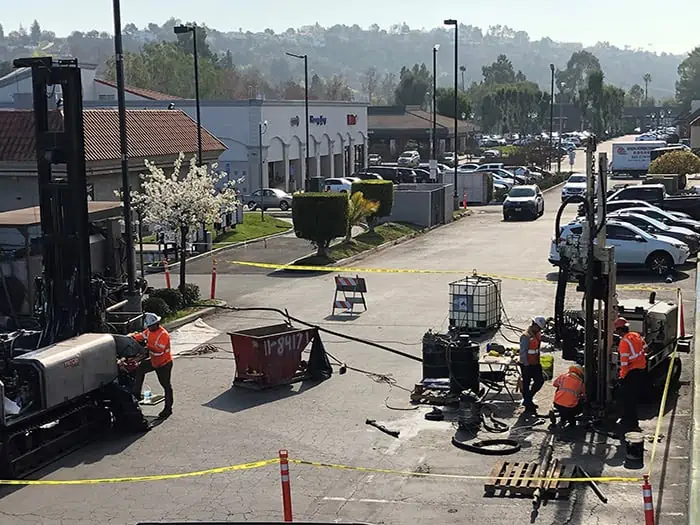
Subsurface assessment activities defined the extent and scale of chlorinated solvent impacts to soil vapor, soil, and groundwater, enabling the design of a remediation program. To reduce the groundwater contamination to cleanup levels set by the LARWQCB, SCS Engineers designed and implemented an injection program to deliver engineered chemicals directly to the groundwater plume. The injected chemicals destroy the chlorinated solvents via in situ chemical reduction and stimulation of biological degradation.
While challenging drilling conditions precluded previous consultants from attempting groundwater remediation, SCS industry experts safely achieved up to a 99 percent concentration reduction within the groundwater plume. SCS designed a soil vapor assessment that relied more on site-specific data collection and less on conservative default assumptions while conforming to the most current regulatory guidance targeted at minimal impact on the building tenants.
SCS managed all aspects of the project, including grant requirements and communication between the client, regional and state water board staff, city staff, and subcontractors. Obtaining and managing entrance under state waste discharge requirements is necessary, and SCS completed all necessary permitting and reporting requirements to facilitate the groundwater mitigation activities. Careful planning and experience with similar projects minimized impacts on tenants and kept the project on a strict timeline with no missed regulatory deadlines. SCS continues working with the LARWQCB to conclude the client’s final closure requirements and is in the process of applying for an additional $900,000 in SCAP funding to implement the final stages of the project targeted at obtaining final regulatory closure.
Changes Coming to Regulatory Guidance
Recent changes to regulatory guidance in California are arguably making obtaining closure on sites with vapor intrusion health risk concerns more difficult to achieve. The Draft Cal-EPA Supplemental Vapor Intrusion Guidance (DSVIG) suggests changes to the methods in which vapor phase transport and potential health risks are modeled and calculated for occupants of buildings with known soil or groundwater contamination beneath them. These changes, which result from a multi-year working group collaboration, recommend a more extensive and site-specific data collection effort. They include indoor air quality calculation methods relying on EPA work and guidance and empirically derived attenuation factors (AFs) which some would argue lead to overestimating potential health risks.
The consequences of the DSVIG are potentially significant if adopted as is and appear likely to result in more sites being “screened in” with vapor intrusion issues and more sites requiring mitigation. The impact, resultant costs, and possibly detrimental secondary effects such as decreases in affordable housing production, particularly in urban infill areas. And while none would argue with appropriate protection of health risk, the question is whether the studies and empirical data used to support the DSVIG represents the best available science and is truly representative and predictive of risk.
The DSVIG adopts an attenuation rate of 0.03 for the flux of both soil and sub-slab vapor to indoor air based on a previous 2012 EPA Study comprised of empirical data collected from buildings arguably not representative of modern construction in California.
The development of a reliable screening level attenuation factor for California based on high-quality, recent, California-specific data:
1) Will be protective of human health, as no toxicological imperative or basis supports a call for accelerated or immediate action (as evidenced by the fact that the DSVIG workgroup commenced its work in 2014 and issued the review draft in 2020).
2) Will ensure California’s environmental policy satisfies the gold standard for data quality and insightful analysis in which the state once took pride.
3) Will not unnecessarily decimate the California housing development market. The empirically derived screening level AF in the DSVIG is overly conservative based on the available data. More accurate empirical data and measurement methods for site-specific measurement are available.
With respect, oversimplifying the VI health risk assessment methods has constrained the environmental community’s ability to apply science-based health risk screenings, often resulting in costs associated with additional environmental assessment and mitigation. An additional revision to the DSVIG to utilize a screening level AF more reflective of the current California data and building specifications could save state resources, increase infill development by reducing urban sprawl, promote housing development, all while protecting human health.
 About the Author: Keith Etchells is a professional geologist and hydrogeologist with over two decades of experience assisting clients in managing environmental risks associated with ownership, transfer, or operation of commercial, industrial, and waste disposal properties. His particular technical expertise involves aspects of groundwater science and engineering relevant to contaminated sites and landfills, including supervision and conduct of subsurface data acquisition, remedial design and implementation, conceptual site model development, aquifer testing, extraction well design, groundwater quality evaluation and treatment, vapor intrusion health risk assessment and mitigation, predictive modeling, and contaminated soil and groundwater remediation design.
He is responsible for designing analytical, geotechnical, and hydrogeological data collection programs to complete subsurface assessment and remediation. He has prepared subsurface assessment documents, property mitigation plans, vapor intrusion risk assessment documents, soil management plans, aquifer characterization documents, conceptual site models, and groundwater remedial design and implementation documents.

Recent changes to regulatory guidance in California are arguably making obtaining closure on sites with vapor intrusion health risk concerns more difficult to achieve. The Draft Cal-EPA Supplemental Vapor Intrusion Guidance (DSVIG) suggests changes to the methods in which vapor phase transport and potential health risks are modeled and calculated for occupants of buildings with known soil or groundwater contamination beneath them. These changes, which result from a multi-year working group collaboration, recommend a more extensive and site-specific data collection effort. They include indoor air quality calculation methods relying on EPA work and guidance and empirically derived attenuation factors (AFs) which some would argue lead to overestimating potential health risks.
The consequences of the DSVIG are potentially significant if adopted as is and appear likely to result in more sites being “screened in” with vapor intrusion issues and more sites requiring mitigation. The impact, resultant costs, and possibly detrimental secondary effects include decreases in affordable housing production, particularly in urban infill areas. And while none would argue with appropriate protection of health risk, the question is whether the studies and empirical data used to support the DSVIG represents the best available science and is truly representative and predictive of risk.
The DSVIG adopts an attenuation rate of 0.03 for the flux of both soil and sub-slab vapor to indoor air based on a previous 2012 EPA Study comprised of empirical data collected from buildings arguably not representative of modern construction in California. The development of a reliable screening level attenuation factor for California based on high-quality, recent, California-specific data:
1) Will be protective of human health, as no toxicological imperative or basis supports a call for accelerated or immediate action (as evidenced by the fact that the DSVIG workgroup commenced its work in 2014 and issued the review draft in 2020).
2) Will ensure California’s environmental policy satisfies the gold standard for data quality and insightful analysis in which the state once took pride.
3) Will not unnecessarily decimate the California housing development market. The empirically derived screening level AF in the DSVIG is overly conservative based on the available data. More accurate empirical data and measurement methods for site-specific measurement are available.
Oversimplifying the VI health risk assessment methods has constrained the environmental community’s ability to apply science-based health risk screenings, often resulting in costs associated with additional environmental assessment and mitigation. An additional revision to the DSVIG to utilize a screening level AF more reflective of the current California data and building specifications could save state resources, increase infill development by reducing urban sprawl, promote housing development, all while protecting human health.
Take a deeper dive into this topic in the Daily Transcript article Vapor intrusion rules hamper infill projects.

“The Infrastructure Investment and Jobs Act, signed into law last month, will dedicate more than $1.5 billion to the U.S. EPA Brownfields program. The Act includes hundreds of millions of dollars allocated to Multipurpose Grants, Assessment Grants, Cleanup Grants, Revolving Loan Fund Grants, and technical assistance intended to improve equity, create jobs, and mitigate environmental degradation.”
CCLR has provided the expected breakdown and timelines from EPA. The EPA has hundreds of millions of dollars allocated for FY22 that will be applied for in July and awarded in November 2022. This timeline is different and with much larger individual grants possible, up to $10mil per grant.
SCS Engineers has a stellar win rate for brownfields grant writing and implementing brownfields programs. Please let our brownfields and remediation experts know if you have any questions or if we can provide assistance in grant support.
Click here to learn more and obtain support and funding for your community’s brownfields project.
Corporate Headquarters