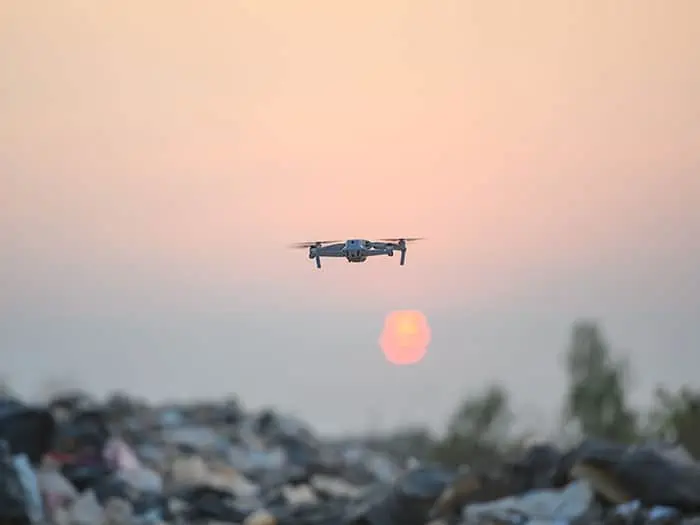
The California Air Resources Board (CARB) is amending its Landfill Methane Regulation (LMR) to strengthen landfill compliance and meet the state’s target of reducing methane emissions by 40% by 2030. The rules target steep emissions reductions through enhanced surface monitoring, including drone-mounted scanners, robotic sensors, and remote monitoring, as well as stricter wellhead thresholds, among other measures.
The CARB-proposed amendments will have significant impacts on landfill and gas collection and control systems (GCCS), for which owners and operators will need to plan and implement to meet the requirements. As the nation’s top engineering specialist firm in this sector (ENR Solid Waste and Environmental Sourcebook), SCS Engineers has prepared articles and videos to assist landfill owners/operators in complying with these new requirements, including proactive measures that can be deployed to minimize impacts, planning for additional staffing support to complete all of the new monitoring, new or modified GCCS equipment and other infrastructure that will be needed, and new technology necessary to meet new deadlines.
As essential services, or any business for that matter, the changes require additional budget and capital investment to meet extensive surface and leak-monitoring and repair protocols, tighter regulatory timelines for installing GCCS, and more frequent and extensive monitoring and analysis of cover integrity, temperature, oxygen, and liquid levels.
Planning begins now.
SCS’s first article summarizes the key changes and highlights the most salient points of the revised LMR. The companion educational video and slide set are available free of charge to the public and can serve as a starting point for owners, operators, compliance staff, field technicians, and engineers in landfill and gas management, including energy recovery and renewable natural gas facilities.
CARB Landfill Methane Regulations Free Resources:
SCS Engineers shows you in this short video featuring SCS Remote Monitoring & Control technology built for landfill owners and operators, solar farms, and for use on pipelines by SCS Engineers, landfill and environmental practitioners.

Webinar | April 28, 2021 | 10:00 a.m. (PDT)
Field data acquisition and site monitoring are key activities for environmental projects. Mobile GIS technology has quickly become a critical component of successful environmental management projects. Firms are improving their field operations and expanding the value of their services using mobile apps. In this webinar, you will learn how two environmental firms use ArcGIS field applications to locate sites and assets, access system information, collect field data, and provide real-time information.
Attendees will gain valuable insights on the following:
Maximizing field efficiency with apps
Managing field operations in real-time
Working in offline remote areas
Presenters:
Casey Talento and Matthew Nanney, AECOM and
Joy Stephens and Cesar Leon, SCS Engineers
“Using Drones and ArcGIS Field Apps for Operational Efficiency at Landfills”
Do you glaze over when the tech-speak starts? In our blog, we’ll try to prevent that from happening while describing new technology for landfills and industrial use. We’ve merged our SCS Engineers technology with some new web-based technology that will make your landfill, facility, or plant safer for workers and help lower operational costs. Not only that, with SCS Dataservices® (already on over 600 landfills) you will have a complete and accurate record at your disposal.
You can find information on our website, but here we describe the most exciting new Remote Monitoring and Control (RMC) options:
SCS owns a small fleet of no-crew aerial vehicles (UAVs) and employs licensed UAV pilots nationwide. The use of UAV technology, commonly known as drones, can produce photogrammic and aerial photographic imagery offering site owners and operators the ability to take measurements from photographs, especially useful for recovering the exact positions of surface points quickly and efficiently. Some of the benefits of UAVs are:
SCS deploys UAV technology on a case-by-case basis as an adjunct to our RMC® services. We also offer to consult and training on the implementation of UAV programs at solid waste and other facilities.
SCS can also present real-time data in mixed reality environments (e.g., Microsoft HoloLens2). Augmented 3D facilitates the difficult task of visualizing actual and conceptual site conditions. Another application of reality technology includes analyzing landfills in more than three dimensions by combining multiple datasets. These 4D models enable operators to view conditions over time, providing the ability to detect and measure changes and insight into the benefits of critical infrastructure such as earthworks and systems. One could add costs as a 5th dimension to visualize the resources, time and money needed to move solid materials.
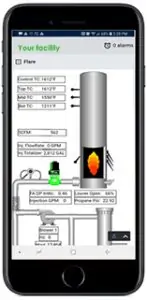
The SCS RMC® team integrates web-based technology called Ignition 8 into our client solutions. An Inductive Automation product, Ignition 8 enables us to build dynamic industrial applications that automatically respond to each client’s unique perspective.
Ignition Perspective enables us to build full SCADA, HMI, and alarm systems, and provide clients with a mobile view of their operations via smartphones and other mobile devices. Full-control of industrial processes is more mobile, customizable, scalable, and secure than ever before. For example, one of our clients uses advanced SCS RMC® – Ignition Perspective HTML 5 integration for remote access and control of piping and instrumentation diagrams that stream live sensor data. The application reduces O&M costs by:
Read Waste Today’s article Using Drones for Landfill Monitoring to learn more.
Corporate Headquarters