Sometimes geosynthetic material specifications for a specific project, i.e., lining system or final cover system, is a performance-based specification which does not specify the type of product for use in construction. What does the engineer need to do when the selected contractor submits a product for approval in accordance with a performance-based specification? What should the engineer do when the owner purchases the material and identifies a product for use based on the performance-based specification?
Specifications that SCS has prepared are performance-based and include a qualifying procedure whether the product is introduced by a contractor or owner. This qualifying procedure is specifically left to the engineer to carry out by laboratory testing of typical samples of the specific product for use in construction. Typical reported values by the manufacturer or test results submitted by the contractor or owner are not acceptable under these procedures. Since the engineer is taking the liability of accepting a specific type of product for his or her project, the engineer should have the right to perform laboratory testing before the product is approved for use in the project, that only makes sense in the world of taking liabilities!
The testing performed by the engineer for qualifying a product do not count toward conformance testing of materials delivered to the site. The qualifying procedures are solely for accepting a certain type of product to be used in the project, but the specific rolls of pre-qualified product manufactured for use in engineer’s project must go through the required conformance testing specified in the specifications before use in the project.
The process of qualifying a product, ordering the qualified product, and performing conformance testing on the pre-qualified materials takes time. Engineers need to consider the amount of time necessary for the involved stages of approval into the construction schedule. If using material purchased by the owner, the owner needs to keep the timeline in mind to allow the engineer to carry out all necessary testing for the approvals to be in place before construction begins.
Repeating the qualifying procedure for a product from one project to the next depends on how the performance-based specification is written. Sometimes, the engineer accepts a product that was qualified for use in a prior project as long as the product has not changed since last used in accordance with statements by the manufacturer. If the performance-based specification includes such options, SCS highly recommends identifying the period between a prior project and the next project in the specification. In some cases, this means the product must go through a qualifying process even if it has not changed for many years but the previous set of qualifying data is older than a certain number of years. The period is based on the engineer’s judgment, but most professionals normally use five years in their specifications. During a five-year period, if the product changes or there are indications that the product might have changed due to recorded changes in certain reported values by the manufacturer, the qualifying process must be followed irrespective of the number of years passed since a recent past project to maintain quality and minimize risk.
Questions? Contact the author, Ali Khatami.
The industry standard SP001 is incorporated into many Spill Prevention, Control, and Countermeasure (SPCC) Plans is now updated. How does it affect your facility’s SPCC Plan?
The Steel Tank Institute (STI) recently released an updated version of SP001 – Standard for the Inspection of Aboveground Storage Tanks. This document is the industry standard used in most SPCC Plans for inspection guidelines and integrity testing for shop-fabricated aboveground storage tanks. In a typical SPCC Plan prepared by SCS Engineers, your monthly and annual inspection forms, and tank integrity testing frequency requirements are based on the criteria provided in SP001.
No. We recommend incorporating the updated inspection forms during your next SPCC Plan Amendment or 5-year renewal.
The inspection criteria have been simplified, and more flexibility is allowed with the revised inspection forms. This will help make your inspection process easier and of higher quality.
Need help sorting out the details of the revised standard, or have an SPCC Plan that needs amending or is due for a 5-year review? Contact , and we will help you stay on top of your SPCC needs with offices nationwide.
Coauthors: Denise Wessels and Amber Fidler.
SCS Engineers SPCC specialists in Pennsylvania.
Landfills are getting larger in height and greater in footprint area, but the location of leachate tanks, leachate ponds, or discharge points to an on-site or off-site leachate treatment plant usually don’t change.
A larger footprint means leachate force mains are getting longer and pumps have to work harder to push leachate through the system to a target point. Some operators carry on with the same pumps for decades and don’t monitor the performance of the pumps after expanding the landfill footprint.
SCS highly recommends that you evaluate the performance of the existing pumps again. Such an evaluation may require hydraulic analysis of the entire network of pipes along with pumps, or whatever segment of the network that is affected by the expansion. The effort is minimal in retrospect, but the operator makes sure that the system will function in an optimized zone with minimal wear on the pumps.
Sometimes the hydraulic evaluation may require up-sizing all or certain pumps in leachate sumps because not enough flow can go through the force main due to high friction loss in the expanded leachate force main. Up-sizing pumps may be achievable depending on the type of the leachate sump, i.e., riser system or vertical manholes. If the up-sized pump in a riser system is too long to fit inside a riser system or too long to the point of making routine maintenance too cumbersome, your engineer needs to come up with another idea.
Booster pumps along an expanded leachate force main can certainly be an option. Booster pumps can be the inline or offline type. Install the inline pumps on the actual force main, and position the offline type on the side so that liquids go through bends and elbows to reach the pump, and again through bends and elbows to get back in the force main. In either case, the booster pump adds hydraulic energy to the flow inside the force main to push the liquids at a higher pressure and velocity through the remainder of the force main and to the target point.
Operators need to be aware of the dynamic nature of the leachate piping network and the role of booster pumps in dynamic environments. After landfill expansion, with new cells coming online -increasing leachate generation, and when closing landfill slopes -decreasing leachate generation over time, the flow in the force main may change. Sometimes booster pumps have to be up-sized or down-sized depending on flow and pressure in the system.
Have a Leachate System question? Contact the author Ali Khatami.
It might feel like the July 1 deadline is far away, but it is time to start preparing to report your releases of toxic materials. The U.S. Environmental Protection Agency (USEPA) indicates that printing and related industries are subject to this report. It is an important part of your environmental compliance strategy if you have a facility with at least 10 full-time equivalent employees in a covered NAICS code that exceeded a reporting threshold in the previous calendar year. Reporting releases of toxic materials on an annual basis is one aspect of the Emergency Planning and Community Right-to-Know Act (EPCRA).
Read the article with steps to your report for printing and related industries.
Consolidated List of Chemicals Subject to the Emergency Planning and Community Right To Know Act (EPCRA), Comprehensive Environmental Response, Compensation and
Liability Act (CERCLA) and Section 112(r) of the Clean Air Act
Modeling for a Worst Case Release and the Alternative Release Scenario – not so mysterious after all. Lee Pyle explains it to you in her recent article in the RETA Breeze. Lee is SCS Engineers National Expert on Industrial Risk Management Plans and Process Safety Management.
All of us with over 10,000 pounds of ammonia in our plant system are well aware of the EPA Risk Management Program Hazard Assessment requirements (40 CFR Part 68.20). When the EPA inspector shows up, we hand them the manual and cross our fingers that they understand what they are reading and pray they do not ask a question.
Do not fret; chances are that the inspector at your plant is probably not much more fluent in dispersion modeling than you are. Much debate occurs over how long it would take to stop a release, but you do not want to get into a debate with an EPA inspector.
Read, share, or print Unmasking the Mystery of the Worst Case Release and the Alternative Release Scenario here. Happy Modeling!
Secondary containment is a basic engineering control to prevent a chemical or oil spill. There are misconceptions, though, regarding secondary containment requirements. In terms of oil-based storage, these misconceptions can lead to not enough containment capacity, significantly more containment capacity than necessary, or simply not providing the right level of containment when containers are grouped.
Chris Jimieson of SCS Engineers explains the five most common misperceptions and advises you how to keep your facility in compliance.
Read the article by clicking here.
This article discusses global air quality and how the collaboration between policy-makers and the scientific community can have a continued positive impact on air quality in the U.S. This collaboration has been the primary cause for the improvements observed in air quality over the past few decades.
U.S. Environmental Protection Agency (EPA) programs, such as the New Source Performance Standards (NSPS), New Source Review, and Maximum Achievable Control Technology standards, have all had a significant impact on improving air quality by lowering the ambient concentrations of NOX, VOC, CO, SOX, and PM.
Some areas, such as southern California, have committed to working toward electrifying the transportation network, implementing more stringent standards on diesel fuel sulfur content, and encouraging heavier utilization of public transportation.
Author: SCS Engineers’ Ryan Christman, M.S., is an air quality engineer and environmental management information systems specialist with experience in the oil and gas industry and the solid waste industry. He is just one of SCS’s outstanding Young Professionals.
Waste characterisation studies are important tools for helping local governments and private companies make decisions on the best solid waste management programs, policies, and technologies to reduce short-lived climate pollutants. Knowing what materials comprise your waste stream will help you establish the right mix of waste diversion and energy programs to make your community more sustainable.
This webinar led by Brent Dieleman of SCS Engineers, a Senior Project Professional with the division of Sustainable Materials Management provides information on how to conduct a waste characterisation study, what data you can expect to obtain from a study, and how it can be used to make solid waste program and policy decisions. Topics of discussion during the webinar include:
We thank Abt Associates on behalf of the US Environmental Protection Agency for the CCAC Waste Initiative for sponsoring the webinar which took place on March 2, 2018, at 2:00 pm CET.
View the webinar by clicking here.
Vapor intrusion (sometimes known as soil gas intrusion or soil vapor intrusion) is a potential environmental risk that can occur at a wide variety of properties, from former industrial facilities, shopping malls, and even residential properties. Knowing how to assess the risk and mitigate potential harm from soil vapor intrusion is critical to reducing health impacts and mitigating financial and other liability from potential exposures.
What is Vapor Intrusion?
Developers and the public understand that soil and water contamination can pose a health hazard, but vapor intrusion is an environmental health risk that can be overlooked. It is a hazard that can result from both heavy industrial operations and small “mom-and-pop” businesses so that it can be an issue both at industrial properties, suburban strip malls, and even residential developments.
Vapor intrusion is the migration of soil or water contamination from below structures into businesses or homes as a vapor. Common vapor intrusion contaminants from small businesses include benzene from gasoline and perchloroethylene (perc) from dry-cleaners, while large industrial facilities may have a wide range of industrial chemical contaminants. Less common vapor intrusion hazards are mercury, polychlorinated biphenyls, and pesticides.
Determining Whether Vapor Intrusion is an Issue
Environmental due diligence is key to determining whether vapor intrusion is a likely issue. An environmental site assessment (ESA) is critical in assessing the potential for vapor intrusion issues and the current state of vapor intrusion based on past site history. A Phase I ESA will review the current and historical use of the property and surrounding properties to determine where and when potential sources of contamination were present. Leaky underground gasoline storage tanks and poor chemical handling practices at dry cleaners lead to chemical contamination that can create vapor intrusion issues, so the “corner” gas station or the strip mall dry cleaner can be the source of vapor intrusion hazards.
Vapor intrusion can also come from groundwater plumes that originate outside the property boundary, so it is important that any assessment looks for potential contamination issues from nearby properties as well as on-site.
When the potential for a vapor intrusion issue exists, a Phase II ESA should be conducted to determine whether there is contamination, the extent and magnitude of the contamination, and whether the contamination poses a significant health risk. In the Phase II ESA, samples of soil and groundwater are collected from the property and analyzed for evidence of contamination.
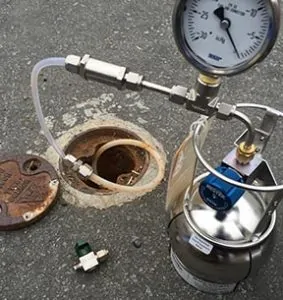
If contamination is present, results are compared to screening levels established by regulatory agencies or a health risk assessment (HRA) can be prepared. Either of these strategies can potentially be used to demonstrate that health risks are not significant for the property’s current or future use or to determine the level of remediation necessary.
Dealing with Significant Soil Vapor Contamination
If soil vapor intrusion poses a significant health risk, there are ways to mitigate that risk. Mitigation can include removal of the contamination, active mitigation of the contamination source, and protection against indoor air exposure. The approaches are not mutually exclusive, and multiple risk reduction strategies may be used.
The most effective way of reducing soil vapor risk is to remove or treat the soil or water that is the source. This remediation is the most cost-effective for small sources of contamination and when that contamination can be easily accessed. It is often not feasible to remove the source when contamination originates offsite and moves onto the property in a groundwater plume. It may also be more cost-effective to mitigate risk through other means when the source of the vapor intrusion is extensive or difficult to remove.
In active mitigation, soil vapor intrusion is mitigating by reducing contamination at the source. Active systems can include soil vapor extraction, in which vapor is collected and removed; in situ treatment, which uses chemical reagents to transform the contamination into less toxic chemicals; and containment of the contamination source by some form of barrier. Under ideal conditions, these methods have the potential to be highly effective in reducing contamination but monitor treatment for effectiveness and to determine that the resulting contamination levels are acceptable.
It is also possible to mitigate indoor air exposure to soil vapor intrusion. Underground vents, membranes, and seals beneath the foundation and slab depressurization can reduce the flow of soil vapor into a building. This type of passive mitigation leaves the contamination source in place, which may limit future uses for the contaminated property, but it may be more cost-effective than active mitigation, especially in cases where contamination originates off the property. Regulatory agencies typically require that properties mitigating the movement of soil vapor into buildings monitor the ongoing mitigation on a continuous basis with sensors and alarms or periodic resampling.
What You Need to Know
Soil vapor intrusion is a potential environmental liability, but it is manageable. Environmental due diligence can significantly reduce unforeseen costs of vapor intrusion by identifying the issue for proactive management before development, which is always easier and more cost-effective than trying to address a problem after development. It is possible to mitigate health risk from soil vapor intrusion on developed sites. Developers should work with qualified environmental consultants to address vapor intrusion through each stage of the process to adequately minimize risk.
 The CCAC Waste Initiative is hosting a webinar on Best Practices for Waste Characterization Studies on March 28, 2018 from 8:00 – 9:00 am ET. The webinar will be led by Brent Dieleman of SCS Engineers, on behalf of the U.S. Environmental Protection Agency.
Webinar Description
A waste characterization study is an important tool for helping local governments and private companies make decisions on the best solid waste management programs, policies, and technologies to reduce short-lived climate pollutants. Knowing what materials comprise your waste stream will help you establish the right mix of waste diversion and energy programs to make your community more sustainable.
This webinar provides information on how to conduct a waste characterization study, what data you can expect to obtain from a study, and how it can be used to make solid waste program and policy decisions. Topics of discussion during the webinar include:
Webinar access:
Join WebEx meeting
Meeting number (access code): 648 518 922
Join by phone
+1-415-655-0002 US Toll
Global call-in numbers
Thank you to the United Nations Environment, Climate & Clean Air Coalition (CCAC) for sponsoring this valuable event.
Corporate Headquarters