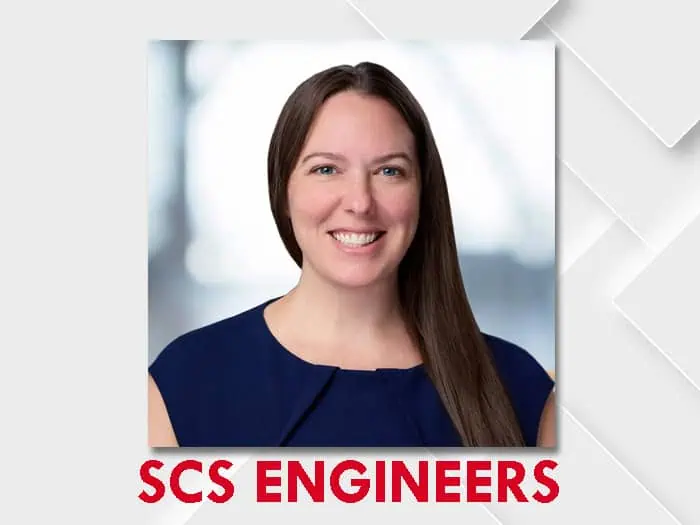
Ann Gibbs has joined SCS Engineers as a Senior Project Professional in the firm’s Sustainable Materials Management (SMM) practice. She brings more than six years of experience in the solid waste, recycling, and sustainability sectors, strengthening SCS’s capabilities in strategic planning, data analytics, and financial modeling.
Before joining SCS Engineers, Gibbs served as a Project Manager and Senior Data Analyst for an economic research and consulting firm, where she managed consulting and grant-funded projects for municipal, utility, and state-level clients. Her experience includes financial and rate-setting models, program cost forecasting, waste diversion analyses, and long-term sustainability planning.
“We are very excited to have Ann join our team,” said Senior Vice President Michelle Leonard. “Our clients expect data-driven rate structures, reliable cost forecasts, improved recycling and organics programs, reduced contamination, and practical long-term sustainability plans tailored to their communities, enhanced by her financial expertise.”
Her previous work includes an organics management planning initiative for the Colorado Department of Public Health and Environment that identified major diversion potential, compost demand possibly five times current production, and needs for infrastructure, education, markets, and coordinated policy; it later informed a state organics-diversion study and toolkit.
She also worked with the prestigious Environmental Research and Education Foundation on a contamination-reduction and recycling-system improvement strategy to benefit communities nationwide.
“I’m excited and grateful to join SCS and the SMM team,” said Ann Gibbs. “From day one, I’ve been impressed by how welcoming and collaborative the SCS team has been. I look forward to learning from the company’s deep expertise while helping communities of all sizes achieve their sustainability goals through practical planning, financial analysis, and sustainable solutions.”
On October 8, 2026, the U.S. Environmental Protection Agency (EPA) signed and posted a prepublication interim final rule extending the Reporting Year 2025 deadline under the Greenhouse Gas Reporting Program (GHGRP) from October 30, 2026, to March 10, 2027.
This is an interim final rule with a public comment period until November 30, 2026. As an interim final rule, it is effective immediately, but it could change after public comments are received/addressed.
The rule provides administrative relief, not a change in emissions requirements:
The new deadline is March 10, 2027, replacing October 30, 2026. Reporting obligations remain in effect unless EPA’s final reconsideration action changes them.
As EPA continues to reassess the GHGRP, the extension gives regulated entities more time to prepare and submit their Reporting Year 2025 reports. It also provides EPA additional time to consider more than 50,000 comments received on the GHGRP Reconsideration Proposal and complete any related final action. This timing will allow affected industries to account for any revisions EPA makes for Reporting Year 2025.
EPA will hold a 45-day public comment period beginning when it publishes the interim final rule in the Federal Register. EPA has not yet announced the exact comment deadline. [EPA Notices]
To read the prepublication interim final rule and related materials, visit the Rulemaking Notices for GHG Reporting page. For questions about your specific facility or industry, please contact SCS Engineers.
References:
ENVIRONMENTAL PROTECTION AGENCY
40 CFR Part 98 [EPA-HQ-OAR-2025- 0186; FRL-12720.2-01-OAR]
RIN 2060-AX07
EPA Rulemaking Notices for GHG Reporting
SCS Engineers will join refrigeration professionals from across the industry at the 2026 RETA-RSES National Conference, October 26 to 30 at the Caribe Royale in Orlando, Florida. The conference brings together operators, technicians, engineers, facility managers and environmental and safety professionals for technical education, professional development and industry networking.
SCS experts will lead sessions focused on refrigeration safety, management of change and practical tools for operators:
Connect with the SCS team at RETA-RSES to exchange ideas, discuss refrigeration challenges and learn more about approaches that support safe, compliant and efficient operations.
Join SCS Engineers at Booth #85 at SCANPH’s Annual Conference on October 8, 2026, at the Los Angeles Convention Center in downtown Los Angeles, CA. As Southern California’s largest regional affordable housing conference, the event brings together regulators, firms, and organizations involved in affordable housing development. Connect with more than 1,300 affordable housing thought leaders, policymakers, developers, and stakeholders from across California to explore solutions and tools that help ensure everyone in our communities has a safe place to call home. See you there.
Join SCS Engineers on October 6-7 in Winston-Salem for the North Carolina Environmental Conference. We are excited to support this event as a gold sponsor and will be exhibiting throughout the program. Swing by Booth 511 to say hello to our folks and learn more about our services and how we help advance environmental excellence in North Carolina.
SCS will also be hosting a panel breakout session on Tuesday, October 6, discussing “Air Permitting of Renewable Natural Gas Facilities and Landfill Energy Projects”. Moderated by David Greene, PE, our panelists, Andy Sheppard, Ryan Christman, PE, and Lucas Nachman, will be discussing the key regulatory requirements, permitting considerations and practical strategies for navigating the RNG facility air permitting process.
We look forward to connecting with you at NCEC. Register at the event site here!
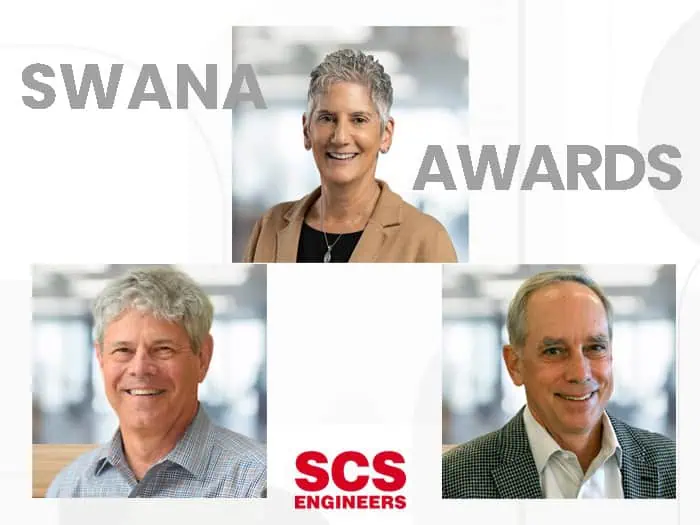
Please join SCS Engineers in congratulating three outstanding colleagues being honored at SWANA RCon this year: Michelle Leonard, Pete Carrico, and Eric Peterson.
Michelle Leonard, Senior Vice President and National Expert in Solid Waste Planning, Recycling, and Sustainable Materials Management, will receive SWANA’s Robert L. Lawrence Distinguished Service Award, the association’s highest individual honor. Michelle’s career reflects decades of leadership in recycling, organics diversion, sustainable materials management, mentorship, and professional service.
Pete Carrico, Senior Vice President and Business Unit Director of SCS Field Services, will receive the SWANA Landfill Gas and Biogas Division Hall of Flame Award, recognizing more than 40 years of sustained contributions to landfill gas systems, operations, monitoring, troubleshooting, safety, and industry education.
Eric Peterson, PE, Vice President and Director of SCS Engineers’ Medford, New Jersey office, will receive the SWANA Landfill Gas & Biogas Technical Division Distinguished Individual Achievement Award for his long-term service, technical leadership, landfill gas recovery expertise, renewable energy work, and commitment to mentoring the next generation of professionals.
These honors reflect the depth of talent, service, and innovation across SCS Engineers and our continued commitment to helping communities and clients advance practical, sustainable solutions in solid waste, recycling, landfill gas, biogas, and resource management.
Congratulations, Michelle, Pete, and Eric. We are proud to celebrate your well-earned recognition and your lasting impact on SWANA, SCS Engineers, our clients, and the solid waste and recycling industry.

On September 14, 2026, the Environmental Protection Agency (EPA) finalized the repeal of most 2024 federal greenhouse gas standards for power plants and proposed eliminating the remaining requirements. The EPA argues that the previous rules exceeded its Clean Air Act authority, relied on inadequately demonstrated technologies, effectively forced plant closures, raised electricity costs, and produced limited climate benefits. EPA claims $310 billion in savings, plus $370 million in direct compliance savings if the proposed repeal is finalized.
Coal and Gas Plants Could Gain More Runway
The power industry in the United States has largely pulled away from coal-burning generation, but reliance on natural gas has grown and remains a dominant energy source. [1, 2]. The repeal could extend coal and natural-gas plant operations, delay retirements, increase fossil-fuel demand, and expand reliable power capacity for manufacturing and energy-intensive AI data centers.
Clean-Energy Projects May Lose a Regulatory Tailwind
Utilities may avoid emissions-control investments and federal carbon-reduction planning, while renewable energy, storage, and carbon-capture projects could lose regulatory incentives. Because power plants are a major source of U.S. greenhouse-gas emissions, the changes could also increase emissions and slow national climate progress.
State Climate Programs Remain in Play
At the state level, the repeal would eliminate federal requirements for states to prepare and enforce carbon-reduction State Implementation Plans for existing power plants. Fossil-fuel-heavy states could allow utilities to operate plants based more heavily on cost and reliability without meeting federal emissions limits. However, the rollback does not override independent state climate laws, permit conditions, clean-energy standards, greenhouse-gas targets, or cap-and-trade programs. States including California, New York, and Massachusetts could therefore continue imposing stricter requirements, widening the regulatory divide between states.
Reporting Duties Are Not Going Away
Repealing power-plant emissions standards does not automatically eliminate separate climate-reporting obligations. Facilities may still be required to measure and report greenhouse-gas emissions under applicable federal reporting programs, environmental permits, and other regulations. These reporting requirements generally disclose emissions data but do not necessarily require facilities to reduce those emissions.
Companies are advised to distinguish between the removal of federal emissions-control requirements and their continuing responsibility to monitor, document, retain, and submit emissions information. Remember that the EPA’s federal Greenhouse Gas Reporting Program (GHGRP) deadline for 2025 remains October 30, 2026, even as proposals to dismantle or scale back the program move through the regulatory pipeline.
Multi-State Compliance Will Get More Complicated
State obligations will vary considerably. Facilities may remain subject to state emissions inventories, air-permit reporting, cap-and-trade reporting and verification, clean-energy program disclosures, or other state-specific greenhouse-gas requirements. Companies operating in multiple states may need separate reporting procedures for each jurisdiction, even when federal power-plant standards no longer apply. Contractual reporting commitments and corporate Scope 1 and Scope 2 inventories may also continue independently of regulatory changes.
Legal Challenges Keep the Timeline Uncertain
Several states are already challenging the repeal in federal court, creating uncertainty over when the changes will take effect and whether future administrations could restore national standards. The proposed repeal must still complete a public comment and finalization period, so affected companies should continue meeting current federal and state requirements while monitoring rulemaking, litigation, permit conditions, and reporting deadlines.
Additional Power Plant and GHG Reporting Resources:

With the publication of new landfill rules, landfill management is shifting from periodic compliance using decades-old technology to more rigorous methane management using the newest monitoring technologies. Landfill operations must quantify emissions, install new or upgrade existing gas control systems, monitor using ground-based and remote methods, make repairs more quickly, and maintain audit-ready records.
SCS Engineers, North America’s most recognized landfill service provider, publishes technical bulletins that summarize each rulemaking to highlight the most significant factors that will affect landfill operators.
You will find these publications below, along with our recommendations for identifying and addressing the requirements a landfill must meet to comply with the new standards. By clicking the underlined jurisdiction, you will be directed to more detailed information on the rules.
If you have not already done so, SCS recommends a gap analysis to outline the operational, monitoring, design/construction, and technological changes landfill operators face. The results will support a compliance roadmap: emissions modeling, GCCS capacity review, necessary system upgrades, corrective actions, remote monitoring readiness, leak response staffing, digital recordkeeping, capital budgeting, and site-specific deadlines by jurisdiction.
California: Prepare for faster plume response, including investigation and repair of methane plumes detected by CARB-approved remote sensing technologies, and required monitoring of unsafe-to-walk areas using new technologies.
Maintain rapid repair workflows: for example, the current LMR requires that exceedances be remediated and re-monitored within 10 calendar days, whereas the new standard requires corrective action to begin within 3 calendar days.
Verify that all control devices can meet the 99% methane destruction efficiency standard, with annual source testing and recordkeeping, not just flares.
Plan for increased stringency in almost every aspect of the new rule.
Colorado: Align landfill compliance programs with Regulation 31, Control of Methane Emissions from Municipal Solid Waste Landfills, effective February 14, 2026.
Prepare for waste-in-place/GCCS determinations, gas collection and control requirements, surface emissions monitoring, remote methane monitoring, cover requirements, recordkeeping/reporting, and test-method compliance.
Canada: Determine applicability, calculate annual methane generation with ECCC’s Landfill Methane Modelling Tool, and prepare Methane Generation Assessment Reports; additional requirements apply to emissions above 664 tonnes/year for open landfills and 1,000 tonnes/year for closed landfills.
Plan for new gas systems or upgrades to existing systems by the deadline: 2028 for ≥1,000 tonnes/year with existing recovery systems; 2029 for ≥1,000 tonnes/year without recovery systems; and 2035 for 664–1,000 tonnes/year sites.
States Actively Considering or Developing New Rules
Across North America, we urge operators to build a compliance roadmap now. Stricter rules are in effect in Canada, Colorado, California, Oregon, Washington, and Maryland. They are under consideration in many more states, including Illinois, Michigan, New Mexico, New York, North Carolina, Pennsylvania, and Virginia.
Additional Resources:
SCS Engineers is participating in San Diego State University’s STEM Career and Internship Fair on September 10, 2026.
This event is a great opportunity for all students and alumni to connect with a diverse array of employers, from corporations to nonprofits, for internships, part-time, and full-time positions.
SCS is an employee-owned, award-winning environmental engineering, consulting, and construction firm with offices nationwide. We are seeking a wide variety of dedicated, hard-working professionals with Science, Technology, Engineering, and Mathematics (STEM) backgrounds. Learn about internships at SCS and browse entry-level environmental jobs. Register today!
SCS Engineers is excited to participate in the University of Wisconsin-Madison Engineering Career Fair on September 15, 2026. We’re looking for talented Engineering and STEM majors at all degree levels who want to explore summer internships, co-ops, or full-time opportunities after graduation. The career fair provides an excellent opportunity for students pursuing degrees in Engineering and STEM fields to learn about exciting career paths with SCS Engineers, where innovation meets environmental solutions.
Stop by our booth to meet with our team and discover how you can kick-start your career with a leader in environmental consulting! Click to learn more.
Corporate Headquarters