SCS Engineers announces today that they are a founding sponsor of WISR – Women in Solid Waste & Recycling. WISR is the first of its kind nonprofit organization created in 2017, dedicated to preparing women for leadership positions in the industry by organizing chapters in key industry centers and providing opportunities for networking, leadership development, career mapping and mentoring. SCS Engineers’ support will help establish education programs in leadership as well as contribute to the creation of new chapters in at least six cities by the end of 2019. WISR is in the process of forming chapters in key industry centers — including Los Angeles, New York City, and Atlanta — that will offer quarterly programs including professional development with skills training, site tours, networking and leadership training.
“We look forward to meeting with colleagues in the solid waste, recycling, and environmental services fields to share our scientific, financial, and technical knowledge to move sustainable waste management forward in the U.S.,” stated Michelle Leonard, a vice president of SCS Engineers. “WISR will help us make a difference; for women and for the industry.”
Ryan Joslyn
University of Central Florida, MS
Robert P. Stearns/SCS Engineers Master’s Scholar
Project: Field Investigation of an Elevated Temperature Florida Landfill
For reasons that are not entirely clear, incidents of elevated temperatures in municipal solid waste landfills are occurring at increasing frequency. These landfills present temperatures that well exceed the range tolerable for micro-organisms (~176°F). Given the significance of elevated temperatures at landfills and the growing number of landfills with these issues, the goal of Joslyn’s research is to develop a more complete understanding of elevated temperature landfills using landfill gas and leachate monitoring data, specifically in the state of Florida.
Robert P. Stearns, Chairman and CoFounder of SCS Engineers, joined the EREF Board of Directors in 1999 and served as Chairman from 2004–2005. At SCS, he directed or served in a review capacity on many of the firm’s solid waste management-related projects. In 2007 EREF awarded the first Robert P. Stearns/SCS Engineers Master’s Scholarship, which was established to expand EREF’s successful doctoral-level scholarship program.
In this day and age, a back office customer information software system is a “must” for solid waste agencies managing inventories, work orders, and large numbers of customers.
However, many solid waste agencies have inadequate computer hardware and software systems to enable tracking of work productivity and customer service. Oftentimes, many use a combination of an Excel-based software system and manual card systems to track residential and commercial accounts. To the world of business operations, these manual systems are analogous to a stone and chisel versus a typewriter.
There are a wide variety of management information and software products used by solid waste agencies across the U.S. Each has its particular advocates and uses in the solid waste management practice. This article will provide an overview of the major trends in software development.
About the authors: Marc J Rogoff, Ph.D. and Laurel C. Urena, M.S.
Read and share the WasteAdvantage article describing the solution process here. Written by:

Increasingly, solid waste and recycling agencies are being asked by their political decision makers to improve efficiency, focus on customers, and reduce increased costs. Many agencies are managed with a combination of manual processes, desktop computer tools, limited vehicle and cart tracking and management tools, and custom databases. While effective, these methodologies often entail more effort, labor, and costs.
Smart technologies are expected to grow substantially over the next decade as agencies attempt to minimize their overall costs in solid waste collection and recycling and increase overall efficiency. As discussed briefly in this article, smart technologies have advantages and disadvantages. As agencies investigate technology to help support their service, ensure continued quality service delivery and meet demanding business requirements, it is important to conduct feasibility assessments to evaluate the economic costs to implement and update the use of new technologies in a sustainable manner.
Marc J. Rogoff and Laurel Urena of SCS Engineers.
SCS Engineers’ Phillip E. Gearing, PE is a winner of the SWANA 2017 Young Professional Award from the Wisconsin Badger Chapter. The Solid Waste Association of North America honors individuals like Phil who make a significant difference in the solid waste industry.

Phil represents the best of the young professionals working within Wisconsin’s solid waste industry. Clients, contractors, and team members appreciate Phil’s leadership and passion for doing the job right.
He is a dedicated father of three children and an avid fan of all things Wisconsin, namely Badger sports, Green Bay Packer football, and Brewer baseball. Wisconsin from head to toe! Phil was raised on a dairy farm in Jackson County near Merrillan and attended the University of Wisconsin – Madison where he earned his B.S. in Geological Engineering, Geology, and Geophysics.
Phil serves clients out of the SCS Engineers office in Madison, WI.
Read about Phil’s work and SWANA award here.
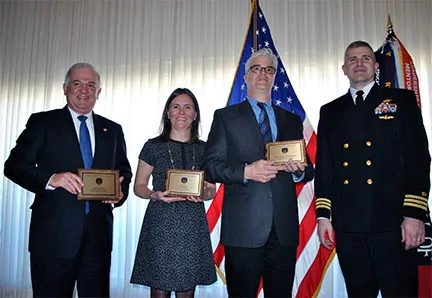
The Society of American Military Engineers recognized SCS Engineers for their 15 years of service and volunteer support at the District of Columbia post this month. The award was presented by Commander Craig Clutts of the US Navy, the Outgoing DC Post President.
On hand to receive the award for SCS was John Tabella, PG, LEED AP®, National Expert for Environmental Due Diligence and for Federal Services; Heather Blake (pictured), Federal Marketing Coordinator, and Dave Hostetter, PE, LEED AP®, and CEM at SCS Engineers.
SCS Engineers has a very long track record of solving environmental and energy management, solid waste, hazardous waste, water, and air compliance challenges. Approaches we pioneered include risk-based cleanups, voluntary cleanups, accelerated investigations, presumptive and sustainable remedies, environmental management systems, energy systems, and waste minimization. These approaches are at the forefront of local and Federal environmental and energy programs today.
SCS provides professional engineering and scientific services with a focus on environmental protection and conservation of resources. Our clients come back because we find practical approaches to even the most complex environmental challenges.
Getting a firm handle on a solid waste operation and expenses is a challenge for any solid waste agency manager or landfill operator. It is particularly imperative in this era of “lean and mean” budgets and looming regulatory policy. Doing more with less is the watchword for most operations across the country still reeling from the financial impacts of the Great Recession.
SCS Engineers has created a package of articles to help you identify if your landfill, landfill gas, or solid waste operation is ready for 2017. We hope this useful guidance will help you plan for the upcoming year. SCS professionals are always available to answer questions and provide advice. Find the office or SCS professional nearest to you by clicking on one the links here: Offices and Professionals.
Download, print or share this package by using the download button under the articles or by using the navigation at left. The package includes the following information written by SCS National Experts:
Read the full article by Marc Rogoff, SCS Engineers.
Do you have NSPS or EG sites per the new definitions of “new” and “existing”?
Does your EG site have any upcoming planned or permitted expansions, or will it be commencing construction on an expansion permitted after July 17, 2014?
Will you need to submit/resubmit Design Capacity and NMOC reports to establish your sites status as subject to the new NSPS? Over, or under 34 Mg/year of NMOCs?
Are you a candidate for Tier 4? In the closed landfill subcategory?
For EG sites contact the SCS state representative by sending a request to
SCS Engineers will be publishing Pat Sullivan’s Technical Bulletin Summary of Final NSPS/EG Rules for Landfills as soon as it is published in the federal register. Meanwhile, please contact your SCS Project Manager or for answers to your questions or advice. Follow SCS Engineers on your favorite social media site or check our events for new presentations, publications, and webinars explaining the rules in more detail.
Corporate Headquarters