Kacey Garber wanted to be a storm chaser when she grew up, trained to detect and alert others of brewing severe weather. But then she found geology and went on to earn graduate and postgraduate degrees in this discipline, which brought the summa cum laude scholar to SCS Engineers. Her charge is groundwater protection, an area where she aspires to grow her expertise further.
The young professional (YP) is already moving quickly along that trajectory, beginning by supporting landfills and utilities and now applying her strong skill set in a highly specialized, fast-evolving arena – deep-well injection.
A common thread binds Garber’s main interests – groundwater protection, geology, and meteorology/trained weather spotter, which she still does in her spare time.
“What draws me to these niches is the thrill of being part of the scientific community collecting and interpreting compelling data to figure out solutions. And not just any solutions but those with the promise of helping protect people and the environment. That’s where I want to have an impact,” she says.
She’s heard of climate change almost her whole life and has thought for almost as long that someday she would play some problem-solving role to help mitigate its effects.
Garber splits her time at SCS between several areas. She monitors and tests groundwater for landfills, closely following both active and closed sites, and helping landfills prepare for post-closure. She supports electric utilities with groundwater issues potentially related to their closed coal ash ponds and disposal sites. And now, she is leading groundwater protection tasks for class VI deep-well injection projects as part of a dedicated team that permits and builds these wells.
The cutting-edge, EPA-regulated technology injects and stores carbon dioxide underground safely, preventing this potent greenhouse gas from releasing into the atmosphere.
Garber’s on-the-job experience in the field is paramount to her new, added role. Her studies in geology focused on sedimentary basins are also proving important.
“Sedimentary basins [where large bodies of rock occur] are ideal spots for carbon sequestration. But first, you must understand the geologic characteristics of the basin and each rock formation and determine exactly which locations within the basin are best for injecting and storing carbon dioxide. That’s a big part of what I do to ensure efficiency and safety,” she says.
In her eyes, Garber lives and works in the best of two worlds in that she can concentrate on different but related interests.
“Joining our deep-well injection team brings me back to my roots in traditional geology. But it also enables me to stay on the groundwater monitoring track, which is meaningful as I aim to position myself as a national expert who can do this important work. Ensuring water quality is critical to protecting the environment and communities, as a large part of our country relies on groundwater for its water supply.”
As she grows her reach into deep-well injection, she grows her relationships too. The multidisciplinary team—all new colleagues to her a year ago are her newest work family addition.
“It’s humbling to partner with so many incredibly smart people, each with their respective areas of expertise. We’ve come to trust each other’s judgment as we solve issues together. And as it turns out, we have a lot in common, especially our love of nature—the joy we find in being outdoors, camping, and hiking.”
Getting a foot in the door of a nationwide environmental firm has been good. Especially one that welcomes YPs and is vested in their career development, something she found uncommon among companies with as great a geographical reach and breadth of expertise.
She seized the opportunity.
“I saw it as a way to gain visibility early in my career. And to become well-rounded in my discipline. We perform groundwater monitoring for many project types, and there are parallels in how it’s done in each; I can support and learn from all of them.”
At the same time, she explores other specialized areas.
“There are designated experts here at SCS in many professions and industries dedicated to caring for the environment. They are great resources to learn from.”
Where she would land one day was unknown for a while. Garber thought she’d become a professor or researcher at one time. But that changed when she interned with the United States Geological Survey, venturing beyond the classroom and lab to assess land use impacts on water quality and floodplains.
“I liked solving problems out in the field and decided pretty quickly that’s where I wanted to be,” she says.
The desire to teach is still in her, though. She travels state to state, presenting to regulators, technology experts, and other seasoned professionals and decision-makers on groundwater modeling, monitoring, and testing.
She also reaches out to ambitious geology students, visiting them on campus to tell them about deep-well injection and carbon sequestration and that the company she works for does these projects around the country. Their curriculum rarely includes an introduction to this specialized niche.
Remembering herself as one of them, Garber says, “I didn’t know of this work in college. I first learned as a newcomer to SCS.
It intrigued me, and I was excited to hear that the deep-well injection group needed a team member with a strong monitoring background. Later I thought, how cool it would be for students to discover this potential career path early.”
How else does she fill her days? Besides watching for and reporting developing storms to weather bureaus– she called in a funnel cloud once out in the field—she plays guitar in a local band.
Sometimes she goes solo and has played and sung at a nearby rehabilitation center and nursing home.
“I love playing music. It makes me happy. But what really feels good is to play for folks, especially those who may be more limited in what they can do and where they can go. For them, listening to music and dancing seems to be the highlight of their day. It makes me happy to see them happy.”
Ensuring a safe, healthy environment and a better world for everyone is about a commitment to people, community, and hard work. Thank you, Kacey Garber, for your dedication to keeping our groundwater safe, for helping execute innovative solutions to advance sustainability, and for bringing a lift to others along the way.
You, can make a difference in your life, your work, and your community!
The technology of safe wastewater sequestration into deep formations has been in use for more than 60 years. As deep well injection is gaining interest for the management of industrial wastewater, one of the more frequently asked questions is whether an injection well is feasible in a specific location.
Detailed feasibility studies dive deep into the many considerations that are the basis for a preliminary deep well injection system design, estimated costs to drill and operate, determination of a return on investment, and project schedule. But first, you’ll want to gather enough information to move forward confidently with an investigation.
Find the Fatal Flaws First
The diagram below illustrates a high-level process for identifying obstacles that may represent a fatal flaw to Class I injection well construction and operation in a particular location.
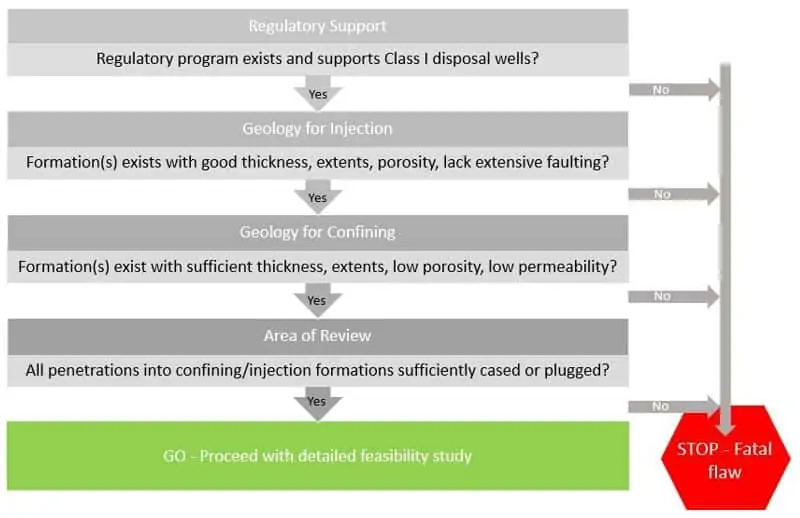
We’ll walk through this evaluation sequence to determine whether additional resources are justified to study injection well technologies for your facility by answering two questions:
Does Your Local Regulatory Program Support Deep Well Injection?
The U.S. Environmental Protection Agency (USEPA) regulates injection wells under the 1974 Safe Drinking Water Act with stringent criteria governing the construction and operation of injection wells for industrial wastewater. There are six defined classes of injection well types, each based on the type of disposal activity. Class I wells are useful to inject non-hazardous or hazardous industrial process fluids into deep, isolated rock formations.
Thirty-one states and three territories are the permitting authorities, with primacy delegated to its regulatory program that meets or exceeds the minimum standards established by the USEPA. One of ten regional USEPA offices issues permits and regulates Class I injection wells in the nation’s balance where authority remains with the USEPA. Most USEPA regions, states, and territories have a favorable outlook on the construction and operation of injection wells. Although permitting hazardous injection wells in some states is permissible, you can expect a more robust permitting effort and additional costs for financial assurance.
Following a determination that injection wells are permissible at a specific location, it’s important to identify whether active or plugged Class I injection wells exist within the respective state. The technology of wastewater sequestration into deep formations has been in use for many decades, so the absence of active or abandoned injection wells in an area where regulatory support is present may raise flags related to permitting hurdles or the sufficiency of the local geology.
We’ve prepared a table containing Class I industrial injection wells’ permissibility and existence by state, current at this publication. It is a compilation of various USEPA regions, states, and territories program websites. Since the concentration of total dissolved solids defines protected aquifers, those with 10,000 mg/L or less are considered potential underground sources of drinking water and are therefore strictly prohibited from injected fluids.
Is Your Local Geology Sufficient for an Injection Well?
Considerations for suitable geologic conditions include rock formations that provide sufficient capacity for injected fluids while preventing the upward migration of injected fluids into protected drinking water aquifers. You’ll find regional and local geological information through public sources like the U.S. Geological Survey, state geological surveys, local oil and gas associations, universities, and private clearinghouses.
A sufficient injection zone consists of formation(s) with adequate thickness, high porosity and permeability that can accept the fluids at the proposed injection rate and pressure required to handle the anticipated disposal volumes. These are typically high porosity limestone, dolomites or sandstones at depths exceeding 3,000 feet.
Shale, low permeability limestone, or a sequence of rock types low in porosity and permeability act as “caprocks,” creating a confining zone. These are typically 200 to 1,000 feet above the injection zone but below the base of the protected underground drinking water sources.
Artificial penetrations may consist of oil and gas wells and mining and exploration boreholes. A lack of artificial penetrations within approximately two miles of the desired injection well reduces the potential for artificial vertical migration pathways for injected fluids to reach the protected drinking water aquifers. In some cases, wells or boreholes may penetrate the top of the designated confining zone. In these cases, it is important to obtain abandonment records to demonstrate the occurrence of proper plugging so that the injected fluids stay in the injection zone.
A continuous gentle subsurface geologic structure, lacking faulting and folding, is ideal for reducing the potential for injection-induced seismicity. Complex geologic structures, such as major faults, may act as natural vertical migration pathways for injected fluids to reach the protected drinking water aquifers. Some faults may have the potential to respond to the injection of fluids through seismic action. Although all jurisdictions don’t require an evaluation of the induced seismicity component, it may have local implications in areas with dense oil and gas production.
This two-component evaluation helps identify high-level obstacles that may represent a fatal flaw to the installation or operation of an injection well. A detailed feasibility study may be the logical next step if your facility passes such an evaluation. Feasibility studies build upon the evaluation to provide you with specific information and requirements, including:
SCS’ injection well practice is available to address your questions on whether this disposal technology is appropriate for your facility.
Additional Resources
Video: Leachate and Other Industrial Fluid Injections
Paper: Managing Industrial Liquids
Paper: Deep Disposal Well Considerations for Leachate Management
About the Author:
 Stephanie Hill is a Professional Geologist licensed in Florida, Kentucky, Illinois, and Texas and is a key member of the Deep Well and Underground Injection Control practice. Her experience includes permitting and regulatory compliance for underground injection control and coal mining, hydrologic investigations, and identifying large-scale environmental impacts to surface and groundwater resources from various industry practices.

There are many methods and actions businesses, industries, and consumers are taking to mitigate the generation of carbon emissions, such as recycling, composting, and moving to hydrogen-power vehicles, to name a few. There is no one-size-fits-all solution, the answer to cleaner air, water, and soil vary widely and work differently, but all aim to achieve the same goal. We, as environmental engineers, have the benefit of helping our communities and industries move forward using a variety of new technologies that support the lowering of carbon emissions and are sustainable.
SCS Engineers works behind the scene with many clients and thought we’d share some of their new technologies and processes that are expected to help lower greenhouse gases in the future. We kick off this series with Charm Industrial’s new method that captures atmospheric CO₂ in biomass, then converts it to a liquid and injects it into rock formations that have stored crude oil for hundreds of millions of years. While recycling and low emission vehicles lower the generation of CO₂, this one is engineered to extract existing gases and remove them.
You can learn more on the Charm Industrial website or visit SCS’s Liquids Management page for more environmental solutions.
Understanding the entire range of wastewater management and disposal alternatives can be a daunting task, particularly as increasingly stringent surface water discharge standards take effect or as zero discharge facilities find the management of their waste liquid needs changing over time. Former solutions are no longer options or may be too costly. One alternative that is rapidly gaining traction is deep injection wells.
Deep well injection is a viable leachate management option in many parts of the United States, yet it is often screened out as a possible alternative due to a lack of understanding of the technology or gross misconceptions about its acceptance or applicability. The purpose of the Monte Markley’s paper The Basics of Deep Well Injection as a Leachate Disposal Option is to present the basic technical, economic and regulatory considerations of deep well injection as a technology a facility should evaluate when considering the applicability of geologic sequestration of leachate.
Technical criteria discussed are potential disposal volumes, geologic suitability, chemical compatibility, pre-treatment requirements, and leachate chemistry. The economic considerations are evaluated based on the technical criteria noted above, management of public perception/relations, current leachate management expenditures, the service life of the asset and risk to develop accurate capital, O&M costs, and return on investment. Regulatory considerations include the role of state vs. federal primacy for each state, the general stance of regulatory acceptance in specific areas of the United States, and a discussion of the permitting process and typical reporting requirements.
These key considerations are then integrated into an overall suitability evaluation that an owner can utilize to accurately determine if deep well injection is a viable option and, if so, how to educate other stakeholders and manage the process of implementation as a project moves forward.
About the Author: Monte Markley, PG, SCS Engineers
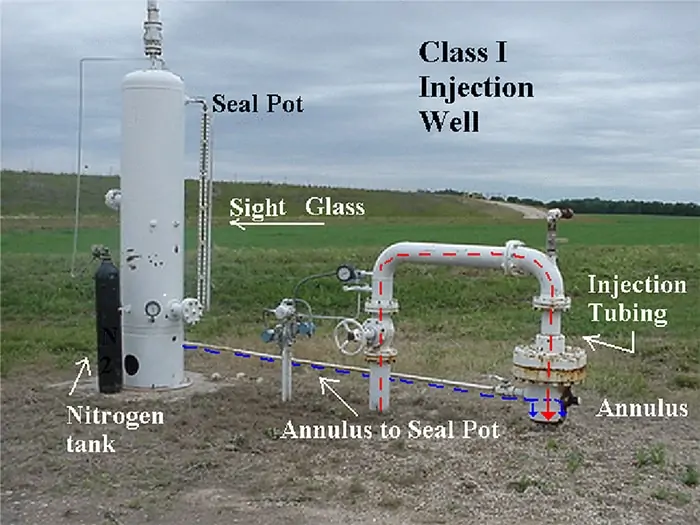
High-pressure injection of liquids can be challenging in Class I wells where depths exceed 10,000 feet and extreme temperature variations occur between injection and shut-in conditions. Elevated downhole temperatures at these depths create a high-temperature differential between the injectate and annular fluid resulting in significant swings of annulus pressure and surface seal pot volumes. One-way micro tubing leaks at joints have also occurred due to these conditions.
The injectate cools the annular fluid resulting in contraction of the annular liquid and lowering of the seal pot volume, which requires the addition of fluid into the annulus. Once the wells are shut in, annular pressures rise as the annulus fluid is warmed by the native formation fluid, creating an increased pressure differential on the downhole components and increasing the seal pot volume and potentially creating high-pressure situations in the annulus. In addition to the labor-intensive operation of having to add and remove liquid from the annular space, greater downhole pressure differentials may affect long-term integrity of the injection tubing and protective casing.
Maintenance of an annulus pressure that is less than the injection pressure, similar to the operation of more shallow Class I wells, is impractical under the operating scenario for deeper wells. It also creates the potential for fluid migration from the tubing into the annular space in the event of a leak.
Monte Markley, P.G., and Stephanie Hill will present this and more at the 2018 Underground Injection Control (UIC) Conference. The presentation will focus on the design and implementation of an innovative high-pressure annulus monitoring system that mitigates the presence of micro tubing leaks in joints, and pressure and temperature swings of the annulus.
Corporate Headquarters