EPA is hosting a free workshop in January on landfill monitoring and emissions. The workshops are scheduled twice, over half-day sessions. These sessions will include presentations highlighting the latest technological developments for monitoring and measuring landfill gas emissions.
Dates and Times: Register once for both sessions.
If you have any questions, please contact Shannon Banner at or John Evans at .
As large tracts of geographically desirable vacant land become scarcer, residential and commercial property developers are increasingly turning to old landfills or former dumps. However, such redevelopment is complex and rife with uncertainties. When compared to greenfield development, the land acquisition costs are lower. Still, any savings are typically offset by greater environmental and infrastructure costs associated with the foundation, landfill gas management, stormwater management, groundwater impacts, meeting closure requirements, and multiple regulatory agency coordination. Therefore, it is important to maximize the developable area while providing engineering solutions to make the project economically feasible. In this blog, we identify some options to reuse challenging sites and lessons learned to contribute to successful redevelopment projects.
Deep Dynamic Compaction
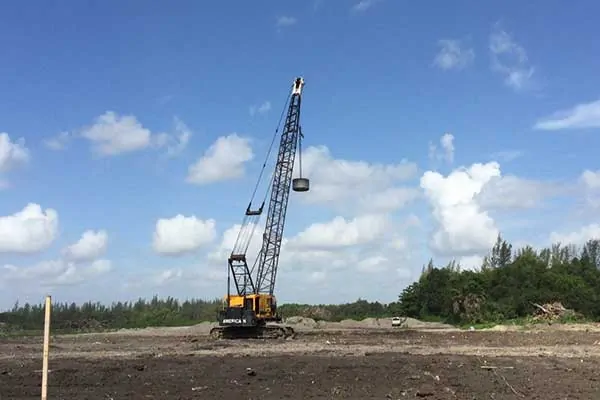
Old landfills or dumps present some unique soil stability challenges. Deep dynamic compaction (DDC) is a ground stabilization technique that has gained popularity in recent years to improve subsurface soil conditions. DDC involves dropping 6 to 30-ton weights from a height between 30 and 75 feet to achieve the desired soil compaction. DDC can effectively apply to a range of subsurface materials, including former C&D debris or municipal solid waste dumps.
DDC provides a stable foundation for future development, minimizes differential settlement while leaving the landfill waste in place, and eliminates the costs associated with removing, transporting, and disposing of buried waste, costing millions of dollars. For simplicity’s sake, let’s consider a 1-acre old landfill or a dumpsite with an average of 15 feet of waste. If excavating the waste and replacing it with clean fill, the disposal fee costs for the excavated waste alone could exceed $400,000. Alternatively, DDC costs range from $1.50 to $2.00 per square foot or $65,000 to $87,120 per acre, excluding mobilization, which costs around $30,000.
Gas Mitigation Systems
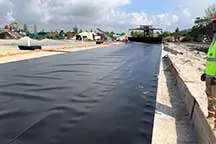
Constructing buildings on top of dynamically compacted areas generally requires a combustible gas barrier layer below the building foundation to manage subsurface combustible gases (typically methane). The barrier is required because the waste remains in place. In its simplified form, gas mitigation systems include:
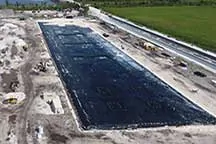
These gas mitigation systems can be either a passive or an active system with a blower. The cost of such systems varies depending on the size of the building, location, and type of liner system used. Typical capital costs for passive systems are in the range of $7 to $9 per square foot for the spray-applied liner and $3 to $4 per square foot for the HDPE liner. For an active system using blowers, add $3 to $4 per square foot. The designer configures a system from these options to address the client’s risk preference and considering future tenant preferences.
Using innovative approaches, impaired lands are increasingly attractive to developers. Beyond the cost-saving benefits to developers realized through DDC and an appropriate gas mitigation system, such projects also create local jobs, increase the tax base, and protect public health and the environment.
About the Authors:
 Somshekhar Kundral – Mr. Kundralis, PE, is a Senior Project Manager with over 12 years of broad and diverse environmental engineering experience that includes projects in landfill redevelopment, landfill gas management system design, site assessment, groundwater remediation system design, stormwater management, and injection well system construction. Som is experienced with site permitting, compliance reporting and construction administration services, and remediation systems’ operation and management.

Maura Dougherty is joining SCS’s Southwest Business Unit as a Senior Project Manager in the solid waste engineering practice. Dougherty will execute engineering design, operations support, and construction quality assurance projects. She is responsible for project management, client service, business development, technical leadership, and overseeing professional staff teams. Dougherty reports to Vice President and Southwest Business Unit Director of Engineering, Vidhya Viswanathan, P.E., from SCS’s Pleasanton office.
“Maura is a senior professional with proven extensive success in solid waste engineering, construction, and construction quality assurance solutions,” said Viswanathan. “Her experience managing landfill and landfill gas collection and control system engineering and construction projects strengthen our efforts to support our solid waste and recycling clients.”
Dougherty is a registered Professional Engineer in California, Oregon, Washington, and Hawaii. She brings over 20 years of experience overseeing landfill engineering and construction projects, coordinating with regulatory staff, conducting design and technical reviews, and supporting construction work. Dougherty earned her B.S.E. in civil engineering at the University of Princeton and her M.S. in environmental engineering from U.C. Berkeley.
Register for SCS Engineers’ January webinar to learn more about the proactive strategies and practices you can implement at your critical solid waste facilities. This free webinar will help you develop capabilities to assess the potential for odor issues and, by doing so, set realistic benchmarks toward cost-effective and meaningful mitigation measures.
DATE: Thursday, January 21, 2021 TIME: 2 p.m. ET
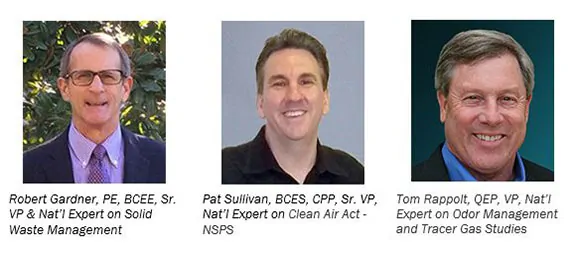
Our panelists bring comprehensive expertise to the table, including facility design and planning, technical experience in air quality compliance and pollutant dispersion and air measurement programs, atmospheric dispersion and transport of airborne pollutants, particularly in the area of complex terrain. They will provide decades of strategies, resources, and best practices and technologies based on successful solutions that help support your facility as you prepare for, and likely will, experience odor complaints.
The team answers questions throughout the presentation, and the second portion of the program is devoted to Q&A and idea exchange.
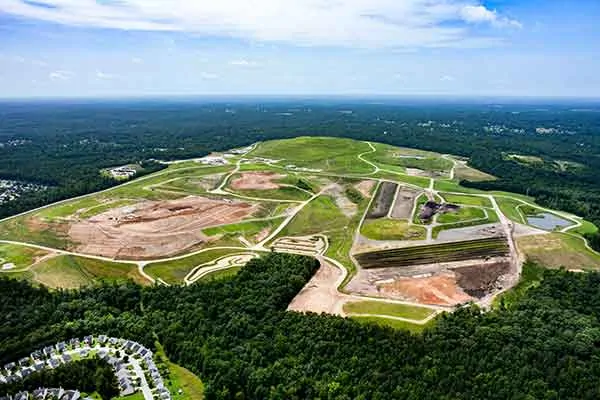
It is not out of the ordinary to see several different landfill designers providing services at a specific site over many years. Each landfill designer brings his/her preferences and designs to the owner, depending on the urgency of the projects and the owner’s willingness to accept new concepts.
Experienced landfill designers review the prior history of design work at the facility and ensure that their new design work is compatible with previously developed cells and final covers. Lack of such due diligence could impede landfilling operations following implementation of the design with implications that may survive for many years to come at a high cost to the owner.
Proper due diligence may reveal issues that the owner may not be aware of. In such cases, the new landfill engineer attempts to explain the observed issues from a previous design to the owner’s attention during one or more meetings or through a narrative report including documentation of the issues and measures to address each issue. The owner may accept or reject the technical matters brought to their attention by the new landfill designer. If accepted, authorize the new design engineer to prepare proper plans and details, and assist in retaining a contractor to fix noted problems. If rejected, the new landfill engineer can feel confident he/she is professionally conducting himself/herself considering the ethical obligations in his/her profession.
If the new landfill engineer had not brought up issues discovered during the due diligence, the owner could blame the new designer claiming that he/she should have known better. Such situations do not get resolved easily and could lead to another change in the design team.
The cost of performing thorough due diligence may not be in the first task order’s budget. However, it will certainly pay off over time with back-to-back task orders from the owner when confidence n the designer’s capabilities build over time.
Changes to the landfill personnel may occur similar to any other organization. Landfill general managers, operation managers, site engineers, or compliance engineers may leave, and the position filled by a new person who has no site familiarity or history. These types of rotations can provide the opportunity for inexperienced landfill designers to influence the site’s long-term plans. Mistakes by inexperienced designers can last decades in some instances, while new and remaining personnel must deal with the consequences.
SCS’s project management protocols require project managers to constantly learn about the site’s history and review documents representing the backbone of the facility development over the long-term life of the site to the present. This type of continual learning of important matters and minute nuances of the site history equips a project manager to address technical and permitting issues based on knowledge of prior work performed at the facility. Implementation of new ideas based on prior knowledge of the site history is considered the backbone of properly managing projects and serving the client in consideration of their business priorities.
Past knowledge comes from documents prepared by prior designers and knowledge of site personnel who have been working at the site for a long time. Competent engineers welcome opportunities to interview and discuss site history, especially with long-term site personnel. The knowledge these people carry with them is not found in any document that the designer, if lucky enough to get his/her hands-on, may obtain by review. The knowledge of the changes to existing systems during original construction and a later date, which may not have been documented, can lead the engineer to concepts that otherwise would not have been envisioned without the long-term employee’s information of the site.
About the Author:
 Ali Khatami, Ph.D., PE, LEP, CGC, is a Project Director and a Vice President of SCS Engineers. He is also our National Expert for Landfill Design, Construction Quality Assurance, and Elevated Temperature Landfills. He has over 40 years of research and professional experience in mechanical, structural, and civil engineering.

SCS Engineers’ SCSeTools® platform and applications help facilities and companies operate more efficiently by continually gauging operational health and identify trends critical to operations and the environment.
SCS Technology Services®, the technology development practice within SCS Engineers, announces a new application for tracking and analyzing environmental data. The application expands the firm’s SCSeTools® platform, demonstrating its commitment to developing the most advanced data-driven technology in the environmental services industry.
Groundwater monitoring and compliance services are long-term and expensive responsibilities that generate enormous amounts of monitoring and laboratory data. SCS Groundwater™ is a tool to monitor and manage the data associated with operations and reporting requirements for various sites. Sites include active or closed landfills, plants, and impact sites such as former dry cleaners or industrial facilities.
The application also monitors and manages data effectively for clean groundwater applications such as groundwater basin management projects consistent with standard protocol under state and federal environmental compliance rules. SCS Groundwater™ collects and efficiently organizes groundwater monitoring and maintenance data providing those responsible for environmental compliance with a reliable, consistent, and cost-effective way to manage the large volume of information.
The application’s primary value is enabling users to set up a detailed monitoring plan for any number of events, including the sampling points to include and what analyses to perform at each point. Once the information upload is finished, the application checks incoming data against the plan to confirm all work is complete.
SCS Groundwater™ generates reporting components such as data tables, charts, graphs, and maps for compliance, reporting, and finding trends. For example, on a brownfield site, the compliance manager could upload historical monitoring data results, view the data trends over time, and then produce report tables and figures. Operators can also use the data in other applications for additional analysis or visualization.
SCS Engineers’ environmental solutions and technology directly result from our experience and dedication to industries responsible for safeguarding the environment as they deliver services and products. For information about SCS, visit the SCS eTools pages or enjoy our 50th Anniversary video to see the technology in action.
The SCSeTools® platform and applications help facilities operate more efficiently by continually gauging operational health and spot trends that help determine when and how to invest in infrastructure. Field staff, environmental compliance experts, brownfields, developers, and clients in the waste industry guide the technology designs. For additional information and demonstrations of these productivity-enhancing tools, please contact .

The events of 2020 have affected the economy, the way we conduct business, and even our social interactions. Now, more than ever, streamlining costs is key for public and private sector clients across the country. Enter groundwater monitoring projects.
Often overlooked as an opportunity to reduce costs, it’s an excellent place to start when examining the costly operational processes of a solid waste facility. Groundwater monitoring is often thought of as necessary for compliance requirements and overlooked when considering ways to reduce spending. However, the proactive review of all monitoring projects may offer monitoring reduction or even cessation opportunities.
SCS Engineers has successfully employed these strategies at several Florida landfills. For instance, in Marion County, the SCS team worked to get a cessation in landfill gas and groundwater monitoring at the Martel Closed Landfill. Hired to conduct routine post-closure monitoring, the team observed obvious trends in the data that were favorable to the County. If you consider that monitoring costs average $10,000 to $50,000 per year, the potential cost savings over ten years is $100,000 to 500,000.
Bottom line: you should take the initiative to ask a few simple questions to see if further examination is warranted. What if contaminants are naturally occurring? Is the data in the technical reports supporting conclusions that include reduction or cessation when appropriate? Are you simply meeting the minimum requirements of the permit without an eye on the future?
About the Author: SCS Project Director David Atteberry puts his 20+ years of environmental consulting and management experience to work for his clients. His technical experience includes geologic and hydrogeologic investigations involving hazardous waste, solid waste, environmental, and water supply. Dave’s technical areas of expertise include contamination assessments, remediation, site characterization, aquifer characterization, RCRA compliance, waste characterization, environmental due diligence, reserve budgeting, and field sampling techniques.
SCS Groundwater® collects and efficiently organizes groundwater monitoring and maintenance data providing those responsible for environmental compliance with a reliable, consistent, and cost-effective way to manage, view, and assess large volumes of information.
The application’s primary value is enabling users to set up a detailed monitoring plan for any number of events, including the sampling points to include and what analyses to perform at each point. Once the information upload is complete, the application checks incoming data against the plan to determine if all work is completed.
Efficient and consistent data collection means better quality control, fewer violations, and less costly operations. The application is a relational data management system specifically designed for groundwater management. Learn about more benefits here.
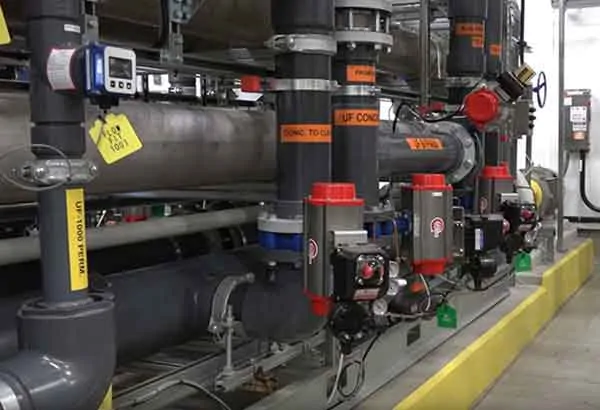
Across the industry, stakeholders agree the next few years will be critical in shaping how landfills deal with PFAS and how the public perceives it. Waste trade associations, scientists, and a host of organizations are in the midst of conducting a number of studies looking closely at the issue, PFAS treatment options, the positive impact of recycling, and regulatory policies.
While there are sites noted in the article, there’s no practical way for most companies and landfills to respond at this time responsibly. Additionally, landfills are unique; no two are alike. Most human exposure to PFAS occurs through contaminated food. The majority of landfill leachate is pre-treated at the landfill before going to a wastewater treatment plant, where additional treatment occurs before discharge.
According to EREF President Dr. Bryan Staley, in the article, “The relative impact of leachate as a human exposure pathway needs further evaluation to understand its relative degree of importance as it relates to health implications.”
Dr. Gomathy Radhakrishna Iyer, landfill leachate and design expert for SCS Engineers, said some operators are waiting to see what regulations may come even as they work on accounting for potential compliance issues and seeking solutions. “When the clients are thinking of upgrading their treatment plans, some are definitely taking into consideration PFAS treatment,” Radhakrishna Iyer said.
“You’re spending millions of dollars, you need to do your due diligence, right? At this point, consideration should be given to PFAS treatment during the feasibility stages,” she said.
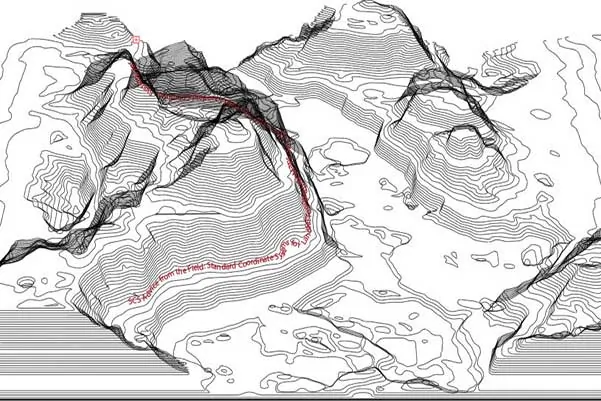
Landfill engineers rely heavily on topographic maps in their design work. Topographic maps present elevation contours, known as contour lines, for changes in the ground surface. Surveying companies create contour lines by performing land surveys, Light Detection and Ranging (Lidar) surveys, or aerial mapping. In all cases, the topographic maps are generated based on a standard coordinate system.
Basing horizontal systems on geodetic coordinates worldwide, they may be updated every few years or decades. An example of the horizontal coordinate system is the North American Datum (NAD). A datum is a formal description of the Earth’s shape and an anchor point for the coordinate system. Using the NAD system, engineers can make horizontal measurements in consideration of the anchor point information.
NAD 27 and NAD 83 are two versions of the NAD system with slightly different assumptions and measurements. A point with specific latitude and longitude in NAD 27 Datum may be tens of feet away from a point with similar latitude and longitude in NAD 83 Datum.
The latitude and longitude of an initial point (Meads Ranch Triangulation Station in Kansas) define the NAD 27 Datum. The direction of a line between this point and a specified second point and two dimensions define the spheroid. Conversely, NAD 83 Datum uses a newer defined spheroid, the Geodetic Reference System of 1980 (GRS 80). GRS 80 is an Earth-centered or geocentric datum having no initial point or initial direction.
Similarly, vertical systems provide surveyors the means to measure vertical measurements based on a standard system. Examples of the vertical datum are the National Geodetic Vertical Datum 1929 (NGVD 29) and North American Vertical Datum 1988 (NAVD 88).
Using topographic maps, solid waste engineers pay special attention to the standard coordinate system used for generating the topographic map made available to them for their design work. Engineers will want to check for additional topographic maps using another Datum for the same site. Checking eliminates the possibility of discrepancies in the design documents.
Typically, the standard system set for a landfill site remains unchanged for consistency among topographic maps generated over the years. If the standard system must change, document the conversion making it available to the solid waste engineers working at the site. The conversion information is valuable for converting engineering plans to prevent the older plans from becoming obsolete and unusable for practical engineering work.
A solid waste engineer that begins work for the first time at an existing landfill site pays special attention to the standard system (horizontal or vertical). The engineer wants to ensure the time spent producing design documents and plans aren’t wasted. For optimum efficiency, landfill owners contracting with new solid waste engineers should provide conversion information from the old to the new system upon the contract’s commencement.
The United States National Spatial Reference System NAD 83(2011/MA11/PA11) epoch 2010.00, is a refinement of the NAD 83 datum using data from a network of very accurate GPS receivers at Continuously Operating Reference Stations (CORS). A new Global Navigation Satellite System (GNSS) will replace the National Spatial Reference System NAD 83 and the NAVD 88 in 2022, according to the National Geodetic Survey Strategic Plan 2019-2023. The GNSS will rely on the global positioning system and a gravimetric geoid model resulting from the Gravity for the Redefinition of the American Vertical Datum (GRAV-D) Project. The new systems’ intention is easier access and maintenance than NAD 83 and NAVD 88, which rely on physical survey targets that deteriorate over time.
Solid waste engineers should be aware of the upcoming changes to adapt site designs as necessary and to check with landfill owners and operators to check for any implementations at their facilities.
About the Authors:
Ali Khatami, Ph.D., PE, LEP, CGC, is a Project Director and a Vice President of SCS Engineers. He is also our National Expert for Landfill Design, Construction Quality Assurance, and Elevated Temperature Landfills. He has over 40 years of research and professional experience in mechanical, structural, and civil engineering. Dr. Khatami has been involved for more than 30 years in the design and permitting of civil/solid waste/environmental projects such as surface water management systems, drainage structures, municipal solid waste landfills, hazardous solid waste landfills, low-level radioactive waste landfills, leachate and wastewater conveyance and treatment systems, gas management systems, hazardous waste impoundments, storage tank systems, waste tire processing facilities, composting facilities, material recovery facilities, landfill gas collection and disposal systems, leachate evaporator systems, and liquid impoundment floating covers. Dr. Khatami has acquired extensive experience and knowledge in the areas of geology, hydrogeology, hydrology, hydraulics, construction methods, material science, construction quality assurance (CQA), and stability of earth systems. Dr. Khatami has applied this experience in the siting of numerous landfills.
 William Richardson, EIT is Project Professional at SCS, and part of our Young Professionals organization. Will has two years of experience with landfill design projects, including permit modifications and siting requirements. He is currently working in Virginia Beach under the tutelage of Dr. Khatami.
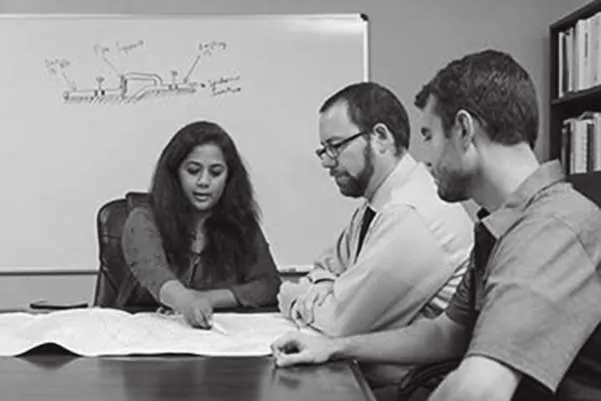
Landfills are large and dynamic systems that can take several decades to develop. Unlike many other infrastructure projects that have a beginning and an end to the construction of the project, landfills constantly grow and change due to many factors, including but not limited to:
From an engineering perspective, it is very common to see changes to the engineering team over time. Each team brings about their ideas and preferences to the operator, and if they present technically competent and economically solid ideas, they can change the course of the landfill development. The course change could be shaped by what will get constructed, how it will get constructed, when it will get constructed, and what sequence it will get constructed. In most cases, the owner is in the loop, but the owner may not be intimately familiar with the nuances that such designs and modifications entail. Therefore, the owner may not necessarily realize hidden problems or mishaps that may happen in the future, which could be prevented by the engineer at an earlier stage of work.
Competent engineers starting work at an existing landfill site for the first time need to review years of data to become familiar with the history of the site before they can begin design work. The history of the site involves, but is not limited to, land use approvals, permitting, designs, modifications, environmental impacts, subsurface conditions, environmental improvements, leachate and gas collection and disposal, existing and future planned developments, operation requirements, and many other features that vary from site to site. Without such knowledge, the engineer is working in the dark without the owner’s knowledge that the engineer’s path lacks familiarity with details. Work products generated by an engineer with limited familiarity with the site are, at best, not reliable. Even potentially having significant impacts on the owner to fix issues that otherwise are preventable with sufficient due diligence.
For example, tasking an engineer to close a portion of the landfill, the engineer must investigate any plans set for landfill development, in the area planned to close. The engineer and owner can discuss any problems discovered by the engineer’s early due diligence, and solutions will be developed and adopted to address issues during the design. This level of due diligence provides the opportunity to generate sound designs and develops a level of confidence in the engineer in the mind of the owner.
SCS landfill design professionals train regularly to be thorough and comprehensive in their familiarization with a site. They spend significant effort to foresee potential problems that might arise many years down the road and find solutions for them now.
About the Authors:
Ali Khatami, Ph.D., PE, LEP, CGC, is a Project Director and a Vice President of SCS Engineers. He is also our National Expert for Landfill Design, Construction Quality Assurance, and Elevated Temperature Landfills. He has over 40 years of research and professional experience in mechanical, structural, and civil engineering. Dr. Khatami has been involved for more than 30 years in the design and permitting of civil/solid waste/environmental projects such as surface water management systems, drainage structures, municipal solid waste landfills, hazardous solid waste landfills, low-level radioactive waste landfills, leachate and wastewater conveyance and treatment systems, gas management systems, hazardous waste impoundments, storage tank systems, waste tire processing facilities, composting facilities, material recovery facilities, landfill gas collection and disposal systems, leachate evaporator systems, and liquid impoundment floating covers. Dr. Khatami has acquired extensive experience and knowledge in the areas of geology, hydrogeology, hydrology, hydraulics, construction methods, material science, construction quality assurance (CQA), and stability of earth systems. Dr. Khatami has applied this experience in the siting of numerous landfills.
William Richardson, EIT is Project Professional at SCS, and part of our Young Professionals organization. Will has two years of experience with landfill design projects, including permit modifications and siting requirements. He is currently working in Virginia Beach under the tutelage of Dr. Khatami.
Corporate Headquarters