The industry is designing and building more substantive drainage features and larger collection systems from the bottom up, that maintain their integrity and increase performance over time, thus avoiding more costly problems in the future.
Waste360 spoke with three environmental engineers about what landfill operators should know about liquids’ behavior and what emerging design concepts help facilitate flow and circumvent problems such as elevated temperature landfills, seeps, and keep gas flowing.
The engineers cover adopting best practices and emerging design concepts to facilitate flow. They cover topics such as directing flow vertically to facilitate movement to the bottom of the landfill, drainage material, slope to the sump percentages, vertical stone columns, installing these systems at the bottom before cells are constructed, and increasing cell height to prevent the formation of perched zones.
Ali Khatami, one of the engineers interviewed, has developed standards for building tiered vertical gas wells that extend from the bottom all the way up. He frequently blogs about landfill design strategies that his clients are using with success. His blog is called SCS Advice from the Field. Dr. Khatami developed the concept of leachate toe drain systems to address problems tied to seeps below the final cover geomembrane. These seeps ultimately occur in one of two scenarios, each depending on how the cover is secured.
Landfill Gas Header: Location and BenefitsBy continuing to design gas header construction on landfill slopes, all of the components end up on the landfill slope as well. You can imagine what type of complications the landfill operator will face since all of these components are in areas vulnerable to erosion, settlement, future filling, or future construction. Additionally, any maintenance requiring digging and re-piping necessitates placing equipment on the landfill slope and disturbing the landfill slope surface for an extended period.
AIRSPACE, the Landfill Operators’ Golden EggAirspace is a golden egg, the equivalent to cash that a waste operating company will have overtime in its account. With each ton or cubic yard of waste received at the landfill, the non-monetary asset of airspace converts positively to the bottom line of the …
Gas Removal from Leachate Collection Pipe and Leachate SumpKeeping gas pressure low in and around the leachate collection pipe promotes the free flow of leachate through the geocomposite or granular medium drainage layer to the leachate collection pipe and improves leachate removal from the disposal cell. Using gas removal piping at leachate sumps is highly recommended for warm or elevated temperature landfills where efficient leachate removal from the leachate collection system is another means for controlling landfill temperatures.
Leachate Force Main Casing Pipe and Monitoring for LeaksLandfill operators may add a casing pipe to their leachate force main for additional environmental protection. Consequently, the leachate force main is entirely located inside a casing pipe where the leachate force main is below ground. In the event of a leak from the leachate force main, liquids stay inside the casing pipe preventing leakage …
Pressure Release System Near Bottom of LandfillsPressure Release System Near Bottom of Landfills – Essential Component for Proper Functioning of the Landfill Drainage Layer. Landfill designers are generally diligent in performing extensive leachate head analysis for the design of the geocomposite drainage layer above the bottom geomembrane barrier layer. They perform HELP model analyses considering numerous scenarios to satisfy all requirements …
Landfill Leachate Removal Pumps – Submersible vs. Self-Priming PumpsSelf-priming pumps can provide excellent performance in the design of a landfill leachate removal system. Landfill owners and operators prefer them to help control construction and maintenance costs too. A typical system for removing leachate from landfill disposal cells is to have a collection point (sump) inside …
In this Waste Today article, Sam Cooke discusses the factors, treatment options, analytical methods, and identifying PFAS sources to most effectively reduce the concentrations of ammonia and PFAS in landfill leachate.
Reducing these concentrations help meet discharge permit requirements for direct discharge of treated leachate to surface waters and to meet publicly owned treatment works (POTW) discharge permit standards.
Sam points out that accomplishing ammonia and PFAS reduction with established wastewater treatment technologies works, but the right treatment depends on each site’s specific parameters. He suggests conducting bench-scale and pilot-scale testing for any feasible nitrogen removal or treatment system. Testing the wastewater helps to identify any changes in the concentration of nitrogen compounds. Thus, necessary changes to the treatment processes, such as additional aeration or chemical additions are easier to identify and less costly to implement.
About the Author: Mr. Cooke, PE, CEM, MBA, is a Vice President and our expert on Industrial Waste Pretreatment. He has nearly three decades of professional and project management experience in engineering with a concentration in environmental and energy engineering. Mr. Cooke works within SCS’s Liquids Management initiative to provide services to our clients nationwide.
Scientists and experts agree that climate change is a present-day threat to communities across the U.S., manifesting in both predictable and unpredictable ways. As detailed in the National Climate Assessment Vol. 4 (NCA4), coastal storms are increasing in strength and frequency, forest fires are becoming much larger and more destructive, annual precipitation is changing and increasing in variability, and widespread flooding is becoming more common both in the interior of the nation and along the coasts.
These changes present complex challenges to the waste management industry that must be addressed and planned for. For example, one challenge is an increasing frequency of large-scale weather events and natural disasters, which are creating more debris that must be managed and which affects the characteristics of landfilled waste. Landfill design needs to incorporate precipitation changes and increased threats due to weather variability, flooding, and sea-level rise. Precipitation changes affect gas generation rates and require a diligent reaction to maintain effective gas collection. Because of weather pattern changes, risks of cover material erosion and swales have increased for landfills in both wet and dry climates, which may require stronger natural caps or the use of emerging technologies for alternate cover. Additionally, landfills are affected by an increase in the variability of precipitation and rapid changes between weather extremes.
It is clear that waste management facilities must adapt to these changes in addition to scenario building for pandemics to maintain effective operations. Adaptations available include making changes to landfill design and planning, such as incorporating precipitation changes into the modeling of leachate and gas generation or increasing the distance between the bottom liner and groundwater.
Systems should be regularly evaluated and areas needing repairs should be corrected quickly and diligently. Gas generation models should be updated regularly and collection systems need to be expanded or adjusted to account for precipitation increases or decreases.
More frequent and intense storms are creating challenges for cover material management, liquids management, and maintaining slope stability. Facilities should implement innovative uses of both existing technology and new or emerging technologies.
Communities with waste management facilities should include waste management infrastructure in emergency management plans, including maintaining landfills and collections operations and using landfills as both temporary debris storage and as an option for final disposal.
Since climate change effects vary by region and locale, many facilities are developing a specific plan for adaptation and management. To reduce the inevitable costs of adaptation and maintain responsiveness to weather changes, a reactive approach is being abandoned in favor of a proactive approach.
About the Author: Jacob Shepherd is a Senior Project Professional specializing in air compliance and reporting within EPA Region III. He is experienced in environmental engineering, air compliance, renewable energy, landfill and landfill gas engineering, and environmental services throughout the mid-Atlantic region, and is a licensed P.E. in Virginia.
Resources and Recovery
Get started with these resources and recovery success studies; click to read, download, or share each:
Expansion of An Active Landfill – Vertical expansion increases the landfill volume within the existing footprint of the permitted Landfill. A landfill can run out of its storage capacity prematurely for many reasons including a response to a huge amount of debris waste from a natural disaster like a tropical storm or hurricane. Covered by ISWA.
Contact for assistance starting or refining your plan ahead of natural disasters and pandemics. We offer these services:
Planning for Natural Disaster Debris – help for communities to develop or revise a disaster debris management plan. Many aspects of disaster debris planning can be relevant to communities demolishing abandoned residential buildings and remediating properties.
Guidance about Planning for Natural Disaster Debris – much of the construction or demolition waste can be recovered and recycled. SCS Engineers designs and builds these facilities so we can help locate the nearest C&D debris recyclers as part of your plan.
Planning Financial Response and Recovery – the SCS Management Services™ team offers services to support financial planning and to quickly access budget and operational financial impacts. Eliminate concerns about the upcoming fiscal year expectations and anticipated medium-term impacts of pandemics and natural hazards on local government operations and revenue streams. Address issues such as:
Micro-analysis – For near-term (1-2 year) budget/operational impacts. Results produced in one day.
Avoiding municipal or utility service interruptions
Continuing to provide services to customers who can’t afford to pay
Predicting impact on property, earnings or sales tax revenues
Estimating change in water usage or waste generation
Longer-term financial impacts of staffing changes, prolonged vehicle/equipment replacements, and postponing or increased borrowing for capital projects.
For International Women’s Day, SCS decided to interview one of our own, Nicole Kron, who is a Hydrogeologist in Madison, Wisconsin. Nicole joined SCS Engineers in December 2017, as a project professional in the Environmental Services practice. Nicole graduated with her Bachelors of Science in Geology from the University of Illinois and earned her Masters of Science in Hydrogeology from Illinois State University.
Early in her career, prior to working at SCS, she did a lot of fieldwork – characterizing sites, determining where there might be issues of contamination that would need to be cleaned up, drilling and installing wells, collecting groundwater and soil sampling and just getting an understanding of the geology of the site.
Nicole now focuses more on the evaluation and preparation for the fieldwork. Once the fieldwork is completed, Nicole conducts the evaluation of the lab data that comes back and a groundwater analysis if needed. Based on the data they receive, whether it’s groundwater data or soil data or any other medium, she performs evaluations for what that means for that site. She then develops reports that explain the geology and hydrogeology of the site, the extent of contamination, and what are the next steps, whether that be to close the site or needing to do more work to better define the issue. She assists in a lot of those different areas and helps with managing the reporting and analysis of the findings.
What attracted you to SCS Engineers?
Prior to coming to SCS Engineers, I had worked with two other firms. They were good firms but did not always have the warmest culture. I had a friend who worked in the SCS Engineers’ Madison office and mentioned that he enjoyed working for SCS and encouraged me to apply. There’s always going to be challenges and difficult times wherever you work. What I appreciate about working at SCS Engineers is that when there are those challenges, or if I’m having a tough day, there is still an environment of support at SCS and a desire for everyone to achieve their goals. SCS Engineers has the best work culture I’ve ever worked in!
What is your favorite part of working at SCS?
Working with my team! I also love that I have the opportunity to develop my own career path and can contribute to finding solutions to issues we encounter while working on projects. I always feel respected and not just a “cog in the wheel,” but a part of the team. I appreciate that my work is valued here.
What do you feel is your greatest achievement or contribution at work?
This is hard to answer! I’m a part of such a great team and am able to do a lot of work for some of our bigger clients in the Midwest. I’ve also taken over as the local SCS Young Professionals Leader for the Upper Midwest, where I help arrange meetings and lead discussions. I work on ways to help the YP’s feel like a connected group, supported while learning new skills, and improving work environments.
What was your greatest challenge at SCS, and how have you overcome that?
We all have different personalities and strengths to our personalities. There are no personality types that are designed for one type of career. For example, I’m an extrovert and like to collaborate with other people. But, not everyone is an extrovert and may take on challenges differently than I do. On the DiSC chart of personalities, I am a solid “iD,” which means I like to be high-spirited and enthusiastic and am also strong-willed. It’s good to recognize everyone has different strengths and weaknesses, and learning what works and doesn’t work for your team.
In your college career, were there as many women as men at school in Illinois?
Surprisingly, there were! It was fairly balanced. Many of the women that I attended school with have gone into a variety of fields since graduating – Oil and Gas, government and state agencies, and a few went into environmental consulting. I do see an increase in women joining the environmental field, which is exciting! Most are just starting off in their careers, but I think it’s great that hopefully there will continue to be more women in STEM fields!
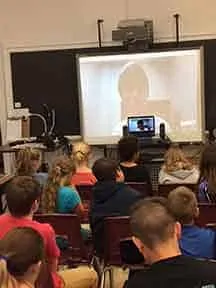
Tell us about “Skype with a Scientist” and how you got involved with this program.
Skype a Scientist
The non-profit organization was started by a graduate student who wanted to ensure that science would continue beyond just the classroom and that students could see scientists as well-rounded people. Scientists are paired up with a classroom over a Skype video conference, and the students can ask questions about the scientist’s work and why they chose their career path. It’s a great opportunity for students to see what scientists are like and what they do. The founder of the program wanted to make sure students would see more of a scientist than the stereotype of a person with a lab coat and goggles on, mixing chemicals all day.
I’ve participated in two sessions – a 4th-grade class and a 10th-grade class. The 4th graders were from Canada, wanted to talk about volcanoes, and where they could find diamonds! The 10th-grade class happened to be an all-female class. They were excited to learn that I was a dancer and used to perform in plays and on the speech team in college. We also talked about how it is okay to fail sometimes and to recognize failure as part of the journey in your career and in life. Failure is part of being a scientist. If your experiment fails, you can’t just give up. You have to try something new! It was great to be able to remind your students that it’s okay to fail sometimes as long as you learn how to work through it.
What advice do you have for scientists just entering the field of Hydrogeology?
Don’t discount opportunities to learn something that would be applicable to your field. When I was finishing my Masters, I had an opportunity to take a class that would give me the foundational understanding in this field, but I elected not to take it because I did not believe I would go into environmental consulting. Now I’m working in this field! Yes, it was one class and didn’t hinder my abilities to get a job or do my job today, but you never know what may be in store for you in the future. If you have an opportunity to learn something new, try it anyway! This should go beyond STEM as well. If you have a chance to learn, do it!
Have you had to overcome any obstacles as a woman in the field of Environmental Services?
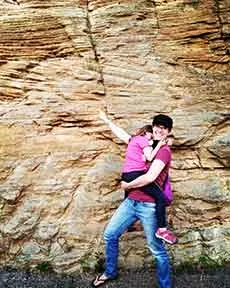
This Mom never gets tired of rocks and water!
As a woman in the environmental field, sometimes you are the minority, but that’s not a bad thing. You are there to contribute and to be a part of a team. It shouldn’t matter the color of your skin, how old you are, or what gender you associate with.
What advice do you have for women getting into the STEM field?
Remember that your voice is just as important as everyone else’s! Be ready to listen and learn. Your voice has just as much power and meaning as any other person in the room.
What are your favorite hobbies outside of SCS?
I love to knit, go camping, and kayaking! I also really love to go dancing! I used to take ballroom dance classes when I was younger, so I take any opportunity I have to go dance!
Interview by Lindsay Evans, SCS Engineers Human Resources
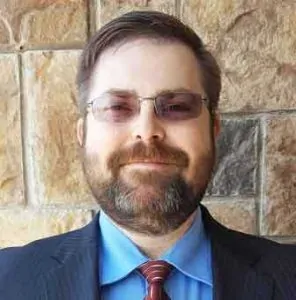
Ben Reynolds, PE, SCS Engineers in Little Rock, Arkansas
SCS Engineers welcomes Ben Reynolds, to our Little Rock, Arkansas office. Mr. Reynolds joins the SCS environmental services team providing support to real estate developers, construction firms, and industrial clients in the region. These businesses need to manage air, water, and soil safely within federal and state policies as they operate.
Ben is a Professional Engineer in Arkansas, Oklahoma, and Tennessee. He comes to SCS Engineers from the Arkansas Division of Environmental Quality (DEQ), where he served as the technical branch manager for Assessment and Remediation and in the Hazardous Waste Division as a permit engineer. His expertise and working knowledge from the DEQ is valuable to clients who need support to obtain multiple permits and to complete successfully Brownfield and other voluntary remediation projects.
Working as an environmental engineer, Ben gained experience helping clients with Phase I and Phase II environmental site assessments, Spill Prevention, Control, and Countermeasures (SPCC) Plan, and Storm Water Pollution Prevention Planning (SWPPP). These assessments and plans keep businesses compliant with environmental federal and state regulatory policies. Ben approaches each project analytically, mitigating the financial risk and future liability through careful evaluation, analysis, and planning that protects clients and the environment during all phases of redevelopment or production.
Ben also has experience with real-time telemetry for directional drilling, assisting with well completions, and the production of oil and natural gas. Telemetry is useful in many industries for collecting measurements and other data at remote or inaccessible points. These systems complement SCS’s technologies, SCSeTools® and SCS RMC®, to help streamline monitoring, auditing, and record-keeping, which reduce the cost of operations and of maintaining environmental records. His experience complements and enhances SCS’s Oil & Gas and SCS’s Energy practices too.
Ben earned his Bachelor of Science in Mechanical Engineering at the University of Arkansas. His supplemental professional education includes Establishing Energy Metrics, Closure Cost and Financial Assurance, Resource Conservation and Recovery Act (RCRA), RCRA Sampling Techniques, and Stack Sampling. He is certified as an STI/SPFA SP001 Aboveground Tank Inspector; with OSHA Hazardous Waste Operations and Emergency Response (HAZWOPER) 40-Hour Certified.
“Ben’s a valuable resource for our clients,” stated Dan McCullough. “We’re happy to welcome another SCS member with strong analytical skills and the expertise to resolve complex environmental challenges.” The SCS Engineers Little Rock office supports the growing demand for environmental scientists, engineers, and consultants. SCS professional staff specializes in meeting federal, state, and local clean air, water, and soil goals, and the restoration of property once thought impractical to revitalize.
Joseph Dinan heads the SCS Engineers new office at 101 Arch Street, Boston, MA 02110, Tel: 857-444-6302
SCS Engineers opened a new office in Boston’s Downtown Crossing district. The new location is more convenient for clients and enhances support to the firm’s growing client base in New England.
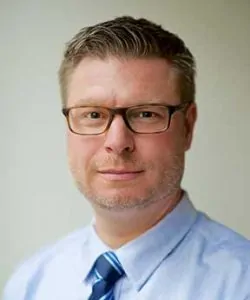
Joe Dinan heads the SCS Engineers’ environmental services team in Boston.
Joseph Dinan, an accomplished project manager and senior scientist heads Boston’s SCS team. Dinan has an excellent record meeting regulatory compliance and accountability for his clients to efficiently permit projects, keep them on budget and maintain the redevelopment schedule while meeting all environmental guidance. His background includes applied sciences including chemistry, microbiology, and environmental and soil sciences. Dinan has successfully managed hundreds of environmental assessment and remediation projects, both domestically and internationally.
Dinan’s Boston team resolves complex environmental challenges through the application of comprehensive analytical skills and technologies. Approaching each project with decades of expertise, mitigating the financial risk through careful assessment, analysis, and planning protects clients and the environment during all phases of redevelopment.
The Boston location supports the growing demand for environmental scientists, engineers, and consultants. SCS professional staff specializes in meeting federal, state, and local clean air, water, and soil goals, and the restoration of property once thought impractical to revitalize. The firm also provides vapor intrusion systems for protecting existing properties and a range of comprehensive environmental services for public and private entities.
As with most established urban environments, many properties may have previously been industrial or mass transportation sites, which often means that extra care is taken during redevelopment. Commercial real estate transactions must take environmental issues into consideration. Complex laws can impose significant environmental liabilities on purchasers, sellers, and lenders, whether or not they caused the problem, and whether or not they still own the property.
Important rules published by the U.S. Environmental Protection Agency – USEPA and in Massachusetts and other states offer defenses against environmental liabilities provided that the defendant conducted “all appropriate inquiries” regarding the property at the time of the acquisition, and then took reasonable steps to mitigate the effects of hazardous substances found on the property.
For more information, case studies, events, and articles visit these pages:
Recently, Waste360 published “Organics Diversion Drives Changes in Landfill Operators’ Roles,” an article examining the evolving role of landfill operators in organics waste diversion. Five industry leaders provide insight into how landfill operators and the solid waste industry are adapting to accommodate the evolution and the cost of organics management.
Waste360 interviewed:
Susan Robinson, senior director of sustainability at Waste Management
Robert Gardner, senior vice president at SCS Engineers
David Biderman, executive director, and CEO for Solid Waste Association of North America
Jason Munyan, manager of engineering for the Delaware Solid Waste Authority, and
Jim Stone, deputy director of public works/operations for San Joaquin County, California
The article provides best practices, strategies, technology, and systems that could support or supplement landfill operators’ response plans to the changing policies and contract requirements in more economically sustainable ways. Waste360 rounds up answers to the most common challenges operators and public works departments face including how to reduce permitting time, cost, and environmental impact.
Like many Young Professionals, Steve is more than a Professional Engineer. To his clients, he’s a manager often exceeding their expectations; to others a mentor and to his community a man involved.
Steve Linehan, PE
As a Senior Project Manager at SCS, Steve is responsible for overseeing solid waste and environmental services projects from SCS’s Oklahoma City and Wichita offices. He has a broad range of expertise, including solid and hazardous waste regulations, landfill design, and regulatory compliance. Steve supports his clients providing landfill and solid waste solutions that include compliance audits, stormwater modeling and design, remedial action plans, remedial systems designs, site investigations, health and safety assessments, waterway crossing assessments, and construction.
Living and working in the Heartland, his efforts take him to sites including solid waste facilities, active and closed landfill sites, oil well fields, fuel storage facilities, vehicle maintenance facilities, truck stops, industrial sites, and agricultural sites. Chemical contamination encountered in both soil and groundwater media is of growing concern across the nation. Steve mitigates and helps prevent contamination from petroleum, dioxin, herbicides, pesticides, heavy metals, and solvents. Some of these sites have complex management systems that protect the air, water, and soil from harm. Operating these systems in harmony is expensive, requiring experience and understanding of each of the components plus regional knowledge.
Sangeeta Bhattacharjee, EIT
Sangeeta Bhattacharjee, E.I.T., an SCS Engineers Associate Professional, submitted Steve’s name as a Waste360 candidate, unknown to him. So being among the honorees came as quite a surprise. Sangeeta told us, “I wanted to let everyone know about his work and take inspiration from him.” She went on to say:
If anyone is looking for a professional who has experience, knowledge, expertise in landfills but who is still so humble, honest, and always there to learn more, it is Steve in my eyes. Anyone who meets Steve will be assured that he will get the work done. That much confidence and expertise with so much coolness is a rare combination. I, and most of my colleagues, depend on his personal qualities every day; I am sure others will be happy to know him.
Steve, a graduate of Kansas State University, is licensed in Kansas, Missouri, Nebraska, and Oklahoma. He is a member of the National Society of Professional Engineers, the Kansas and Oklahoma Societies of Professional Engineers, where he served in several chair positions as well as Chapter President; and the Solid Waste Association of North America where he recently served in the Sunflower Chapter as a Director.
Thanks to Sangeeta, Steve and all the Waste360 40-Under-40 Award Winners for their commitment to solving solid waste industry challenges and facing these challenges positively − you make a difference.
The staff at SCS Engineers (SCS) has talked at length about how changing the parameters of a coal ash remediation project impacts the eventual outcome of that project. That involves not only the factors present at a particular site but also the regulatory environment in which that site operates, certainly as rules evolve regarding the disposal of coal combustion residuals (CCRs).
Two primary means of coal ash remediation are closure-in-place, or cap-in-place, of an existing coal ash storage site, and closure-by-removal. Closure-in-place involves dewatering the storage site, or impoundment, in effect converting from wet storage to dry storage of ash. A cover system is then used to prevent more water from entering the site.
Closure-by-removal involves dewatering of the coal ash, and then excavating it, and transporting it to a lined landfill or a recycling center.
“There are lots of technical reasons and site-specific factors that can influence a project’s outcome,” said Eric Nelson, vice president of SCS and an experienced engineer and hydrogeologist. “These might include the type and volume of CCR, the geologic setting [e.g., groundwater separation], presence and proximity of receptors [e.g., drinking water supply], and physical setting [e.g., constraints such as access, available space onsite for re-disposal, proximity/availability of offsite re-disposal airspace, etc.].”
Sherren Clark, an SCS team member with experience in civil engineering and environmental science, said “risk evaluation is a key component of remedy selection. A CCR unit undergoing an assessment of corrective measures [ACM] could be a 100-acre ash impoundment containing 30 feet of fly ash, but it also could be a 2-acre bottom ash pond. It could have numerous groundwater constituents exceeding drinking water standards by a significant margin, or it could have a single parameter slightly above the limit at a single well. And there could be water supply wells nearby in the same aquifer, or none for miles around. All of these factors play into the selection of a remedy that addresses the existing risks, without creating other negative impacts such as site disturbance, dust, or truck traffic.”
Tom Karwoski, a hydrogeologist and project manager for SCS who has designed and managed investigations and remediations at landfills as well as industrial, Superfund, and other waste storage sites, noted the challenges inherent to individual sites and stressed careful planning is needed to achieve the desired result. At some sites, “given the size and the nature of the impoundments, transport of CCR off-site may not be the best option.” When moving from the ACM to the remedy [selection], it’s extremely important to have multiple meetings with the client to set the schedule. Based on the way the [CCR] rule is written, things have to progress logically. There’s time available for careful planning. The last thing we want to do is start making assumptions without input from the client and other interested parties. Regulatory compliance and concern for the surrounding community and the environment are important to us and our clients.
“If the nature of the site in its current condition allows it, capping of the site will reduce surface water moving through the waste and significantly cut down on the risk of groundwater contamination,” Karwoski said. “At sites where you have CCRs that may be distributed across a site, to consolidate that onsite and then the cap will address CCRs impacting groundwater.”
Jennifer Robb, vice president and project director with SCS’s Solid Waste Services Division, and the company’s Groundwater Technical Advisor for the Mid-Atlantic region said her group has “done corrective measures for cobalt, arsenic, and thallium,” all contaminants found in coal ash. “There are some in situ bio-remediation that can be done, where basically you’re trying to alter the chemistry to immobilize the metal.” Jennifer noted that there are also more physical remedies where contaminated groundwater is extracted from the subsurface by pumping or the groundwater plume is contained or treated in-situ with the construction of “cut off trenches.”
Karwoski said, “we have no preconceived notions about what is best for all sites, but if you consolidate [waste] onsite and then cap, it will certainly take care of a lot of situations where you have CCRs impacting downgradient groundwater.” This approach may not be appropriate in every situation, but, if arrived at after thoughtfully navigating the remedy selection process defined in the current Federal CCR rules (40 CFR 257 Subpart D—Standards for the Disposal of Coal Combustion Residuals in Landfills and Surface Impoundments), should result in an approach that is effective based on the site-specific factors present.
SCS provides valuable technical and engineering business experience as you work alongside our professional staff on a diverse range of solid waste and environmental projects. Opportunities can jump-start your career path as SCS interns become part of the solutions we deliver to our clients.
Opportunities in 2020 are available nationwide.
Interns typically work 40 hours per week. Paid internships start in May or June, and end in August or September; your exact start and end dates are arranged to accommodate your school schedule.
You are about to leave the SCS Engineers’ website and be directed to an external third-party site, ICIMS. SCS is not responsible for the collection and use of information on the ICIMS site, which is governed by its own privacy practices, not this Notice. We encourage you to review their privacy notices for additional information. Do you want to continue?
To provide the best experiences, we use technologies like cookies to store and/or access device information. Consenting to these technologies will allow us to process data such as browsing behavior or unique IDs on this site. Not consenting or withdrawing consent, may adversely affect certain features and functions.
✕
We use cookies and similar technologies for the following purposes:
Cookie usage
We use cookies to ensure the basic functionalities of the website and to enhance your online experience.
You can choose for each category to opt-in/out whenever you want.
Functional
Always active
The technical storage or access is strictly necessary for the legitimate purpose of enabling the use of a specific service explicitly requested by the subscriber or user, or for the sole purpose of carrying out the transmission of a communication over an electronic communications network.
Statistics
The technical storage or access that is used for statistical and/or tracking purposes.The technical storage or access that is used exclusively for anonymous statistical purposes. Without a subpoena, voluntary compliance on the part of your Internet Service Provider, or additional records from a third party, information stored or retrieved for this purpose alone cannot usually be used to identify you.
Marketing
The technical storage or access is required to create user profiles to send advertising, or to track the user on a website or across several websites for similar marketing purposes.

 About the Author: Jacob Shepherd is a Senior Project Professional specializing in air compliance and reporting within EPA Region III. He is experienced in environmental engineering, air compliance, renewable energy, landfill and landfill gas engineering, and environmental services throughout the mid-Atlantic region, and is a licensed P.E. in Virginia.