Visit SCS Engineers’ speakers and exhibitors at the CRWA Education & Exhibitor Show, April 27th – 30th, 2026 at Harrah’s Convention Center! The CRWA annual conference is your opportunity to connect, learn, and showcase—all in one unforgettable alpine setting. Throughout the event, attendees can participate in educational sessions led by industry experts, network with peers, and engage with exhibitors showcasing the latest technologies and services supporting rural water systems.
SCS Engineers’ experts Chuck Houser and Jonathan Meronek will present:

Geology Rules: Case Studies in Geo-Sciences of Ground Water Assessment and Supply
Wednesday April 29, 2026 | 9AM – 12PM
Engage with exhibitors offering the latest in rural water technology and collaborate with peers to solve real-world challenges facing your systems. With networking breakfasts, themed receptions, and hands-on demonstrations built into the schedule, you’ll come away with both actionable knowledge and lasting relationships. Between conference hours, enjoy Caesars Republic South Lake Tahoe’s welcoming resort atmosphere and the natural beauty of South Lake Tahoe—a setting that makes connecting, learning, and recharging enjoyable. Register today to join us!
Join SCS Engineers at the 2025 Groundwater Protection Council (GWPC) Annual Forum in New Orleans, September 16–18, 2025. This event brings together state and federal regulators, academia, industry leaders, and consultants from across the country to collaborate on the latest strategies for groundwater protection and water quality.
SCS Engineers is proud to participate in discussions covering underground injection control (UIC) best practices, carbon capture and storage, PFAS, produced water, aquifer storage and recovery, source water protection, geothermal energy, and more.
SCS Presentations:

Class VI Critical Pressure Calculations – Tara Gross
Current EPA guidance for calculating threshold pressure often underestimates risks by overlooking time-dependent processes. This session introduces a kinetic, time-based modeling framework that better reflects real project conditions and provides a practical, reliable approach for evaluating pressure buildup in Class VI CO₂ injection projects.


Pretreatment Design for UIC Wells – Jon Yang & Siamak Modarresi
As industries face stricter discharge provisions and PFAS regulations, deep well injection is re-emerging as a secure wastewater solution. This session explores pretreatment approaches across the well life cycle, from feasibility and operational window assessment to technology selection and design integration—ensuring optimal well performance, cost efficiency, and environmental protection.
The GWPC Annual Forum offers insightful sessions on today’s most pressing environmental challenges and valuable opportunities to network with peers, experts, and decision-makers shaping the future of groundwater management. Register today!
Establishing a site-specific groundwater monitoring protocol sensitive to changes in the groundwater chemistry related to potential leakage and also sensitive to natural variability will be imperative for developing cost-effective and robust testing and monitoring plans.
In CCUS projects, a site-specific testing and monitoring plan is mandatory to ensure the protection of underground sources of drinking water (USDWs) from Class VI injection well practices. As these projects have long durations with multiple phases, it is imperative for the groundwater monitoring program to be cost-effective with a robust sensitivity to detect any leakage.
Previously demonstrated changes in pH, carbonate chemistry, and certain trace elements (i.e., those that form strong-complexing anions) are geochemical indicators of initial CO2 leakage in relatively dilute aquifers. In this case study, SCS Engineers examine the sensitivity of dilute aquifer chemistry (major and minor cations and anions) to the leakage of CO2 and brines from the injection formation. We use an inverse thermodynamic modeling approach to simulate the effect of the progressive intrusion of CO2 and brines from the injection zone on the geochemical composition of the overlying dilute aquifer waters. From this, we can infer which geochemical parameters are most likely to be affected by the potential intrusion of CO2 and brines.
To attend this live presentation of Geochemical Effects of CO2, register for the upcoming National Carbon Capture Conference on November 8-9 in Des Moines, Iowa. Visit SCS Engineers at booth 120. Meet Kacey Garber.
EPA permit requirements for Class VI injection wells explicitly include incorporating a Testing and Monitoring Plan to optimize protection of USDWs – Underground Sources of Drinking Water. The regulatory requirement is for periodic monitoring of groundwater quality above the confining zone that may result from injection fluid movement through the confining zone. Testing and monitoring plans usually implement an antidegradation strategy. Take sufficient background data to characterize the statistical distributions of groundwater quality parameters before operation. Then the same water quality parameters are sampled periodically during and after injection and compared to the background. Any statistically significant increases over the background are investigated as a possible result of injectate migration above the confining zone.
To make the detection monitoring program more robust, there is a tendency to increase the number of well/parameter pairs in the monitoring network. This is done by adding additional wells to decrease well spacing and by adding monitoring parameters to make sure that nothing gets missed. Paradoxically, this tendency decreases the statistical power of the groundwater monitoring network by increasing the sitewide false positive rate (i.e., the number of false positive detections increases, often to an unreasonable degree). Each apparent statistically significant increase involves a costly investigation with greatly increased complexity. In this talk, we examine the sitewide false positive rate for sitewide groundwater monitoring networks and its relationship to the number of well/parameter pairs and discuss how hydrologic and geochemical knowledge and characterization can be used to build a more robust and cost-effective groundwater monitoring plan that is protective of USDWs near Class VI injection wells.
To attend this live presentation, register for the upcoming National Carbon Capture Conference November 8-9 in Des Moines, Iowa. Visit SCS Engineers at booth 120. Meet Charles Hostetler.
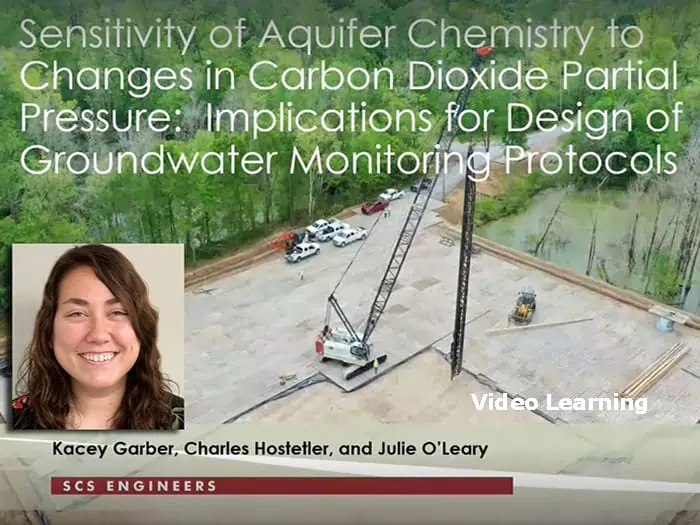
Did you miss the 2022 Annual GWPC & UIC Conference in Salt Lake City? We welcome you to view SCS Engineers’ presentation by Kacey Garber entitled “Sensitivity of Aquifer Chemistry to Changes in Carbon Dioxide Partial Pressure: Implications for Design of Groundwater Monitoring Protocols,” where Kacey discusses permitting requirements for groundwater monitoring for carbon sequestration and storage sites.
In her technical presentation, Kacey Garber of SCS Engineers discusses the great care taken in the design and operation of the injection of carbon compounds to ensure that the sequestration is effective and permanent. Each injection site also has permitting requirements for groundwater monitoring in any overlying aquifer as a protective measure. Because the injection and sequestration periods are long, CSS solutions need a cost-effective groundwater monitoring program with a robust sensitivity to detect any leakage. By establishing a groundwater monitoring protocol specific to the site, sensitive to changes in the partial pressure of carbon dioxide, and relatively insensitive to natural variability and hydrochemical facies changes, implementing optimal and cost-effective groundwater protection is possible. Using a case study, Kacey tells us how her team did this in detail.
Kacey Garber is an experienced groundwater project manager for active and closed landfills, including routine groundwater monitoring and statistical analyses; reports and permit applications; designing sampling and analysis plans; special groundwater studies; and conducting groundwater well construction planning and design.
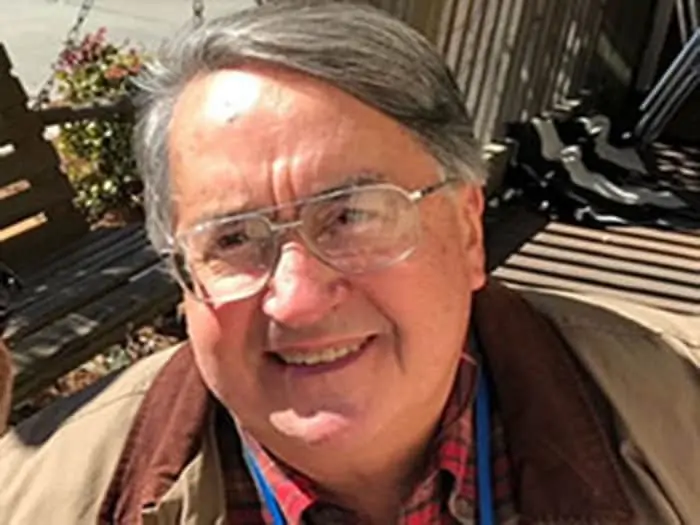
Michael Simms – Appointed by the Governor to the Louisiana Board of Professional Geoscientists
The Louisiana Board of Professional Geoscientists oversees the approvals of hydrogeologists and like scientific professionals in the state. This is quite an honor for Mike, a hydrogeologist with more than 30 years of experience. He learned of the appointment earlier this month and just had his first meeting.
Hydrogeologists are attempting to solve some of the big questions facing the world today, including sustainable water supply, food and energy production; environmental protection; and coping with climate change. They work closely with a wide range of industries to protect groundwater and much, much more.
Congratulations, Mike!
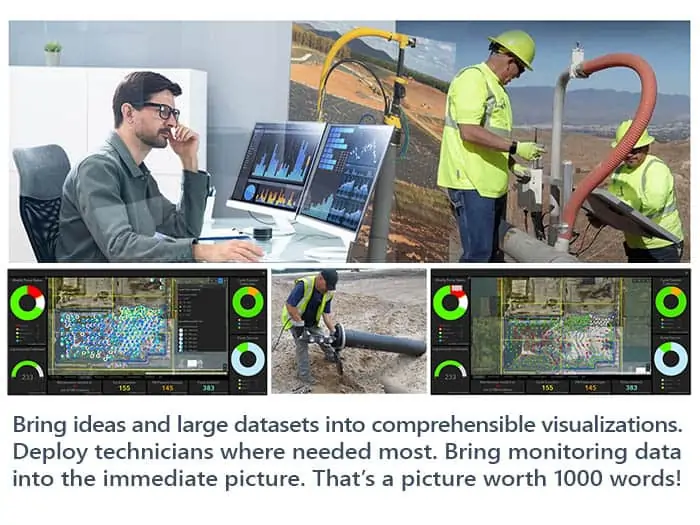
Landfill data collection and analysis are more tactical than ever, and landfill technology provides methods to manage and use the data to create efficiencies. With the implementation of the NESHAP, NSPS/EG requirements, Landfill Operators will monitor more often and maintain more records. Data collection mechanisms will likely broaden soon to include drone and satellite data collection as acceptable for agency requirements.
Our September 23, 2021, SCS’s Client Webinar focuses on landfill gas maintenance and how Operators find efficiencies by monitoring and collecting LFG data. Using SCS eTools, the webinar includes common scenarios at landfills and answers several questions, including:
Demonstrations include:

Popular Mechanics recently published an article entitled The Pungent History of America’s Garbage Mountains. The article starts with a little-known ferryman on Lake Michigan when a storm beached his craft on an offshore sandbar in July 1886. Thus started Chicago’s open dump on today’s Lake Shore Drive, home to landmarks such as the Museum of Contemporary Art, the Wrigley Building, the Chicago Tribune Tower, Northwestern University, and the Magnificent Mile – all on turn-of-the-century garbage.
Transportation centers, stadiums, and even entire neighborhoods are now built on landfills. This is a fascinating, well-written article on the history and possibilities of building on remediated properties and brownfields.
“Landfill redevelopment projects tend to be real estate projects, and you know what matters in real estate: location, location, location,” says Mike McLaughlin of SCS Engineers, who specializes in brownfields and landfill redevelopment. “A landfill in an urban area might be the only piece of open land in that area. People go to extraordinary lengths to redevelop because the property is so valuable.”
SCS periodically prepares Technical Bulletins to highlight items of interest to our clients and friends. We publish these on our website.
Our most recent Bulletin summarizes and updates the TCEQ’S New Rules Implementing Compliance and Registration Requirements for Coal Combustion Residuals (CCR) Management. In addition, this Bulletin covers TCEQ’s development of a program for implementing the Federal rules governing CCR facilities in Texas. While TCEQ’s CCR program needs to be as protective as the federal CCR rules, there are important distinctions in Chapter 352.
SCS’ Texas-based professionals are experts on TCEQ’s new program for registering coal combustion residue (CCR) sites. We are currently working to support multiple sites needing to meet the application deadline. Our engineers and geologists know how to use site-specific design and related technical documents to complete TCEQ’s detailed application for a registration consistent with TCEQ’s new regulatory program.
For additional information on the updated regulations, deadlines, and compliance requirements, contact:
SCS periodically prepares Technical Bulletins to highlight items of interest to our clients and friends. We publish these on our website.
Our most recent Bulletin summarizes and updates the TCEQ’S New Rules Implementing Compliance and Registration Requirements for Coal Combustion Residuals (CCR) Management. In addition, this Bulletin covers TCEQ’s development of a program for implementing the Federal rules governing CCR facilities in Texas. While TCEQ’s CCR program needs to be at least as protective as the federal CCR rules, there are important distinctions in Chapter 352.
SCS’ Texas-based professionals are experts on TCEQ’s new program for registering coal combustion residue (CCR) sites. We are currently working to support multiple sites needing to meet the December application deadline. Our engineers and geologists know how to use site-specific design and related technical documents to complete TCEQ’s detailed application for a registration consistent with TCEQ’s new regulatory program.
For additional information on the updated regulations, deadlines, and compliance requirements, contact:
Corporate Headquarters