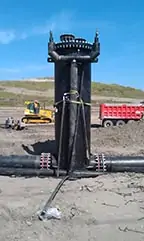
 Lessons learned from previously constructed gas collection and control systems teach solid waste professionals valuable lessons about designing for long-term survivability and reducing the maintenance cost of gas system components. The location impacts operating and maintenance costs for various components of gas collection and control systems such as condensate force main, condensate sumps, force main for well liquids, air lines to pumps in gas wells, and gas headers long into the future. As often as possible, design the gas header in the landfill perimeter berm along with the condensate sumps. Landfill perimeter berms constructed in an engineered manner with well- compacted soils and a well-defined geometry provide a long-term cost-effective alternative to earlier designs outside the berm.
For many years, gas headers were designed and constructed outside of the landfill perimeter berm, on the landfill surface. Of course, landfill surface changes as waste elevation increases over time, resulting in many gas headers that now may be 30 feet or more below the current waste surface. Deeply buried gas headers are unreliable at best, and the operator loses access to them as soon as 20 feet of waste covers the header.
Collapsed gas headers buried deep in waste are an expensive challenge when operating a large number of gas wells connected to the gas header, and could cause serious compliance issues. Upon discovery of a collapsed buried gas header, installing a new header is a lengthy process with significant costs, not to mention the hurdles the operator will have to jump addressing noncompliance with their state agency.
The benefits of placing gas headers in the landfill perimeter are:
Since the condensate force main follows the gas header in the perimeter berm to flow to a tank or discharge point, there are additional maintenance benefits.
By continuing to design gas header construction on landfill slopes, all of the components end up on the landfill slope as well. You can imagine what type of complications the landfill operator will face since all of these components are in areas vulnerable to erosion, settlement, future filling or future construction. Additionally, any maintenance requiring digging and re-piping necessitates placing equipment on the landfill slope and disturbing the landfill slope surface for an extended period.
For more information about these benefits and more, please refer to the MSW Magazine article series Considerations for the Piping Network, the author, or contact SCS Engineers at .
 About the Author: Ali Khatami, Ph.D., PE, LEP, CGC, is a Project Director and a Vice President of SCS Engineers. He is also our National Expert for Landfill Design and Construction Quality Assurance. He has nearly 40 years of research and professional experience in mechanical, structural, and civil engineering.
Learn more at Landfill Engineering
SCS Engineers writes blogs to offer suggestions and tips, which we hope will save you money in your short and long-term landfill operations. Here are several popular ones from our landfill series SCS Advice from the Field, along with links to articles and papers with more details.
Landfill Disposal Cell Base Slope Design – – Focuses on the loss of the airspace and lower liquid transmissivity in the geocomposite drainage layer of landfills with steeper slopes. Also, the analytical formulation presented in Dr. Khatami’s publication “Formulation for Optimizing Landfill Base Slopes and Maximizing Airspace,” provides landfill owner/operators with an analytical tool to perform a basic sensitivity analysis in a short period at a very low cost.
Landfill Leachate Collection Pipe, SDR 11 vs. SDR 17 HDPE – – Designing a leachate collection system for a landfill disposal cell involves numerous engineering analyses of different components involved in collecting and conveying leachate. One of the important engineering evaluations is the determination of structural stability of HDPE leachate collection pipes at the bottom of the landfill.
Wastewater Deep Injection Wells For Wastewater Disposal – Industries Tap a Unique Resource – – The increasingly stringent surface water discharge standards are an ongoing challenge for industries generating a wastewater stream. DIWs could be considered as a potentially viable option for long-term, cost-effective wastewater disposal, where a viable receiving geologic strata exists and when wastewater management alternatives are evaluated.
Dynamic Compaction for New Development on Old Landfills – – Dynamic compaction is a proven geotechnical construction engineering method used to improve certain landfill areas to support their redevelopment. A combustible gas barrier layer is generally required below the building footprint to collect subsurface combustible gases. The article “Pursuing Dynamic Compaction,” has more details.
A recent article in Waste Advantage Magazine features a detailed and comprehensive operation, the Sussex County, NJ Municipal Utilities Authority (SCMUA). The SCMUA team continuously looks for innovative solutions that will not only make operations more efficient but also help them to ‘be a good neighbor ’and resource to the surrounding communities.
“We are self-sufficient. Right now, we can manage our own solid waste through 2066, depending on a number of factors—recycling rates, population growth and what the regulations are going to be in 20 years, etc.,” says John Hatzelis, SCMUA Administrator.
The SCMUA is headed by a nine-person Board of Commissioners, and employs about 70 people, including wastewater, solid waste and central services staff, and receives support from SCS Engineers.
According to Tom Varro, Executive Director and Chief Engineer, “Everyone who works here knows their job and does it well. With the amount of traffic, 20,000 customers per month, 240,000 per year, that is a lot of potential for complaints. Every once in a while, you get someone that wasn’t happy, but for the most part, we get a lot of positive feedback, like ‘I love this place’, ‘I go here every Saturday’, ‘The guys are helpful’, etc. That is part of what we do as a service to the county and I think we’ve worked hard to get the staff trained and motivated.”
Learn more about this landfill operation’s best practices and outreach program in Waste Advantage.
The days of laying out ground control points and spending hours in front of a computer processing data have come and gone. Phil Carrillo of SCS Engineers and others discuss how to get a drone program started that will add real value to your landfill operations, and provide a good return on investment.
In addition to the expert tips, the article provides links to information and resources important to planning a program. Here are a few tips from the experts:
Still sound daunting? It’s not for the professionals at SCS Engineers. Read the article on our website; we encourage sharing it with others too.
More landfill technology resources are here
Regulatory and siting restrictions are such that many solid waste operators prefer to expand their existing landfill footprint as much as possible instead of finding a new disposal footprint at a different location. As landfills are getting larger in height and greater in footprint area, the location of leachate tanks, leachate ponds, or discharge points to an on-site or off-site leachate treatment plant usually does not change. A larger footprint means leachate force mains are getting longer forcing the existing pumps to work harder to push leachate through the system to a target point. Some operators carry on with the same pumps for decades and do not monitor the performance of the pumps after expanding the landfill footprint, which could be more costly in the long-term.
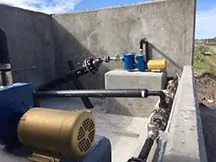
Hydraulic Evaluations for Lateral Expansion
The longer leachate force main with possibly additional bends in the line increases friction in the line and causes flow rates to reduce to unexpected levels. We recommended that landfill operators evaluate the performance of the existing pumps along with new pumps when designing a lateral expansion. Such an evaluation may require hydraulic analysis of the entire network of pipes along with pumps, or only the segment of the network affected by the expansion. However, the effort is minimal in comparison to the operating costs of inefficient flow and overtaxing the equipment.
Sometimes the results of a hydraulic evaluation may require up-sizing all or specific pumps in leachate sumps because not enough flow can go through the force main due to high friction loss in the expanded leachate force main. Up-sizing pumps may be achievable depending on the type of the leachate sump, i.e., riser system or vertical manholes. If the up-sized pump in a riser system is too long to fit inside a riser system, or so long that it makes routine maintenance too cumbersome, your engineer may consider enhancing the functionality of the design.
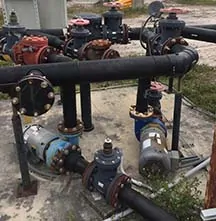
Inline and Offline Pumps
Booster pumps located along an expanded leachate force main can certainly be an option. Booster pumps can be the inline or offline type. Install the inline pumps on the actual force main, and position the offline type on the side so that liquids go through bends and elbows to reach the pump, and again through bends and elbows to get back in the force main. In either case, the booster pump adds hydraulic energy to the flow inside the force main to push the liquids at a compensated pressure through the remainder of the force main and to the target point.
Operators need to be aware of the dynamic nature of the leachate piping network and the role of booster pumps in the dynamic environment. Changes to the flow in the force main may change following a landfill expansion when the new cells are coming online increasing leachate generation. Alternatively, after closing portions of the landfill slopes, that decreases leachate generation over time. Sometimes booster pumps have to be up-sized or downsized depending on the flow and pressure in the system.
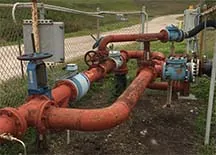
Optimizing Performance, Reduce O&M Costs
The cost of replacing pumps, up-sizing, or downsizing, is insignificant compared to the revenue that landfills generate. Proper adjustment of the pumping system keeps the entire network operating at the appropriate range of pressure, and velocity in the line; increasing the life of the pumping system. Less wear and tear on the system produces a reduction in maintenance costs along with less equipment downtime.
Lower maintenance requirements may also reduce the number of personnel required to keep the system in operational condition. Landfills with a large pumping system employing a second technician because of the high maintenance of multiple pumps may find a single technician sufficient for the upkeep of the system. Proper sizing of pumps and operating the pumping system as designed within the evaluation parameters can significantly reduce the cost and frequency of pump maintenance.
 About the Author: Ali Khatami, PhD, PE, LEP, CGC, is a Project Director and a Vice President of SCS Engineers. He is also our National Expert for Landfill Design and Construction Quality Assurance. He has nearly 40 years of research and professional experience in mechanical, structural, and civil engineering.
Landfill Engineering and Leachate Management
ISWA World Congress 2018 will feature a comprehensive scientific program highlighting the socio-economic impacts of waste recycling, waste reduction, and health, safety and policy regulation pertaining to recycling and climate change. It will also include areas of current interest such as marine and coastal waste management.
Please join SCS Engineers at one of these sessions, we always look forward to visiting and exchanging ideas with our ISWA colleagues.
DAY 1
Join Moderator David Ross at the session Sustainable Consumption and Waste Management in Developing Countries. This session is in Conference Hall 3, Level 3, on Monday, October 22. The presentation begins at 1130.
Or, join Presenter Bob Dick for Technological Innovation in Solid Waste Management Meeting for his presentation of a case study on Quarry Landfill Permitting. This presentation examines the application to productively use former quarry sites and avoid landfill development on greenfield sites. This strategic session is in meeting room 304, on Monday, October 22. The presentation begins at 1130.
You may choose to join Moderator James Law for the Climate Change and Landfills
This strategic session is in meeting room 304, on Monday, October 22. The presentation also begins at 1130, in meeting room 306, Level 3.
Join Moderator Dr. Fangmei Zhang at the session Closing Dumpsites and Marine Litter. Dr. Zhang will also present a case study on the Technical Challenges of Closing Old
Dumpsites for Redevelopment. Jose Luis Davila in the same session will present a case study on the San Cristobal Open Dump Conversion to an Engineered Landfill. These informative sessions are in meeting room 304, on Monday, October 22. The presentation begins at 1400.
DAY 2
ISWA Working Group on Landfill Closing Dumpsites
Keynote Session with Moderator James Law at 0830 am Conference Hall 3, Level 3.
ISWA Consortium of Working Groups – Landfill, Climate Change, and Waste Management
Climate Benefits
A Keynote Session with presentations by James Law and Alex Stege at 0930 in Conference Hall 3, Level 3. This forum includes ISWA Task Force on Closing Dumpsites and Evaluating the Effects of Closing Open Dumps on Greenhouse Gas Emissions.
Climate Change and Landfills will take place in meeting room 306, Level 3 at 1600. James Law will present Addressing Slope Failures and Fires at Major Landfills – A Case Study of
Ghazipur Landfill in Delhi, India.
DAY 3
Improving Air Quality and Mitigating Climate Change through Better Waste Management, Bob Dick will present Landfill Operations to Maximize
Landfill Gas Recovery in Conference Hall 3, Level 3 at 1030.
DAY 4
Post Conference Workshop on Landfill Dumpsite Stability by James Law at 1550 through 1630.
It’s been 10 years since the first Research, Development, and Demonstration (RD&D) Plans were approved allowing liquids to be applied to municipal solid waste landfills in Wisconsin. What have we learned?
Under an approved RD&D Plan, landfill operators can apply liquids other than recirculated leachate to the waste at municipal solid waste landfills. The RD&D Rule was published by US EPA in 2004, and states had the option of adopting the rule and issuing RD&D approvals. Wisconsin was an early adopter, and 13 of the approximately 30 landfill sites in the US with RD&D approvals are in Wisconsin.
This presentation will look at data from the Wisconsin landfills with RD&D Plans. Each site is required to report annually on a very detailed basis. For this presentation we will zoom out and look at the data on an aggregated basis to address big-picture questions. What are the trends in volumes applied for leachate recirculation versus RD&D Liquids? How do these volumes compare with precipitation? What liquid waste streams have been accepted and how have they been applied? How has RD&D liquid application affected landfill gas generation?
We will also provide an update on the regulatory status of the RD&D rule. On May 10, 2016, a final federal rule was published that revised the maximum permit term from 12 years to 21 years; however, WDNR will have to adopt this change in order for it to be available to Wisconsin landfills.
As some landfill owners have learned the hard way, the co-disposal of construction and demolition (C&D) fines or sulfur-containing industrial wastes in municipal solid waste (MSW) landfills can generate hydrogen sulfide (H2S) gas. H2S emissions are problematic at a landfill as they can cause odor, create worker safety issues, and cause wear or damage to landfill gas (LFG) collection and energy utilization components. Sulfur content in landfill gas can also impact air permitting for a landfill, either in the form of fugitive H2S emissions or sulfur dioxide (SO2) emissions from combustion.
We will discuss the biological, chemical and physical conditions necessary for H2S generation in a landfill. H2S generation can be prevented by knowing which waste types are likely to contain sulfate and testing incoming waste streams when appropriate. We will also discuss the complexities in trying to model and predict H2S generation in MSW landfills. For sites with high H2S concentrations and/or low H2S limits, we will review different H2S treatment technologies in use today.
Hundreds of closed landfills in Wisconsin are required to perform groundwater monitoring and reporting. Typically, the frequency of monitoring, size of the monitoring well arrays, and the list of required parameters, was established many years ago as part of the landfill operating permit or closure plan approval. There is a potential to reduce, or terminate landfill monitoring when groundwater quality improvements are documented. WDNR guidance entitled “Reducing or Terminating Groundwater Monitoring at Solid Waste Landfills,” (PUB-WA 1013) provides instructions for requesting reductions to monitoring requirements.
Learn about new revisions to the WDNR guidance, developed with input from the WDNR’s Waste and Materials Management Study Group, which are intended to improve both the range of options for monitoring reductions and the process for requesting reductions. In addition to providing procedures for reduction in monitoring frequency, new revisions to the guidance include procedures for requesting reductions to the required number of monitoring wells and parameters. The revised guidance also provides instructions for communicating monitoring reduction requests to the WDNR review hydrogeologists.
Tuesday, October 10, 1:00 pm – 2:30 pm ET
This Air & Waste Management Association webinar covers the effective, sustainable operation of municipal solid waste (MSW) landfills in today’s changing environment.
The latest updates to EPA regulations in over two decades limiting air emissions from landfills will be reviewed in detail.
Participants will learn the available models for quantifying landfill gas generation emissions and which model to use in different situations as well as energy recovery from landfill gas, its emissions, and how control requirements can affect feasibility.
Corporate Headquarters