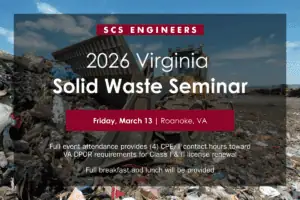
Join industry professionals in Roanoke, Virginia, for a half-day seminar on Friday, March 13 at Hotel Roanoke. This event will feature the latest regulatory, policy, and technological updates impacting the solid waste, landfill, landfill gas, and sustainable materials management industries. This program delivers practical insights from experienced practitioners and regulators to help attendees stay current on evolving requirements, emerging technologies, and industry best practices.
Full event attendance provides four (4) CPE/T contact hours applicable toward Virginia DPOR Class I & II license renewal.
RSVP Here: https://lp.constantcontactpages.com/ev/reg/xepmdav
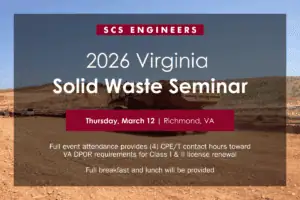
Join industry professionals in Richmond, Virginia, for a half-day seminar on Thursday, March 12 at the Virginia Crossings Hotel & Conference Center. This event will feature the latest regulatory, policy, and technological updates impacting the solid waste, landfill, landfill gas, and sustainable materials management industries. This program delivers practical insights from experienced practitioners and regulators to help attendees stay current on evolving requirements, emerging technologies, and industry best practices.
Full event attendance provides four (4) CPE/T contact hours applicable toward Virginia DPOR Class I & II license renewal.
RSVP Here: https://lp.constantcontactpages.com/ev/reg/xepmdav
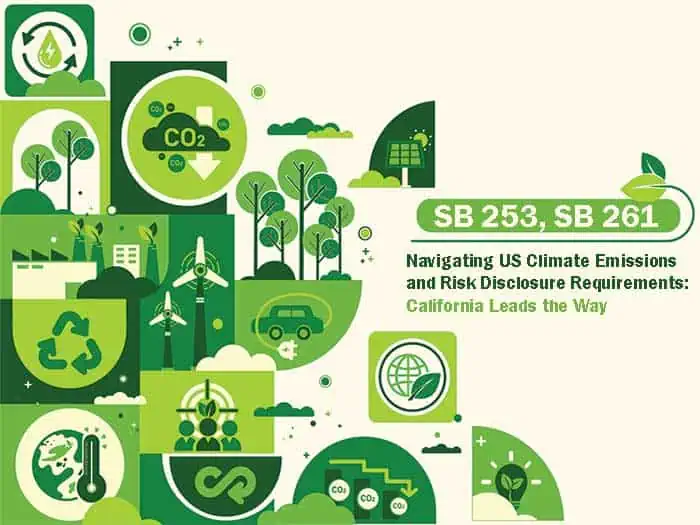
This Frequently Asked Questions blog contains two sections: the first related to the California Air Resources Board’s (CARB) regulatory development for the Corporate Greenhouse Gas Reporting (SB 253) and the Climate-Related Financial Risk Disclosure Programs (SB 261). The second FAQ section concerns only SB 261 reporting.
What is the purpose of the draft regulation posted by the California Air Resources Board (CARB) on December 9, 2025? The draft regulation aims to implement California’s climate disclosure programs, specifically SB 253 (Corporate Greenhouse Gas Reporting) and SB 261 (Climate-Related Financial Risk Disclosure). It outlines requirements and processes for organizations subject to these laws.
What is the public comment period for the regulation? The 45-day public comment period will begin on December 26, 2025, and conclude on February 9, 2026.
How will stakeholders be notified of any updates before formal publication? If CARB makes revisions or updates to any documents in the rulemaking package before formal publication, they will update their rulemaking webpage and notify stakeholders directly who sign up for their listserve at https://public.govdelivery.com/accounts/CARB/subscriber/new.
What topics are covered in the draft regulation? The draft regulation covers definitions of exempt organizations, the provisions for calculating, paying, and collecting fees for each program, and alternative definitions of the fiscal year for SB 253 reporting of corporate greenhouse gas emissions.
Which organizations are required to comply with SB 253 and SB 261? Organizations not listed as exempt in the draft regulation must comply with the reporting and disclosure requirements specified under SB 253 and SB 261. As of December 15, 2025, non-profits, government entities, California-regulated insurance companies, companies in the business of insurance in other states, businesses with only teleworking employees in CA, and businesses with only wholesale electricity transactions in CA are exempt.
Where can stakeholders find updates and further information? Stakeholders can visit CARB’s rulemaking webpage for the latest updates, documents, and notifications regarding the regulation.
California Climate-Related Financial Risk Reporting (SB 261) FAQs
Do I need to post my Climate-Related Financial Risk Report (CRFRR) online by January 1, 2026, to comply with Senate Bill (SB) 261? No, the California Air Resources Board (CARB) issued an Enforcement Advisory on December 1, 2025 (see Enforcement Advisory) to inform covered companies that enforcement of SB 261 (specifically Health and Safety Code section 38533) is paused due to a court injunction. Covered companies are not required to submit or post climate-related financial risk reports by the January 1, 2026, deadline or while the appeal is pending. CARB will not enforce this deadline and will provide further guidance, including a possible alternate reporting date, after the appeal is resolved.
What is the current status of the legal proceedings? On November 18, 2025, the Ninth Circuit Court of Appeals granted an injunction in the case, Chamber of Commerce v. Sanchez, halting enforcement of SB 261 until the appellate proceedings are resolved. The appeal is scheduled for argument on January 9, 2026, which is notably after the legislative January 1, 2026, reporting deadline.
Can entities submit reports voluntarily during this period? Yes, entities may choose to report voluntarily. CARB opened a docket for voluntary submissions of the link to company reports on December 1, 2025. It will be open until July 1, 2026. See Climate-Related Financial Risk Reports (SB 261) Docket
What should we do in the meantime? Together with other stakeholders, we recommend a ‘No Regrets’ approach and continuing the work to complete the CRFRR for your firm. While voluntary reporting is an option, several organizations have already done so by posting on their websites. This ensures you are prepared to submit promptly if and when the program is reinstated.
Where can I find updates or further information? CARB will issue additional information and guidance after the appeal is resolved. Covered companies should monitor CARB communications or their website for updates regarding alternate reporting dates and procedures. See California Corporate Greenhouse Gas (GHG) Reporting and Climate-Related Financial Risk Disclosure Programs.
CARB SB 253 and SB 261 Resources
Please take a look below for links to the notice of public hearing, staff report, and proposed regulatory text, along with contact information for subject-matter experts if you need any more help.
See the most recent program updates.

The U.S. Department of Energy (DOE) is awarding millions to boost U.S. power reliability and capacity, and is emphasizing coal power modernization and mineral recovery from waste streams. This funding repositions coal within the energy mix to counter the high cost of new natural gas plants and current storage limitations of renewables. The value of existing coal assets and capacity is surging as funding announcements revive ready-to-use coal plants and support new technologies and processes that will keep America’s lights shining as energy demand escalates.
Jon Yang, a senior geochemist at SCS Engineers, has been eagerly following the dollar trail and client opportunities. “Power providers and coal plants are in a great spot to develop new value streams while mitigating risks of coal-centric operations. This is a mega-win for everyone,” says Jon.
As utilities and coal plants pursue funding and explore new markets, Jon offers guidance to maximize progress, derisk their market entry, and avoid setbacks.
Quickly Identify the Economic Opportunity of Mineral Recovery
The DOE dedicated $355 million to expand domestic recovery and production of Critical Minerals (CM) and Rare Earth Elements (REE) from waste streams. This investment will help commercialize recovery technologies, meaning the 4.4 billion tons of coal waste (including 2 billion tons of coal ash) dispersed across the country could be worth $8.4 billion. Simultaneously, this opportunity for CM and REE recovery can also mitigate risks of coal waste handling and storage, which are currently significant liabilities for power providers and coal plants. But, how do you know whether ash equals cash?
“Rare earth elements are often misunderstood and misinterpreted—they can be difficult to quantify and interpret accurately,” Jon says. “Moreover, technologies for the extraction of REEs from these types of materials are still in their infancy and require careful vetting. SCS has the expertise to bridge these gaps in the form of expert analysis, quick-turn feasibility studies, and strategic relationships.”
To assess the economic opportunity of coal waste, SCS collects small-scale samples and works with specialized laboratories to analyze the composition, concentration, and extractability of valuable elements. With this data, utilities and coal plants can pinpoint their opportunity, attract investors, and green-light projects with limited early investment. Building on the feasibility study, SCS can conduct a full resource assessment for a comprehensive market analysis that considers extraction technology, production costs, and market potential.
“Our client experience in coal waste mineral and metal valuation is proven,” Jon says. “We excel as owner-advisors because we are experts in CM and REE geochemistry, techno-economic evaluations to determine feasibility, and business case development.”
Invest in Fundamental Coal Plant Processes to Better Support Innovation
The DOE earmarked $100 million to restore coal plants—including water and wastewater management, and environmental monitoring and controls—to enable them to run longer and enhance byproduct and mineral recovery. As utilities and coal plants pursue new value streams, they should also bolster critical foundational systems.
“Coal waste stream recovery requires precise systems and approaches to manage water use, wastewater management, and environmental standards. You won’t get far without them,” Jon says.
Extraction technologies, such as high-pressure acid leaching, require large amounts of water and produce difficult-to-treat wastewater containing dissolved metals and acids. By strengthening the critical systems that support the beneficial reuse of coal waste streams, utilities and coal plants maximize waste-stream value, increase extraction efficiency, reduce environmental liabilities, and meet environmental standards.
Start with a Strong Grant Application
Applicants seeking DOE funding must submit grant applications and, in some cases, work proposals. When dealing with technical requirements, applicants who partner with a specialized company are better able to address the complexities inherent to engineering and scientific grants. As a technical partner, SCS can manage the entire application process, allowing utility and coal plant teams to remain focused on operational priorities.
With millions of grant dollars up for grabs, now is the time to lock in a strong partner. Jon says there are three essential priorities to look for:
“We frequently succeed in securing federal grants because our technical specialization translates to specific, measurable, achievable projects that are aligned to government missions and priorities,” explains Jon. “With the right partner, utilities and coal plants will win grants and lead coal down new, sustainable paths.”
Related Mineral Recovery Resources:
Today, December 9, the California Air Resources Board (CARB) posted the draft regulation for California’s climate disclosure programs, SB 253 and SB 261, and a public hearing notice for February 26, 2026.
The regulation covers both of California’s climate disclosure laws for Corporate Greenhouse Gas Reporting (SB 253) and Climate-Related Financial Risk Disclosure (SB 261). For the most current information see SCS’s answers to the most frequently asked questions.
If CARB makes any revisions or updates to any of the documents in the rulemaking package before the formal publication on December 26, 2025, they will update their rulemaking webpage and notify stakeholders.
Draft Regulation
The topics covered in the 7-page regulatory document are:
CARB SB 253 and SB 261 Resources
We’ve included below the proposed regulation, the resources CARB has published, and how to get expert support.
Submit Public Comments to CARB
Comment on a CARB topic open for public comment. Please note that your written and oral comments, attachments, and associated contact information (e.g., your address, phone, email, etc.) become part of the viewable public record. Additionally, this information may become available via Google, Yahoo, and any other search engines. If you experience technical issues, submit your comments to the Clerk of the Board via email, and indicate the relevant docket number.
See the most recent program updates.
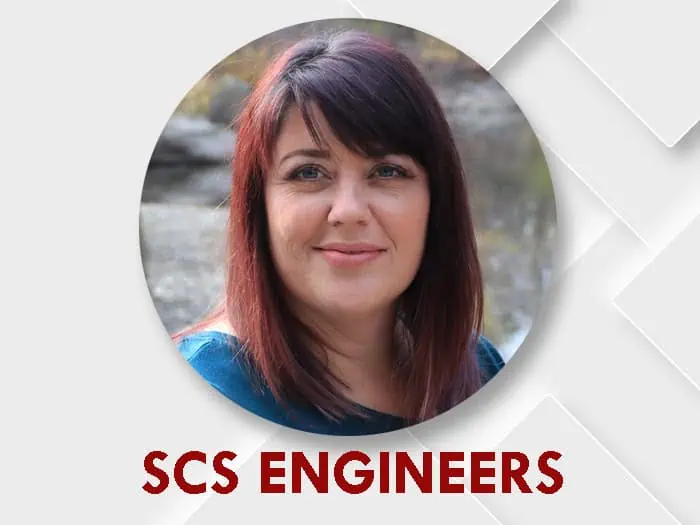
Michelle Langdon, PE, joins SCS Engineers to serve solid waste clients nationwide as Waste Management Project Director. Michelle works from Boise, ID, and brings to SCS her impressive expertise, qualifications, and success record.
Michelle Langdon is a licensed Professional Engineer in multiple states with a comprehensive work history emphasizing leadership in engineering projects related to waste management systems. She has over two decades of experience leading full-service, multidisciplinary teams across planning, design, construction, operations, and permitting. As a consultant, Michelle brings her years of experience working for a county waste management division to her work, helping her understand project challenges from her clients’ perspectives.
Her background includes designing and managing multiple projects to develop sustainable, efficient waste management systems that optimize operations, create safer work environments, reduce methane emissions, capture waste materials for beneficial reuse, and protect the environment.
Michelle says, ”After a lot of research and meeting with different firms, I knew SCS was the right place for me. I knew they were an industry leader with a deep breadth of technical expertise, but it is their focus on client service and employee welfare that drew me in.”
SWANA (the Solid Waste Association of North America) honored Michelle with the 2025 prestigious Professional Achievement Award for her work directing engineering efforts on complex and diverse solid waste projects, landfill expansions, coal combustion residuals, transfer station designs, master planning, and operations assessments. Along with managing multimillion-dollar civil and environmental engineering projects for landfills, composting facilities, recycling centers, and transfer stations, she oversees all phases of work from conceptual design and permitting through construction, and quality assurance/quality control (QA/QC). Her passion lies in sharing her knowledge with the waste industry and young professionals through teaching, presenting, and mentoring, and she has been fortunate to do so across the nation.
SCS Vice President Greg Helland says: In addition to Michelle’s successful record of accomplishments for her clients, she is a skilled presenter, trainer, and mentor. A great fit with our SCS culture. She regularly shares her comprehensive knowledge with our industry through training and leadership positions. As a natural leader, we believe Michelle builds trust, fosters collaboration, and empowers others to see the bigger picture for sustainable results.
Additional Qualifications
Join SCS Engineers and John Tsun as he serves as one of the co-organizers for the 24th Annual Joint Venture NJDEP/Air & Waste Management Association (A&WMA) Regulatory Update Conference, November 21st.
 This one-day virtual event provides attendees with the latest updates on New Jersey Department of Environmental Protection (NJDEP) regulatory initiatives and programs related to environmental compliance, air quality, contaminated site remediation and redevelopment, energy, materials sustainability, water quality, and climate change mitigation.
The conference offers a valuable opportunity for environmental professionals, regulators, and industry leaders to engage directly with NJDEP representatives and stay informed on emerging policies, research, and best practices shaping the future of sustainable environmental management. Register now.
Join SCS Engineers Vice President James Law on November 12th as a featured speaker at COP30, joining Zero Waste Europe (ZWE) and global leaders to discuss innovative strategies for reducing methane emissions in the waste sector.
 James will speak during the session “MRBT – Fast Track Climate Solution for Residual Waste: Shifting from Post-Landfill Capture to Pre-Landfill Methane Prevention” on Wednesday, November 12, 2025, from 3:30–5:00 p.m. in the Nordic Pavilion.
This event will highlight how Material Recovery and Biological Treatment (MRBT) offers a scalable pathway to cut methane emissions, recover valuable resources, and advance circular economy goals. By focusing on pre-landfill methane prevention, the session underscores how early waste treatment can support climate-neutral systems and accelerate progress toward the Paris Agreement targets.
We’re proud to have James representing SCS Engineers on the global stage, contributing his expertise to help shape sustainable, low-carbon waste management solutions worldwide.
Join SCS Engineers, sponsors and exhibitors at COMPOST 2026, February 2-5th at the SAFE Credit Union Convention Center in Sacramento, California. Compost 2026 is the world’s largest composting event. The U.S Composting Council’s Annual Conference and Tradeshow is the premiere professional meeting for composting, organics recycling, and related topics. USCC provides training, demonstrations, and the opportunity to engage with member organizations, industry leaders such as SCS, investors, advocates, and partners. We look forward to seeing you there. Register now!

Soil health is a cornerstone of sustainable agriculture, and the USDA’s Natural Resources Conservation Service is taking steps to support it through Conservation Practice Standard Code 336. This initiative, part of the Environmental Quality Incentives Program (EQIP), offers financial incentives to land managers who apply soil carbon amendments, such as compost, biochar, and blended materials, to improve soil quality and sequester carbon. For compost and biochar producers, this program could be a significant driver of demand for compost and biochar products that meet USDA standards for soil carbon amendments.
Why Soil Carbon Amendments Matter
The USDA’s Code 336 program enhances soil organic matter, increases carbon sequestration and soil carbon stocks, improves soil aggregate stability, and supports healthy soil ecosystems. These benefits contribute to long-term agricultural productivity and align with broader climate resilience goals.
Reimbursement Rates and Financial Incentives
Reimbursement rates vary by state and are higher for historically underserved (HU) land managers. EQIP covers the cost of purchasing, transporting, and applying soil carbon amendments. For example, in Massachusetts, reimbursement for 100% biochar is $211.37 per cubic yard, while HU land managers receive $253.64. Blended compost/biochar options and small-area applications are also eligible, with rates adjusted accordingly.
Here’s a snapshot of some Massachusetts EQIP rates:
| Component |
Unit |
Standard Rate |
HU Rate |
| 100% Biochar | CuYd |
$211.37 |
$253.64 |
| 20% Biochar / 80% Compost | CuYd |
$105.91 |
$127.09 |
| Compost Off-site by Volume | CuYd |
70.02 |
84.02 |
Eligible Land Types in USDA EQIP Code 336
The program applies to a wide range of land uses, including:
Landowners are responsible for planning and implementing the amendment applications, including securing necessary permits. EQIP may also reimburse planning and testing costs, provided the soil at the proposed site is evaluated and found to need amendment.
Standards for Compost and Biochar in USDA EQIP Code 336
To qualify for reimbursement, amendments must meet specific criteria, including:
Compost Requirements
Biochar Requirements
Conclusions About USDA EQIP Code 336
The USDA’s EQIP Code 336 program offers a valuable opportunity for land managers to enhance soil health while receiving financial support. By encouraging the use of compost and biochar, the program promotes sustainable agriculture and helps build a robust market for carbon-based soil amendments.
For compost and biochar producers, this program could be a significant driver of demand for products and support environmentally beneficial practices across many land uses.
Additional Resources:
Corporate Headquarters