
Soil health is a cornerstone of sustainable agriculture, and the USDA’s Natural Resources Conservation Service is taking steps to support it through Conservation Practice Standard Code 336. This initiative, part of the Environmental Quality Incentives Program (EQIP), offers financial incentives to land managers who apply soil carbon amendments, such as compost, biochar, and blended materials, to improve soil quality and sequester carbon. For compost and biochar producers, this program could be a significant driver of demand for compost and biochar products that meet USDA standards for soil carbon amendments.
Why Soil Carbon Amendments Matter
The USDA’s Code 336 program enhances soil organic matter, increases carbon sequestration and soil carbon stocks, improves soil aggregate stability, and supports healthy soil ecosystems. These benefits contribute to long-term agricultural productivity and align with broader climate resilience goals.
Reimbursement Rates and Financial Incentives
Reimbursement rates vary by state and are higher for historically underserved (HU) land managers. EQIP covers the cost of purchasing, transporting, and applying soil carbon amendments. For example, in Massachusetts, reimbursement for 100% biochar is $211.37 per cubic yard, while HU land managers receive $253.64. Blended compost/biochar options and small-area applications are also eligible, with rates adjusted accordingly.
Here’s a snapshot of some Massachusetts EQIP rates:
| Component |
Unit |
Standard Rate |
HU Rate |
| 100% Biochar | CuYd |
$211.37 |
$253.64 |
| 20% Biochar / 80% Compost | CuYd |
$105.91 |
$127.09 |
| Compost Off-site by Volume | CuYd |
70.02 |
84.02 |
Eligible Land Types in USDA EQIP Code 336
The program applies to a wide range of land uses, including:
Landowners are responsible for planning and implementing the amendment applications, including securing necessary permits. EQIP may also reimburse planning and testing costs, provided the soil at the proposed site is evaluated and found to need amendment.
Standards for Compost and Biochar in USDA EQIP Code 336
To qualify for reimbursement, amendments must meet specific criteria, including:
Compost Requirements
Biochar Requirements
Conclusions About USDA EQIP Code 336
The USDA’s EQIP Code 336 program offers a valuable opportunity for land managers to enhance soil health while receiving financial support. By encouraging the use of compost and biochar, the program promotes sustainable agriculture and helps build a robust market for carbon-based soil amendments.
For compost and biochar producers, this program could be a significant driver of demand for products and support environmentally beneficial practices across many land uses.
Additional Resources:

On Thursday, September 25, at the Southern California SWANA Annual Meeting and Workshop, Michelle Leonard completed her 18-year tenure as a member of the Southern California Founding Chapter Board of Directors, and most recently as Chapter President. Her departure marks the end of an era defined by visionary leadership, advocacy, and transformative impact in the solid waste management industry.
Michelle’s journey with SWANA began in the early 1990s, when she joined SCS Engineers and quickly became a trailblazer in a field where women were few and far between. Over the years, she rose through the ranks of SWANA’s Executive Board, serving as Treasurer, Secretary, Vice President, and ultimately President in 2015. Her commitment to education, mentorship, and innovation has left an indelible mark on the organization and the broader environmental community.
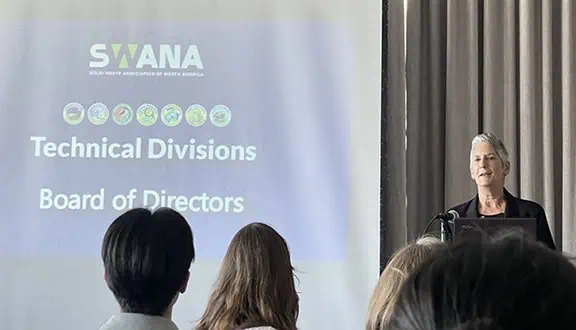
At the September 25 workshop held at The Reef in Long Beach, Michelle opened the day with a warm welcome and presided over the annual business meeting, which included board slate approvals and by-law updates. Later in the day, she delivered a deeply personal and inspiring keynote titled “If I Knew Then What I Know Now: My Journey in SWANA and the World of Waste”—a reflection on her career, the evolution of the industry, and the lessons learned along the way.
As Senior Vice President at SCS Engineers, she has led dozens of high-impact projects across California and beyond. Her expertise spans solid waste management planning, recycling program design, regulatory compliance, and sustainable materials management. She has worked with municipalities, tribal governments, and regional authorities to develop innovative solutions that reduce, reuse, and recycle waste while improving operational efficiency.
Her leadership has also extended to national platforms. Michelle is a past recipient of SWANA’s Sustainable Materials Management Technical Division Distinguished Achievement Award and Waste 360’s inaugural Women Who Inspire Award. She is known for her ability to moderate panels, present at conferences, and mentor the next generation of environmental professionals.
As Michelle steps down from her role on the SWANA SoCal Board, her legacy continues through the programs she helped build, the people she inspired, and the standards she set. Her swan song may mark the end of her board position, but it is far from the end of her influence as she continues supporting SCS Engineers clients.
Say hello to Michelle on LinkedIn or from the SCS website!
Join SCS Engineers at AEC PM Connect 2025 – Kansas City, October 27-28 at Keen Wealth Advisors in Overland Park, KS. This event focuses on project management in the Architecture, Engineering, and Construction industry.
 On Tuesday, October 28 at 10:45 a.m., Jenny Taylor will join the panel “Ask Me Anything About Project Management”, sharing insights alongside other AEC leaders to help project managers strengthen their strategies, lead effectively, and drive successful outcomes within their organizations.
AEC PM Connect – Kansas City offers two tailored learning tracks for project managers and those responsible for their development, covering essential topics like risk management, scope creep, earned value, PM tools, and strategies for building a strong project management culture.
We’re proud to have Jenny representing SCS at this impactful event and look forward to connecting with industry peers in Kansas City! Register Today
On September 17, 2025, the U.S. Environmental Protection Agency (EPA) announced the next steps regarding regulatory efforts to address the cleanup of perfluorooctanoic acid (PFOA) and perfluorooctanesulfonic acid (PFOS). In the press release, EPA Administrator Zeldin said, “…we will need new statutory language from Congress to fully address our concerns with passive receiver liability.”
CERCLA imposes broad, retroactive, and potentially costly strict liability on those who release hazardous substances to the environment. This liability can sometimes attach to entities that did not manufacture or generate the substance but received it in feedstocks, products, or landfilled waste. The EPA refers to these entities as “passive receivers.” Members of Congress received testimony and input from various industries, including private and municipal landfills, and passed it to the EPA, which intends to continue working with Congress. No workshops or additional input forums were announced.
The major concern for passive PFOA and PFOS contamination receivers, including local municipalities and service providers, is potentially passing decontamination costs onto ratepayers, taxpayers, and consumers. EPA will continue to collect information on its costs and benefits, but feels the best solution to this issue is a statutory fix to protect passive receivers from liability.
For now, EPA is retaining the Comprehensive Environmental Response, Compensation, and Liability Act (CERCLA or Superfund) hazardous substance designation for PFOA and PFOS and will initiate future rulemaking to establish a uniform framework governing the designation of hazardous substances under section 102(a) of CERCLA moving forward. The current rule mandates reporting of releases of one pound or more of PFOA or PFOS within 24 hours. It designates Perfluorooctanoic Acid (PFOA) and Perfluorooctane sulfonic Acid (PFOS) as CERCLA hazardous substances. See 42 U.S.C §9602; Docket EPA-HQ-OLEM-2019-0341.
According to the EPA, a CERCLA section 102(a) Framework Rule would provide a uniform approach to guide future hazardous substance designations, including how the agency will consider the costs of proposed designations. Section 102(a) gives the EPA authority to designate additional hazardous substances beyond those listed under the other statutes referenced in CERCLA (the Clean Water Act, the Clean Air Act, the Resource Conservation and Recovery Act, and the Toxic Substances Control Act). Once finalized, the 102(a) Framework Rule would provide a uniform approach for future designations.
In response to the EPA’s August 26, 2022, proposed rule to list PFOA and PFOS as CERCLA hazardous substances, numerous comments were submitted requesting that the final CERCLA HS rule include exemptions or similar liability relief for passive receivers that did not generate the chemicals – e.g., landfills, wastewater treatment facilities, and water supply systems.
Background
EPA’s May 8, 2024, final CERCLA HS rule did not provide an exemption. However, EPA’s April 19, 2024, Memorandum entitled “PFAS Enforcement Discretion and Settlement Policy Under CERCLA” outlines enforcement discretion considerations for the following entities:
(1) Community water systems and publicly owned treatment works (POTWs)
(2) Municipal separate storm sewer systems (MS4s);
(3) Publicly owned/operated municipal solid waste landfills;
(4) Publicly owned airports and local fire departments; and
(5) Farms where biosolids are applied to the land.
Despite the enforcement discretion policy, some passive receivers were disappointed that the agency did not provide stronger liability protection. Based on EPA’s September 2025 press release (above), EPA now plans to take a closer look at the issue, including the possibility of providing a statutory fix to protect passive receivers from liability.
If you have questions regarding this rule, please get in touch with SCS Engineers.
SCS Engineers is excited to join the NWTC Advanced Manufacturing & Engineering (STEM) Career Fair!
We look forward to meeting Northeast WI School of Innovation High School Seniors from 10:00 – 11:00 a.m., and connecting with all NWTC students between 11:15 a.m. – 1:00 p.m.
SCS Engineers provides innovative environmental consulting and engineering solutions in solid waste management, renewable energy, remediation, and sustainable infrastructure. Whether you’re exploring full-time roles, internships, part-time work, or networking opportunities, our team is eager to share how you can grow your career and make an impact with SCS.
SCS Engineers is proud to take part in Engineering Career Night at Messiah University.
This event provides students the opportunity to network with industry professionals, attend targeted workshops, and explore career paths across engineering disciplines. Join us in Brubaker Auditorium at the Eisenhower Campus Complex to connect with our team and learn more about internships, co-ops, and full-time roles with SCS Engineers.
At SCS, we combine engineering expertise with a passion for sustainability—delivering innovative solutions in solid waste management, renewable energy, remediation, and infrastructure. We look forward to meeting students who are ready to plan their careers and make an impact in their communities.
SCS Engineers is excited to attend Day 2 of the upcoming career fair focused on Architecture, Construction, and Structural Design and Engineering roles!
With more than 50 years of experience, SCS provides innovative environmental engineering and consulting services in solid waste management, renewable energy, remediation, and sustainable infrastructure. We’re looking forward to connecting with students and alumni across 11 colleges and 190+ degree programs who are eager to explore careers that combine engineering expertise with real-world impact.
Join us on Day 2 to learn more about internships, Co-Op placements, and full-time opportunities at SCS Engineers. Whether you’re just beginning your journey or preparing for your next step, you’ll find exciting ways to grow your career while making a positive difference for communities and the environment.
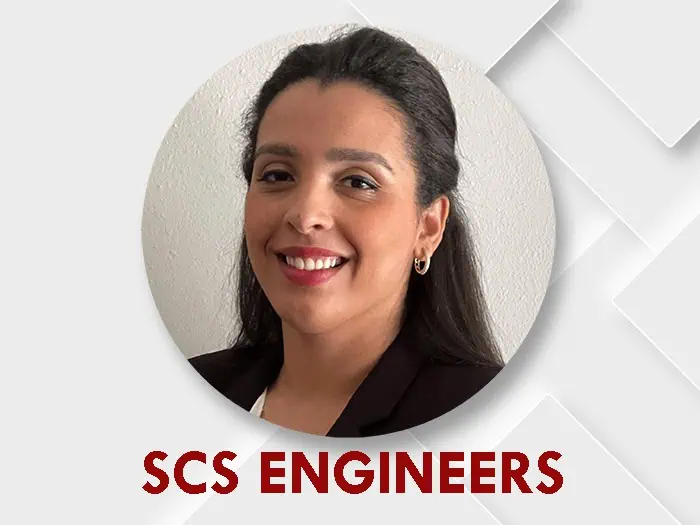
Please join SCS Engineers in welcoming Dr. Aicha Slassi Senou to our Greenhouse Gas (GHG) and Climate Change Practice.
Dr. Slassi Senou brings over 10 years of expertise as a GHG and sustainability expert in GHG accounting, decarbonization planning, and life cycle assessments. She has successfully delivered over 30 third-party verified Corporate GHG Inventories for scopes 1, 2, and 3 by responding to auditors’ technical questions about data collection, calculations, in alignment with the World Resources Institute’s GHG Protocol’s Corporate Standards, and ISO 14064-1. She is skilled in managing corporate climate and GHG projects, including GHG inventories and climate disclosures, including reporting to the Science Based Targets Initiative and CDP.
Her experience includes end-to-end GHG inventory development for corporate clients from various sectors, including services and manufacturing. Over the last two years, she has experience ensuring compliance with GHG Protocol standards across Scopes 1, 2, and 3 for 45 corporate inventories. She has demonstrated deep technical expertise across all 15 Scope 3 categories. Dr. Slassi Senou delivered sector-specific decarbonization strategies, including value chain engagement for a Fortune 50 manufacturer and net-zero road mapping for multiple clients.
SCS’s National Expert on Climate Change, has this to add:
Aicha’s a formidable addition to our deep bench of engineers, scientists, and consultants. In addition to her expertise, she completed two Environmental Defense Fund (EDF) Climate Corps Fellowships, one with Hershey’s Company and one with Meta Inc.
Her background includes laboratory research on biochar’s carbon and environmental benefits from alternative feedstocks. She worked at Moody’s as a Corporate Sustainability Reporting (CSR) analyst on ESG data collection, analysis, and comparative ranking of corporations relative to their peers.
We’re sure Aicha will be pleased to hear from you. Please extend a greeting on LinkedIn.
Additional Resources:
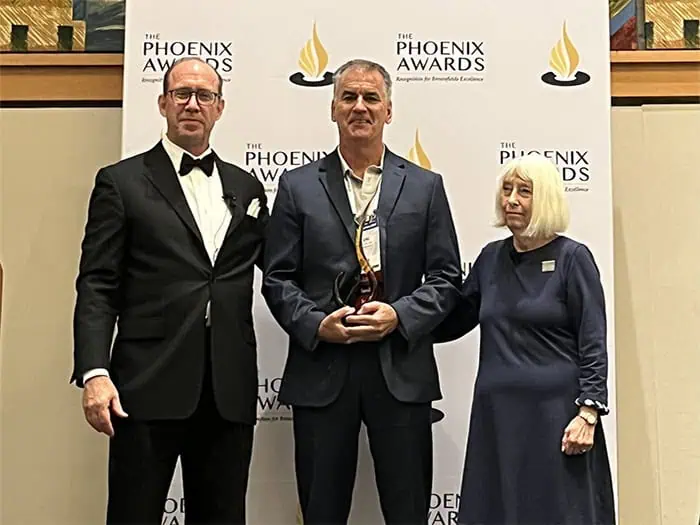
Phoenix Awards reflect the progression of brownfield redevelopment over the past 20+ years by recognizing extraordinary practitioners and projects by the EPA.
SCS Engineers expresses gratitude to IQHQ, the EPA, and the San Diego community for their collective support in achieving a Phoenix Award that features the RaDD project as an exemplary model of innovative environmental remediation and sustainable design, demonstrating how large-scale redevelopment can address environmental challenges while enhancing community quality of life and promoting economic and environmental benefits for future generations.

IQHQ’s RaDD project exemplifies a transformative redevelopment of San Diego’s waterfront, integrating sustainability and environmental stewardship into a life sciences campus. The project involved extensive soil excavation and innovative environmental management to address legacy contamination while promoting economic and community revitalization.
Historic site reclamation: The RaDD project was developed on 15.89 acres of former Navy land reclaimed between 1915 and 1917, involving dredged bay sediments and industrial debris requiring careful environmental management.
Soil management strategy: IQHQ partnered with SCS Engineers to create and implement a rigorous soil management plan, including regulatory collaboration to safely characterize, excavate, and dispose of nearly 800,000 cubic yards of soil, protecting public health during construction.
Innovative contamination treatment: Discovery of 7,000 cubic yards of highly contaminated material led to on-site treatment using a mobile unit and proprietary admixtures under regulatory oversight, reclassifying hazardous waste to reduce disposal costs and saving over $1.1 million.
Sustainable campus features: The 1.7 million square feet RaDD campus includes green spaces, solar power exceeding 0.5 MW, over 200 EV charging stations, and a carbon-neutral building design, aiming for LEED, Fitwel, Smartscore, and WiredScore Platinum certifications in 2025.
Learn more about this award-winning Brownfields redevelopment project here!
Actionable Resources:
Congratulations to Gabrielle Stephens for her promotion to lead SCS’s Southwestern U.S. Air Compliance Group. She brings over two decades of client success to the role.
Greenhouse gas (GHG) reporting or verification, regulatory air compliance, and air permitting services fall within Ms. Stephens’ purview. She leads teams that support clients in the solid waste and manufacturing industries, who find value in having a regulatory liaison to navigate ever-changing federal, state, and local regulations. These teams help maintain efficient operations and enhance business communication with stakeholders.
Regulatory agencies often operate independently, and knowledgeable environmental consultants know how best to meet multiple agency data requirements, resulting in positive relationships between agencies and clients. SCS clients find that improved communication helps minimize or prevent permitting and compliance delays. Agencies, especially air district staff, can depend on the accuracy of Clean Air Act experts who are experienced with newer technologies proven to work, but potentially new in a district.
Ms. Stephens’ experience spans multiple states, numerous air districts and local enforcement agencies.
Beyond her work in air permitting and compliance, Ms. Stephens works on emissions estimates and inventories and has extensive experience preparing permit-to-construct/operate and Title V permit applications. She has also undertaken projects evaluating and reporting to meet the federal Greenhouse Gas (GHG) Rule and the AB 32 Landfill Methane Rule. Her collaborative efforts with the solid waste industry contribute to multiple facilities obtaining landfill gas-to-energy and RNG permits that positively impact air quality.
Ms. Stephens’ air compliance audits, permitting, and compliance reporting for manufacturing facilities, including fiberglass boats, product removers, ceramics, paper products, and cement/aggregates, help ensure regulatory compliance and improve operational efficiency.
Additional Clean Air Act Resources:
Corporate Headquarters