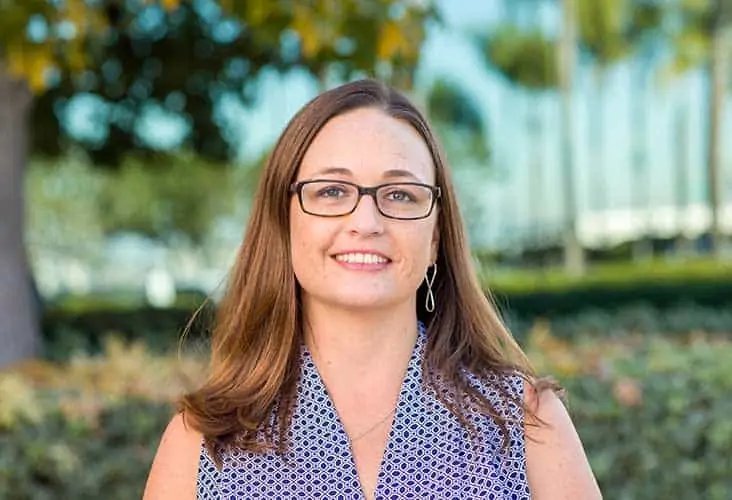
SCS Engineers Vice President Ashley Hutchens is now the Environmental Services Director for its Long Beach and Las Vegas operations. Besides managing her current projects and clients, Hutchens will manage the environmental professionals and technicians in each city. She is responsible for allocating resources for business development, project management, and coordinating activities with other SCS offices nationwide.
“Ashley’s proven capabilities solving environmental challenges for industries will serve our Long Beach and Las Vegas clients well,” said Julio Nuno, SCS Senior Vice President.
Hutchens has 18 years of experience in property evaluation and due diligence, site assessment, characterization, remediation; vapor intrusion assessment and mitigation; and hazardous waste management. She has led hundreds of projects, including all phases, from the development of cost estimates for site assessment, mitigation, and remediation, to groundwater monitoring and sampling, preparation and review of final reports, interfacing with regulatory agencies, and management of all aspects of projects, staff, and various subcontractors.
SCS Engineers’ environmental solutions directly result from our experience and dedication to solid waste management and other industries responsible for safeguarding the environment. For more information about SCS, please visit us at www.scsengineers.com, or contact .
SWANA recently announced the winners of the SWDC competition hosted by SWANA’s Young Professionals Group. The competition aims at providing design experience to students interested in pursuing an education or career in solid waste management. The outcome is that all participants are winners, gathering real-world experience to help solve complex solid waste management issues in a supportive environment.
Seven universities participated in the competition: Arizona State University, Wayne State University, University of Southern California, University of Vermont, the University of Texas at Arlington, University of British Columbia, and the National University of Engineering in Peru.
 This year’s project challenged teams to find solutions for closing the Bakoteh Dumpsite and supporting changes to modern solid waste management in Kanifing, The Gambia. The dumpsite is one of the largest disposal facilities in The Gambia and the only one in the Kanifing Municipality.
“Our team of judges was impressed with how this group of student design teams engaged in understanding this solid waste challenge plaguing The Gambia,” Competition judge and SCS Engineers Project Manager, Chris Jimieson, says. “The students developed diverse designs that we believe will become part of the eventual solution of constructing The Gambia’s first engineered, sanitary landfill.”
The judging panel included John Welch, Director of the Dane County Department of Waste & Renewables; Kaba Bah, Principal Manager at the Midwest GOOH Group in Madison, WI; Lamin Sanyang, Director of Services at Kanifing Municipal Council in The Gambia; and our own Chris Jimieson. The judges have a long association with the Bakoteh Dumpsite.
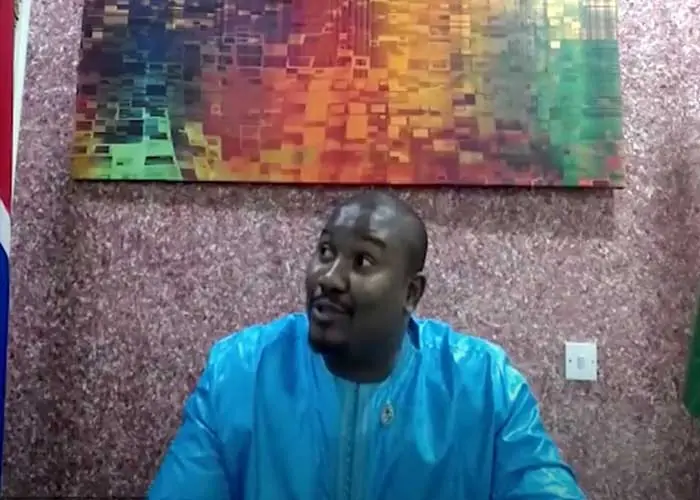
The SWANA Awards Ceremony features two guest speakers, including David Biderman, CEO and Executive Director of SWANA, and Mayor Talib Ahmed Bensouda, Lord Mayor of the Kanifing Municipality, The Gambia. Mayor Bensouda explains in the video how the Bakoteh Dumpsite became a significant problem for the growing community and the solutions they are using to fix it.
Chris Jimieson provides us with an update from his travels to The Gambia in Africa to evaluate their solid waste challenges.
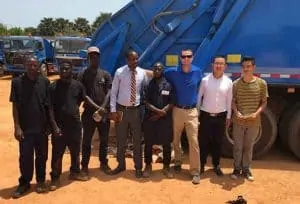 Many of you attended my presentation at the office in July 2019 following the Mayor’s visit. I have continued to stay in touch with our contacts in Kanifing, The Gambia. In February 2020, we presented the project at WIRMC to solid waste professionals across Wisconsin. During the pandemic, Lindsey Carlson and I participated in a series of weekend phone calls to stay engaged in understanding their solid waste challenges.
In October 2020, I presented The Gambia situation as a design project to college students worldwide that wanted to compete in the SWANA YP’s International Solid Waste Design Competition. We asked them to provide a closure plan for the Bakoteh Dumpsite, provide a conceptual design for a new sanitary landfill, and share some cost estimates for each of these endeavors. Seven teams from across the Americas decided to compete. If you are interested, please browse through student design posters, reports, and presentations or contact me, Chris Jimieson.
Thanks to the SWANA YPs, my SCS colleagues, and so many who volunteered to help elevate this project to the international stage.
Virtual Conference on April 15, 2021, recording on YouTube
Recorded at the Virtual Conference on April 15, 2021, this recording is available online.
Moderated by Michelle Gluck of Cornell Cooperative Extension Dutchess County, the panel discusses waste reduction, composting, anaerobic digestion, compost use, carbon sequestration…so many avenues to reduce climate impacts through organics management.
We’ll hear about New York State’s Climate Leadership and Community Protection Act, the progress of its waste advisory panel, and from a Climate Smart Community on how they’re planning to manage their organics with greenhouse gas emissions in mind.
Panelists include:
Suzanne Hagell, Climate Policy Analyst, New York State Department of Environmental Conservation
Molly Trembley, Environmental Engineer, NYSDEC
Greg McCarron, Vice President, SCS Engineers
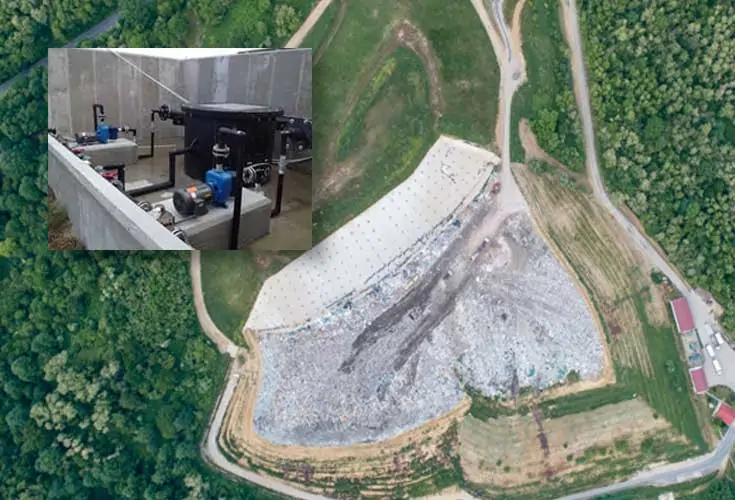
Landfill operators forever work to stay on top of a diverse and complex mix of leachate contaminants—heavy metals, ammonia, and biochemical oxygen demand (BOD), among them; but lately, they think about even more. For one: how to keep concentrations of these contaminants within wastewater treatment’ plant’s tightening discharge limits. Add to this concern the possibility of more compliance pressure as the constituents’ list on regulators’ radar grows. From microplastics to PFAS and PFOA, the latter sometimes called the “elephant in the room” –some operators are preparing for what may be down the pike.
Among strategies, some are looking at are on-site leachate treatment options, and there are several. Finding the most fitting, sustainable, and cost-effective one takes vetting. This continuing blog series explores studies conducted by SCS Engineers for operators nationwide. Here you will get an inside look at what these leachate management experts found, what treatment system they recommend in each scenario, and why.
A Solution to a Nebraska Landfill’s Rising Leachate Volumes
A Nebraska landfill needs to manage its rising volumes of leachate, causing disruptions to operations. The liquid goes into a 20,000-gallon tank, is pumped into a tanker, and is driven to the municipal wastewater treatment plant. The tank was filling so fast that the operator has trouble staffing and scheduling its few commercial driver’s-licensed operators to haul it. This logistical task has become a near-daily necessity. Sometimes the liquid level indicator will go off on the weekend. Management has to move quickly, sometimes on a dime, find someone to come in, and pay overtime.
“The staffing challenge is the main issue that brought the operators to SCS. They want to understand the whole leachate management structure better, and as we answer their questions, they want to know how we can improve the overall system in the long-term, says Zach Mahon, the SCS staff professional who works on the project. “After an extensive assessment, we provide options whereby the operator no longer has to pump leachate to a holding tank and then truck it to the wastewater treatment plant. And we provide site-specific recommendations to take their leachate management practices further,” he says.
Mahon and the SCS team of leachate management experts headed to the landfill to talk to operations staff and get their historical generation records, which is the basis they start with for their assessment. “We correlate the landfill information with our research to determine yearly generation figures as well as a peak generation number over the landfill’s projected life. This site is expanding, and we want to size the equipment so that when it reaches capacity, the system can handle the higher volume,” Mahon says.
SCS plans in other ways to ensure the recommended technology will take its client into the future on solid footing. For instance, accounting for the reality that operators may one day have to remove per- and poly-fluoroalkyl substances (PFAS) to send their multi-thousands of gallons of leachate to their wastewater treatment plant each year. Operators are keenly aware that utilities and regulators are looking with more scrutiny at PFAS and other emerging contaminants of concern.
Through due diligence, SCS engineers came up with three treatment options. Mahon explains each:
Install a leachate force main. This system includes a pipe with a pump that pushes the liquid through the force main, directly to the sewer line and, ultimately, to the municipal treatment plant. The pump kicks in automatically, negating the need to have drivers in the wings at all times. This system is quick to build and fairly simple to operate. It is the least expensive of the modifications that SCS vetted.
Install a leachate evaporator, which heats the liquids and evaporates the water molecules. This system reduces leachate volume by 90%. Managing liquids on-site eliminates dependency on drivers, but on the wastewater treatment plant too. The gas-fueled system is suited for sites with surplus landfill gas to help cut their operational costs.
Install a reverse osmosis treatment (RO) system where material passes through a membrane, which separates contaminants. RO treatment can reduce contaminated water by 90%, typically rendering it clean enough to discharge directly to surface water with appropriate permits. Or, it can be discharged to the city sewer, eliminating the permitting step.
“For each leachate treatment option, we looked at cost, the feasibility of short- and long-term implementation, and regulatory acceptance,” Mahon says. “We deliver the data with these priorities in mind, make our recommendations, and leave it to our client to decide.”
What did the SCS team recommend in this scenario?
“We suggested the force main. It solves the primary operational issue around staffing. And the economics of this comparatively inexpensive system make sense in these times when landfills are dealing with astronomical leachate management costs, among other increasing operating and capital expenses,” he says. This option does more than meet the client’s most immediate needs at a minimal cost. It provides the option to upgrade should regulators’ requirements around leachate change or should the wastewater treatment plant tighten its discharge limits. We design the modular system to add on reverse osmosis if necessary in the future. Thus, we help ensure that our client will continue having a home for its leachate.
A value-add, regardless of the operators’ decision, is more knowledge. SCS clients have a deeper understanding of industry standards. They are also more aware of how the industry is shifting in managing leachate and how these shifts could affect them. We follow up with technical bulletins explaining proposed and final federal rules in plain language influencing their operations, deadlines, and how to provide feedback to the appropriate agencies.
“We provide a lot of data to continuously inform our clients and to help them compare their operational costs now to what they would be if they invest in a new leachate management strategy. We ensure they fully understand each option’s capabilities to decide if it pencils out for their budget and operations. They have what they need to make informed decisions for a hands-off system to take them into the future,” Mahon says.
Leachate and Liquids Management
Managing oil and gas waste is challenging, even when practicing due diligence. The job requires impeccable skill and attention and sometimes outside support, which Colorado operators recently learned when they found high oil content in leachate coming out of their sump. They turned to SCS, knowing through their longstanding relationship with the engineers and that their liquids management team could deal with oil-laden wastewater.
Ensuring sustainable outcomes begins with collecting and analyzing comprehensive data that become the building blocks for a feasibility study. The study helps with immediate challenges and builds a more holistic approach to tackle increasingly expensive operation challenges at landfills.
“First, we talk about the site’s leachate history, including quality and quantity. What is the source of the waste generating the leachate, and where is it deposited? How are liquids used in current operations? The current practice used the liquids on the landfill surface for dust control, leaving an unsightly oily sheen.
Once we talk about how the site currently manages these liquids, we discuss options for future handling for improvement,” says Neil Nowak, SCS Engineers project director. “You’ve got to have a holistic understanding of day-to-day operations with the data to solve the problem cost-effectively.”
Neil’s preliminary research led to one recommendation to meet all the criteria – separate oil and water from leachate as the liquid exits the pump. The separation process can reduce the oil-laden leachate volume by 70 percent.
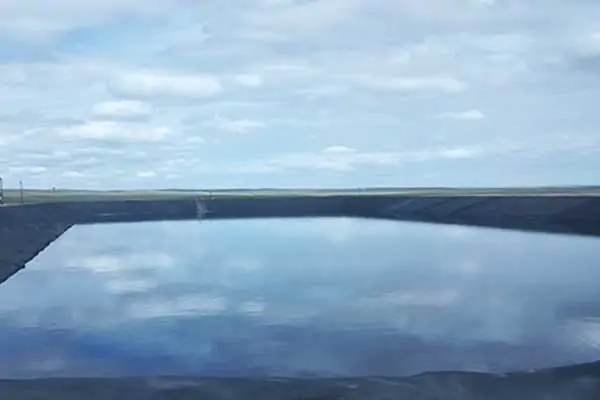
The technology works by separating the leachate into oil and water portions using an oil/water separator, such as a gun barrel tank, which is low cost and effective. After piping the water to an evaporation pond, the collected oil is sent offsite for future handling, usually disposal.
“This method gives the operator a better option for dealing with the leachate over the current practice of spraying it on the landfill surface for dust control,” Nowak says.
Spraying usually provides an alternative for liquids while reducing disposal time and cost. However, he explains, oil-laden leachate is a different beast than typical MSW liquids and calls for a more creative solution to remain within regulatory compliance.
Oil and water separation eliminates the aesthetics issues at the site with its previous practice. The greater value is that this method gives operators full control of oil’s movement, which can otherwise be very hard to accomplish.
“Oily leachate can adhere to the wheels of equipment that move dirt over the landfill surface; consequently, it ends up in places operators do not want it to go. Oil and water separation technology is a reliable way to keep it out of surface drainage areas and ensure it does not infiltrate into groundwater outside of the lined space,” Nowak explains.
Operators avoid short- and long-term consequences springing from compliance issues, but beyond today, the technology that SCS sizes operates for 20-plus years and helps prepare them for the long haul.
This option enables waste pros who take on growing demand from the oil and gas industry to protect the environment and public health, even as volumes increase. Oily liquids are particularly challenging for wastewater plants. Separation technology provides greater assurance that the landfill will still have a home for their leachate as wastewater treatment plants raise the bar on what they will allow.
The remaining question…
What is the most cost-effective and safe way to eliminate the filtered oil?
The solution for the immediate need is straightforward and simple. Depending on geology, local regulatory policy, and cost factors, solidification or injection are the most common, safe practices now, but reuse options are under development. Reuse and prevention are part of a longer-term landfill strategy, so Neil draws on his colleagues’ expertise.
Nowak’s expertise comes from years of experience supporting the oil and gas industry. Backing him is national liquid management expert Nathan Hamm, who lends technical expertise and insight on best practices for reducing leachate.
Explains Hamm:
Commonly the best bang for your leachate management dollar is to reduce the volume of leachate or wastewater to treat in the first place. Operators can begin by diverting stormwater away from active portions of the landfill, then installing a better cover system. Depending on the landfill’s need and location, reducing the size of new cells and timing those new cells to come online during low precipitation seasons is practical. Leachate minimization practices such as these directly reduce the treatment system capital and ongoing operational costs.
The Colorado operator now has oil and gas waste management options and has a comprehensive, site-specific review of leachate management with a clear understanding of where there is room for improvement.
As far as their immediate priorities, says Nowak, “We have left them with enough thought-out information to make informed decisions, and for now, they are leaning toward the oil and water separation technology. Though they can keep operating without it, they are looking to get ahead of possible compliance issues by making changes voluntarily, which are usually less costly in the end and demonstrates social responsibility to the Colorado Department of Public Health and Environment and the EPA.
Liquids and Leachate Management

Cities like Oviedo, Fla. are investing in the cleanup of defunct brownfield sites, converting even highly contaminated properties from liabilities to assets that pump economic vitality into their communities. And municipalities are getting reimbursed for doing so. But these ambitious undertakings require the expertise of professionals with strong environmental engineering and remediation backgrounds and an understanding of federal and state regulations aimed to protect public health and the environment.
This spring, after over two years of working closely with SCS Engineers and the development team, the City of Oviedo will unveil its redevelopment project: a 3.7-acre public park with a walking and jogging trail. The loop trail will be part of a larger trail system interconnecting through the City and the Cross-Seminole trail, with the latter running throughout the county.
The walking and jogging path surrounds a pond with a dual purpose: to serve as an added feature to this peaceful retreat and part of an enhanced stormwater management system that will allow business owners to convey drainage from their properties via an underground stormwater management system. Along the park perimeter, historical displays will tell the story of the nearly century-and-a-half-old City’s past.
SCS helped the City navigate regulatory issues associated with redeveloping environmentally impacted land, ensuring safe and environmentally sound practices, and maximizing financial reimbursement through the Florida Brownfields Program.
In the 1940s, the site operated as a farm but lay idle and overgrown with vegetation decades after. When SCS came in to complete the environmental assessment, the team confirmed that years of pesticide application did leave arsenic behind in the soil.
“It appears that the pesticides were used appropriately, but with the change in land use and to meet the state’s environmental criteria, we need to address the residuals to redevelop the property as a park. It would otherwise remain as unusable land without this cleanup,” says Kirk A. Blevins, SCS senior project manager.
SCS completed site assessment activities according to Chapter 62-780 FAC, which includes additional testing to delineate the extent of arsenic-impacted soil further and evaluate groundwater conditions. Assessment activities indicated that while not impacting groundwater, the soil contained arsenic above acceptable regulatory levels. In its next step, the team designed a remedial action plan with multiple considerations for success.
“Given that the site would include both a stormwater management pond and a public park, we recommended that rather than cap the soil to reduce potential exposure, the City meet the strictest cleanup criteria. This option is the most protective of human health and the environment,” Blevins says.
The plan included removing approximately 47,000 cubic yards of arsenic-impacted soil, then placement of clean import fill for areas open to the public. Blevins and his team proposed excavating to the property boundary, and they provided technical guidance to the City contractor on how to efficiently and safely execute this undertaking. “It was important to excavate to the property boundary to assure removal of the impacted material so that the City would receive unconditional closure approval from the regulatory agency,” explains Blevins.
Concise reporting of the work is key to securing that approval, so SCS documented the excavation of impacted soil to the appropriate depths and lateral extents, managing it appropriately onsite, and transporting it to an approved landfill for disposal.
The team worked with the City’s environmental counsel to bring the site into the Florida Brownfields Program and prepared its voluntary cleanup tax credit (VCTC) applications for submission to the Florida Department of Environmental Protection (FDEP). All expenses and payment, confirming the expenditures “integral to rehabilitation,” are documented. With this validation, the City of Oviedo is getting back about half of its $1,432,000 related investment. It will receive another 25% bonus once FDEP issues a letter stating that no further action is required.
Documentation and communication with the state regulators is an ongoing process requiring a detailed review of contractor proposals, invoices, pay applications, proof of payment, and a summary of progress each year over the project’s life. “In particular, a line-item review of invoices can sometimes establish additional actions that are critical to remediation that otherwise might have been overlooked and not captured. This process is vital to maximize reimbursement,” Blevins explains.
Cost, as always, is a client priority. So, SCS and the remedial team focused on minimizing offsite disposal of the impacted soil, proposing over-excavating the pond, using the unimpacted soil as the onsite fill, and placing a portion of the impacted soil at the pond’s bottom.
“This was possible because testing indicated that the impacted soil would not leach arsenic into the pond water at a rate that would adversely affect water quality. We confirm that arsenic concentrations are below the strictest regulatory level before any soil from over-excavating the pond can be of beneficial reuse onsite. Safety of people and environmental protection always comes first,” Blevins says.
The ultimate outcome: Oviedo has a regional stormwater pond suited for potential commercial operations to use for drainage, maximizing available land for economic development, as well as a recreational park for the community and visitors.
SCS’s technical expertise was crucial to successfully remediating this site, attests Bobby Wyatt, Public Works Director at City of Oviedo, Florida.
“The team easily navigated and sped up the permitting process for the arsenic removal and provided continuing assistance with monitoring during construction. The process for completing the specific remediation/permitting was unfamiliar to City staff, and SCS provided efficient and competent assistance to get us where we needed to go.
Their experience provided a sense of confidence that we were going to be able to make the park project successful,” Wyatt says.
SCS has worked on brownfields projects and voluntary remediation across the U.S. for over 45 years. We convert once nonproductive commercial and industrial properties into revenue-generators and affordable housing.
Resources:
Brownfields and Voluntary Remediation
Not too long ago, SCSer Gomathy Radhakrishna Iyer thought she’d become a mechanical engineer but decided to go down another path at her father’s coaxing, and she’s never looked back. Today she is a Civil & Environmental Engineering Ph.D. and has become deeply entrenched in the world of landfills—human-made formations that she calls “beautiful.”
Dr. Iyer’s work spans research and engineering projects in landfill gas emissions reduction, landfill design, and leachate management. She’s also keeping up with PFAS to be ready for what may lie ahead around these emerging contaminants. “What I’m most into these days is researching and helping clients select leachate treatment systems and doing landfill expansion designs. It’s so mentally rewarding when you find solutions for the client’s problems. They are happy, and you are happy,” says the SCS staff professional.
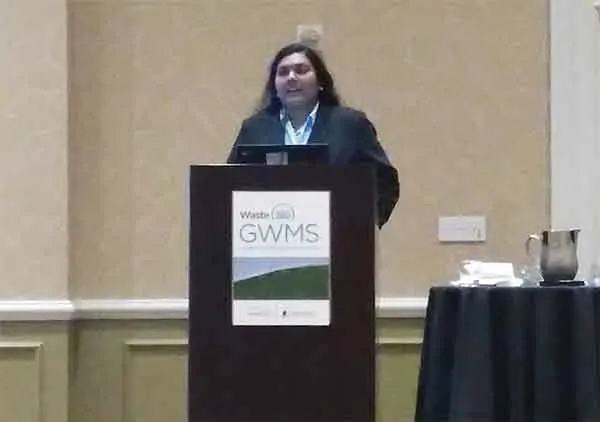
She is known by more than her work family. Gomathy is a published researcher and speaker, most recently presenting at the Global Waste Management Symposium in February 2020. Her presentation covered one of her pet topics, her Ph.D. focus: using grass clippings and biosolids as biocovers to remove methane from landfills.
Pre-COVID, she spent many of her days in the field. Lately, she spends a little more time anchored to her computer in her home office. There she typically works on a few spreadsheets at a time, maybe as part of a gas emissions report, a stability analysis, or settlement analysis. Then she shifts her focus to her design drawings. Dr. Iyer still manages to break away to put on her PPE – her hardhat, safety vest, and steel-toed boots. She happily drives off in a company truck to the landfill, lugging field parameter testing probes and a 10-pound ISCO to collect leachate samples; or do other fieldwork like locating LFG wells and pipes or other features that help her design.
In the summers, it gets scorching hot. And the winters can be bone-chilling cold, especially for a woman who spent most of her life in India, where she was born and raised. In her last years there, she studied the transport of heavy metals through groundwater. Then, it was on to the University of Texas, Arlington, where she earned her Ph.D. and became set on finding work at SCS, coming on board in 2019.
Among her earliest challenges was communication. “Sometimes I would be in a meeting or having lunch with my colleagues, and they would bring up baseball or other games or a Netflix series. They were new concepts to me, and I couldn’t relate. While I speak English, I was unacquainted with the vernacular. I was like, what is Super Bowl? I thought maybe it was something very big that people eat from,” she recalls. That does not stop a researcher.
Finding a way to become better acclimated became a project of sorts. She started spending weekend downtime in front of the TV to learn about these American pastimes. Baseball still isn’t her first love, but she’s happy to say, “In 2019, I went to my first Washington Nationals game with a big group from SCS, and I had at least some knowledge of what was going on.”
The ambitious civil engineer has pushed past another on-the-job challenge—one brought on by the impulse to know every detail she can nail down before setting to work. “Since I’m from a research background, I tend to dig to the very bottom to try and know the problem completely. Sometimes it’s a good thing. But I’ve had to be conscious of time constraints, gain an understanding of the minimum required to do the job well, and move on,” she says.
What first brought her to the United States was her husband, Ramesh Padmanabhan. He was working on a Ph.D. at the University of Texas at Dallas while she was studying in India, so the relationship truly began as a long-distance one. They got to know each other through a combination of old-world traditions and 21st Century channels. “Ours was an arranged marriage. Our parents introduced us, and for the first year, we met up and talked on SKYPE,” Dr. Iyer recollects. He’s a molecular and cell biologist and sometimes her consultant too.
“In my job, I need to know the biology and chemistry of microbes as they are responsible for breaking down waste, and he is my encyclopedia. I don’t have to Google as much when he’s around.” She adds: “I can’t complete my story without talking about my brother who has given me unconditional support and career advising through my life. These two men are pillars of my life.”
As a woman civil engineer who’s all about waste, she’s in the minority, but she doesn’t feel as if she is because women are moving into waste engineering. She’s one of four women on an eight-person team, who she says is “like my family. And my supervisor is a great supporter of women in STEM (science technology, engineering, and math).”
She hears from many newly degreed civil engineers, including “young ladies” with questions about waste management. They read blogs about her work that originated on SCS’s website and are on social media. “These graduates want to take their career to the next level, and they have a lot of questions about how to start solving waste issues,” she says. She tells them that solid waste management is one of the best and most stable industries they can choose and that the pandemic has driven that point home. “We are reminded through COVID that waste management is an essential business, and there will always be jobs to support it,” she says.
What Dr. Iyer loves most about her job is what she and her team imagine and draft in drawings, keeps developing, and in time, is built. “It’s like giving birth to a baby. Very exciting,” she says. Her groundwater contamination remediation work got her interested in PFAS, even before she finished her studies. “I had a lab mate in school who did PFAS research. That got me curious about these emerging contaminants. I’ve stayed vigilant to keep up with what’s happening with regulations and treatment options under research. If regulations now under consideration are implemented, our clients will have to start thinking more proactively about addressing PFAS. So, we need to learn more on a holistic level about what these contaminants can do and the best way to treat them.”
She tells the story of how her venture into civil engineering started with her father. “He wanted to be a civil engineer himself but was the eighth son, so his parents couldn’t afford tuition, and in India, you don’t go to college once you are grown with a family,” she explains. He wanted his daughter, already drawn to engineering, to pursue what had been his dream and said he thought it would suit her better than the direction she was leaning. “Had I studied mechanical engineering as I’d been thinking of doing, I would not have come into waste.” She is happy with where she’s landed.
“When you work all day and still are not tired –you still enjoy it and are happy to contribute to something good—that’s how you know it’s the right fit.”
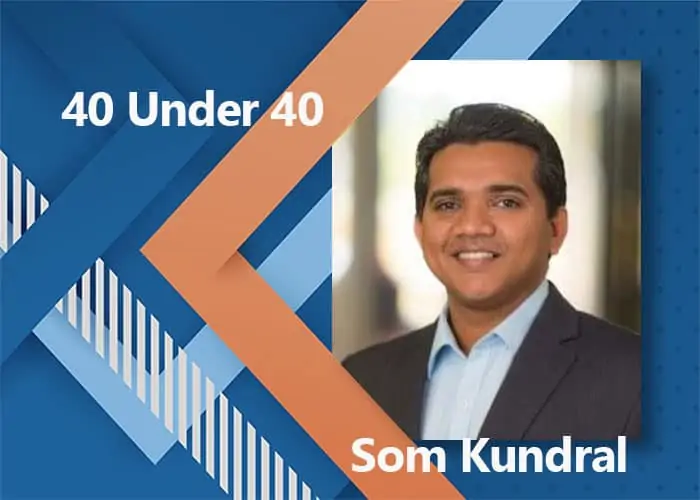
Somshekhar (Som) Kundral is SCS Engineer’s most recent go-getter to receive the honor of a Waste360 40 Under 40 Award. Described by his supervisor, SCS Vice President Bob Speed, as ‘humble, hungry, and smart,“ Kundral has spent no time in the slow lane.
He joined SCS as a young engineer in 2010, and quickly worked his way up, reaching a senior management position in a few years.
He now oversees multiple remediation projects, from small to multimillion-dollar jobs, taking ownership of environmental aspects of redevelopment, from remediating groundwater contamination to addressing landfill gas problems as challenges. He has come up with unique and far-reaching solutions through collaboration with his team to help clients achieve their business goals.
But before telling the story of Kundral, the senior-level engineer and project manager, let’s start with an earlier chapter.
“It’s an interesting and kind of odd story,” he recalls. “A friend asked me to drive him to a job interview as he did not have transportation. The HR person, for some reason, asked both of us to interview [having heard I was an engineer too].
“I was dumbfounded and a little nervous as I was not prepared. I had to download my resume from my yahoo ID quickly… I thought, what have I got to lose? It’s a good engineering job with a large real estate company.”
He got the job and continues to seize practically every opportunity before him, growing from each one. Today at SCS, Kundral oversees several redevelopment projects, including a 500-acre landfill conversion to a large business park, which received the American Council of Engineering-Florida and the Environmental Business Journal awards.
“The landfill had a lot of environmental and geotechnical issues, with the largest ones around groundwater contamination and stormwater management. They are typical redevelopment challenges we need to overcome, and in this case, they were on a larger scale,” he says.
As the intricate strategy evolved, Kundral, working with his project advisor, Senior Vice President Eddy Smith, called many multidiscipline group huddles. Kundral has assessed, reassessed, stopped, and restarted. And he has brought in more engineers to pump up the team’s expertise and take this project to the next level.
“We are now halfway through. And I tell you, I don’t think I should have gray hair yet, but I have some now. Still, I feel so relieved because we have the formula to make this work. “We did it by integrating the groundwater and stormwater management systems,” he says.
The integration resolves two big issues: It, of course, addresses groundwater contamination. But Kundral and the team also want to maximize areas for redevelopment, and the design supports this goal as it eliminates the need for stormwater ponds.
To him, the job is as much about open communication and teamwork as technical talent.
“At the end of the day, no matter what we do, we deal with people. I believe in staying in front of our clients, explaining what to expect when, and I continually engage with staff who support me.” With this business park conversion, as they dove deeper, they saw more intricacies. “It was important to help our client see we were not simply trying to catch up; for them to understand we had to give more time and attention to do the job as best as it can be done.”
From age 28, when he came to SCS, Kundral was keenly aware that there was potential to do plenty and wanted to take on more. “I’m just curious to see what I can get into,” he says. He began with smaller projects, each with one or two focuses. Little by little, he could connect more dots. “I could start to see the big picture and wanted to know more about how to pull the whole project together,” he says.
While he mostly oversees redevelopment projects, he has also supported industrial waste permitting and compliance reporting endeavors. He describes the latter projects as straightforward.
“I prefer the more involved brownfields projects; there is more to learn when overseeing the work. Each site is unique, with different challenges. And each time, what you discover and how you approach it is different.”
Doing the work he loves has come with tradeoffs, such as giving up kayaking and cutting back on trips to the beach—once his favorite pastimes. “They’re fun, but they are day- and night-long ventures. By the time I got home, Saturday was gone. And I needed to catch up on work emails at night and plan for the next week.”
He does find a few hours some weekends for another interest—photography—heading to the zoo or state parks with his wife, Anjana, who shares his passion for watching out for a good “Kodak moment” and capturing it.
Nevertheless, figuring out how to fix problems is still his greatest passion, further maturing from experience. When asked if he could be someone else for a day, who that would be, he thought for a while, then said: “I would love to be myself again but be able to watch as a third person and make note of the scope of improvements I have made over time. From that, perhaps I can learn even more.”
Kundral speaks of three people who helped shape him: his grandfather, father, and father-in-law.
“Growing up watching my grandfather’s resilience helped me learn how to manage hard situations.
From my father, I learned to view situations in ways to understand people better. This has helped shape my thoughts to improve my communication.
From my father-in-law, I learned the importance of humor and gained a sense of humor. This is a good thing for lightening up situations and reducing stress.”
Kundral will take on challenges because it’s part of getting to the end goal. And reaching that goal is what sparks him. He goes back to the 500-acre Florida brownfield to illustrate. “This property is being converted to a business park with great companies operating there, like Home Depot and Boeing. So, our client is creating a legacy. The project creates jobs. It brings in taxes. It improves environmental conditions. We are part of it, and that excites me.”
Kundral is in good company. These other SCS Young Professionals are past 40 Under 40 Award recipients. Like Kundral, they work diligently, solving an array of complicated solid waste challenges. SCS Engineers is very proud of our YP’s award-winning accomplishments for their clients and their contributions to their communities’ health and welfare.

Steve Linehan is a Senior Project Manager who oversees solid waste and environmental services projects from SCS’s Oklahoma City and Wichita offices. Linehan has a broad range of expertise, including solid and hazardous waste regulations, landfill design, stormwater modeling design, and remedial action plans. He holds professional engineering licenses in Kansas, Missouri, Nebraska, and Oklahoma.

Srividhya (Vidhya) Viswanathan, Vice President, is recognized for her innovative engineering plans and designs of traditional solid waste and renewable energy programs. Viswanathan, Southwest Director of Engineering, continues consolidating and integrating engineering operations to provide more streamlined and efficient services. She leads solid waste engineering operations in California, Arizona, Nevada, Utah, and New Mexico.
Solavann (Sol) Sim, a Project Director and OM&M Western Regional Manager for SCS Field Services, has expertise in all facets of landfill operations, including landfill gas and liquids management. His teams keep landfills safer and running within compliance. He is a licensed professional engineer in Alaska, Arizona, California, Colorado, Hawaii, Montana, New Mexico, Nevada, Oregon, and Utah.

David P. Hostetter, Business Manager for SCS RMC® (Remote Monitoring and Controls), works in environmental engineering and technology. He serves clients by leveraging technology to reduce business and industry environmental impacts. His environmental solutions reduce potential greenhouse gas emissions and lower environmental risk from landfills, thus protecting workers and local communities.
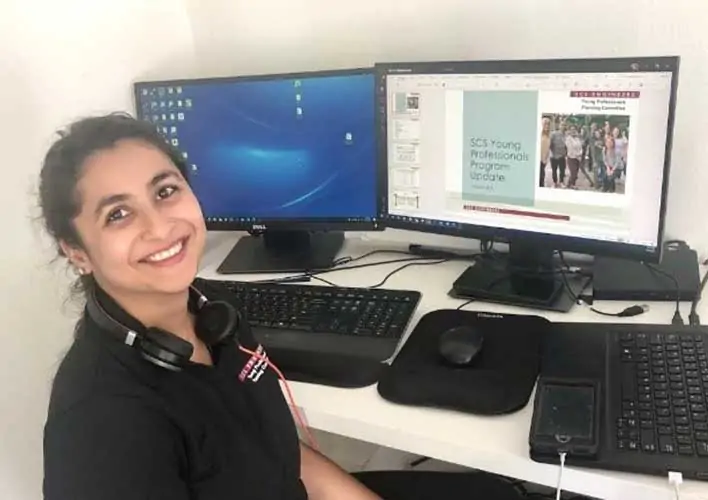
What is your title and responsibilities at SCS Engineers?
My title at SCS Engineers is “Project Professional.” In the Southeast region, we have something called “Assistant Project Managers,” which is not an official title. However, as the name suggests, the position entails helping the project manager run the project. My responsibilities include:
What attracted you to join SCS?
 While completing my Master of Environmental Engineering, most of my classes were either water or wastewater-related. I had heard of SCS Engineers; from what I had heard and seen, it was focused heavily on landfill engineering. As a millennial, I did not have a positive outlook on landfills; I was interested in the environmental remediation of properties. Luckily, I was in a restaurant and ran into Eddy Smith, Senior Vice President of Client Success. We went over my career goals and the projects at SCS. I applied for a job, and the rest is history!
What attracted me initially to SCS was working in Environmental Services. I have been with SCS for over three years now and have expanded into sustainable materials management (SMM), which is interesting and good for communities and the environment. I’m also eager to build a more comprehensive knowledge of using what was once waste to renewable energy sources and clean-burning fuel. Solid waste management and landfills are fascinating, more than I ever imagined. SMM, renewable energy, remediation, and landfill operations are interconnected and essential for keeping people and communities safe and thriving.
What is your favorite part of working at SCS?
The people at SCS! We hire humble, hungry, and smart people. The knowledge pool is incredible, and everyone is always willing to help, no matter what part of the country you’re working. People are just a phone call away.
What do you feel is your greatest achievement or contribution to date?
I am working on a 500-acre landfill redevelopment project divided into four quadrants. Our client completed construction on one quadrant with nine buildings. We’ve received closure for eight of the nine buildings and anticipate closure for the remaining building soon. I take pride in supporting them to accomplish the closure and earn the environmental approvals safer and faster because of my combined team’s expertise and experience.
What is challenging for you as a YP?
Learning to manage my time was the greatest challenge. Regularly, I would stay late to work on projects and completing my tasks. It wasn’t a sustainable balance in my life. I said yes to everything assigned instead of letting the project manager know that my plate was full. Now, by planning my day better, prioritizing, and giving project managers realistic deadlines. I found the balance that works, and I am more productive.
What has helped with your success?
The support of management and our team at SCS has made me successful. If I have an issue with a project or unsure of the direction I need to take, I know I can rely on my team to help. There have been times when colleagues have dropped what they are doing to help me finish a project on time and within budget.
Do you have a favorite aspect of SCS’s Young Professionals Program, and describe your role as Chair?
My favorite aspect of the YP program is the mentorship program that the committee relaunched in 2020. It is such an incredible opportunity as a YP to be guided by an experienced professional. They have stood where we are today, and getting to learn from their experience is invaluable; our YPs take advantage of it.
I enjoy my role as the Chair of the YP program; I spend my energies organizing by:
What are your favorite hobbies outside of SCS?
I am a bit of a nerd, so my friends and I play Dungeons and Dragons every week. I also like DIY projects with arts and crafts – I made wall décor out of cardboard when I moved into my house!
What advice do you have for others getting into STEM fields?
When I was younger, I was advised not to go into the science, technology, engineering, and mathematics fields by my career advisors and teachers because they did not think I would be successful. In fact, because of their advice, I tried out classes in the non-STEM field like history, commerce, geography, and I did not enjoy them. I was still intrigued by the STEM field, so I listened to my gut and look where I am today! STEM is not biased. My advice would be not to let anyone tell you that STEM is not for you. If you want to study science, technology, engineering, and mathematics, just do it!
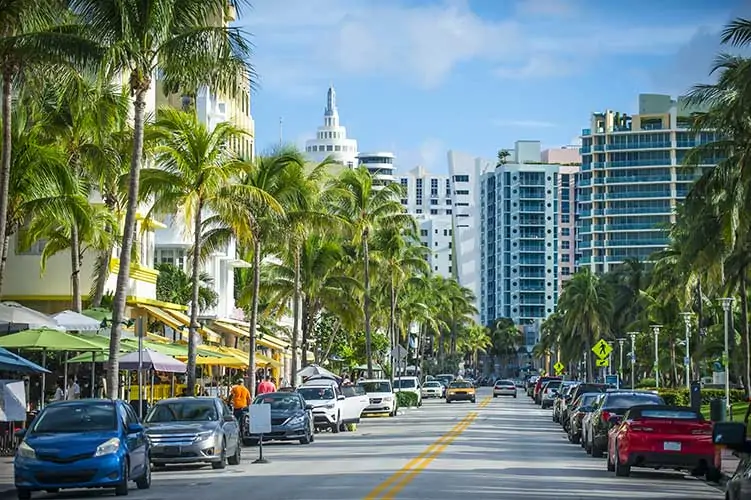
Thanks to South Florida’s hot real estate market and impressive growth rates, a dwindling supply of properties are available for development in the area. The Atlantic Ocean limits South Florida’s development options to the east and Florida Everglades to the west. Due to these supply limitations, developers seek to redevelop contaminated landfills, golf courses, and agricultural land. Environmental due diligence is essential to the successful redevelopment of these types of properties. Depending on the property’s size and the extent of the contamination, redeveloping contaminated properties can cost upwards of a million dollars.
Typically, developers will have to deal with contaminants like ammonia at a landfill redevelopment project, arsenic at a golf course redevelopment project, or pesticides at agricultural redevelopment projects. In some cases, remediation and assessment using the standard or “default” cleanup target level (CTL) can stop a project from proceeding. However, before abandoning the project, developers should consider the potential for establishing alternative cleanup target levels (ACTLs) for the site’s contaminants.
Several technical strategies are available to developers considering redeveloping contaminated properties to reduce overall costs and expedite the construction schedule. Costs associated with managing material above a default CTL can include disposal of contaminated material, importing clean fill, and delays to permitting and construction schedules if an environmental regulator determines your assessment is incomplete.
Understanding Default Cleanup Target Levels
Environmental regulators use a range of tools to develop default CTLs. Default CTLs can be based on complex equations that consider toxicity and exposure assumptions such as ingestion rates, body weight, age, and exposure levels. Soil properties are also considered. In some cases, human health may not even be the determining factor in calculating a default CTL. Rather, a particular contaminant’s environmental impact on the local ecosystem may be what determines its default CTL.
While default CTLs are useful tools to formulate remediation strategies on a broad range of sites, default CTL values will be overly conservative for other sites. More explicitly, some sites’ present and future use and exposure characteristics are so different from the assumptions used to calculate the default CTLs – that the default CTL does not accurately correspond to the risk associated with the proposed sites’ use. In such cases, explore the development of an alternative cleanup target level (ACTL).
Establishing Alternative Cleanup Target Levels
With the right approach, a site ACTL could provide significant cost savings while maintaining regulatory compliance. But buyers beware; choose your environmental consultant carefully. The consultant should understand the site-specific factors that affect the calculation of the ACTLs. Often, a knowledgeable consultant has a good idea of the outcome even before investing the client’s time and money pursuing the alternative.
Cost and Schedule Benefits
To illustrate cost and development time-savings, consider a simple example of arsenic-contaminated soil at a residential development. Suppose there are no other reuse options available for the contaminated material, and the material must be disposed of at a landfill. Given 100,000 cubic yards (cy) of contaminated material at a disposal cost of $60 per cy, we estimate 6 million dollars in disposal costs, not including importing clean fill. However, if the site is an age-restricted residential community, certain exposure assumptions could be modified to calculate a much higher ACTL for arsenic. The soil would no longer be regulated as contaminated, and costs associated with disposal, imported material, and soil tracking are eliminated. Soil that was considered contaminated based on the default CTL is now clean based on the ACTL.
Let us look at a more complex example. Consider the case of a site contaminated with dieldrin, a common pesticide found at golf courses and agricultural properties. A leachability ACTL recalculates the default leachability of a particular soil contaminant. A leachability ACTL uses site-specific soil chemical and physical properties, such as soil organic matter content, bulk density, and annual average soil moisture content, and determines a more realistic risk profile associated with soil that could potentially leach contaminants into the groundwater. With an ACTL above the default CTL, remediation may not be necessary, or the site may not require a deed restriction, or ongoing costs associated with monitoring of the groundwater or operation of a remediation system could be eliminated, making the completed project more attractive to potential buyers.
Summary
Developing ACTLs is a careful, thoughtful strategy that an experienced environmental consultant can propose based on the site’s unique conditions. The developer’s financial objectives and schedule and the property end-use must be carefully considered to develop a thorough redevelopment approach. The use of an ASCTL could mean the difference between a project that is financially infeasible and one that is attractive and profitable.
Learn more about remediation and brownfields redevelopment.
 About the Author: Troy Schick, PE, specializes in stormwater and groundwater management and voluntary remediation of properties, including brownfields and former landfills. Troy uses his experience at SCS Engineers and education as an Environmental Engineer and Environmental Manager with field inspection, sample collection, documentation, and project management to benefit Florida communities. Troy is available for consultation at tschick@scsengineers.
Corporate Headquarters