In September the City of Bangor will formally move over to a new arrangement in which residents will throw all of their recycling in with their trash and leave the mixed waste to be picked up from the curbside every week, as now happens with trash.
Bangor will also close their local recycling station as part of the city’s switch to a new integrated waste conversion plant in Hampden developed by Coastal Resources of Maine with Fiberight technology. The new facility includes a materials recovery facility (MRF), organic processing, plastics processing, anaerobic digestion (AD) and wastewater treatment. The integrated technology is intended to increase recycling rates without the need for extensive outreach programs and is easier for customers to use. According to Coastal Resources of Maine, the benefits are:
The advanced technologies are undergoing final testing at the Hampden, Maine facility, and are already in use at automated material recovery facilities in the United States and in Europe. The end product is cleaner and provides more diverse types of materials that can then be reused to create new products.
The Hampden facility’s advanced MRF has a high degree of separation, recovery, and monetization of commodity products, and then employs additional processes for generating clean cellulose, engineered fuels, and biogas from traditionally non-recyclable materials. Hired for the firm’s technical expertise and experience planning large municipal solid waste and biogas programs and facilities, SCS provided an in-depth examination and analysis of the technologies, program sustainability, and potential economic impacts of the facility.
The facility will serve 116 municipalities and public entities represented by the Municipal Review Committee, a non-profit organization that currently manages the waste disposal activities in Eastern and Northern Maine. The facility is planning to start accepting waste from its municipal customers shortly.
“With the planning and cooperation of many, Fiberight’s providing a truly sustainable solution in Maine while solving several challenges when consumers separate their recyclable materials and eliminating contamination,” stated Bob Gardner, SCS Engineers Senior VP. “The facility is capable of reusing nearly 150,000 tons of what formerly went into a landfill, is processing more municipal solid waste into high-value commodities, and is helping local municipalities and private waste haulers offset the cost of recycling.”
This EREF Summit will bring together practicing engineers, academics, industry professionals, government personnel and policymakers to facilitate discussion and provide various perspectives on the management, issues, and policies related to PFAS.
Per- and polyfluoroalkyl substances (PFAS) are a group of compounds that are man-made and are commonly used in industrial processes and consumer products such as food packaging, fire-fighting foams, metal plating, outdoor gear, popcorn bags, food wrappers, facial moisturizers, mattresses, carpeting, and cookware. Despite the widespread use of PFAS in everyday products, there are still significant knowledge gaps associated with the management of these compounds.
SCS Engineers is a sponsor of this EREF Summit. Liquids Management at SCS Engineers
Forester University recently hosted Dr. Viraj deSilva P.E., BCEE of SCS Engineers in their well-received educational webinar “All About PFAS: Emerging Contaminants That Are Everywhere.”
Dr. deSilva teaches you all you need to know to protect yourself and your community from PFAS—from generation, formation, and environmental release to sampling and analysis.
He provides an in-depth overview of the treatment of PFAS in sources that do not currently have maximum containment levels, such as landfill leachate, wastewater, surface water, and groundwater.
This course covers nomenclature, chemistry, sources, exposure, and future concerns as well as discusses the current regulatory status of these contaminants.
Learning Objectives
We encourage our readers to see the webinar on Forester University’s website. Credits: 1 PDH / 0.1 CEU. Forester offers registration savings to groups. Register here.
Additional Resources with Links – click to read
SCS Engineers’ Associate Professional, Lindsey Carlson recently coordinated a cleanup on the Beaver Dam River in Wisconsin. The cleanup is a part of the mission of Living Lands and Waters to clean the nation’s major rivers and watersheds. The Adopt A River Mile program enables people to support the mission in their own communities. SCS Engineers joined other members of the SWANA Badger Chapter, the Associated Recyclers of Wisconsin, and five members of the Beaver Dam community. SCS’s Adam Gorski and Phil Gearing are shown removing a tractor tire and other debris here.
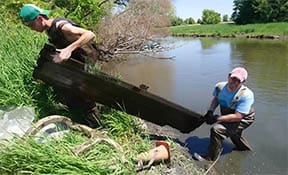
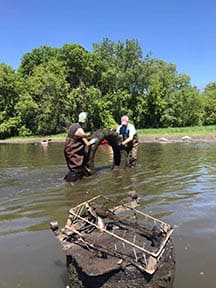
Phil called the experience “a great time and very fulfilling.”
While getting wet and muddy, the team picked up trash and debris that filled one 5’x8’ utility trailer plus two pickup truck beds – that’s about 8 cubic yards for those not in the waste management industry 😉
The trash included a tractor tire; about seven car tires; an aluminum truck topper; an office chair; two bicycles (one still ridable); a motorcycle helmet; at least 15 feet of culvert piping; about 10 trash bags full of plastic bottles and other lightweight garbage; and quite a few other miscellaneous items.
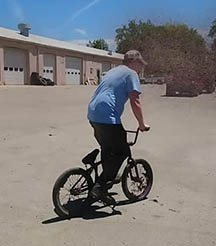
Lindsey served as a volunteer on Living Lands and Waters’ barges during a week-long cleanup in Memphis in 2017, and “that’s how I came to know and become passionate about their cause,” she says.
Contact Living Lands and Waters to clean up your mile of river. Every mile makes a difference to help watershed conservation efforts in your community. Imagine the impact thousands of volunteers of all ages, willing to roll up their sleeves and get dirty are making. Thank you!
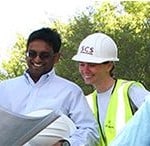
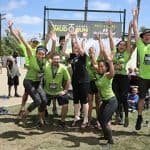
You’re not just an employee at SCS; you’re an Employee-Owner which means as you grow professionally, you develop yourself, exponentially. We value our team members, so we offer them more.
Have student debt? Join the SCS team, and we’ll make a monthly payment toward your eligible student loans up to $10,000.
 |
 |
 |
Our Employee Stock Ownership Program – ESOP provides stock ownership and retirement savings over and above our 401k program.
Instead of non-industry investors making a profit, we provide more to our employees for a job well done.
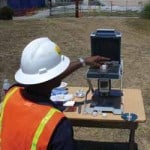
College is an excellent start to your professional career, but there’s so much more to learn. SCS offers professional and people skills development, mentoring from the best in the industry, and an environment of continual growth.
Already an experienced professional? Consider joining a firm that puts your expertise to work, creating the most innovative environmental solutions, and helping municipalities and businesses meet some of the most challenging issues of our time. SCS offers you opportunities to share your knowledge with industry peers, in publications, and with our client community.
 |
 |
 |
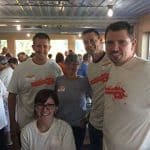
In addition to medical, dental, vision, Life, AD&D, LTD, STD, Accident & Hospital Indemnity, we personalize the employee experience with service achievement awards, blog and social media shout-outs, industry association networking, and community service opportunities.
Be more, do more, grow more.
Why settle for being employee #10234 when you can experience a deep sense of personal satisfaction where your achievements have a positive impact on our environment. SCS Engineers, one of the most respected environmental companies in North America, has open positions now.
EPA announced today a final policy to enhance effective partnerships with states in civil enforcement and compliance assurance work. The memorandum from EPA’s Assistant Administrator for Enforcement and Compliance Assurance Susan Bodine articulates the final policy procedures and practices for effective coordination between EPA and states when carrying out shared responsibilities under environmental laws.
The final policy memorandum is divided into three sections. The first section details requirements for joint planning and regular communication between EPA and states to promote enhanced, shared accountability. The second section of the policy provides greater detail on EPA and state roles and responsibilities in implementing authorized programs. The third and last section of the policy provides a process for the elevation and resolution of issues.
The issuance of today’s final policy replaces the interim guidance memorandum on enhanced planning and communication between EPA regional offices and states issued by Susan Bodine on January 22, 2018.
If you have questions about the final policy, please contact your SCS Project Manager, or send an email to .
Bill Lape discusses the most frequently asked questions about designing a training program that is part of your facility’s PSM and RMP programs and provides a defensible position during inspections while ensuring that your facility operators and maintainers perform their jobs safely.
Bill tackles all your questions in this article. Set-PSM-RMP-Hut-Hut
Operators know that selecting a Landfill Designer involves careful consideration of the designer’s experience and knowledge of construction to control costs and capital outlay.
Landfill operators usually seek to pay the lowest price for design work. While this is in line with the competitive market models, operators need to be sure that the designer’s experience lines up with their desired outcome, or problems may arise later for the operator. If the designer’s general or specific experience in the region is lacking, reconsider your selection parameters.
General experience is the comprehensive knowledge of landfill design and the development of expertise gained on similar projects over an extended period. A few project experiences in the remote past do not adequately qualify a designer. Experience in the region means that your designer has designed and developed similar projects in the larger vicinity of the project.
Regional experience demonstrates that the designer has significant knowledge of geology, hydrogeology, climatology, and available constructions materials in the area. Without this level of experience and understanding, the operator risks ending up with a system that does not function well and may be susceptible to environmental conditions, causing excessive project maintenance costs over time.
I recommend that operators work with a known entity; look for a designer who has done similar projects on numerous occasions in your region, and who can provide proof of their experience and knowledge to design according to your specific goals. A designer may not meet the criteria of the least expensive vendor, but a properly designed and constructed project can save a tremendous amount of money by:
Landfills are unique systems that require explicit design and construction criteria in order to operate seamlessly and safely for a very long period of time. Developing landfills generally takes several decades to complete and requires a substantial amount of knowledge and design consistency to ensure that the various landfill components function together.
Some operators change designers every few years without realizing that they risk inconsistencies in the design and construction every time a new designer comes into the picture. For this reason, I recommend that operators find the most qualified designer who is also very familiar with the construction and field maintenance of similar projects, and then stick with that designer for a long time.
At times, several different designers may be involved with various components of the landfill. To improve design consistency, I recommend that the most experienced design group review each design package regularly in order to help eliminate inconsistencies, improve the overall design integrity, and facilitate proper operation of the constructed systems during operation.
 About the Author: Ali Khatami, Ph.D., PE, LEP, CGC, is a Vice President of SCS Engineers and the firm’s National Expert for Landfill Design, CQA, and Elevated Temperature Landfills (ETLFs). Ali has 40+ years of research and professional experience in mechanical, structural, and civil engineering acquiring extensive experience and knowledge in the areas of geology, hydrogeology, hydrology, hydraulics, liquids management, construction methods, material science, construction quality assurance (CQA), and stability of earth systems.
He applies his experience in the siting of numerous landfills and the remediation of hazardous waste contaminated sites. Ali’s expertise includes the design and permitting of civil/environmental projects such as surface water management systems, drainage structures, municipal solid waste landfills, hazardous solid waste landfills, low-level radioactive waste landfills, leachate and wastewater conveyance, and treatment systems.
His cross-practice experience includes the design of gas collection and disposal systems, hazardous and non-hazardous waste impoundments, storage tank systems, waste tire processing facilities, composting facilities, material recovery facilities, leachate evaporator systems, and liquid impoundment floating covers.
SCS Engineers has just added over 40 new NH3 refrigeration training sessions to our 2019 schedule. These intensive training includes:
Contact us for on-site SOP and specific Refrigeration Training for operators customized for your system/facility. We also provide PSM/RMP and Ammonia Awareness training. Contact us today at or visit our website.
SCS Engineer’s Long Beach Headquarters sponsored and participated in the U.S. Vets Storm the Beach 5K/10K Run, Walk & Roll for Veterans event in Long Beach, CA.
U.S. Vets is an impressive organization supporting our Veterans in Long Beach, many of whom are homeless. These men and women who have served our country receive housing, employment opportunities, and counseling services from this private non-profit organization.
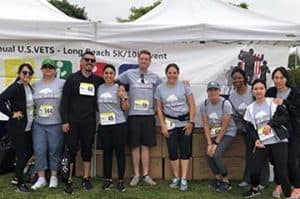 Participating this year, left to right: Sonia Aguirre, Wendy Mendoza, Sara Garcia and husband, Brendan McGarrity, Jennifer McCafferty, Stacey Dolden, Deidra McGrew and Hanna Suh and friend.
Visit our website and look for careers with our award-winning team of professionals.
Corporate Headquarters