Imagine that one of your employees comes and tells you that a 100-gallon spill just took place at your facility and it is flowing swiftly toward a storm sewer on your property.
Suddenly all eyes are on you. What you do next will show your leadership and skill at addressing the issue and limiting the company’s liability. Are you ready to be the hero, or is spill preparedness the one item that just keeps slipping down your to-do list?
Use the techniques recommended in Chris Jimieson’s latest article to make your spill response training engaging and interactive for staff handling oil. Spill preparedness becomes part of your routine and you’re ready to be the hero if a spill occurs.
Improve Your Spill Preparedness
Are you approaching the required five-year review/plan re-certification for your facility’s Spill Prevention, Control, and Countermeasure (SPCC) Plan? Even if you’ve been through several cycles of performing five-year tune-ups on your SPCC Plan, you can make your next review easier and prepare yourself for future SPCC Plan re-certifications if you follow these five tips.
Start Early
Late renewals are a consistent pain point for many companies. To avoid being late with your next re-certification, start your review six months before your SPCC Plan is due for its 5-year review. If you are conducting the review internally, start by identifying the person who will be doing the review. If you are using a third party, this approach will help you go through the proposal/contracting process, so you are ready to conduct the actual review and complete the re-certification before the Plan expires.
Simplify Data Collection
One of the keys to a compliant SPCC Plan is to collect accurate data in the field about your facility’s oil sources. Streamlined data collection is of particular importance if you have a large facility or your oil storage changes regularly. The key to simplifying data collection is to make sure your reviewer has organized information to evaluate the compliance aspects of each source. Accurate data collection can limit the follow-up required from plan preparers to verify information, as well as minimize the potential for discrepancies. Moreover, particularly useful if a third party is auditing your Plan or if it is in review during an EPA inspection.
Reduce Redundancy with a Summary Table
One way to simplify your Plan is to use an oil source summary table to cover as much information as possible. A table can include each oil source and the aspects of how the oil source is compliant with the SPCC Rule. There may be areas in the Plan where you need to provide additional text discussion regarding oil sources to explain a compliance matter. In general, try to avoid duplicating information within the Plan.
Watch Out for Commonly Overlooked Areas
While secondary containment and overfill protection are key elements to review at each oil source, some reviewers forget to measure the size of containment structures. Dimensions need to be carefully measured in the field to verify and show sufficient secondary containment capacity in your facility’s SPCC Plan.
Another commonly overlooked area is facility drainage; specifically the overland flow in the proximity of each oil source, which is key to determining the potential receptors where spilled product can travel. These receptors could be storm sewers, ditches, wetlands, or waterways. You can discuss the protection of these receptors during your facility’s annual SPCC training. Swift action and concise communication during a spill can help limit your liability.
Use Targeted Annual Training
Many companies struggle to comply with the annual training requirement. One of the tripping points is trying to train all employees who handle oil for example. To avoid this pitfall, implement a tiered training program so you can focus the training content based on an employee’s responsibility level.
Spill recognition and notification through proper internal channels to get a spill cleaned up is an essential message for employees that occasionally handle oil. These employees could also be trained to aid with the initial control and response to a spill. A second tier may include team members who manage the SPCC Plan; they have additional responsibilities such as inspections of oil sources and spill reporting.
By Chris Jimieson, SCS Engineers
Chris Jimieson has over 17 years of experience supporting industrial, commercial, military, federal, state, municipal, and solid waste companies with environmental compliance. He has extensive experience building and reviewing SPCC and Storm Water Pollution Prevention Plans (SWPPP) and manages compliance assignments, providing computer-based training modules to meet employer training needs. Contact Chris at or 608-216-7367.
Listed here are the names and short bios of those currently serving on the transition team and new members announced by Catherine McCabe on Monday, January 23.
Catherine R. McCabe is EPA’s Acting Administrator. Previously, she served as the Deputy Regional Administrator of EPA’s Region 2 in New York City. In this position, she assisted the Regional Administrator in overseeing the Region’s operations and regional implementation of all EPA programs in the States of New York and New Jersey, in the Commonwealth of Puerto Rico and the U.S. Virgin Islands. She has also been a member of the national EPA’s Executive Management Council.
Mike Flynn serves as the Acting Deputy Administrator of EPA. Previously, he was EPA’s Associate Deputy Administrator, serving as a key advisor to the Deputy Administrator on management and policy issues. He was the Director of the Office of Radiation and Indoor Air in OAR for six years, where he expanded federal action to address health risks from radon exposure indoors, enhanced EPA’s preparedness for radiation emergencies and played a role in the Agency’s response to the 2011 Japanese nuclear incident.
Newly Announced:
Layne Bangerter is an Idaho native who most recently worked with Sen. Crapo. He has experience in the natural resources world related to farming and ranching.
Don Benton, Senior White House Advisor, is from Washington State and served in the State Senate there for 20 years. Don has a history in the private sector in addition to his service as the head of a large county environmental office in Washington.
Patrick Davis is a political consultant and strategist. Since 1992, he has advised candidates for President, Governor, U.S. Senate, Congress, and state/local offices. Patrick is an organizational, strategic, and communications consultant to corporations, issue committees, and non-profits.
Doug Ericksen, Communications Director, is a Washington State native and a current member of the Washington State Senate. Senator Ericksen has a background in energy and environmental policy. He holds a B.A. in Government from Cornell University and an M.A. in Environmental Policy.
Holly Greaves, Budget Issues, has a background in government accounting and Federal financial management. Ms. Greaves previously worked as a senior manager with KPMG and with the public accounting firm EY. She is a licensed CPA, CISA, and CGFM.
David Kreutzer finished nine years with the Heritage Foundation as Senior Research Fellow in Energy, Economics, and Climate Change. David taught economics at Ohio University for three years and at James Madison University for 22 years. His academic research has been published in numerous professional publications.
Charles Munoz, White House Liaison, comes to the EPA from Nevada, where he served in key capacities for Americans for Prosperity. For the last two years, Charles served The Donald J. Trump campaign in several high-level positions.
David Schnare, Esq., Ph.D., is an attorney and environmental scientist returning to EPA after a 41-year career in the field of environmental science, with 33 of those years at EPA. Most recently, Dr. Schnare has been associated with the Free-Market Environmental Law Clinic, The Energy and Environment Legal Institute and the Center for Environmental Stewardship at the Thomas Jefferson Institute for Public Policy.
Justin Schwab, Legal Advisor, is an environmental and regulatory lawyer currently practicing in the Washington, D.C., area. Justin will be serving as a legal advisor on several fronts including environmental health and safety, in addition to other key areas of implementing EPA’s core mission.
George Sugiyama brings over 30 years of EPA experience with him to the transition team. George will be serving as a senior advisor to the team.
If you have questions about how regulatory policies could impact your business or service, please contact SCS Engineers for answers. SCS is a leader in environmental compliance solutions for business and industry.
Our latest SCS Technical Bulletin summarizes the EPA federal mandatory greenhouse gas (GHG) reporting program (GHGRP) into two pages of the most vital information. The new reporting requirements for Subparts HH and A discussed in our bulletin are effective January 1, 2017.
Remaining updates will be phased in from 2017 to 2019. These updates include, but are not limited to, revisions to the reporting regulation for all reporters including Subpart A Administrative Requirements, Subpart C Stationary Combustion Sources, and Subpart HH Municipal Solid Waste Landfills the three most common reporting sectors for MSW landfills. SCS Engineers will continue to post timely information, resources, and presentations to keep you well informed.
Use our resources for guidance or to answer questions.
Share, read, or print the Technical Bulletin
Greenhouse Gas Service Information
Getting a firm handle on a solid waste operation and expenses is a challenge for any solid waste agency manager or landfill operator. It is particularly imperative in this era of “lean and mean” budgets and looming regulatory policy. Doing more with less is the watchword for most operations across the country still reeling from the financial impacts of the Great Recession.
SCS Engineers has created a package of articles to help you identify if your landfill, landfill gas, or solid waste operation is ready for 2017. We hope this useful guidance will help you plan for the upcoming year. SCS professionals are always available to answer questions and provide advice. Find the office or SCS professional nearest to you by clicking on one the links here: Offices and Professionals.
Download, print or share this package by using the download button under the articles or by using the navigation at left. The package includes the following information written by SCS National Experts:
Article in Waste360: explains who’s impacted and how to begin managing the costs.
SCS Technical Bulletin: a digest of hundreds of EPA regulatory policy into the information and timelines to act on now.
Article: strategic financial planning to support infrastructure costs.
Call our compliance specialists – find the office nearest you or email us at
SCSeTools® gives you the ability to instantly map air leaks, vacuum distribution, wells that are “over pulling” and wells that are underutilized – valuable tools for every wellfield technician to maximize system performance beyond simple compliance tracking and reactive wellhead tuning.
As a field technician, you walk a fine line – tuning to a threshold, pulling as hard as you can, as safe as you can. When important data factors start to wander you need to troubleshoot quickly to keep collecting as much as gas as possible without over compensating and adjusting wellheads multiple times. SCSeTools® makes troubleshooting faster and more efficient by turning your data into maps identifying important conditions in the field and the wellheads that need tuning. Field technicians know how to balance the wellfield without killing bacteria and without diluting the gas.
A map of your field with your specific tuning range quickly shows data that are typically missed in reams of data. SCSeTools alerts you to these indicators using a map of each wellhead in the wellfield. Where you formerly needed months for these changes to become apparent, SCSeTools tells you at the touch of a button when a change began occurring and which wellheads are impacted. As a technician you know what you need to tune and which wellheads need your attention.
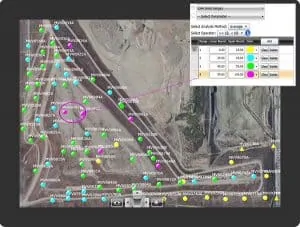
Using SCSeTools pick any parameter that the GEM collects and create custom ranges or use specified guidelines to quickly identify trends throughout the landfill. Tuning ranges can be adjusted to specific conditions found at individual landfills. Smooth a saw tooth collection pattern and learn from your data for maximum vacuum and maximum collection without risk.
Any facility that manufactures, uses, stores, or distributes certain chemicals above a specified quantity listed on Appendix A must complete and submit a Chemical Security Assessment Tool (CSAT) Top-Screen within 60 days of coming into possession
of the Chemicals of Interest (COI) .
In developing the list, the Department looked to existing expert sources of information including other federal regulations related to chemicals. With the publication of a final Appendix A, all provisions of 6 CFR Part 27, including § 27.210(a)(1)(i), are operative and in effect. The other sources that the Department referenced in part are:
Many manufacturers, food storage facilties, cold storage facilities, and industries have chemicals that fall into one or more of the listed categories. Please contact our professional staff to find out if your business is at risk of non-compliance of CFR Part 27.
What to do? Who to contact? Jake Tilley or Lee Pyle of SCS Engineers.
For years, Wisconsin landfills have relied on compliance with the storm water (stormwater) management requirements in the Chapter NR 500 code series to achieve compliance with the NR 216 storm water standards. Effective June 15, 2016, the Wisconsin Department of Natural Resources (WDNR) changed their policy, and now requires landfills and associated non-commercial borrow sites to obtain separate industrial storm water permit coverage.
Read the SCS Engineers Technical Bulletin to determine what action you may be required to take and by what date.
If you have questions or need help filing or developing a plan, please contact:
Betsy Powers, PE
(608) 216-7347
Sherren Clark, PE, PG
(608) 216-7323
…and as waste settles, it can have an effect on equipment,” according to Pat Sullivan of SCS Engineers in this ClimateWire article. As the U.S. EPA focuses on pushing landfill owners into cutting down on methane emissions some worry that a combination of tightening regulations and poor cost analysis might put some smaller landfills out of business.
LANDFILL EMISSIONS: Going to the dump? You might make electricity
Kavya Balaraman, E&E reporter
Reprinted from ClimateWire with permission from E&E Publishing, LLC. Copyright 2016.
Corporate Headquarters