On June 1, 2016, the National Waste & Recycling Association (NWRA), the Solid Waste Association of North America (SWANA), and the Coalition for Renewable Natural Gas (RNG Coalition) provide comments on Pipeline Safety: Safety of Gas Transmission and Gathering Pipelines (FR20722) proposed rules to Mr. Mike Israni, Deputy Associate Administrator for Pipeline Safety – Field Operations at U.S. Department of Transportation. Comments by the three not-for-profits were made on behalf of the solid waste industry including companies, municipalities, and professionals.
The letter reflected the solid waste industry support for the efforts made by the Pipeline and Hazardous Materials Safety Administration (PHMSA) to ensure pipeline safety and included comments on the Advance Notice of Proposed Rulemaking, (ANPRM) as follows:
The revised definition for gathering line (onshore) as the basis for determining the beginning and endpoints of each gathering line requires further clarification. The definition remains too broad for applications that do not have the same level of risks since they are not accessible to the public.
PHMSA has elected not to propose rulemaking for landfill gas systems. However, it notes that pipelines that transport landfill gas away from the landfill to another facility are transporting gas and that PHMSA may consider this in the future.
The associations pointed out that the same rulemaking for landfill gas systems should apply to all forms of biogas that are collected and managed in a similar manner to landfill gas. Also noted was that low-pressure gas lines delivering biogas off-site to a dedicated end user need not be considered for further regulation as they do not present the same level of risk that natural gas or other high-pressure gas lines do. Landfill gas/biogas systems fall under federal, state and local regulators. Because landfill gas/biogas systems are regularly inspected for safety, generally use plastic piping, and do not present a substantial risk to the public the Associations feel that it is not necessary to consider additional regulation.
Contact NWRA, SWANA, RNG Coalition or SCS Engineers for more information.
The Environmental Protection Agency (EPA) has recently proposed increases in renewable fuel volume requirements across all types of biofuels under the Renewable Fuel Standard (RFS) program. The proposed increases would boost renewable fuel production and provide for ambitious yet achievable growth.
The Clean Air Act requires EPA to set annual RFS volume requirements for four categories of biofuels: cellulosic biofuel, biomass-based diesel, advanced biofuel, and total renewable fuel. EPA implements the program in consultation with the U.S. Department of Agriculture and the U.S. Department of Energy.
EPA will hold a public hearing on this proposal on June 9, 2016, in Kansas City, Missouri. The period for public input and comment will be open through July 11, 2016.
For more information on the proposal, see www.epa.gov/renewable-fuel-standard-program/proposed-renewable-fuel-standards-2017-and-biomass-based-diesel.
For more information on the public hearing, see www.gpo.gov/fdsys/pkg/FR-2016-05-25/pdf/2016-12358.pdf.
Glass accounts for almost 5% of the municipal solid waste stream; state and local agencies have set ambitious zero waste goals; many agencies are not ready to give up on glass recycling. How do they manage to keep their programs viable despite the cost of processing, transportation, and the challenge of cross contamination?
Sustainable Solid Waste Managment Planning and Programs
East Alton Defense Area Rehabilitation Project Receives Illinois Governor’s Affordable Housing Champion Award. SCS Engineers provides environmental services that help move redevelopment project forward. – Congratulations RISE!

Mark Stroker, Director of Real Estate Development, RISE St. Louis, informed the SCS Engineers team about the honor, saying he felt “a great deal of pride and appreciation that Emerald Ridge was selected by IHDA [Illinois Housing Development Authority] as the Champion’s Award winner for excellence in affordable housing development for 2016.”
Mr. Stroker went on to tell the SCS team that, “It is an extraordinary honor and represents a long and collaborative effort… This was a tough project and wouldn’t have been possible without all of your help.” He attended the Illinois Governor’s Conference in late March 2016, where he accepted the award and discussed the project with conference attendees.
In his notification to Mr. Stroker about the award, Benjamin Fenton, IHDA’s Housing Coordination Services Manager, explained that three nominees are chosen for this award every year for distinguished developments, initiatives, or programs in affordable housing. The nominees stand out for their commitment to serving the Annual Comprehensive Housing Plan focus areas and one or more of the State’s Priority Populations, and for having positive impacts on the community in which they are located.
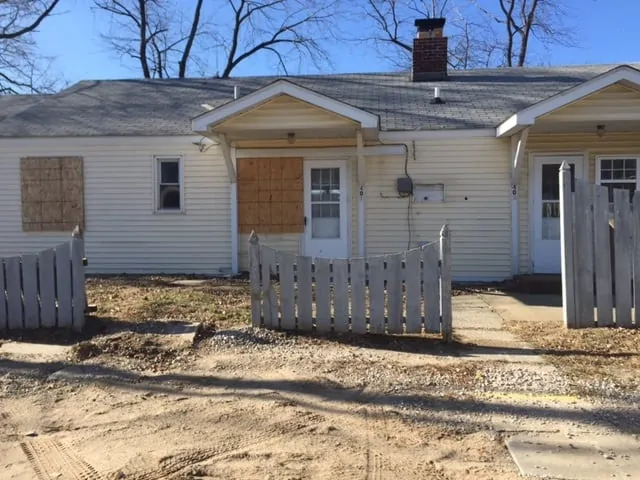
Before it was redeveloped, The Emerald Ridge Development was known as the “Defense Area,” and it consisted of 18 one- and two-story multi-family buildings containing approximately 80 apartments. The Defense Area was built by the Federal government as temporary housing in the early 1940’s to accommodate workers at the nearby Olin ammunition plant during the war effort. After the war, these barracks-style buildings were not dismantled as originally planned but were sold off to private owners. Over the years, they were re-sold multiple times, and the condition of most of the buildings became more and more deteriorated, in addition to being constructed with asbestos-containing materials and lead-based paints.
Residents were temporarily relocated, and the old buildings were demolished and replaced with 46 newly constructed, high-efficiency single-family homes. The residents who lived in the area when the redevelopment project commenced were given the opportunity to rent homes in the new development, and some accepted. The rechristened Emerald Ridge Development is located in the Village of East Alton, Illinois, and the new single-family homes are affordable to families earning 60% of the Area Median Income, which includes nearly two-thirds of the residents of East Alton.
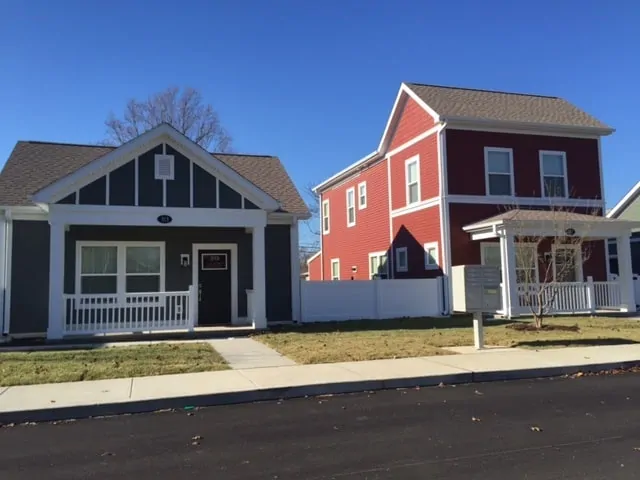
Services that SCS Engineers provided at the site included lead and asbestos abatement sampling and specifications, asbestos abatement management, subsurface investigation for a Phase II ESA, NESHAP demolition inspections, and two Phase I ESAs to assess the property for potential environmental impairments, to satisfy IHDA requirements, and to satisfy the CERCLA requirements to qualify for landowner liability protection.
Stephanie Hill, SCS Project Director, said: “I am honored to be part of the RISE team that brought so much value to the community.” Ms. Hill offered special thanks to Randy Homburg, SCS Geologist and Project Manager, for his work on this redevelopment project, and to the other SCS team members who performed the environmental site assessments.
An SCS Engineers Technical Bulletin will be released early in the week.
The U.S. Environmental Protection Agency issued limits on methane emissions from oil and gas wells that are more stringent than those it proposed last year. The final regulations released on Thursday, May 12, 2016, will add hundreds of millions in additional costs per year; at least 25 percent higher than the preliminary version published in August 2015.
EPA Administrator Gina McCarthy told reporters on a conference call that the mandates, applying immediately to new and modified wells, are a “critical first step in tackling methane emissions from existing oil and gas sources.”
Under the rule, companies must upgrade pumps and compressors while expanding the use of “green completion” technology meant to capture the surge of gas that can spring out of newly fracked wells. Such green completion techniques have been required for new and modified natural gas wells since 2015, but Thursday’s rule would broaden the requirement to oil wells too.
Take me to the EPA summaries. Click on the information sheets listed below:
“Our clients enable SCS to build, grow, and sustain an engineering firm dedicated to solving environmental challenges,” said Jim Walsh, President and CEO of SCS. “We sincerely thank our friends, colleagues and, in particular, our clients for helping us achieve a highly regarded ranking each year.”
Firms are ranked in terms of revenue by Engineering News-Record magazine (ENR), as reported in the May 2, 2016, issue of the “ENR Top 500 Design Firms Sourcebook.” SCS has made the Top 500 list since its publication in 2002 and has ranked in the top 100 of that list since 2008.
When sorted by firm type, SCS Engineers is ranked the second largest environmental engineering firm (ENV) and is ranked in the “Top 20 Sewerage and Solid Waste” service firms in the nation. SCS has made this top 20 list since 2002.
Later in the year, ENR will publish additional resources and lists, including the “Top 200 Environmental Firms” issue, typically published in the month of August.
Learn more about our latest innovation, SCSeTools
If you are buying or selling a property with a history of soil or groundwater contamination in Wisconsin, the state’s Department of Natural Resources requires vapor intrusion pathway screening. The screening is also necessary when buying or selling a property adjacent to a property with soil or groundwater contamination. Is this analysis necessary?
The screening is essential; vapors from contaminated soil or groundwater may transfer to indoor air, causing health risks. The vapors may or may not have an odor. Screen testing and analysis will determine their existence and the level of concentration. Most commonly levels are low, and no additional action is necessary. If beyond the threshold determined safe by your state, some mitigation may be required before purchase.
It is not a simple matter to apply an individual state’s current regulatory guidance to determine the need for vapor intrusion mitigation. The actual intrusion, or expected intrusion in the case of new buildings, is often overstated, and some regulatory agencies use screening values for indoor air chemical concentrations that are at or below levels commonly found in buildings. The slightest error in sampling technique can dramatically affect the resulting data.
SCS offers the full array of vapor intrusion services for residential, commercial, and industrial properties, and for developers, municipalities, lenders, attorneys, industrial facilities, tenants, landlords, and buyers and sellers of real property.
Contact SCS at 1-800-767-4727 or email us at .
Question about this blog, please email one of the authors Robert Langdon and Thomas Karwoski.
SCS has offices nationwide to serve our customers. To learn more about vapor mitigation, please visit the SCS website here: https://www.scsengineers.com/services/hazardous-waste-and-superfund/vapor-intrusion-mitigation-systems.
The Solid Waste Association of North America (SWANA) Applied Research Foundation released a report concluding that: a significant amount of additional food waste processing capacity will be required to achieve national, state, provincial, and local food waste diversion goals. The report also emphasizes the need for local decision-making in selecting and implementing those food waste diversion programs.
…a significant amount of additional food waste processing capacity will be required to achieve national, state, provincial, and local food waste diversion goals. The report also emphasizes the need for local decision-making in selecting and implementing those food waste diversion programs.
The report goes on to say that interest in recovering food waste from municipal solid waste is growing to meet goals established by the U.S. Environmental Protection Agency and U.S. Department of Agriculture, but many major metropolitan areas lack the infrastructure to manage the ability to meet the established goals. Two examples were cited:
Several states, including Massachusetts and Connecticut, condition their food waste diversion requirements on the ability of generators to access adequate capacity within a certain distance.
Speaking as SWANA’s Executive Director and CEO David Biderman stated:
We believe that Americans need to rethink how food is handled before it is considered waste, to divert it into programs to feed people, and to find other productive uses for food as food. Once it becomes waste, however, municipal decision-makers, working with their processing partners, need to determine how to best manage the material.
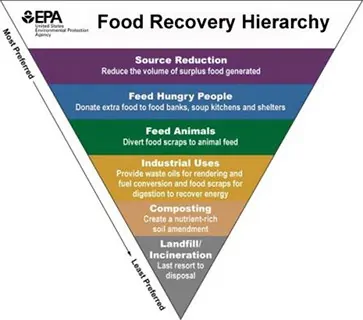
The SWANA report focuses on the effects of food recovery at the two lowest tiers of the hierarchy – composting and landfilling/incineration. The report concludes that food waste diverted from landfill operations has the potential to be processed at composting facilities. Then, going on to say that anaerobic digestion (AD) and co-digestion at wastewater treatment facilities are also likely destinations for diverted food waste.
Jeremy O’Brien, Director of the Applied Research Foundation, noted:
The food recovery hierarchy does not apply universally; an analysis of greenhouse gas impacts based on local data and conditions is needed to identify the best food scraps management options for a specific community.
The report encourages solid waste managers to perform a life cycle analysis of economic and environmental costs and benefits based on local needs, system capabilities, and data to identify the most effective ways to manage food waste at the local level.
SCS Engineers and SWANA are both long-time advocates for local decision-making in establishing programs to collect and manage municipal solid waste.
Related articles:
This workshop was insightful, tightly constructed, and – most impressive – able to deliver high quality information that businesses can use immediately. I have been to hundreds of business workshops where companies feel drowned in the amount of expert information coming at them. Not so at this concise, one-hour workshop where businesses clearly understood the next steps they should take and where they can find resources to help them proceed.
Jo Marie Diamond, President and CEO, East County Economic Development Authority after attending the SCS seminar in San Diego, CA. on March 1, 2016.
SCS Engineers staff professionals are available to answer questions about compliance and the proposed fee schedule changes for attendees and any business unsure about the storm water permit. We can help clarify questions such as:
See the slide presentation here if you have not attended the seminars.
If you have questions about how the storm water permit could impact your business, or would like to know more about the permit fees, please contact Cory Jones, your nearest SCS office in California, or .
Cory Jones, P.E., ToR, QSIP, is a stormwater program manager at SCS Engineers. Jones manages complex projects for private and public clients that include site/civil, water/wastewater and stormwater engineering. He has completed a wide variety of special studies in storm water management and National Pollutant Discharge Elimination System (NPDES) compliance for federal, state and municipal public agencies.
Thirty-four senators and 171 representatives argue in a brief filed February 23, that the EPA overstepped its boundaries in creating the carbon-cutting Clean Power Plan. In short, the brief states that they feel that Congress never gave the EPA a clear statutory directive or authority to transform the nation’s electricity sector. The brief points out that the EPA seeks to make “decisions of vast economic and political significance” under a “long-extant statute,” and in doing so must point to a “clear statement from Congress.”
Yesterday’s brief comes just two weeks after the U.S. Supreme Court ruled the EPA cannot begin enforcing the rule until legal challenges filed by 25 states and four state agencies are resolved.
The D.C. Circuit Court of Appeals will hear oral arguments on the merits of the states’ case on June 2.
With the brief it is clear that the Clean Power Plan is not only facing legal challenges but also political ones. It may be left for the next Administration to pick up this pieces and decide the fate of the Plan.
Corporate Headquarters