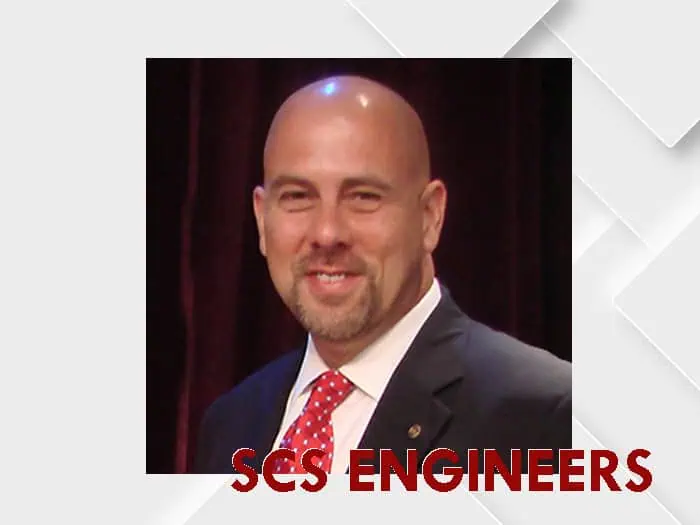
SCS Engineers welcomes Russell Wharton, PE, to SCS Engineers as our new Project Director in Nashville, Tennessee. Russ will run the office that serves the state and brings to diverse SCS clients over three decades of expertise in civil engineering design, municipal, environmental, and geotechnical engineering, architecture, alternative energy (including renewable natural gas), and consulting.
With his years of experience in civil and environmental engineering, Russ’s expertise includes construction management and quality assurance, saving clients time and money. His ability to incorporate LEED elements and sustainability procedures with minimal cost impacts brings more value when applying design elements in the field. These strategies help avoid cost overruns and project delays.
While having experience working on national accounts spanning from the West to East coasts, Russ’s work experience includes counties and cities throughout Tennessee, serving as the client contact and managing regulatory needs, including federal and state agencies and Authority Having Jurisdiction requirements for entitlements (rezoning, special use, variances, design review approvals), and permitting, including such clients as New York City, the Port Authority of NY and NJ, and various international airports.
His broad development design experience – facility siting, grading/drainage, utility (water, sewer, stormwater), pavement, erosion, and sediment control is especially helpful for many businesses and facilities facing stricter regulatory policies necessary to comply with Clean Water regulatory actions.
As a professional engineer and general contractor licensed in Tennessee, Russ earned a Vanderbilt B.E. in civil and environmental engineering. He is also an active member of Rotary International.
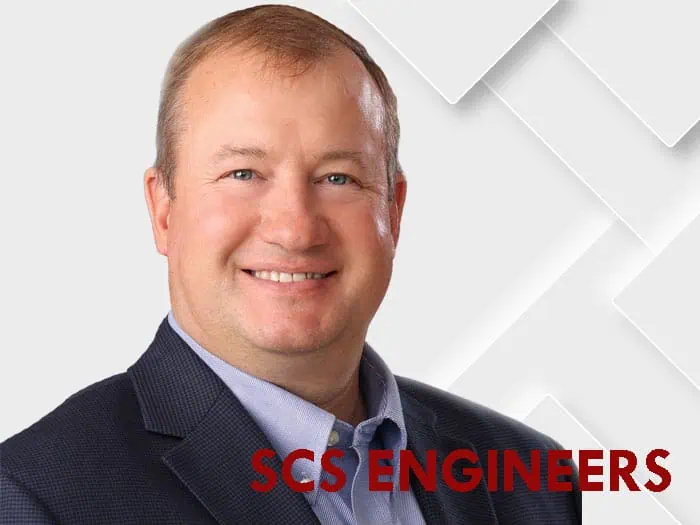
Please join SCS Engineers in congratulating our Chief Strategy Officer (CSO), Nathan Hamm, for his new position. As CSO, Hamm will lead SCS efforts for strategic planning, identification of short-and long-term growth objectives, and new business and expansion opportunities.
Hamm will coordinate and facilitate the optimization of the marketing and business development efforts across SCS to support strategic efforts. Further, he will lead the Client Success Program, which seeks to provide the highest value to our clients. As a professional engineer, Nathan Hamm has nearly three decades of experience and an ideal blend of client-focused consulting, business acumen, and hands-on work with our strategic initiatives to draw from.
Further, his previous experience as a Client Manager, Project Manager/Director, and the leader of our Leachate and Industrial Wastewater Treatment strategic initiative provides him with a broad perspective, key relationships, and strategic insight across SCS and the industries we serve. Hamm will oversee the program strategies that keep SCS’s deep bench of professionals poised to provide sustainable, full-service solutions.
SCS Engineers CEO Doug Doerr says, “Nathan Hamm’s background as part of SCS’s executive team, his work with our talented professionals, and his legacy of success with clients are key as SCS continues evolving to serve our core and expanding industry base.”
Additional Information:
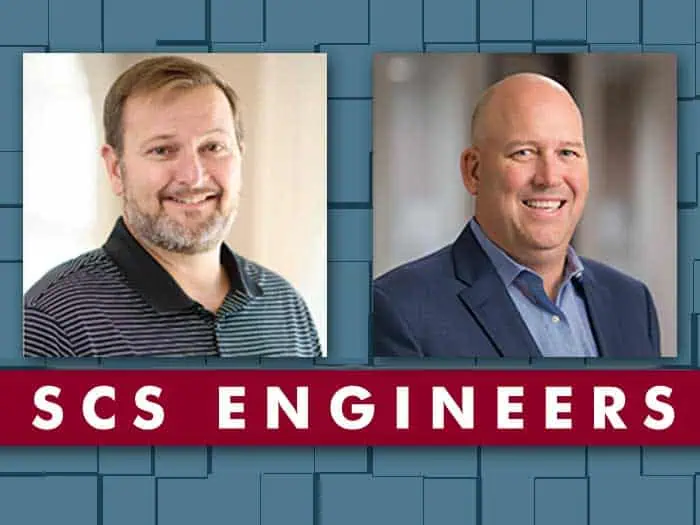
SCS Engineers is excited to announce two new National Market Leaders for the firm in 2025 backing SCS’s ongoing commitment to growth. One SCS is how the firm works proactively as one team to leverage talent across the company, applying systems and processes locally that deliver the highest quality and value to clients.
 Mike Miller takes the reins from Mike McLaughlin to lead the Environmental Services (ES) practice. Mike Miller has been with SCS for nearly 20 years, serving in various roles across the company. He served as the Environmental Services Leader in the firm’s largest region and has also served SCS as one of the National Experts for Environmental Due Diligence. Mike is a Project Director and was appointed as a Senior Vice President in November of 2023. Mike Miller will oversee the strategic direction, growth, and performance of the company’s ES market. Undoubtedly, he will continue to be fueled by his passion for engaging SCSers across the company with his One SCS spirit to provide exceptional service for clients.
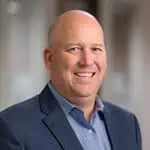 Dan Cooper now leads SCS’s Solid Waste practice, taking over from Bob Gardner. Dan joined SCS in 2005 and has been an integral part of the Southeast region, most recently serving as their Solid Waste Leader. Under Dan’s leadership, the Southeast solid waste practice has grown by over 70% since 2019, when he took on his current position. Dan is a professional engineer in several states and serves SCS as a Project Director and Vice President. Dan, newly elected to SWANA’s Board of Directors, is the Region 5 Director for Florida and the Caribbean. Similarly to Mike, Dan will focus his efforts on the strategy, growth, and performance of the solid waste market for SCS with a heavy focus on enhancing our One SCS approach to serving clients.
SCS’s employee-owners and clients are deeply grateful to Mike McLaughlin and Bob Gardner, who have been instrumental in guiding the firm to its current success. Their dedication and leadership have left an indelible mark on the organization, and we extend our heartfelt gratitude for their years of service.
Additional Information:
About SCS Engineers:
SCS Engineers’ consultants, scientists, engineers, and contractors provide expertise in designing and implementing solid and hazardous waste management, biogas, RNG, carbon capture – reduction, measurement, air quality, greenhouse gas verification solutions, and land recycling, each compliant with the most rigorous regulations and standards. Our award-winning teams work with industries, manufacturers, developers, and municipalities to prevent, mitigate, and remediate environmental challenges while applying our knowledge of environmental regulatory systems and technologies. SCS professionals work effectively to shorten project timelines, stay on budget, and close gaps between sustainability goals and achievements so our clients can produce and deliver products and services more efficiently.
On Tuesday, September 25, the U.S. Environmental Protection Agency (EPA) issued two enforcement alerts addressing regulatory requirements and associated compliance issues at municipal solid waste landfills (MSW landfills). The alerts address Clean Air Act requirements that control the release of landfill gases (LFG), particularly methane, from MSW landfills.
These reminders represent compliance issues that EPA has flagged during enforcement actions. EPA thought they were important enough to publish these alerts for the benefit of landfill OM&M; expect state and local agencies to focus on these during their regulatory inspections.
The alerts provide an overview of the Clean Air Act regulatory requirements related to landfill air emissions and aim to help landfill owners, operators, and contractors comply with the law and take the necessary steps to avoid potential EPA enforcement actions.
The first enforcement alert, “EPA Investigations Find Municipal Solid Waste Landfill Operators are Failing to Properly Conduct Compliant Monitoring and Maintenance of Gas Collection and Control System,” is intended to remind MSW landfill owners, operators, and their consultants to conduct routine monitoring and maintenance of gas collection systems to ensure all landfill emissions are being properly captured and controlled.
The second enforcement alert, “MSW Landfill Operators Fail to Include Wastes from Total Degradable Waste-in-Place and Properly Sample Landfill Gas, Resulting in Underreported Emissions,” is intended to remind MSW landfill operators, owners, and their consultants to identify and document nondegradable wastes excluded in calculations properly and to collect representative LFG samples for non-methane organic compounds analysis and emission calculations.
If you are operating a landfill that gets an EPA Section 114 request for data, is having or has had an EPA inspection, or has received an EPA NOV, you may want to contact the compliance experts at SCS Engineers to seek advice on EPA’s perspective on rule history, interpretation, and assist how best to prevent or defend against enforcement actions.
Additional Resources
 Based on your feedback, SCS is excited to thank you for the 2024 CX Award. It is a pleasure and privilege to help you with your environmental needs. At SCS Engineers, we recognize that a substantial part of the value we deliver is how well we serve our clients. To that end, we have in place several long-standing programs to make it easy for you to reach us, find help, and provide feedback.
Reach Out Toll-Free +1 (800) 767-4727
Our receptionists answer calls between 8:30 am ET through 5:00 pm PT. We promptly answer voicemails and messages sent to our general email () 24/7.
Client Feedback Tool
SCS solicits feedback from clients during ongoing projects via short (2-3 minute) surveys using our electronic Client Feedback Tool (CFT). These surveys are designed to ensure we are on track to deliver project solutions to your satisfaction. Surveys are less than ten questions, and space is available for additional comments. Your Project Manager will work to establish a convenient schedule for you if you’d like to participate. This is not a marketing survey. It is a way to check in with you regularly to ensure your project is on track, in addition to regular communications with your Project Manager. Your participation is greatly appreciated.
Quality Management
SCS maintains a stringent, comprehensive Quality Management program. Quality Management ensures that SCS staff professionals, scientists, technologists, and field technicians, including administrators and subcontractors, have the necessary training, tools, and skills to employ sound, ethical processes on every environmental solution.
Our robust program includes apps built by SCS for our staff to continuously improve our services and communications. SCS staff have access to thousands of resources at the touch of a button, including libraries, compliance documents, safety information, training, and our National Experts and specialists nationwide to maintain the highest level of quality in our products and services. We make many of our resources available on our website, too.
The Website
SCS’s website is a rich resource for our clients and visitors. The site has two primary filters: one to find local staff with specific environmental experience. The second is a search filter that results after a search to help you target our resources, available on demand. Service descriptions, articles, whitepapers, blogs, events, and videos can be resources. Each page enables you to print or share the resource privately with others or on social media.
Free Environmental Educational Videos
The SCS Engineers Learning Center contains recorded open forums where participants ask questions throughout. The video recordings are available in our Learning Center to watch at your convenience. These are educational videos, not sales pitches, as we share our experience and expertise in environmental fields with individuals and businesses to enhance a clearer understanding of modern environmental solutions and technologies available.
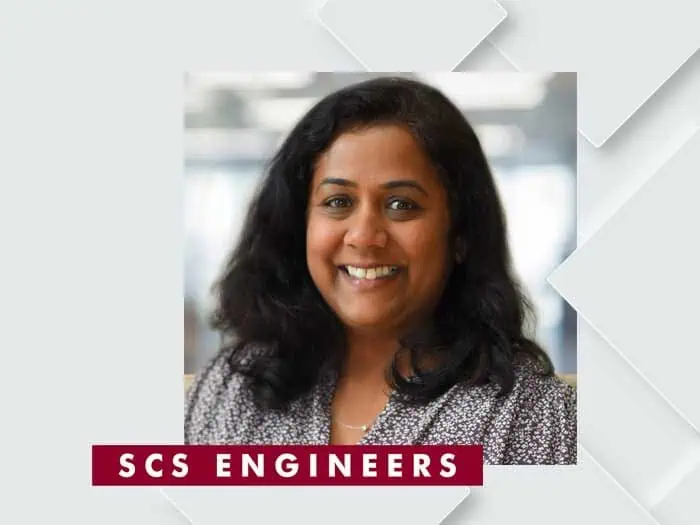
SCS Engineers is excited to announce that Vice President Sowmya Bulusu, who currently runs our Atlanta, Georgia office, is replacing Dan Cooper as the Solid Waste Director for the Southeast US as Dan takes on his new role leading the firm’s Solid Waste Management practice.
Sowmya Bulusu, PE, is a registered professional and geo-environmental engineer with two decades of experience as a project manager and design engineer for numerous landfills, environmental and civil engineering projects. Her work focuses on waste disposal facilities, landfill gas collection operations, and utilization systems, including siting, design, permitting, construction, and monitoring and maintenance. Sowmya’s expertise includes air permitting and compliance, renewable energy projects, and construction quality management to provide successful turn-key solutions.
When asked about her promotion, Sowmya says, “My career in solid waste management has provided me with valuable experience in addressing complex challenges. I am grateful for the mentorship I have received at SCS, which has contributed significantly to my professional development. As a leader in this role, I am eager to mentor, guide, and inspire my team to achieve new levels of excellence.”
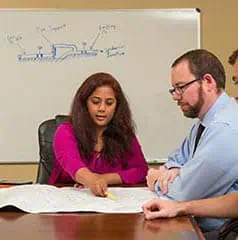
Sowmya also serves on the SCS Sustainability Steering Committee – to help make us all operate cleaner and greener and as the Director of the SWANA Georgia Chapter. She earned her Bachelor of Technology in Civil Engineering and her Master of Science in Geo-environmental Engineering.
She is a disciplined leader who shares what she learns with her colleagues and others, including her culture as a professional Kuchipudi dancer. This major classical dance involves extensive stage movements and exacting footwork. From age 7, she practiced five days a week for up to three hours daily. Sowmya says the regimen and dance tours throughout India and the US taught her valuable skills that she uses today: time management, discipline, responsibility, and cooperation.
Business Unit Director Carlo Lebron says, “I am very excited for Sowmya to take the reins of the solid waste program and build upon Dan Cooper’s legacy. We have full confidence in her ability to lead and look forward to the new levels to which she will take our program.”
Related Resources:
Environmental professionals work to create more sustainable solutions, prevent pollution and accidents, and mitigate former unusable resources. As long as the world continues to consume, environmental consultants and engineers are going to be very valuable for a wide range of industries. Be at the heart of this industry working at SCS Engineers.
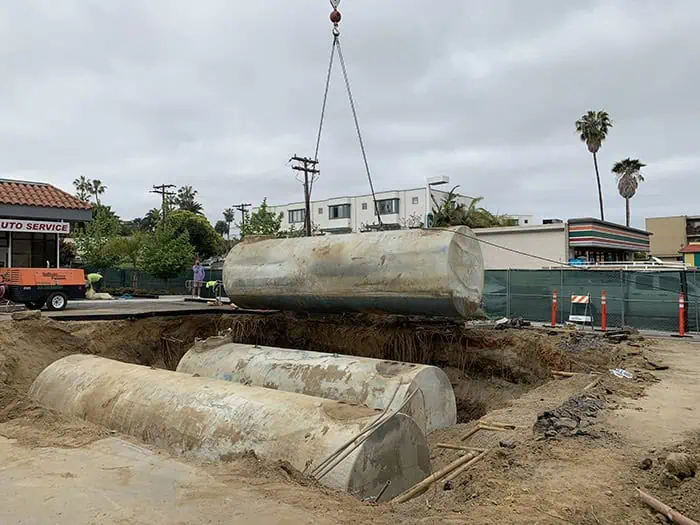
The California State Water Resource Control Board ordered the closure of single-walled underground storage tank systems and single-walled product piping at all facilities. The deadline to remove all single-walled underground storage tanks and single-walled piping is December 31, 2025.
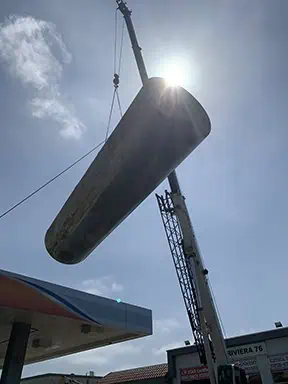
Underground storage tanks recognized as out of compliance will be subject to enforcement actions beginning January 1, 2026.
Grants and loans may be available to eligible small business owners who want to remove, replace, or upgrade USTs.
The professionals at SCS Engineers are ready to assist with closing and removing underground storage tanks. SCS Engineers provides turnkey services, including licensed tank removal contractors, consulting services for agency compliance, and California-certified analytical testing laboratories.
SCS’s National UST Practice Covers:
Contact a UST professional at SCS Engineers today at ; for service in California, click here.
For information on the EPA Federal program, click here.
Additional California Code Information:
Health and Safety Code – HSC
DIVISION 20. MISCELLANEOUS HEALTH AND SAFETY PROVISIONS [24000 – 26275] ( Division 20 enacted by Stats. 1939, Ch. 60. )
CHAPTER 6.7. Underground Storage of Hazardous Substances [25280 – 25299.8] ( Chapter 6.7 added by Stats. 1983, Ch. 1046, Sec. 3. )
25292.05.
(a) On or before December 31, 2025, the owner or operator of an underground storage tank shall permanently close that underground storage tank in accordance with Section 25298 and the regulations adopted pursuant to that section, if the underground storage tank meets either of the following conditions:
(1) The underground storage tank is designed and constructed in accordance with paragraph (7) of subdivision (a) of Section 25291 and does not meet the requirements of paragraphs (1) to (6), inclusive, of subdivision (a) of Section 25291.
(2) The underground storage tank was installed on or before January 1, 1984, and does not meet the requirements of paragraphs (1) to (6), inclusive, of subdivision (a) of Section 25291.
(b) Notwithstanding subdivision (a), the board may adopt regulations to require the owner or operator of an underground storage tank to permanently close that underground storage tank before December 31, 2025, in accordance with Section 25298 and the regulations adopted pursuant to that section, if the underground storage tank meets the conditions specified in either paragraph (1) or (2) of subdivision (a) and the underground storage tank poses a high threat to water quality or public health. The board shall consult with stakeholders before adopting regulations pursuant to this subdivision.
(Added by Stats. 2014, Ch. 547, Sec. 1. (SB 445) Effective September 25, 2014.)

SCS Engineers is excited to announce the appointment of Vice President Jeffrey J. Grill as the new Business Unit Director of SCS Energy. SCS Directors are responsible for geographic business areas or, in this case, a specialty practice in renewable energy under the brand SCS Energy.
Jeff joined SCS Energy in 2019, leading the process engineering team responsible for the design of biogas to renewable natural gas & energy facilities. He has over 20 years of experience in energy and renewable natural gas (RNG) project development. His background is in chemical process engineering and a wide array of engineering and management services, from conceptual to detailed design and implementation. His core values are quality, consistency, and engineering excellence.
Jeff earned multiple B.S. degrees in Chemical Engineering and Materials Engineering at the University of Connecticut. He has professional affiliations and sits on committees with the Renewable Natural Gas Coalition and the American Biogas Council.
During his career, he has built an execution portfolio of 19 patents and applications and designed over 50 Renewable Natural Gas processing plants with a combined designed production capacity equivalent to 16% of California’s 2021 residential natural gas consumption. That is equivalent to almost one and a half percent of the U.S. residential natural gas consumption, equating to a reduction of over 4.1 million tons of CO2 GHG emissions or 2.1 million tons of coal burned annually. The capacity of the landfill gas to pipeline quality RNG projects that Jeff has designed or supervised totals over 335 MMCFD for landfill gas to RNG and over 34 MMCFD for dairy digester and municipal WWTP gas to RNG.
His work at SCS Energy helps many clients and communities, especially those considering landfill gas to RNG to lower carbon footprints and create renewable energy or renewable fuels. Built on one of the U.S.’s longest and most successful biogas practices in North America, SCS Energy designs, constructs, and operates more landfill gas and digester gas to energy facilities than any other engineering firm in the nation. Its biogas and biomass experts provide turn-key services for RNG plants using byproducts from dairy, swine, or poultry farms into carbon-negative renewable energy.
“Jeff’s colleagues and clients are excited to see him take leadership of SCS Energy from Bob Viers, who will now serve in a leadership advisory role. SCS clients attribute their high-quality results to SCS Energy’s industry-leading expertise in biogas gas utilization, combined with the firm’s wealth of knowledge in solid waste management and regulatory compliance,” stated SCS CEO Doug Doerr.
“Our team is a powerhouse of exceptional talent, filled with professionals whose dedication, passion, and pursuit of excellence leave me in awe. Their unwavering commitment to one another and our collective success is inspiring and humbling. I am grateful for the opportunity to work alongside them and deeply appreciate the legacy of Jeff Pierce and Bob Viers,” stated Jeffrey Grill.
Learn More About Biogas and Renewable Natural Gas (RNG):
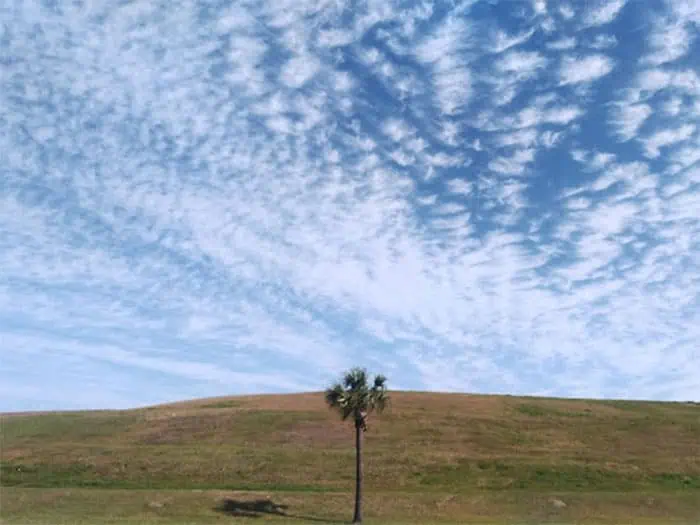
On July 16, 2024, the Volusia County Council approved a contract with SCS Engineers to develop a new 271-acre Class I landfill. The landfill, located at the southeast expansion area (SEA) of the Tomoka Farms Road Landfill, is part of the County’s long-term plan to meet its Class I sanitary solid waste disposal needs for over a century. The Public Works will oversee the project, Solid Waste Division, under the guidance of the County’s Project Manager.
SCS Engineers will provide a range of engineering services, including developing a solid waste permit application package for the Florida Department of Environmental Protection. They will design the landfill gas collection and capture system, supporting infrastructure, geotechnical needs, and leachate collection to protect groundwater and soil. Additionally, they will provide support services for selecting a construction contractor for the first 20-acre disposal cell at the new landfill.
SCS will collaborate with the County to identify any constraints that may impact the cost or constructability of future projects. They will also explore potential opportunities associated with this project to ensure the design complements and maximizes future development opportunities.
Landfills are complex systems integrating liquid and gas management systems to protect the environment. Volusia County selected SCS Engineers for their expertise in designing modern landfills that adhere to strict state and federal regulatory and quality control guidelines. The firm’s understanding of how current landfill operations interrelate with the development of SEA was a key factor in their selection.
Modern landfills are ecosystems that isolate waste from surrounding environments, such as groundwater, air, and rain. While the County’s reuse, recycling, and organics management programs significantly reduce waste in landfills, the SEA development provides an essential service that will continue uninterrupted as communities transition to even more sustainable programs and infrastructure to reuse landfill gas and other byproducts.
Vice President Dan Cooper, P.E., expressed his gratitude, stating, “SCS is privileged that Volusia County has entrusted us as a partner to sustainably engineer SEA’s safe and efficient development. We’re honored to assist the Solid Waste Division in their mission to support the citizens and the environment.”
Additional Resources:
The Association for Environmental Health and Soils (AEHS) is hosting the 40th Annual International (East Coast) Conference on Soils, Sediments, Water, and Energy in Amherst, Massachusetts, October 21-24, 2024. The AEHS conference attracts participants from government agencies, environmental engineering firms, consulting companies, industry, and academia and serves as a networking hub for various associations. The program features technical workshops, presentation sessions, and an exhibit hall. It also offers continuing education credits (please check with your specific board for applicability). SCS recommends attending this conference for its valuable insights and networking opportunities.
Corporate Headquarters