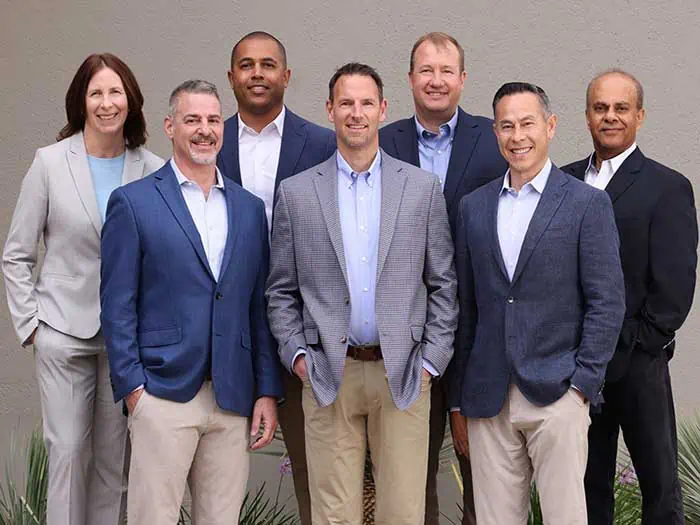
SCS Engineers, a leading environmental engineering firm, proudly announces the appointment of its new executive leadership team subsequent to its semiannual Board of Directors meeting, under the guidance of Chairman Jim Walsh and CEO Doug Doerr.
Curtis Jang assumes the role of President, leveraging his extensive 30-year tenure in financial management and organizational improvement. Mr. Jang, will spearhead strategies aligning with the overarching goals set forth by the CEO and Board.
CEO Doug Doerr affirms the significance of this leadership transition, stating, “To ensure our continued success and to position ourselves for future growth, I’ve entrusted several key individuals to assume new executive roles. As one of the country’s foremost environmental engineering firms experiencing remarkable growth, it is imperative that we equip ourselves for the challenges and opportunities ahead.”
In his capacity as President, Mr. Jang will collaborate closely with Doug Doerr and the newly appointed executive leadership team to steer SCS Engineers towards its envisioned future – prioritizing the welfare of its employee-owners, fostering a cohesive ‘One SCS’ ethos, and delivering unparalleled service to our valued clients.
Eddy Smith, assuming the role of Chief Operating Officer, will lead business strategies across various units and practices to foster enhanced collaboration company-wide, thereby enhancing value delivery to clients. With over three decades of experience in environmental and civil engineering design and consulting, Mr. Smith brings a wealth of expertise to his new role.
Chief Financial Officer Steve Liggins, leveraging his financial acumen and a notable career spanning over 17 years, will oversee finance and accounting functions, ensuring fiscal stewardship within the organization.
Stacey Dolden, entrusted with the role of Chief People Officer, will spearhead the company’s intensified focus on enhancing the employee experience. As a certified Senior Professional in Human Resources with 24 years of experience, Ms. Dolden is committed to nurturing a best-in-class workplace, with a particular emphasis on fostering effective career pathways for all employees.
Jay Hatho, SCS’ Chief Information and Chief Technology Officer, will lead the development and implementation of innovative technological solutions within SCS, as well as for our clients. With over 25 years of experience, Mr. Hatho is dedicated to ensuring SCS remains at the forefront of technological advancement, thereby enhancing client service delivery and fostering employee-owner collaboration.
Nathan Hamm, in his capacity as Senior Vice President, will focus on driving strategic initiatives aimed at expanding the company’s service platform and offering creative solutions to clients’ environmental and business challenges. With over 26 years of industry experience, Mr. Hamm brings a wealth of knowledge and expertise across various service sectors within the engineering consulting arena.
The appointment of this new executive leadership team underscores SCS Engineers’ unwavering commitment to excellence, innovation, and client satisfaction. With their collective expertise and vision, SCS Engineers is poised to embark on an exciting new chapter of growth and success.
About SCS Engineers: SCS Engineers is a renowned environmental engineering firm dedicated to providing innovative and sustainable solutions to complex environmental challenges. With a steadfast commitment to excellence and client satisfaction, SCS Engineers has emerged as a trusted industry leader, serving clients across various sectors with integrity, expertise, and unparalleled professionalism.
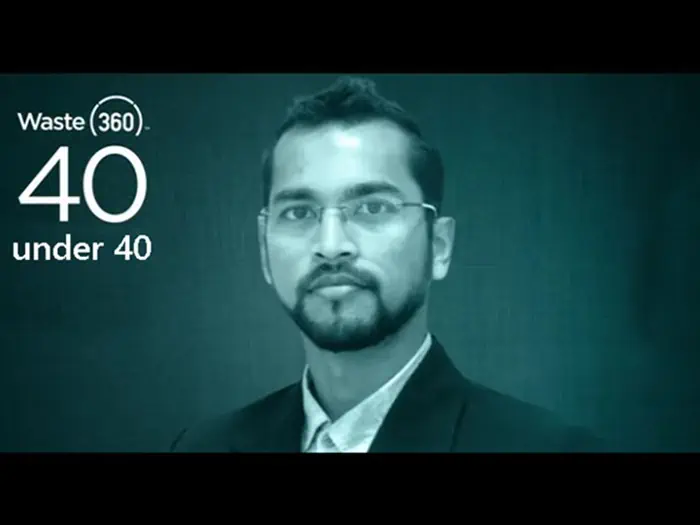
These young professionals, recognized in the environmental industry as rising stars, are making a difference. The 40-U-40 program introduces us to inspiring and innovative professionals under 40 who have made significant contributions through their work in waste, recycling, food waste, and organics. These environmental solutions provide proven and substantial positive impacts in lowering carbon footprints and helping us reach sustainable goals toward carbon neutrality.
Ketan Shah is a dedicated waste industry professional who focuses on technology solutions to lower environmental and health risks while looking to improve efficiency. Shah is an expert in landfill gas recovery modeling, refuse transfer station design, and life cycle assessment modeling. His contributions as a scholar and practitioner to environmental advancement are undeniable due to his published research and award-winning projects.
Dr. Shah’s impact on the waste management industry is ongoing, making him a great asset to SCS, its clients, and the community. Waste 360’s slideshow shows all the 2024 Awardees.
Cited Publications:

Thirty years ago this week, on February 11, 1994, then-President Bill Clinton signed Executive Order 12898, Federal Actions To Address Environmental Justice In Minority Populations and Low-Income Populations. The Executive Order marked the first government action on environmental justice and an important part of the environmental justice movement.
Executive Order 12898 directed government agencies (particularly the US Environmental Protection Agency or EPA) to develop plans and strategies to help address any disproportionally high and adverse human health or environmental effects of their programs on minority and low-income populations.
Redlining
Executive Order 12898 responded to changes that began during the Civil Rights Movement. Minority groups, particularly African Americans, began to object to discriminatory practices long entrenched in government policy. The most notable being the practice of “redlining.” In the 1930s, the United States worked to end the Great Depression. To encourage banks to lend money for mortgages, the federal government began insuring or underwriting housing loans; however, government inspectors designated African American and immigrant neighborhoods uninsurable, and the residents could not obtain loans. Landlords were not vested in maintaining their properties, and much of the housing became sub-standard. Inexpensive swaths of property inside city limits encouraged businesses and industry to purchase and develop this land, increasing pollution from traffic, industrial processes, and edging out small businesses.
Solid Waste Disposal
In 1979, Texas Southern University sociologist Robert D Bullard, Ph.D., studied solid waste disposal sites in Houston, Texas, for a class-action lawsuit seeking to prevent the siting of a new landfill near the Northwood Manner subdivision, a Black, middle-class neighborhood. Dr. Bullard’s work found that five out of five city-owned landfills and six of the eight city-owned incinerators were in Black neighborhoods. While the case was lost, it increased awareness of environmental issues in minority communities.
Hazardous Waste
In 1982, North Carolina sited a toxic waste landfill in Afton, a rural Black community in Warren County, to hold 40,000 cubic tons of polychlorinated biphenyls from illegally dumped contaminated soil along state roads and highways. For six weeks, residents and activists protested, marking what many consider the birth of the Environmental Justice Movement. The contaminated soil ultimately went into the landfill and eventually caused a release that cost the state $18 million to clean up.
In subsequent years, the movement began to attract the attention of public officials. In 1983, the US General Accounting Office Study released the location of Hazardous Waste Landfills. It took another seven years before the federal government began to consider policy change when, in 1990, the Environmental Equity Workgroup was formed to gather information and make recommendations to the government, leading to the creation of EO 12898.
Gaining Traction
Throughout the 2010s, the EPA published a series of plans and guidance documents, including the public release of EJScreen in 2014, the Technical Guidance for Assessing Environmental Justice in Regulatory Analysis, and the Environmental Justice Research Roadmap in 2016.
In 2022, EPA Administrator Michael Regan traveled to Warren County, North Carolina, to officially create the new Office of Environmental Justice and External Civil Rights. Several people involved in the 1982 PCB protests were in attendance.
Today’s Protections
State and federal environmental permitting now requires Environmental Justice (EJ) reviews. Fortunately, most, if not all, of the necessary EJ review data is publicly available online. For example, environmental professionals use EPA’s EJScreen regularly for EJ reviews, and many states have developed or are developing interactive data tools.
In the past decade, the US Census Bureau developed a searchable, interactive online database, and in 2021, the US Council of Environmental Quality released the Climate and Economic Justice Screening Tool. Other online data sources include the Centers for Disease Control and Prevention, the US Department of the Interior Bureau of Indian Affairs, and individual state, county, and tribal organizations. These data not only allow us to meet permitting requirements and identify community challenges but also help guide outreach and facilitate communication with stakeholders.
On April 21, 2023, President Biden signed Executive Order 14096, Revitalizing Our Nation’s Commitment to Environmental Justice for All, expanding upon the direction and intent of EO 12898. Thirty years on, we can see the effects of EO 12898 on incorporating environmental justice into environmental policy so that all people can have a healthier, safer, greener place to live, work, and play.
SCS Engineers Receives Four Environmental Business Achievement Awards
The Environmental Business Journal (EBJ) is an independent business research publication that provides strategic market intelligence to the environmental industry. EBJ is honoring SCS Engineers with four 2023 Business Achievement Awards.
“In a year of strong growth and financial performance for the environmental industry in 2023, a number of companies set themselves apart with performance, transactions, or projects that merit special recognition,” said Grant Ferrier, editor of Environmental Business Journal and chair of the EBJ Business Achievement Award selection committee.
SCS Engineers and our client will accept awards at the awards banquet at Environmental Industry Summit XXII on April 02-04, 2024, in San Diego, along with Business Achievement and Lifetime Achievement awardees.
Lifetime Achievement Award to James Walsh, SCS Board of Directors Chair
 During his 40-year career, Jim worked at the forefront of sustainable solid waste management, sanitary landfills, and landfill gas (LFG), building an international reputation in these specialty fields. Among its many environmental services, SCS Engineers offers one of the longest and most successful biogas practices in the United States, primarily in landfill gas to energy. Jim has been engaged on over 100 landfill design and permitting projects and was chief design engineer, principal investigator, or project manager on over 300 landfill gas projects, in addition to serving as principal investigator on multiple landfill gas R&D projects for U.S. EPA, U.S. DOE, and Gas Research Institute. He continues his work at SCS as a highly sought after expert witness and ETLF specialist in North America, Jim is held in high esteem by his colleagues, clients, and industry.
San Gabriel Valley Food Recovery
The San Gabriel Valley Council of Governments (SGVCOG) retained the services of SCS Engineers to assist their member cities in compliance with state mandates regarding edible food recovery and food waste prevention. Implementing commercial food recovery programs is important to ensure members meet state compliance, avoid penalty fees, and reap the environmental and humanitarian benefits, such as addressing food insecurity.
SCS collaborated with the SGVCOG team and local stakeholders to analyze commercial edible food generation, calculate edible food recovery capacity in the region, develop safe food recovery/donation strategies, and create and implement education and outreach to establish one of the largest SB 1383 edible food recovery programs in California.
The combined effort has helped the SGVCOG better understand how and where food waste is generated within its communities and identify the capacities of food recovery organizations to recover excess edible food from businesses. The program has conducted inspections at over 500 businesses and recovery organizations to educate them on food waste reduction and edible food recovery. The program’s results are impressive.
EBJ Sustainable Solution Planning
Sustainability is the new imperative for public and private sectors to diligently establish sustainability initiatives and plans to meet their goals. Planning is the logical starting point, but planners often lack experience in designing and implementing environmental solutions. This oversight leads to less-than-desirable results against goals.
While others focus on identifying overarching goals related to NetZero or Climate Change, SCS partners with clients, preparing detailed plans and project execution to advance sustainability initiatives that scale. SCS Engineers has produced built projects and programs for over five decades that lower industrial operating costs and reduce greenhouse gases.
Integrating sustainability into the core business strategy ensures long-term viability. Selecting a company that’s engineered, constructed, operated, and monitored sustainable solutions helps ensure individual and holistic sustainable plans that scale based on funding and accommodate evolving technologies, market conditions, and regulatory requirements.
SCS’s sustainable solutions planners’ team with our diverse environmental engineers, scientists, and technicians, including our greenhouse gas monitoring and carbon sequestration practices. Our professional staff are located according to their knowledge of regional and local geography, regulatory policies, and industrial or scientific specialties. Full service by these experts provides added value and quality for our clients so that every project successfully achieves NetZero or Climate Change plan goals.
EBJ Large Company Business Achievement
Winners are awarded based on growth, achievements in profitability, major new project wins, staff hires, and new clients. SCS Engineers has grown steadily for decades and celebrated its 53rd anniversary in 2023. SCS Engineers’ core capabilities are solid and hazardous waste management, renewable energy, land remediation, and environmental compliance. With over 1,200 employee-owners, the firm’s scientists, engineers, and consultants produce technologies and create sustainable programs that help run industrial operations and essential public services more efficiently while reducing and verifying greenhouse gases and environmental impacts. In addition, the firm’s technology and sustainability programs for solid waste management support sustainable environmental solutions in the agricultural, industrial, and manufacturing sectors.
SCS employee-owners have a reputation for philanthropy in the communities they serve and generous donations during the holidays or when tragedy strikes.
SCS wins accolades by functioning across practices and geographical regions — with communications between those in the field, offices, and practices. It takes every SCSer to make this happen.
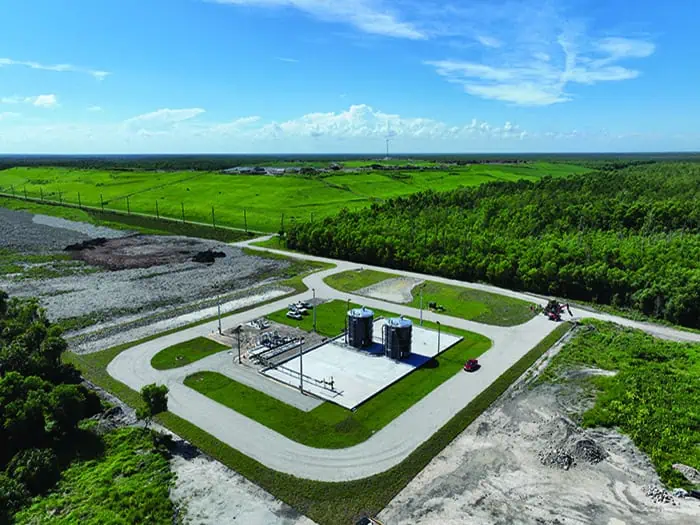
 Inside SCS Engineers, an award-winning environmental services firm, are practices that specialize in permitting, designing, implementing, and performing the operational maintenance and monitoring of modern solutions for essential public services that impact climate change.
Focusing their efforts and investment on solid waste management efficiencies for municipalities leads to better customer service and helps lower emissions that impact communities. For example, the Solid and Hazardous Waste Management Division in Collier County, FL, uses SCS on a variety of progressive solid waste and resource management projects. These projects include sustainable materials management, facilities and operations planning, and landfill optimization.
The County also reaches out to SCS Engineers as a resource to answer questions that only an expert environmental engineer can safely answer. Think of searching Google but only getting advice from qualified professional engineers and scientists who know your specific geology, environmental systems, and regulations.
Environmental Expertise On-Demand
For example, the County’s Division Director called Daniel Dietch, its SCS Engineers client service manager, to inquire about a specific contractor’s plan to excavate stormwater ponds within 1,000 feet of the County’s new deep injection well (DIW). Dietch is not a DIW expert, but with a single call to his colleague, Monte Markley, he could address the Division Director’s question in detail.
The client learned about SCS’s DIW knowledge and expertise in the process.
Knowing SCS’s DIW capabilities, the County’s Division Director contacted SCS again with a different concern and need. The County planned a ribbon-cutting ceremony for their new DIW and asked if SCS could quickly prepare several informational boards to display at the public ceremony.
With SCS’s expertise, Dietch contacted SCS resources, engaging Marketing Manager Renee Roman and Carbon Sequestration and Injection Well Services Leader Stephanie Hill to develop simple yet informative images that helped the County “tell the story” of their DIW. You can view the infographics here!
Outreach with all stakeholders, including community organizations, regulatory agencies, the public, and local environmental advocacy groups, about well-installation plans and the science behind them leads to smoother-running projects. It helps everyone understand how safe DIW technology is and why the EPA and state regulatory agencies approve it.
The work was fast-paced and collaborative, and the finished product showcased how knowing the client, understanding the subject matter, and collaboratively working as OneSCS are successes.
The County’s Division Director shared this with the SCS Team: Thank you for your guidance along the way, offering experts and project management teams, as this project hit bumps along the path. Finally, the much-needed, resilient infrastructure is in place, and not without a team of professional and technical experts, even those that were able to offer support in times of uncertainty.
SCS Educational Resources:

Many companies are scrambling in anticipation of new and pending climate change disclosure requirements. There is much activity, but it doesn’t mean it’s the best or right activity to provide real investment returns on efforts to meet sustainability goals.
In March 2022, the U.S. Securities and Exchange Commission (SEC) announced a proposed rule requiring certain climate-related disclosures in initial filings and annual financial reports. Following several months of silence, the SEC has revealed that the final vote on the Climate Change Disclosure rule has been delayed again until Spring 2024. The final adoption delays result from several groups challenging aspects of the proposed rule. The good news is that this will provide a little more runway for companies to gauge their sustainability programs, allowing time to monitor progress and ensure achieving the desired results.
The SEC’s proposal is similar to the International Financial Reporting Standards Foundation corporate reporting standards for sustainability and climate risk established by the International Sustainability Standards Board (ISSB). Similar to the SEC, similar regulations in Europe affect global companies, like the European Sustainability Reporting Standards (ESRS), which require ESG reporting for companies in the EU starting January 2024.
In addition, California recently passed SB253, Climate Corporate Data Accountability Act or CCDAA, which affects large companies doing business in California and requires them to disclose emissions publicly. Other states are considering climate accountability regulations in their respective committees as well.
Many leaders are looking at how to get the “biggest bang for their buck” from sustainability plans while adhering to the reporting and monitoring required for for climate change disclosure from regulatory agencies. One of the less complicated areas to explore is the utilization of water.
Many companies don’t have full insight into how they measure and monitor their water use within individual process areas, reporting rough estimates and preliminary data. Using a sustainability consultant with experience mitigating environmental impacts can help supplement your efforts with salient data.
In one case study, SCS Engineers partnered with a steel manufacturer to help them prepare a water stewardship program. The steel facility did not have ample clarity on baseline utilization regarding sustainability metrics. Instead of starting from scratch to research the appropriate benchmarking, the SCS team accessed a breadth of data prepared by others in the industry, demonstrating where the steel manufacturer ranked accordingly.
The steel industry’s approach to sustainability benchmarking is a great example of companies proactively addressing their carbon footprints. The ResponsibleSteelTM standard stems from the large target painted on the industry’s back—the process of creating steel is CO2-heavy and energy-intensive.
Steel companies have come together to develop a holistic green standard to improve their image and reduce environmental impacts. Several other industries have collectively participated in blind studies to capture information on sustainability-related metrics from production, buildings, and campus-level processes. SCS accessed publicly available benchmarking data to demonstrate that its steel client was best in class compared to other facilities and helped planners target the higher return on investment activities.
Many large manufacturers keep operational data close to the vest because they don’t want to share confidential or potentially proprietary information with their competitors, which makes perfect sense.
SCS Engineers has faced these hurdles before, like with a recent energy audit for a large aerospace company. The team found many factors other similar companies had published and used this to establish its benchmarks. Steve Stewart, SCS’s Director of Sustainability, says, “Our approach includes taking a handful of sustainability aspects and investigating how the client compares with similar facilities. Then we can start to develop a strategy to see what moves the needle.”
The main question is: where do you invest your sustainability dollars now for the biggest impact? Most focus on greenhouse gasses, so looking at a company’s direct emissions activities is a natural place to start. “We look at how the company uses electricity and natural gas, then move on to other utilities such as waste and water. These are typically your significant opportunities for improvement,” says Steve.
Accounting firms and consulting companies are on the upstream side of establishing sustainability programs; most lack environmental engineers and scientists’ insight on the most innovative approaches and processes used in designing and implementing cost-effective solutions. In other words—they lack the technical knowledge to solve these issues in the field.
“Management consultants can help program and provide reporting structures, but they don’t always understand the execution and requirements from a ‘boots on the ground’ perspective. That’s where the real results happen and what truly moves the needle in reducing GHGs,” says Stewart.
Knowing what’s coming down the line, companies should now select their environmental partners and ask questions about carbon footprint calculations and climate change disclosures. A major misstep is to view disclosures as a mere compliance requirement since many studies correlate stock price with a company’s commitment to ESG principles.
Additional Climate Change Disclosure Resources:
 About the Author: Steven Stewart, PE, is SCS’s National Expert and Director for Sustainability. He is responsible for project development and serving as the client account manager for firms with a sustainability focus. Steven has with more two decades of experience within the environmental consulting and manufacturing industries providing strategic thinking related to project planning, regulatory strategy, and developing sustainability initiatives that deliver as planned. His experience includes energy efficiency measures, GHG reduction, carbon sequestration, water reuse and stewardship, and solid waste minimization and recycling programs. He has additional experience managing and performing permitting, compliance audits, developing environmental management systems, long-term environmental planning, environmental and sustainability capital projects. Steven has served as Environmental Manager and Capital Projects Portfolio manager at a large steel manufacturing facility which provides valuable experience to clients during project development and planning. Mr. Stewart is a licensed Professional Engineer in Alabama and Florida. You can reach him at service@scsengineers.com or on LinkedIn.
Dr. Charles Hostetler is presenting on Wednesday, February 28th (11:00 am – 11:30 am, Century).
“Pore Space Conflicts: Class VI Injection into Previously Utilized Pore Space”
Class VI projects (involving underground injection control (UIC) wells for the geologic sequestration of carbon dioxide) can have a surprisingly large footprint in terms of the lateral extent of pore space occupied by supercritical carbon dioxide as well as pressure increases in the injection zone. A limited amount of subsurface pore space is available in certain economically important sedimentary basins and there can be difficulties in finding unutilized pore space.
Interactions among neighboring UIC projects can be an important consideration in the scoping and design of Class VI projects. Class VI project design has largely focused on examining the extent of the subsurface supercritical carbon dioxide plume and ensuring access to and control over the pore space physically occupied by the plume. The pressure buildup during injection also influences subsurface pore space. The existence of pressure buildup from neighboring injection projects can be an important limitation in efficiently utilizing pore space resources across multiple projects.
In this study, we examine the factors that affect the injectability of a supercritical carbon dioxide stream near a preexisting Class I (liquid waste) UIC well. We consider the factors that influence the pressure distribution in the injection zone, such as the compressibility of water and supercritical carbon dioxide, the properties of the aquifer materials, and the geometry of the injection zone and injection wells. We conclude by summarizing the general factors that should be considered in project scoping and Area of Review delineation—additional authors: Kacey Garber and Lindsey Hawksworth, SCS Engineers.
Additional Resources:
SCS Engineers is participating in Auburn University 2024 Civil & Environmental + Biosystems Engineering ASCE/ASABE Career Fair on February 13, 2024.
This event is a great opportunity for all students and alumni to connect with a diverse array of employers, from corporations to nonprofits, for internships, part-time, and full-time positions.
SCS is an employee-owned, award-winning environmental engineering, consulting, and construction firm with offices nationwide. We are seeking a wide variety of dedicated, hard-working professionals with Science, Technology, Engineering, and Mathematics (STEM) backgrounds.
Students can register on Handshake.com
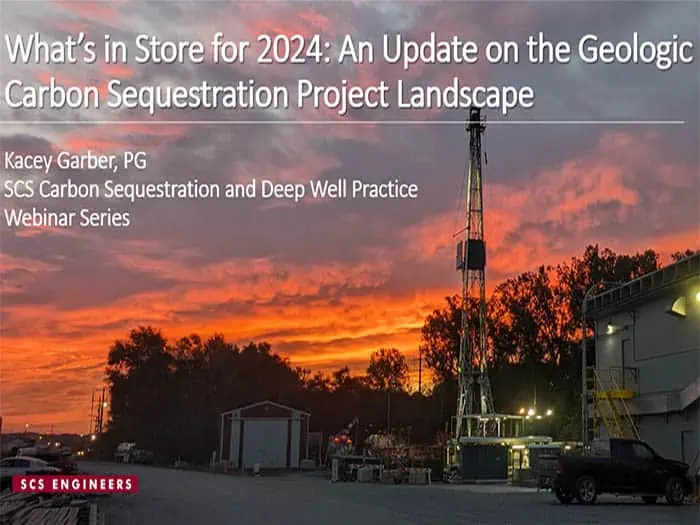
Capturing carbon dioxide and injecting it into a Class VI well for permanent geologic carbon sequestration, or CO2 storage, is a practice that industry leaders use to decarbonize manufacturing processes. Manufacturers use CO2 storage to reduce their greenhouse gas emissions and carbon footprint. There has been an uptick in proposed projects, both commercial hub-scale and single emitter-affiliated scale, particularly within the last year. The catalyst for the uptick in proposed projects is primarily the associated financial incentives, including federal tax credits and grant monies.
In this educational webinar, Professional Geologist Kacey Garber describes what manufacturers interested in geologic CO2 storage can expect the project landscape to look like in 2024. The video includes a discussion of the following:
Understanding the current project landscape and how and when future project opportunities might evolve is important for manufacturers considering the geologic storage of their CO2 stream, whether through a larger commercial hub or a smaller on-site project.
Additional Resources:

About the Presenter: Kacey Garber is a professional geologist experienced as a groundwater project manager for active and closed industrial client sites. Her responsibilities include groundwater monitoring and statistical analyses; reports and permit applications; designing sampling and analysis plans; special groundwater studies; and conducting groundwater well construction planning and design. She has also been involved in PFAS work groups and publishes on the topics of UIC and geologic carbon sequestration.
The U.S. Environmental Protection Agency (EPA) has launched a broad-ranging PFAS Strategic Roadmap aimed at effectively managing Per- and Polyfluoroalkyl Substances (PFAS) in diverse environments, including air, water, soil, and wastewater systems. This roadmap underscores the EPA’s commitment to addressing the challenges posed by PFAS, a group of synthetic chemicals extensively used in various industrial and consumer products for their resistance to heat, water, and oil.
While over 10,000 PFAS variants are known, only a small proportion are currently under regulatory scrutiny, with the number of regulated PFAS varying across countries and regions.
In the United States, the EPA concentrates regulatory and monitoring efforts on a select group of PFAS, primarily due to the scientific complexity of these compounds, analytical limitations, limited toxicity data, and the vast diversity of PFAS chemicals.
This SCS Engineers blog series, Navigating PFAS Compliance, delves into the regulations, management, and monitoring of PFAS at municipal solid waste (MSW) landfills, addressing environmental mediums including air, groundwater, wastewater (i.e., leachate), soil, and waste.
Landfill Regulations and Revisions Anticipated in 2024
Landfills are subject to various regulations, notably under the Resource Conservation and Recovery Act (RCRA) for both hazardous and non-hazardous waste, the Clean Air Act (CAA) for air emissions, and the Clean Water Act (CWA) for water resource protection. The Comprehensive Environmental Response, Compensation, and Liability Act (CERCLA), commonly known as Superfund, also plays a role in addressing contaminated landfill sites, particularly those that pre-date the promulgation of the RCRA Subtitle D program in the early 1990s.
Currently, RCRA does not have specific PFAS regulations for MSW landfills. However, the EPA is developing a rule to classify certain PFAS as “hazardous constituents” under RCRA. We anticipate the proposal in 2024.
Additionally, the EPA has already proposed listing two PFAS constituents – Perfluorooctanoic acid (PFOA) and Perfluorooctanesulfonic acid (PFOS) as hazardous substances under CERCLA, a move that could impact environmental cleanup and liability, particularly for landfills with releases impacting groundwater and adjacent areas. We anticipate the final CERCLA hazardous substances listing in 2024.
The EPA is also revising Effluent Limitation Guidelines to limit PFAS discharges into municipal wastewater treatment facilities. These include amending the Landfills Point Source Category ELGs under Effluent Guidelines Program Plan 15.
While research directly characterizing PFAS in landfill gas is limited, the presence of semi-volatile PFAS in municipal solid waste suggests their occurrence in landfill gas. The EPA is formulating regulations to control PFAS air emissions from multiple sources (e.g., LFG systems), with specific details yet to be fully established.
Federal and State Policies Evolve
The regulatory landscape for PFAS is swiftly evolving, with numerous states setting or updating PFAS standards to address emerging concerns and research findings. States like Alaska, Colorado, Delaware, Florida, Illinois, Indiana, Iowa, Maine, Michigan, Minnesota, Montana, Nevada, North Carolina, Pennsylvania, Rhode Island, Texas, Vermont, and Washington have implemented various PFAS standards.
Managing PFAS in landfills requires a comprehensive approach that includes advanced treatment technologies, compliance with changing regulations, continuous monitoring of the regulatory landscape, and, where necessary, remediation.
This SCS blog series will explore and report PFAS issues across each regulatory category impacting MSW landfills, offering insights into compliance, management, and regulatory aspects. Feel free to contact the authors with questions or comments; we’re here to help.
Additional Resources:
About the Authors: Connect with our authors and experts at
 Jeff Marshall, PE, is a Vice President of SCS Engineers, Environmental Services Practice Leader for SCS offices in the Mid-Atlantic region, and our National Expert on Emerging Contaminants and Innovative Technologies. His four decades of experience include a diversified background in project engineering and management, emphasizing environmental chemistry, hazardous materials, waste and human health risk issues. Focus areas include environmental permitting, regulatory compliance, and hazardous materials treatment and remediation. He is a licensed professional engineer in Virginia, Maryland, West Virginia, North Carolina, and South Carolina.
Corporate Headquarters