See SCS Engineers Waste Management Services
SCS Engineers is a Bronze Sponsor of Air & Waste Management Association’s 117th ACE 2024 Conference, June 24-27, at the Calgary TELUS Convention Centre in Calgary, Alberta, Canada.
The theme is “Emissions Reductions for Sustainable Energy Futures.”
SCS Engineers is hosting two booths at ACE 2024 – so swing by #102 and #104 to talk with our air and waste management experts and see demonstrations of advanced remote monitoring and control (RMC) software! Talk with Pat Sullivan, Mike McLaughlin, Carrie Ridley, Melissa Russo, Ryan Thomas, Ketan Shah, Stephanie Taylor, Evelyn Martinez, and David Greene about how SCS can find solutions for your air and waste management challenges.
Several of our professionals are presenting, including:
The Canadian Prairies region is a fast-growing area with many important exports including oil and gas, agriculture, and timber. In addition, this region spans many latitudes and encompasses many biomes including Grassland, Parkland, Foothills, Boreal Forest, Rocky Mountains, and the Canadian Shield. With this diversity in ecosystems and major exports comes a plethora of challenges. A calculated balance between resource development, social responsibilities, and environmental stewardship is needed; this makes the region a hotspot for emissions reductions and technological innovations.
Calgary is excited to host ACE 2024, bringing industry, academia, and policymakers together so that we can learn, collaborate, and most importantly, improve environmental knowledge and decision-making in this unique landscape which is at the forefront of global change. Alberta’s industries are constantly adapting, creating, and incorporating new technologies for responsible and sustainable development, with a focus on renewable and alternative resources. The global community will find Calgary, Alberta, and Canada a nexus for emerging ideas, innovations, and solutions in the field of environmental stewardship that are applicable worldwide.
Online registration is now open! Click here for more conference details
We hope to see you there!
Waste Management & Research (WM&R) is offering a selection of papers published in WM&R covering a range of relevant state of the art developments in emission reductions. They supplement recent developments with important publications that elaborate on related matters and contribute to making the case for a sound waste management that expressly and substantially supports reduction and control of GHG emissions. We hope that academic researchers and practitioners alike will benefit from this offer.
ABSTRACT: This article reports on how management approaches influence methane emissions from landfills. The project team created various landfill operational scenarios for different regions of the planet with respect to waste composition, organic waste reduction and landfill gas recovery timing. These scenarios were modelled by applying a basic gas generation model according to the United Nations Intergovernmental Panel on Climate Change (IPCC) recommendations. In general, the IPCC’s recommended modelling parameters and default values were used. Based on the modelling undertaken, two options stand out as being the most effective methane mitigation measures in a wide range of conditions throughout the world: (a) early gas recovery and (b) reduction of the amount of biodegradable organic waste accepted in a landfill. It is noted that reduction of organic input to any given landfill can take many years to realize. Moreover, suitable alternative processing or disposal options for the organic waste can be unaffordable for a significant percentage of the planet’s population. Although effective, organic waste reduction cannot therefore be the only landfill methane mitigation measure. Early landfill gas recovery can be very effective by applying basic technologies that can be deployed relatively quickly, and at modest cost. Policymakers and regulators from around the globe can significantly reduce adverse environmental impacts from landfill gas emissions by stimulating both the early capture and flaring and/or energy recovery of landfill gas and programs to reduce the inflow of organic waste into landfills. [CIT]
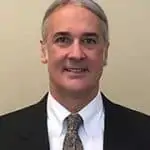 Meet Co-Author Bob Dick: Bob is a Senior Vice President and the Business Unit Director of SCS Engineer’s Mid-Atlantic operations, stretching from Maine to South Carolina. He is also one of our National Experts on Elevated Temperature Landfills. He has over three decades of experience on civil and environmental engineering projects related to solid waste management, and has performed landfill and landfill gas engineering projects (design, permitting, construction, and operations) in more than 15 states and several foreign countries. He is a licensed Professional Engineer in Virginia and North Carolina, a Board Certified Environmental Engineer (BCEE), and a member of the American Academy of Environmental Engineers and Scientists.
Bob has also directed and completed numerous project assignments related to solid waste planning and facility projects which have involved residential and commercial collection and recycling programs, as well as convenience centers, composting facilities, and material recovery facility design, permitting, construction, and operations consulting. He has authored several publications and made numerous presentations on air quality, solid waste management, landfill engineering and LFG management/control, design/operations, GHG emissions, composting, and regulatory compliance.
David Hostetter from SCS Engineers and Dennis Siegel from WM (Waste Management) join Inductive Automation to talk about the unique processes and challenges within the waste management industry, from residential to the engineering and life cycles of landfills. They discuss how operational improvements in this essential service and its environmental footprint are making the industry more sustainable. They dive into the 24/7 maintenance and monitoring of landfills, adjusting to changing conditions in real-time, reducing cost, generating renewable energy, improving the health and safety of operators, and being proactive in a changing world. These landfill systems, such as WM’s Connected Landfills are improving connectivity, mobility, and visualization by using data science to facilitate better decisions.
Visit the SCS RMC site. Learn more about Sustainability in Waste Management.
Recently the state of Wisconsin released its updated 2020-2021 statewide waste characterization study. The study found that the broad organics category, including yard waste and diapers, accounted for about 1.3 million tons. An estimated 924,900 tons of paper, including cardboard, compostable and office paper, comprised about 21 percent of the landfills’ tonnage. That was followed by plastic at about 17 percent or 745,600 tons.
You can read the study, but why do local governments, states, and waste management businesses request these studies? Because waste and landfills are expensive to manage. Diverting waste from landfills cuts greenhouse gases and supplies materials for reuse as new products or compost – a more sustainable system.
Waste characterization information is designed for solid waste planning; however, anyone interested in the characteristics of the solid waste stream may find it useful. Studies can also target specific waste or needs such as construction and demolition waste and business waste generators. A generator means a person, specific location, or business that creates waste.
These studies help start answering questions such as:
States, jurisdictions, citizens, and businesses can use this information as a planning tool to help meet state mandates and their goals to reduce waste and achieve the benefits of sustainable practices. Kudos to Wisconsin, Iowa, and California, several of the many states moving toward more circular waste management!
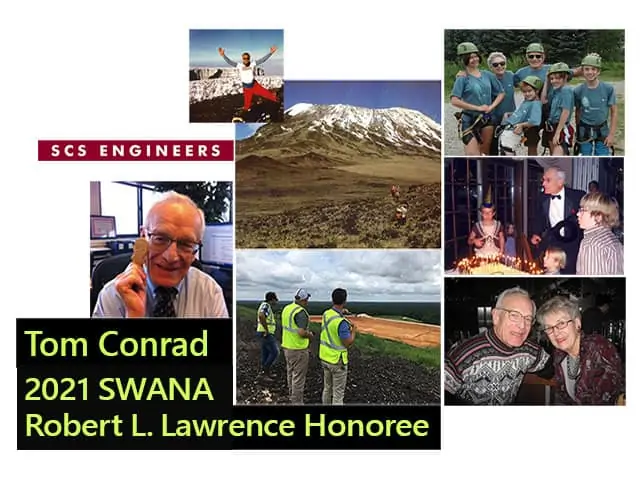
The International Awards Committee and Solid Waste Association of North America (SWANA) Board of Directors unanimously voted to honor Tom Conrad, the “C” in SCS, with the Robert L. Lawrence Distinguished Service Award at WASTECON 2021 in November. The Lawrence award is the highest accolade SWANA bestows on a member of the waste management industry, reserved for those making meaningful and lasting contributions.
“I’m honored and humbled to be selected for the Robert L. Lawrence Award. I thank you and am especially thankful for what SWANA and SCS are today,” stated Tom Conrad.
SWANA recognizes Conrad for over 60 years of significant influence on the waste management and environmental services industry. Conrad, a Founder, Executive Vice President, and Director Emeritus of SCS Engineers, dedicated his career to advancing solid waste management, most notably through the founding of SCS Engineers (Stearns, Conrad, and Schmidt Consulting Engineers) more than 51 years ago.
Tom Conrad worked on a wide range of environmental engineering projects touching almost every aspect of solid waste management throughout his career. As an environmental engineering firm and consultant to the newly created US Environment Protection Agency (EPA), the founders recognized that responsible solid waste management was increasingly important for protecting the environment and the health and safety of the general public.
Leading SCS, he helped the EPA develop the first federal regulations for sanitary landfills, managing and capturing landfill gas, waste sorting protocols, sludge management, and land remediation.
Environmental services, including wastewater management, were always a significant part of SCS services and the waste industry. When new regulatory policies began expanding in the ’80s, SCS’s techniques, technology, and expertise helped a broad range of industries comply with environmental needs and continues today with the firm’s greenhouse gas, landfill technology, renewable energy, remediation, and sustainable materials management programs.
Conrad is also known for hiring and mentoring today’s SCS leaders, many of whom are SWANA leaders, by creating and fostering SCS’s culture encouraging employee participation in industry associations, community, and SCS’s mentorship and leadership programs.
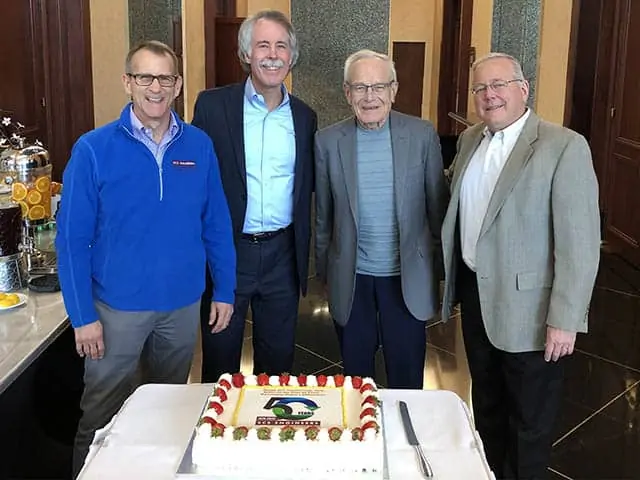
Before his retirement in 2016, Conrad held professional engineering licenses in 24 states. He was a member of SWANA, the American Society of Civil Engineers, the National Waste and Recycling Association, and the Society of American Military Engineers.
He maintains his “work hard – play hard” lifestyle. He is active at SCS, participating in Board of Director meetings and speaking at the Young Professionals Group events and celebrations. While no longer mountain climbing and biking cross-country, he has a vigorous walking, swimming, and biking schedule.
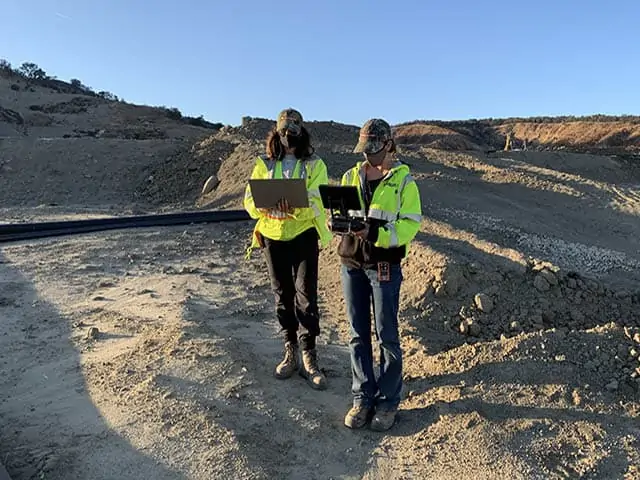
In her first job at SCS Engineers, Joy Stephens worked in a small trailer, consolidating and analyzing data from landfill field techs’ notes, recorded in logbooks they lugged around while navigating the challenging site terrain, then brought to her covered in leachate and mud.
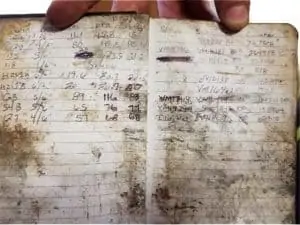
She cross-referenced their detailed, handwritten records with a master list posted on a wall, organized, and methodically examined them. Then she turned them into actionable intel for SCS’s engineers and scientists.
“That was definitely easier said than done. It was a lot of work – a lot of hours to make sure that we were ready for the next day. It struck me that there’s got to be a better way. That we could make collecting and using this valuable information easier for the field staff and OM&M (Operations, Monitoring & Maintenance),” she says.
GIS Supports Wellfield Operations
From that inspiration came a lot of brainstorming, developing, and tweaking what today is a powerful yet user-friendly GIS system that stores and organizes volumes of geographical information in one place and gives users what they need fast to troubleshoot landfill conditions. The customizable application is now used at hundreds of landfills across the country, mainly to support wellfield operations, though it has other landfill system applications.
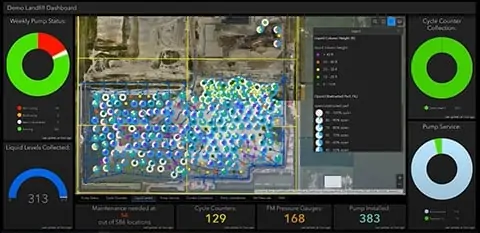
Field techs enter information onto digital forms using a mobile app and submit the data, uploading it to the cloud. OM&M teams have it in a streamlined format in a couple of minutes and can visualize what they are looking for on maps from a dashboard.
The technology that Stephens was an integral player in launching continues to evolve, and there’s a story behind that evolution.
“In the beginning, I reached out to this brilliant young lady, Brooke Aumann, from the Tampa office, who does a lot of GIS work. I had some GIS experience myself, but more landfill knowledge. I picked her brain so we could set up a digital replacement for the logbooks that zeroed in on exactly what the field techs and project managers needed to support our clients,” says Stephens, an environmental scientist.
Together, the two women created experimental web maps to plot and visualize basic information such as the location of each monitoring point, points requiring the collection of liquid levels, and the status of maintenance tasks at each well. Then they developed digital survey forms with more detailed information and connected those forms to the maps; this enabled end-users to overlay even more data for a holistic snapshot of what goes on at wellfields.
“We tried different configurations of web maps and symbology to depict best what we wanted to convey. We talked about what we needed to symbolize and how we needed to symbolize it. And we discussed possibilities for future developments. We knew much more was possible in terms of what we could collect, how all of these data are connected, and how we could exploit the software to better tackle more complex tasks,” Stephens says.
From maps to interfacing data forms to the next level X-ray vision
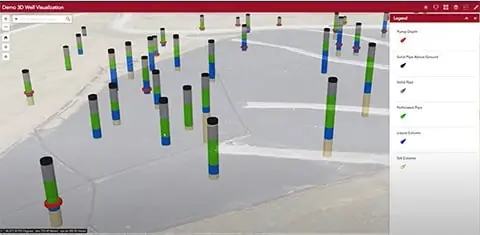
“Now we’ve gone a step further. We’re doing 3D well visualizations, which give a kind of Superman X-ray vision subsurface. You are literally looking beneath to the well to get good intel,” Stephens says.
Traversing the World
With undergraduate degrees in Mandarin Chinese and geology and graduate degrees in teaching science and environmental management, Stephens has long loved learning, the environment, and nature.
“When I was young, my parents were missionaries, and I grew up in the most beautiful, pristine, remote areas, like the Solomon Islands and Vanuatu – so unspoiled and lovely.”
It was a sharp contrast to what she would see later when she moved with her young son to China, where she taught math and science. The air quality was poor, and the streets and landscape were inundated with litter.
That experience was the final push that landed the young professional at the foot of a career path she’d considered for some time; environmental sciences. She’d taught it before, but a voice inside her was telling her to pivot and actually start doing the work.
Stephens found her way into a program at a university in Scotland after researching graduate environmental management programs worldwide. At this prestigious learning institution, she first worked with remote sensors and GIS, identifying and addressing “waste crimes,” namely illegal dumping.
Seizing the opportunity to apply her expertise
After graduation, the teacher-turned-scientist took her education and experience back to the United States and SCS Engineers. The company was not foreign to her. By the time she applied, she had made as much a project of vetting employers as she had of scoping out universities. Two draws drew her attention:
“There is the ethos; SCS is genuinely committed to the environment. And the other part that was important to me is SCS is very invested in professional growth and training to foster that growth. I believed that I would have opportunities to move up,” Stephens reflects, recalling when she said yes to the first job working with those logbooks that would be the catalyst to what was to come.
When she came on board, she had to gain practical experience in the solid waste industry and learn the ropes in the field, in addition to her prior experience in renewable energy. In time she had learned her way around landfill gas collection wells, then kept building on that knowledge.
“I asked a ton of questions. Why are we monitoring for this? What constitutes good gas quality? Why is it important to know liquid levels? What is the difference between vacuum and flow? I think asking all these questions, collecting field data myself, and watching what the guys in the field had to do, gave me a good base understanding to help inform how we would capture the right information using GIS. It was a collaborative effort. Brooke worked on many landfill projects and my colleague, Chris Carver, had 16 years of field and project management work. It all came together.”
She later joined the RMC team (Remote Monitoring and Controls), where she received further training in GIS and mastered other skill sets. Today she is a project professional specializing in GIS and drone services.
At home with waste management
The hybrid techie-artist in Stephens comes out when she makes an analogy that tells a little of how her wheels turn.
She grew up playing Legos and now, at almost 40 years old, still builds with them at home with her son.
She approaches the job the same way as when she assembles those sets.
“You know the pieces fit to make something, but it takes creativity to figure out just how to build it and make it as visually pleasing and functional as you can, or to get it to function in different ways. I try to configure and piece together for the best possible design,” she says.
Stephens has married that approach with a desire to be a part of both restoring and protecting the environment. She thinks she’s in the right place to act on that intention.
“I feel like work with waste management and SCS is a way to achieve what I think is so important. We are trying to protect, remediate, and leave conditions better than we found them. That is what being a good steward is all about.”
See Joy Stephens at work in her recent educational presentation for landfill owners and operators. Joy demonstrates technologies to reduce the time to collect, process, and show data.
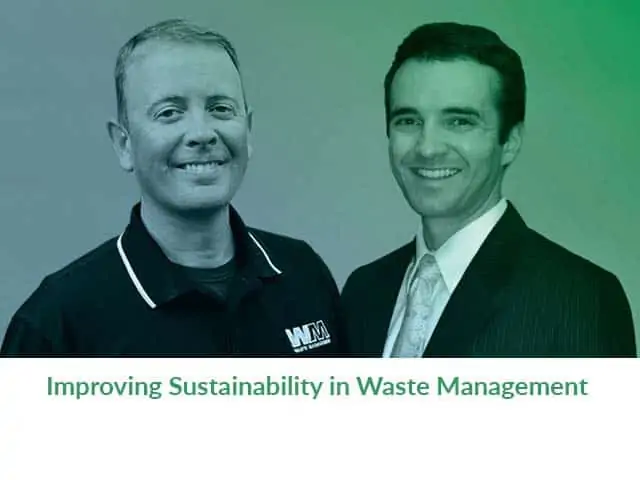 David Hostetter from SCS Engineers® and Dennis Siegel from Waste Management® are the feature speakers on Inductive Conversations, a podcast about the unique processes and challenges within the waste management industry, from residential to the engineering and life cycles of landfills.
Dave and Dennis discuss how operational improvements are being made in this essential service and its environmental footprint. They dive into the 24/7 maintenance and monitoring of landfills, adjusting to changing conditions in real-time, reducing cost, generating renewable energy, improving the health and safety of operators, and being proactive in a changing world. We also hear about an Ignition-based solution called Connected Landfills that improves connectivity, mobility, and visualization by using data science to facilitate better decisions.
Apple Podcasts | Spotify | Google Play | PodBean | TuneIn
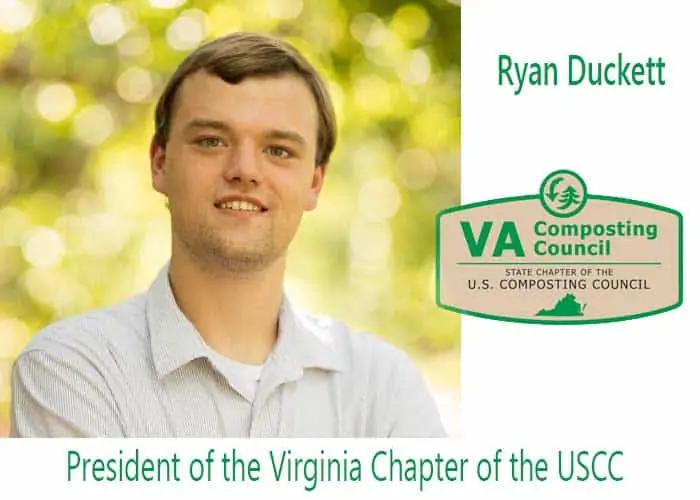
The Virginia Composting Council is the state affiliate of the US Composting Council; its mission is to support the efforts and initiatives of the USCC and bring the practice of composting to more Virginians. The Composting Council is growing because of increased efforts by communities to divert food waste from disposal. Demand is growing with increased awareness of composting’s beneficial uses.
The Virginia Council, led by President Ryan Duckett of SCS Engineers, cites the obvious benefits of less waste going to landfills and lower greenhouse gas emissions in the environment. He also points out the jobs and business development potential and using compost for stormwater management, erosion control, and other green infrastructure as benefits. Expanded programs also offer the opportunity to collect edible foods for non-profits feeding many in need while diverting non-edible organics to composting.
The Council brings together manufacturers, municipal managers, organics collectors, researchers, and other compost allies in the waste industry. The group works to educate state regulators, local officials, and the public about composting’s value in a circular system. Members also help develop positions on regulations and legislation that affect composting and the market.
USCC has 13 state chapters that do local work to advance the composting industry alongside the national advocacy and programs. Without their on-the-ground education, attention to and work in regulations and legislation, and building networks of people in the industry, USCC could not be effective.
Both associations are providing guidance, as many waste management activities must continue. SCS is following association advice, state protocols, and our clients’ recommendations in our own procedures as we continue to perform essential work. We share the SWANA resources and recommendations here and thank them for their dedication. SCS employees should use SCS resources available on the SCS intranet and through our Health & Safety protocol, which reflect the safety precautions advised here.
Reprinted Letter to SWANA Members dated March 23, 2020
As communities and companies throughout the United States and Canada respond to the Coronavirus pandemic, SWANA will continue to provide assistance to its members and the waste industry.
A growing number of states and localities are issuing orders identifying certain industries as “essential” during the pandemic, and these orders typically include the solid waste industry and other categories of employees who may be SWANA members. In those locations, employees and contractors may need to demonstrate proof to law enforcement personnel or others that they work in an essential industry. See this template letter that employers can customize to their needs and provide to employees and contractors. The letter should be on agency/company letterhead and include a contact person and a telephone number to call. The contact person should be familiar with the applicable emergency declarations.
Employees and contractors should carry the customized letter with them at all times, and particularly when they are going to or from work. Several waste industry employees in California in their personal vehicles were stopped on their way to work by law enforcement personnel late last week, but fortunately, their employer had created a letter similar to the attached and the employees were able to show that letter and proceed to their places of employment.
This letter is intended to allow workers to demonstrate that they work in a job category identified as an essential service, including solid waste and recycling operations. It should not be used for any other purpose or by employees that are not actively supporting these operations.
In addition, attached is a notification document for solid waste employers and others to place in their work vehicles to demonstrate they are covered by recent emergency order guidance. It cites the Department of Homeland Security’s Cybersecurity & Infrastructure Security Agency, March 19, 2020 memo that identifies workers engaged in the removal, storage, and disposal of residential and commercial solid waste and hazardous waste as essential infrastructure workers.
Please do not hesitate to contact Jesse Maxwell at or me at if you have any questions about this letter, or need assistance responding to the Coronavirus pandemic. Please stay safe and healthy.
NWRA resources are plentiful and include these:
COVID-19 WORK PRACTICES At this time CDC and OSHA are not issuing waste and recycling specific guidelines for the handling of waste and recycling materials related to COVID 19. If this changes, NWRA will alert its members. Use this industry guidance.
COVID-19 RESOURCES Resources and information provided by agencies and organizations.
Thank you!
This week the solid waste industry is celebrating 25 years of valuable research, inspiration, and support of solid waste professionals provided by the Environmental Research & Education Foundation. On Tuesday, industry leaders met to recognize EREF’s impact on the solid waste industry and acknowledge the role stakeholders play supporting the Foundation and sharing the resulting research.
EREF is a trusted source of data-driven, empirical science for the betterment of solid waste management and policy informing industry, federal and state agencies, academics, and the public. The foundation is also a resource for students and young professionals in the solid waste industry, by providing scholarships, internships, and MSW eTextbook programs. These programs inspire young professionals and ultimately add to EREF’s research and the industry as a whole.
EREF receives funding and participation from companies such as SCS Engineers to continue new research and scholarship programs such as the Robert P. Stearns Master’s Scholarship. The foundation is remarkably successful in producing unbiased reports, which translate ideas and data into action for sustainable waste management practices.
Thank you and congratulations from your colleagues at SCS Engineers for 25 years of scientific research and educational initiatives for the benefit of our industry and the communities we serve.
Corporate Headquarters