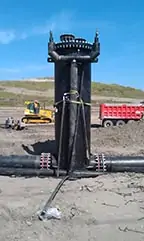
 Lessons learned from previously constructed gas collection and control systems teach solid waste professionals valuable lessons about designing for long-term survivability and reducing the maintenance cost of gas system components. The location impacts operating and maintenance costs for various components of gas collection and control systems such as condensate force main, condensate sumps, force main for well liquids, air lines to pumps in gas wells, and gas headers long into the future. As often as possible, design the gas header in the landfill perimeter berm along with the condensate sumps. Landfill perimeter berms constructed in an engineered manner with well- compacted soils and a well-defined geometry provide a long-term cost-effective alternative to earlier designs outside the berm.
For many years, gas headers were designed and constructed outside of the landfill perimeter berm, on the landfill surface. Of course, landfill surface changes as waste elevation increases over time, resulting in many gas headers that now may be 30 feet or more below the current waste surface. Deeply buried gas headers are unreliable at best, and the operator loses access to them as soon as 20 feet of waste covers the header.
Collapsed gas headers buried deep in waste are an expensive challenge when operating a large number of gas wells connected to the gas header, and could cause serious compliance issues. Upon discovery of a collapsed buried gas header, installing a new header is a lengthy process with significant costs, not to mention the hurdles the operator will have to jump addressing noncompliance with their state agency.
The benefits of placing gas headers in the landfill perimeter are:
Since the condensate force main follows the gas header in the perimeter berm to flow to a tank or discharge point, there are additional maintenance benefits.
By continuing to design gas header construction on landfill slopes, all of the components end up on the landfill slope as well. You can imagine what type of complications the landfill operator will face since all of these components are in areas vulnerable to erosion, settlement, future filling or future construction. Additionally, any maintenance requiring digging and re-piping necessitates placing equipment on the landfill slope and disturbing the landfill slope surface for an extended period.
For more information about these benefits and more, please refer to the MSW Magazine article series Considerations for the Piping Network, the author, or contact SCS Engineers at .
 About the Author: Ali Khatami, Ph.D., PE, LEP, CGC, is a Project Director and a Vice President of SCS Engineers. He is also our National Expert for Landfill Design and Construction Quality Assurance. He has nearly 40 years of research and professional experience in mechanical, structural, and civil engineering.
Learn more at Landfill Engineering
REPRINT OF USEPA PRESS RELEASE
WASHINGTON (Dec. 3, 2019) — Today, the U.S. Environmental Protection Agency (EPA) is announcing several actions to clarify and improve New Source Review (NSR) permitting requirements. These Clean Air Act actions are part of a suite of measures EPA is taking to modernize and streamline the NSR process, without impeding the Agency’s ongoing efforts to maintain and enhance the nation’s air quality. These actions will improve regulatory certainty and remove unnecessary obstacles to projects aiming to improve the reliability, efficiency, and safety of facilities while maintaining air quality standards.
“NSR reforms are a key component of President Trump’s agenda to revitalize American manufacturing and grow our economy while continuing to protect and improve the environment,” said EPA Administrator Andrew Wheeler. “NSR regularly discouraged companies from investing in and deploying the cleanest and most efficient technologies. Through the Trump Administration’s efforts, EPA is providing clarity to permitting requirements, improving the overall process, and incentivizing investments in the latest energy technologies.”
“For too long, New Source Review permitting requirements stifled job creation, hampered innovation and slowed the ability to modernize critical energy infrastructure. Worse, in previous administrations, the permits were weaponized, so liberal activists could delay key projects,” said U.S. Senator Jim Inhofe (OK). “New Source Review hasn’t been updated in over four decades—making it hard to integrate new technologies into our energy infrastructure. I’ve worked for years to modernize the review process, and applaud today’s action by President Trump and Administrator Wheeler to streamline the NSR permitting process.”
“One of my consistent frustrations with New Source Review is what seems to be a perverse incentive away from innovation. Thank you to Administrator Wheeler and the Trump Administration for recognizing this and finalizing these positive reforms,” said U.S. Senator Kevin Cramer (ND). “The EPA’s actions provide certainty while restoring the proper scope of the Clean Air Act.”
“I applaud the EPA for taking further steps to reform the New Source Review permitting program. NSR’s burdensome process can impede upgrades that would actually increase efficiency and improve air quality. The EPA is moving toward a better NSR program that streamlines the process without sacrificing environmental protections,” said U.S. Representative Morgan Griffith (VA-09).
“I applaud Administrator Wheeler for implementing a strong regulatory reform agenda at the EPA. Today’s actions are a solid first step in the right direction to reform the NSR permitting program. I look forward to continue working with the Trump Administration to further reform NSR and allow America’s industry to make their units more reliable and efficient, while maintaining strong environmental standards,” said U.S. Representative Andy Biggs (AZ-05).
“President Donald Trump continues to deliver on his promise to cut burdensome regulations that strangle American manufacturing and energy development. These improvements to the New Source Review (NSR) permitting requirements will protect our air quality, while incentivizing businesses to grow and expand. I look forward to continuing to work with President Trump and Administrator Wheeler to cut needless regulations and create American jobs,” said U.S. Representative Alex X. Mooney (WV-02).
“This Administration is clearing the path for manufacturers to invest in more energy efficient technologies that conserve energy, reduce emissions, and keep U.S. manufacturers competitive,” said Portland Cement Association President and CEO Mike Ireland. “For energy-intensive industries like cement, strategic investment in energy efficiency and emissions reduction are key components of any long-term climate and sustainability strategy, and EPA’s New Source Review reforms announced today help unlock new opportunities for sustainable operation.”
Final Guidance: Revised Policy on Exclusions from “Ambient Air”
After considering public comments, EPA is issuing final guidance, identifying the sort of measures which EPA may take account of in determining whether a source owner or operator has precluded the general public from having access to its property. Where access is precluded, the portion of the atmosphere above that property is not considered “ambient air” for the purpose of conducting air quality analyses under the Clean Air Act. The guidance updates EPA’s policy to recognize that a variety of measures may be considered effective in keeping the public off a source owner/operator’s property. These measures, which account for advances in surveillance and monitoring, depend on site-specific circumstances and continue to include, but are now not solely limited to, fences or other physical barriers. State, local and tribal permitting authorities have the discretion to apply this guidance on a case-by-case basis. The regulatory definition of “ambient air,” as stated in 40 CFR § 50.1(e) to mean “that portion of the atmosphere, external to buildings, to which the general public has access,” remains unchanged.
Final Guidance: Interpreting “Adjacent” for New Source Review and Title V Source Determinations in All Industries other than Oil and Gas
EPA has also recently issued a final guidance that revises the agency’s interpretation of when multiple air pollution-emitting activities are located on sufficiently “adjacent” properties to one another that they should be considered a single source for the purposes of permitting. To determine what activities comprise a single source under the NSR and Title V air permitting programs, three factors must be satisfied: the activities must be under common control; they must be located on contiguous or adjacent properties; and they must fall under the same major group standard industrial classification (SIC) code. In this guidance, for all industries other than oil and natural gas production and processing for which there is a separate set of rules and to which this guidance does not apply, EPA adopts an interpretation of “adjacent” that is based on physical proximity only. The concept of “functional interrelatedness” would not be considered by EPA when determining whether activities are located on adjacent properties. This interpretation should help clarify and streamline the permitting process.
Additional NSR Proposals
EPA also recently issued a proposal to address minor errors that have accumulated over time in four NSR regulations. While these minor errors, such as outdated cross references and typographical errors, have not materially impeded the effective operation of the NSR program, EPA believes that it is important to remove such errors from the regulations in order to provide regulatory certainty and clarity. The proposed corrections are all considered to be non-substantive and are intended to provide clarity and precision to the NSR regulations without altering any NSR policy or changing the NSR program as a whole.
EPA is also proposing to remove from the NSR regulations various provisions, such as certain “grandfathering” provisions, that, with the passage of time, no longer serve any practical function or purpose. EPA will be taking comment on this proposal, which will be published in the Federal Register.
More information on these actions and other NSR improvements are available at: https://www.epa.gov/nsr
Coming Soon: Revisions to Petition Provisions of Title V Permitting Program
EPA is currently working to take final action on a 2016 proposal for revisions to the title V regulations. This proposal would streamline and clarify processes related to the submittal and review of title V petitions.
The proposed rule would bring more certainty for all stakeholders, including the sources required to obtain and maintain title V permits; more focused petitions; better title V permit records which are expected to result in fewer petitions; and reduced administrative burden in the EPA’s review of petitions in a tight timeframe.
Background
Congress established New Source Review as a preconstruction permitting program in the 1977 Clean Air Act Amendments. The program intended to ensure the maintenance of air quality standards around the country and that state of the art technology is installed at new plants or existing plants undergoing major modifications.
Under the NSR program, before constructing a new stationary emission source or major modification of an existing source, the source operator must determine whether the new source will emit or the project will increase air emissions above certain thresholds. If so, the operator may need to get a permit from a state government or EPA that may require installation of pollution control technology or other measures.
Contract your SCS project manager, or if you have questions about the impact of these recent actions.
Before the Court: EPA admits that it has failed to meet its nondiscretionary obligations to implement the Landfill Emissions Guidelines, as compelled by the CAA. The only questions before the Court were whether the Plaintiffs have standing and, if so, how long to give EPA to comply with its overdue nondiscretionary duties under the Landfill Emissions Guidelines. The Plaintiffs are the States of Illinois, Maryland, New Mexico, Oregon, Rhode Island, California, Vermont, and the Commonwealth of Pennsylvania.
Ruling: Plaintiffs have standing, and the EPA must approve existing submitted plans by September 6 and issue the federal plan by November 6.
Impact on Landfill Owners/Operators: This will create some confusion, as landfills will be working on getting revised rules in place while at the same time start complying with the old EG rule. We are already doing that with XXX sites, but this ruling adds complexity. If EPA keeps to the schedule and we have final approved revised rules by March 2020, landfills won’t have to do as much under the old rules before new ones take effect.
Contact your SCS Project Manager for more information, email us at , or follow SCS on your preferred social media.
To generate a return on investment of site-specific GCCS, you need OMM staff who understand the strengths and weaknesses of your site. From that understanding, successful OMM teams and facility owners can design, perform, and fine-tune their program.
SCS’s BMP’s uses a “beyond the compliance OMM model” because the practice leads to strengthening relationships with regulatory agencies and LFG energy providers. Our clients expect to move toward a field optimization program when both OMM procedures and regulatory requirements are fine-tuned to work in concert. That investment pays dividends by increasing compliance and improving gas recovery. When developed OMM principles are defined clearly, and evolved along with GCCS design and construction, teams rise to the challenge, and the reward is a consistent track record of excellent GCCS operation.
Part 1 of the series discusses design considerations for landfill gas collection and control systems (GCCS); Part 2 takes into account construction quality assurance (CQA) measures during construction of GCCS; and Part 3 covers BMP’s for GCCS Operation, Monitoring, and Maintenance (OMM) in the September/October issue of MSW Magazine. The SCS Team covers:
A look at the confusion stemming from regulatory uncertainty of new rules limiting air emissions from municipal solid waste landfills by David Greene, P.E., SCS Engineers – Asheville, NC.
The landfill industry continues to work with EPA Administration to get a longer-term stay to work out needed NSPS/EG rule changes. At this time, industry representatives are hopeful both these related goals can be achieved.
While the new NSPS/EG rules became effective back in 2016, the concerns with the rules raised at the time still remain unresolved. Despite this, we can expect resolution though it may take some time to fix. The fog should be lifting, yielding changes that are expected to be more workable for both the landfill industry and state/local regulators. In the meantime, stay tuned and stay informed.
Read the full article with links to the NSPS/EG update in a recently published SCS Technical Bulletin.
SCS Engineers periodically prepares Technical Bulletins to highlight items of interest to our clients and friends who have signed up to receive them. Our most recent SCS Bulletin summarizes the new rules which took effect on October 28, 2016, with compliance obligations under the NSPS Subpart XXX rule beginning November 28, 2016. Originally, states and local air jurisdictions were to submit their proposed EG rules by May 30, 2017; however, there have been some delays in this process, which we condense and detail in this Bulletin. SCS will continually update coverage of this Rule on our website.
We continue SCS’s Advice from the Field blog series with guidance from an article in MSW Magazine by Daniel R. Cooper, Jason Timmons, and Stephanie Liptak.
The authors of a recent article in MSW Management Magazine present engineering ideas that provide for more efficient construction of a GCCS. Gas system operators will benefit by having fewer pumps to operate and maintain and shallower headers that are more easily accessible. Odor management will be easier along with other benefits.
Read the full article here to learn about the design elements for maximizing long-term benefits, impacting: bottom liners, location of the blower/flare station, leachate risers, extraction well targets, and external header piping.
Temporary Landfill Caps
Temporarily capping landfill slopes is becoming a common measure for landfill operators. There are many benefits to closing landfill slopes with geomembrane on a temporary basis. One of the benefits is delaying construction of the final cover. Following is a discussion of the steps that should be taken to determine whether temporarily capping the slope with geomembrane and postponing the final cover construction is a better financial/operational decision.
Cost Burden
Constructing the final cover is costly, and it is considered an unavoidable expense that has no return on the money spent. Therefore, some operators perform a financial evaluation to determine whether the final cover construction costs can be delayed (provided, of course, that such delays are acceptable to the regulating agency). When evaluating whether to delay the final cover, the cost of maintaining the slopes during the postponement period should be considered. The operator must look at the financial aspects of either closing the slopes with a temporary geomembrane or of leaving the slopes open during the postponement period.
Temporary Landfill Capping Option
The benefits of temporarily capping the slopes during the postponement period may include:
The other side of the coin is the expense associated with the temporary cap. There may be repair costs associated with the geomembrane every few years in order to ensure that the temporary cap remains intact.
Leaving Slopes Open Option
The option of leaving the slopes open during the postponement period involves maintenance expenses such as:
The benefits of leaving the slopes open are twofold: first, the operator will save the costs of constructing the temporary cap; and second, the operator will gain additional airspace as waste settles during the postponement period.
Experience with the Temporary Capping Option
As discussed above, both options provide the benefit of gaining additional airspace during the postponement period. Constructing a temporary cap involves the costs of materials and installation, including the geomembrane and the ballasting system that keeps the geomembrane in place. Generally, the financial and non-tangible benefits of a temporary cap that remains in place five years or longer are more attractive than leaving the slopes open; therefore, most operators choose to install a temporary cap. The next step in the financial evaluation should be comparing the costs of the temporary cap to permanently closing the slopes without postponement.
Final Step in the Financial Evaluation
The next question is whether it makes financial sense to postpone the construction of the final cover.
Waste settlement during the postponement period and the resulting airspace are considered the determining financial factor in choosing the right option. If the present worth value of the airspace generated from waste settlement during the postponement period is greater than the cost to construct the temporary cap at the present time, then the temporary cap option would make financial sense; otherwise, the final cover should be constructed without postponement.
It should be noted that the length of the postponement period plays a very important role in this financial equation. Longer postponement periods have the potential for a greater gain in airspace. Another incentive that should be factored into the financial evaluation is the potential return on the money set aside for the final cover construction during the postponement period.
To assist with this financial evaluation, landfill operators are encouraged to discuss these options with their landfill engineers. Settlement models can be performed to calculate the amount of airspace that may be generated during the postponement period as well as the present worth value of the generated airspace. The returns on the final cover construction costs during the postponement will just be “icing on the cake.”
Read the related Advice From the Field blogs from the landfill and LFG experts at SCS Engineers:
Contact the author: Ali Khatami or your local SCS Engineers’ office.
Getting a firm handle on a solid waste operation and expenses is a challenge for any solid waste agency manager or landfill operator. It is particularly imperative in this era of “lean and mean” budgets and looming regulatory policy. Doing more with less is the watchword for most operations across the country still reeling from the financial impacts of the Great Recession.
SCS Engineers has created a package of articles to help you identify if your landfill, landfill gas, or solid waste operation is ready for 2017. We hope this useful guidance will help you plan for the upcoming year. SCS professionals are always available to answer questions and provide advice. Find the office or SCS professional nearest to you by clicking on one the links here: Offices and Professionals.
Download, print or share this package by using the download button under the articles or by using the navigation at left. The package includes the following information written by SCS National Experts:
Article in Waste360: explains who’s impacted and how to begin managing the costs.
SCS Technical Bulletin: a digest of hundreds of EPA regulatory policy into the information and timelines to act on now.
Article: strategic financial planning to support infrastructure costs.
Call our compliance specialists – find the office nearest you or email us at
Corporate Headquarters