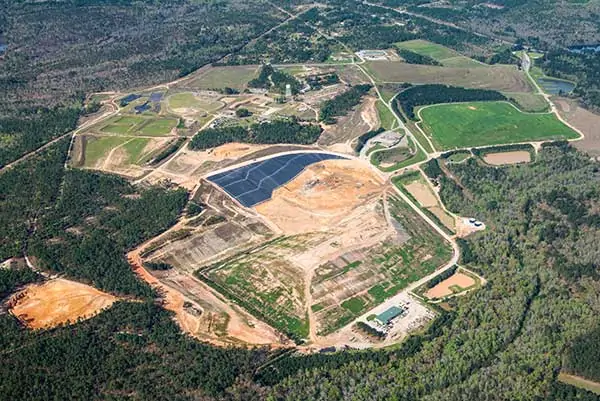
SCS Engineers now provides the Augusta Environmental Services Department with engineering, environmental and testing, and Construction Management & Quality Assurance Services at the Deans Bridge Road Landfill, in Blythe, Georgia. The facility operates under the State of Georgia Environmental Protection Division as a Subtitle D Landfill, accepting up to 1,500 tons per day of waste. Active and closed sections of the landfill comprise approximately 1,177 acres of property. Some additional acreage contains ancillary facilities such as office and maintenance buildings, customer drop off area, sediment ponds, roads, and leachate holding facilities. The Augusta Department of Environmental Services is responsible for the landfill facilities, solid waste management planning for Augusta, and all residential solid waste collections. Additionally, the Department is responsible for the Augusta Brownfield program and other environmental compliance issues.
Landfills are carefully engineered facilities closely regulated and monitored to ensure they have the protections necessary to prevent contamination of groundwater, air, and adjoining land. Best landfill management practices include collecting and treating leachate – the water that passes through a landfill. The methane gas naturally produced from decomposing landfill waste is collected and converted into various forms of energy – including compressed natural gas. This alternative fuel powers Augusta Solid Waste trucks or is a substitute for pipeline natural gas.
The Department consolidated all landfill services assigning them to SCS Engineers, a professional environmental consulting firm with over 50 years of experience in performing landfill site acceptability studies, landfill design services, landfill environmental compliance activities. The firm was already engaged in the Landfill’s Gas Collection and Control System (GCCS) expansion. The consolidation of services provides a more cost-effective approach for permitting, design, operations, monitoring, and maintenance. The comprehensive SCS team is a uniquely qualified and experienced full-service consulting and engineering team with demonstrated relevant field experience in Georgia. Leading the team is Sowmya Bulusu, a Georgia Professional Engineer, with over 12 years of landfill engineering performed in accordance with the Environmental Protection Division (EPD) of the Georgia Department of Natural Resources, the Georgia Solid waste management Act, and other applicable federal, state, and local rules and regulations. As the Project Director, Carlo Lebron is a registered Georgia Professional Engineer for 15 years bringing over 21 years of experience on over one hundred solid waste projects.
“The SCS team brought the five-year permit review submittal package in early, giving Georgia’s Environmental Protection Division plenty of time to deem it administratively complete,” stated Sowmya Bulusu. “Working with our field technicians, we quickly identified and brought at-risk gas wells into compliance, used our drones to provide an aerial survey of the entire landfill, saving Department funds.”
SCS Engineers’ environmental solutions directly result from our experience and dedication to solid waste management and other industries responsible for safeguarding the environment. Click for more information about comprehensive landfill services.
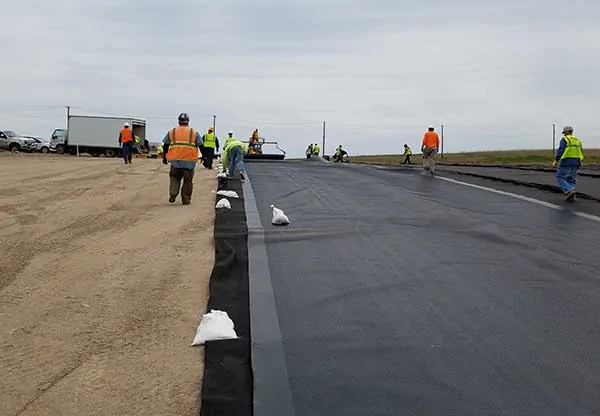
From SWANA’s Executive Summary
A new report developed by the SWANA Applied Research Foundation (ARF) addresses two important questions associated with municipal solid waste (MSW) at landfills.
What tasks will be required to manage closed landfills following the post-closure care period to ensure continued protection of public health and the environment?
How will those associated costs be paid for?
Subtitle D regulations require that the post-closure care period is maintained and the environmental protection systems are managed and monitored—it should be 30 years in length, but the period is determined by the state regulatory agency that issued the landfill permit. Once the post-closure period ends, the closed landfill enters into a new status, which SWANA defines as the “Long-Term Management,” or LTM period. EPA’s Subtitle D regulations don’t address monitoring and maintenance activities required during this period.
Based on the ARF’s research, the new report offers conclusions regarding the long-term management of MSW landfills during the LTM period. Some include best practices, but ARF also had some interesting conclusions related to final cover geomembranes and looking to landfills as longer-term assets.
The full report, The Long-Term Management of Closed MSW Landfills Following the Post-Closure Care Period, is currently available only to SWANA ARF subscribers. SWANA members receive free access to ARF industry reports one year after publication.
Contact your SCS Engineers Project Manager or local office for information on best practices.
FREE ON-DEMAND WEBINAR & Q/A – RECORDED JAN.21, 2021
Landfills, compost facilities, transfer stations, and renewable energy plants are cognizant of odor issues and strive to minimize odors. Proactive odor management is critical to the continued success and operation of these facilities.
More so than ever before, the solid waste industry faces complex and challenging odor issues based upon public, regulatory, and legal actions. Since odors are generally enforced through nuisance regulations, compliance can be difficult to achieve, not to mention almost impossible to define. Enforcement of odor nuisances is subjective, usually at the discretion of an environmental inspector or Air Pollution Control Officer, and often based upon citizen complaints. When citizen complaints mount, and enforcement action is leveraged, lawsuits often surface as an added ongoing challenge to waste facility operations. Now politicians are demanding action and using alleged odor violations as part of their environmental platforms. Facing odor issues can be costly and threaten the intended land-use designs that waste facilities require to serve their local communities.
SCS Engineers’ January webinar was for those who want to learn more about the proactive strategies and practices you can implement at your critical solid waste facilities. This free webinar will help you develop capabilities to assess the potential for odor issues and, by doing so, set realistic benchmarks toward cost-effective and meaningful mitigation measures.
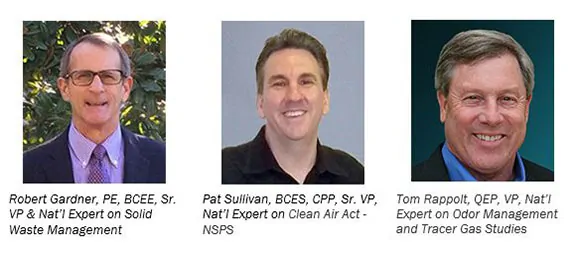
Our panelists bring comprehensive expertise to the table, including facility design and planning, technical experience in air quality compliance and pollutant dispersion and air measurement programs, atmospheric dispersion and transport of airborne pollutants, particularly in the area of complex terrain. They will provide decades of strategies, resources, and best practices and technologies based on successful solutions that help support your facility as you prepare for, and likely will, experience odor complaints.
The team answers questions throughout the presentation, and the second portion of the program is devoted to Q&A and idea exchange.
In implementing the EPA’s federal requirements for Coal Ash Residual – CCR sites, the Texas Commission on Environmental Quality’s CCR program needs to be at least as protective as the requirements of the self-implementing federal CCR rules. The TCEQ also is charged with making the Texas CCR program consistent with other TCEQ regulatory programs. As such, the TCEQ incorporated various provisions of state permitting programs and procedures into Chapter 352.
Whereas many of the EPA’s federal requirements are adopted directly by reference to the federal CCR rules (40 Code of Federal Regulations, as amended through April 17, 2015, issue of the Federal Register (80 FR 21301)), other requirements were tailored and, or expanded to be consistent with TCEQ programs. Following are select examples correlating the EPA and TCEQ requirements:
There were also five provisions of the federal CCR regulations that the TCEQ did not include in its permit program. These are addressed in EPA’S announcement regarding the TCEQ’s application requesting partial approval of their CCR state permit program. See https://www.epa.gov/coalash/us-state-texas-coal-combustion-residuals-ccr-permit-program
EPA is hosting a free workshop in January on landfill monitoring and emissions. The workshops are scheduled twice, over half-day sessions. These sessions will include presentations highlighting the latest technological developments for monitoring and measuring landfill gas emissions.
Dates and Times: Register once for both sessions.
If you have any questions, please contact Shannon Banner at or John Evans at .
As large tracts of geographically desirable vacant land become scarcer, residential and commercial property developers are increasingly turning to old landfills or former dumps. However, such redevelopment is complex and rife with uncertainties. When compared to greenfield development, the land acquisition costs are lower. Still, any savings are typically offset by greater environmental and infrastructure costs associated with the foundation, landfill gas management, stormwater management, groundwater impacts, meeting closure requirements, and multiple regulatory agency coordination. Therefore, it is important to maximize the developable area while providing engineering solutions to make the project economically feasible. In this blog, we identify some options to reuse challenging sites and lessons learned to contribute to successful redevelopment projects.
Deep Dynamic Compaction
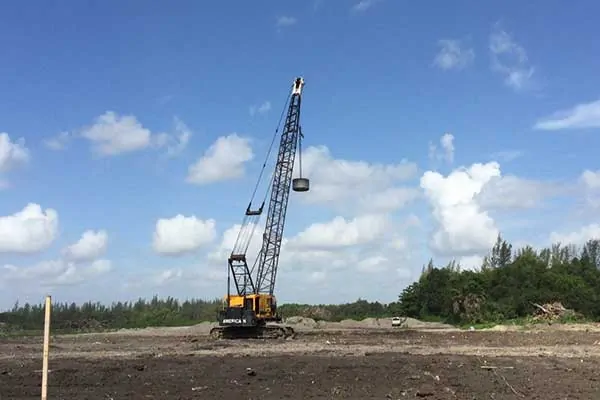
Old landfills or dumps present some unique soil stability challenges. Deep dynamic compaction (DDC) is a ground stabilization technique that has gained popularity in recent years to improve subsurface soil conditions. DDC involves dropping 6 to 30-ton weights from a height between 30 and 75 feet to achieve the desired soil compaction. DDC can effectively apply to a range of subsurface materials, including former C&D debris or municipal solid waste dumps.
DDC provides a stable foundation for future development, minimizes differential settlement while leaving the landfill waste in place, and eliminates the costs associated with removing, transporting, and disposing of buried waste, costing millions of dollars. For simplicity’s sake, let’s consider a 1-acre old landfill or a dumpsite with an average of 15 feet of waste. If excavating the waste and replacing it with clean fill, the disposal fee costs for the excavated waste alone could exceed $400,000. Alternatively, DDC costs range from $1.50 to $2.00 per square foot or $65,000 to $87,120 per acre, excluding mobilization, which costs around $30,000.
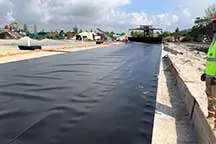
Gas Mitigation Systems
Constructing buildings on top of dynamically compacted areas generally requires a combustible gas barrier layer below the building foundation to manage subsurface combustible gases (typically methane). The barrier is required because the waste remains in place. In its simplified form, gas mitigation systems include:
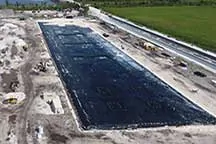
These gas mitigation systems can be either a passive or an active system with a blower. The cost of such systems varies depending on the size of the building, location, and type of liner system used. Typical capital costs for passive systems are in the range of $7 to $9 per square foot for the spray-applied liner and $3 to $4 per square foot for the HDPE liner. For an active system using blowers, add $3 to $4 per square foot. The designer configures a system from these options to address the client’s risk preference and considering future tenant preferences.
Using innovative approaches, impaired lands are increasingly attractive to developers. Beyond the cost-saving benefits to developers realized through DDC and an appropriate gas mitigation system, such projects also create local jobs, increase the tax base, and protect public health and the environment.
About the Authors:
 Somshekhar Kundral – Mr. Kundralis, PE, is a Senior Project Manager with over 12 years of broad and diverse environmental engineering experience that includes projects in landfill redevelopment, landfill gas management system design, site assessment, groundwater remediation system design, stormwater management, and injection well system construction. Som is experienced with site permitting, compliance reporting and construction administration services, and remediation systems’ operation and management.

Maura Dougherty is joining SCS’s Southwest Business Unit as a Senior Project Manager in the solid waste engineering practice. Dougherty will execute engineering design, operations support, and construction quality assurance projects. She is responsible for project management, client service, business development, technical leadership, and overseeing professional staff teams. Dougherty reports to Vice President and Southwest Business Unit Director of Engineering, Vidhya Viswanathan, P.E., from SCS’s Pleasanton office.
“Maura is a senior professional with proven extensive success in solid waste engineering, construction, and construction quality assurance solutions,” said Viswanathan. “Her experience managing landfill and landfill gas collection and control system engineering and construction projects strengthen our efforts to support our solid waste and recycling clients.”
Dougherty is a registered Professional Engineer in California, Oregon, Washington, and Hawaii. She brings over 20 years of experience overseeing landfill engineering and construction projects, coordinating with regulatory staff, conducting design and technical reviews, and supporting construction work. Dougherty earned her B.S.E. in civil engineering at the University of Princeton and her M.S. in environmental engineering from U.C. Berkeley.
On November 30, 2020, the Environmental Protection Agency announced it is aggressively addressing per- and polyfluoroalkyl substances (PFAS) in the environment. The agency announced two steps that it states would help ensure that federally enforceable wastewater monitoring for PFAS can begin as soon as validated analytical methods are finalized.
First, EPA issued a memorandum detailing an interim National Pollutant Discharge Elimination System (NPDES) permitting strategy for addressing PFAS in EPA-issued wastewater permits.
EPA’s interim NPDES permitting strategy for PFAS advises EPA permit writers to consider including PFAS monitoring at facilities where these chemicals are expected to be present in wastewater discharges, including from municipal separate storm sewer systems and industrial stormwater permits. The PFAS that could be considered for monitoring will have validated EPA analytical methods for wastewater testing. The agency anticipates being available on a phased-in schedule as multi-lab validated wastewater analytical methods are finalized. The agency’s interim strategy encourages the use of best management practices where appropriate to control or abate the discharge of PFAS and includes recommendations to facilitate information sharing to foster adoption of best practices across states and localities.
Second, EPA released information on progress in developing new analytical methods to test for PFAS compounds in wastewater and other environmental media.
In coordination with the interim NPDES permitting strategy, EPA is developing analytical methods in collaboration with the U.S. Department of Defense to test for PFAS in wastewater and other environmental media, such as soils. The agency is releasing a list of 40 PFAS chemicals that are the subject of analytical method development. This method would be in addition to Method 533 and Method 537.1 that are already approved and can measure 29 PFAS chemicals in drinking water. EPA anticipates that multi-lab validated testing for PFAS will be finalized in 2021. For more information on testing method validation, see https://www.epa.gov/cwa-methods.
EPA continues to expand its PFAS Action Plan to protect the environment and human health. To date, it has assisted more than 30 states in helping address PFAS, and the agency is continuing to build on this support. Across the nation, the EPA has addressed PFAS using a variety of enforcement tools under SDWA, TSCA, RCRA, and CERCLA (where appropriate), and will continue to protect public health and the environment.
The agency is also validating analytical methods for surface water, groundwater, wastewater, soils, sediments, and biosolids; developing new methods to test for PFAS in air and emissions; and improving laboratory methods to discover unknown PFAS. EPA is developing exposure models to understand how PFAS moves through the environment to impact people and ecosystems.
Related Information
This blog references information issued from the US EPA, Office of Public Engagement.
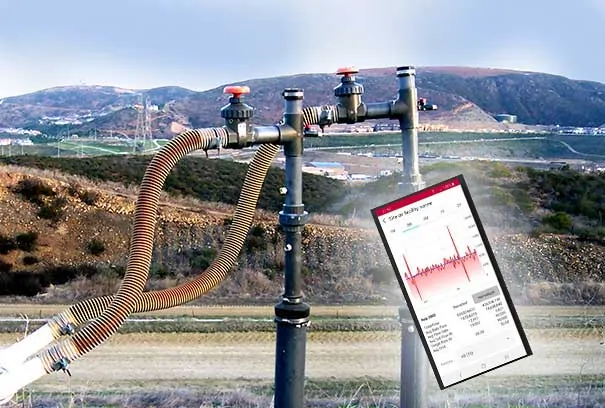
SCS Engineers’ newest environmental technology application is for use at solid waste facilities and landfills. These sites require specific monitoring and analyses of groundwater and liquids, landfill gas – LFG, and surface emissions critical to facility infrastructure and the environment.
 “We work side-by-side with our clients at hundreds of facilities nationwide. SCS MobileTools® supports operating decisions, whether our client is managing one site or hundreds,” states Pete Carrico, senior vice president and assistant director of SCS Field Services.” The App’s interface gives clients quick access to information that drives critical operating decisions and provides data for corporate directives and landfill gas OM&M programs for regional or national operations.
SCS MobileTools® is the iOS and Android mobile interface for the SCSeTools® platform. Access to data to make informed decisions is especially valuable when technicians are in the field, or operators are working remotely. Landfill and solid waste facility owners, operators, and technicians use the new application to observe system and environmental activity securely and in real-time on a mobile phone or device.
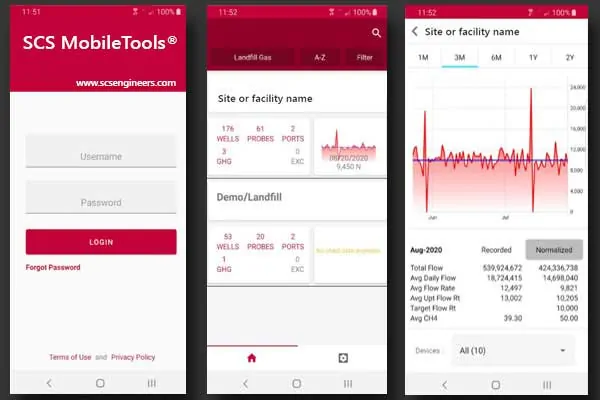
Featuring state-of-the-art technology, SCS MobileTools® provides users the ability to interact with a site or facility data, including site-specific monitoring and exceedance metrics for landfill gas, liquid levels, and surface emissions. Responsive, touch-enabled flow data charting is accessible, illustrating flow targets, reading dates, flow rates, and historical flow data analysis.
When compared year-over-year, generation and disposal trends produce information critical to assessing optimal options and solutions that represent significant savings for landfill gas Operations, Maintenance & Monitoring – OM&M programs. For this reason, the savings compound for regional or national operators.
For instance, monitoring and analyzing landfill gas generation and collection data against modeled estimates are valuable information. SCS MobileTools® handles the input, analysis, review, and export of landfill gas flow and related information, specifically flow rates, impacts on gas collection (e.g., extraction well liquid levels), and analytical data for data collection points.
In SCS’s release pipeline, SCS MobileTools® will include mapping and visualization functions in early 2021. SCS MobileTools® is available for download on the Apple App Store for iPhones and iPads, Google Play for Android.
SCS Engineers’ SCSeTools® platform and applications help facilities and companies operate more efficiently by continually gauging operational health and identify trends critical to operations and the environment.
SCS Technology Services®, the technology development practice within SCS Engineers, announces a new application for tracking and analyzing environmental data. The application expands the firm’s SCSeTools® platform, demonstrating its commitment to developing the most advanced data-driven technology in the environmental services industry.
Groundwater monitoring and compliance services are long-term and expensive responsibilities that generate enormous amounts of monitoring and laboratory data. SCS Groundwater™ is a tool to monitor and manage the data associated with operations and reporting requirements for various sites. Sites include active or closed landfills, plants, and impact sites such as former dry cleaners or industrial facilities.
The application also monitors and manages data effectively for clean groundwater applications such as groundwater basin management projects consistent with standard protocol under state and federal environmental compliance rules. SCS Groundwater™ collects and efficiently organizes groundwater monitoring and maintenance data providing those responsible for environmental compliance with a reliable, consistent, and cost-effective way to manage the large volume of information.
The application’s primary value is enabling users to set up a detailed monitoring plan for any number of events, including the sampling points to include and what analyses to perform at each point. Once the information upload is finished, the application checks incoming data against the plan to confirm all work is complete.
SCS Groundwater™ generates reporting components such as data tables, charts, graphs, and maps for compliance, reporting, and finding trends. For example, on a brownfield site, the compliance manager could upload historical monitoring data results, view the data trends over time, and then produce report tables and figures. Operators can also use the data in other applications for additional analysis or visualization.
SCS Engineers’ environmental solutions and technology directly result from our experience and dedication to industries responsible for safeguarding the environment as they deliver services and products. For information about SCS, visit the SCS eTools pages or enjoy our 50th Anniversary video to see the technology in action.
The SCSeTools® platform and applications help facilities operate more efficiently by continually gauging operational health and spot trends that help determine when and how to invest in infrastructure. Field staff, environmental compliance experts, brownfields, developers, and clients in the waste industry guide the technology designs. For additional information and demonstrations of these productivity-enhancing tools, please contact .
Corporate Headquarters