SPECIAL SESSION: Panel Discussion – How to Write a Good Geomembrane Spec
Organized by: FGI
Tuesday, Feb. 7th 1:30 – 3:00 pm
Join Panelists: Edward Silva, Ray Peebles, Neil Nowak, and Patrick Elliott with Moderator Timothy Stark leading this discussion on the importance of writing a good geomembrane specification and not using an old specification that may or may not be for the type of geomembrane intended for the current project. In particular, the panelists will discuss the most important parameters of a geomembrane specification for a particular application, such as functionality, longevity, and constructability.
Some of the important parameters to consider when preparing a specification may include: chemical resistance, ability to accommodate differential settlement, dimensional stability to control wrinkles, ability to factory fabricate large panels to reduce field time and exposure, and seam strengths but properties should be keyed to the application of the geomembrane. For example, if there are concerns about subgrade compaction, specifying a material with higher multiaxial elongation properties may be desirable.
It is also important that engineers understand that most material types can have very different properties, and it is important that designers select an appropriate geomembrane to meet project requirements. This will help avoid confusion or blended specifications. Finally, the importance of specifying relevant and consistent properties, e.g., long-term durability in terms of plasticizer retention instead of OIT values for a PVC geomembrane. Afterward, the panelists will answer your questions about writing a good geomembrane specification.
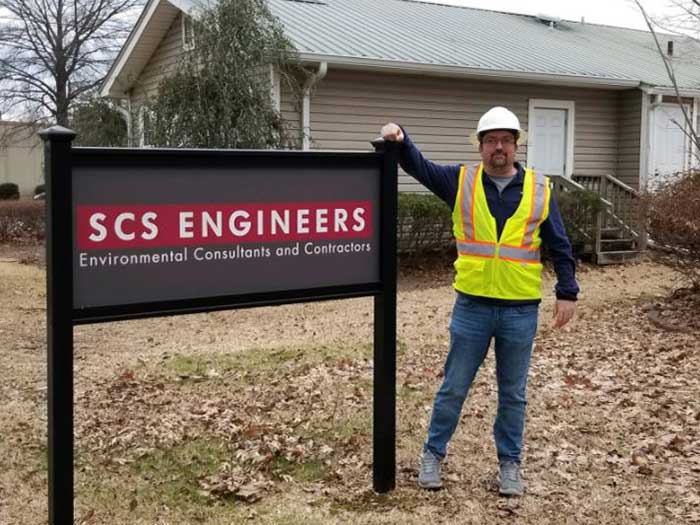
What is your title at SCS Engineers? Please briefly describe your responsibilities.
My title at SCS is “Regional Manager,” specifically Regional Manager of the Southern Coastal Region for Field Services OM&M. The Southeast Region was recently subdivided, and I am responsible for Georgia, Alabama, Mississippi, and Louisiana. My primary responsibilities include employee development, business growth and expansion, client relations, and asset management.
Why did you come to work here? What attracted you to SCS?
In 2007 I was looking for a career change. I was searching for a field where hard work and dedication would yield opportunities and a place where my work makes a difference. SCS presented me with an opportunity to do just that. I get to work every day with an amazing group of people on projects that protect and improve our environment.
What is your favorite part of working at SCS?
The overall work environment is my favorite part of working at SCS. SCS has created an environment where employees can succeed and are rewarded for hard work and contributions to client success. We openly share Ideas and information amongst the team, and the concept of “Our success is driven by client success” is visible in everything we do.
What has your career path been at SCS?
My career path at SCS is similar to many of the people I work with. I started with SCS in 2007 as an entry-level employee in the field. SCS provided me with the resources and guidance necessary to learn our craft; then, I was challenged to do it well. Over the past 15-plus years, I have been given opportunities and rewarded when I succeed. Working my way through the ranks has been rewarding and allowed me to appreciate all aspects of our work.
What do you look for when you are hiring in the field?
When hiring for field positions, humility, honesty, and drive are the most important traits. If a prospective employee has the attitude of wanting to learn and understanding it will take effort and time to become truly proficient, we have a winning combination. SCS has the resources and training programs to develop its employees continually. Finding people that enjoy developing and the challenges that come with it is key to our continued success.
What are your favorite hobbies outside of SCS?
Outside of SCS, I enjoy my time with my family. My daughter and I share enjoyment in golf and get to spend time together on the course. My immediate family also enjoys traveling to explore new places and visiting our extended family.
Interview with Lindsay Evans.

On January 11, 2023, the Illinois Environmental Protection Agency posted the General NPDES Permit for Industrial Storm Water Discharges (NPDES Permit No. ILR00) for public review and comment.
Please note that numerous modifications and additions are proposed for Attachment 1 of the NPDES Permit No. ILR00. The Attachment was just made public by the Illinois Environmental Protection Agency. We are preparing a summary of the changes associated with each subsector.
Modifications and added parts or sections are summarized below:
All comments on the draft permit and requests for a public hearing must be received by the IEPA no later than February 11, 2023.
Our team of Storm Water professionals in Illinois includes Spencer LaBelle and Scott Knoepke, who are ready to answer your NPDES Permit questions and discuss how the proposed modifications to the permit may impact your operation.
The California Gold Rush Chapter of SWANA is hosting its annual Western Regional Symposium and Tradeshow April 3-6, 2023 at the Hyatt Regency in Monterey, CA.
The conference is titled “Navigating Our Future: from Waste to Resources” and will cover a myriad of topics on waste management, including regulatory issues, health & safety, compliance, procurement, monitoring and enforcement, and more.
Several SCS professionals are presenting at the conference, including
Click for conference agenda and other details and registration information.
We hope to see you there!
Join SCS staff as we participate in the 41st annual Baynanza celebration of Biscayne Bay, April 15, 2023.
Baynanza is a celebration of Biscayne Bay and its significance as one of the most important ecological systems in South Florida. Traditionally celebrated throughout March and April, Baynanza culminates with the Biscayne Bay Cleanup Day, where thousands of volunteers join together to help clean up our bay’s shoreline. Since it began in 1982, volunteers have helped remove over one million pounds of trash from Biscayne Bay.
Along with the annual cleanup efforts associated with Baynanza, Miami-Dade County also conducts restoration activities in Biscayne Bay throughout the year. In 2020, staff from the Department of Regulatory and Economic Resources (DERM) coordinated the removal of 70,000 pounds of debris from the Bay and adjacent wetlands. These efforts were partly documented by public service announcements tackling issues of marine debris around Biscayne Bay and illegal dumping in coastal wetlands.
This year, Baynanza commemorates its 41st year, and on April 15, 2023 (from 9 a.m. to noon), the community will come together once again to celebrate the incredible marine resources and help restore Biscayne Bay’s shoreline at over 30 locations across Miami-Dade County. Volunteers at all the cleanup sites will receive a free commemorative T-shirt and community service hours are available to all students who participate.
Click for updates and registration information.

Air permitting compliance is a crucial aspect of operating a facility that generates air emissions. The process involves obtaining permits from regulatory agencies that establish requirements to demonstrate that the facility operates within limits set by air quality regulations.
Air permitting is not just for industrial operations but impacts many businesses.
In Miami-Dade County, Florida, the agency responsible for issuing air permits is the Department of Environmental Resources Management (DERM). Businesses that emit air pollutants, such as fine particulate matter (dust), volatile organic compounds, and hazardous air pollutants, or which operate combustion equipment such as ovens, furnaces, boilers, and backup power generators must obtain air permits to operate legally. The Florida Department of Environmental Quality provides state guidance here. These permits are required to ensure that the facility’s emissions are within limits set by air quality regulations and that the facility is taking the necessary steps to control and reduce emissions.
Local business example
In the case of one apparel printing facility in Miami-Dade County, SCS Engineers (SCS) was hired to assist with obtaining the necessary air permits from DERM. The scope of services included reviewing current and proposed operations information, calculating air emission estimates, and preparing the narrative and application forms. SCS also prepared a Request for Information (RFI) to confirm the necessary background information, such as equipment specifications, facility layout, projected usage, and operating records. The deliverables included an Air Construction Permit Application and an Air Operating Permit Application. In this case, SCS could prove that the client did not need a permit even though the regulatory agency thought they might.
What are the steps?
The process of obtaining an air permit can be complex and time-consuming, which is why businesses often hire specialized environmental engineering firms to assist them. In this example, SCS provided DERM with a detailed report and application package, including a process flow diagram, equipment specifications, and actual and potential emissions calculations.
It’s important for businesses operating in Miami-Dade, or any county, to understand the air permitting process and the regulations set by local authorities. Environmental engineering firms can provide more accurate and detailed information, so management understands the specific air quality regulations that apply to their business.
The value is in implementing the practices necessary to maintain compliance with air quality regulations and keeps your reputation with workers and the community stellar. Businesses continuing to operate illegally face administrative and civil violations, court actions, and potential environmental insurance challenges. Another consideration is that the same engineering firm can likely advise you on stormwater and groundwater permits and compliance for your facility.
About the Author: Troy Schick, PE, is a Project Manager based in our Miami, Florida, office. He is a Professional Engineer licensed in Florida and a Qualified Stormwater Management Inspector.
Stormwater and Air Permitting Compliance Resources for Businesses:
Meet and greet SCS professionals at the 2023 Florida Public Works Expo, April 18-20, at the Jacksonville River City Downtown Hotel and the Prime F. Osborn III Convention Center.
The Florida Public Works Expo attracts hundreds of Public Works professionals from the State of Florida and the Southeast, providing a great opportunity to network with your peers, boost your motivation, and gain powerful new tools for success! You will also have the opportunity to attend a variety of Technical Sessions designed to sharpen your skills, maximize production, and keep you on the cutting edge of emerging technologies and products. Be sure to visit the Trade Show and acquire new tools, tips, and techniques from the leading suppliers and manufacturers in your industry!
There are many great reasons to attend the Expo, including:
The event is hosted by the Florida Chapter of the American Public Works Association.
Click for details and registration information
Meet SCS Engineers professionals at our booth at the SWANA Alabama Chapter’s Spring Meeting, April 3-5, at the Perdido Beach Resort in Orange Beach, AL.
The Alabama Chapter is dedicated to advancing the practice of economical & environmentally sound solid waste management in the State of Alabama. The Spring Meeting awards student scholarships, honors outstanding individuals, and provides continuing education opportunities.
Click for more details and registration information.
On January 11, 2023, the Illinois Environmental Protection Agency posted the General NPDES Permit for Industrial Storm Water Discharges (NPDES Permit No. ILR00) for public review and comment.
Please note that numerous modifications and additions are proposed for Attachment 1 of the NPDES Permit No. ILR00. At the time of authoring this blog, Attachment 1 has not been made public by the Illinois Environmental Protection Agency. Once this document is made available, a follow-up post will be prepared to summarize the changes associated with each subsector.
Modifications and added parts or sections are summarized below:
All comments on the draft permit and requests for a public hearing must be received by the IEPA no later than February 11, 2023.
Our team of Storm Water professionals in Illinois includes Spencer LaBelle and Scott Knoepke, who are ready to answer your NPDES Permit questions and discuss how the proposed modifications to the permit may impact your operation.
Join SCS Engineers professionals at the WMEP Manufacturing Matters! 2023 Conference, “Rising to the Challenge”, April 27, 2023, at the Hyatt Regency in Milwaukee, WI.
This premier manufacturing industry conference will include a Celebration of Wisconsin Manufacturing reception the evening prior to the conference.
The conference is taking shape – check back for conference details and registration information
Corporate Headquarters