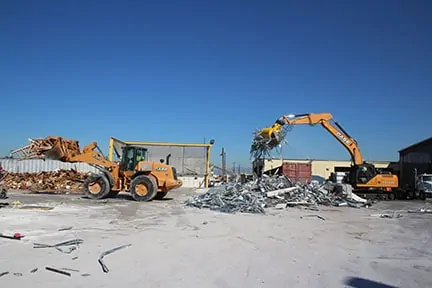
Construction and Demolition Recycling Inc. is a California state certified C&D recycling facility which handles debris from the renovation, construction, and demolition of commercial interior spaces. CDR is the only facility in California that accepts only commercial interior debris, and the only facility in the country that can show a better than 80% diversion rate of these materials traditionally buried in landfills.
CDR’s staff also salvages usable items such as furniture, desks, chairs, file cabinets, and more, for reuse, donating more than 50 tons of these materials every month to not-for-profit agencies and other organizations. All of this allows CDR to divert over 80% of all inbound debris from landfills, a diversion rate that has been third party-verified by the Recycling Certification Institute.
The CDR facility in South Gate, California is a fully permitted C&D/inert debris processing and transfer facility. The facility is owned and operated by Interior Removal Specialist, Inc. (IRS), a demolition company that conducts demolition activities primarily of the interior of offices and other commercial buildings. Construction and Demolition Recycling Incorporated’s goal is to lead by example; showing that the diversion of tenant improvement demolition debris can be accomplished as efficiently and cost effectively as the debris from more traditionally recognized demolition debris. CDR has become the first and so far only recycling facility in Southern California that has earned Third Party Diversion Certification from The Recycling Certification Institute, making CDR the only facility in Southern California that is eligible to provide the US Green Building Council LEED Pilot Point for facilities with 3rd party verification.
Read the full article to learn some of the innovative strategies of this successful recycling company in “Construction and Demolition Debris Recycling Program; How CDR was Conceived and How CDR Remains Sustainable.”
Solid Waste Management, Sustainability, and Recycling Programs
By following the simple procedures governing selective routing in the commercial space, it is possible to turn a high disposal garbage collection system into a high diversion recycling system, without incurring additional costs or losing collection revenue. Read more…
Tracie Onstad Bills of SCS Engineers and Richard Gertman of For Sustainability Too explain the steps for commercial-stream routing and management of commercial recyclables with remarkable results in their Resource Recycling article published in June 2016.
Questions? Ask Tracie, she writes a blog series about recycling.
Tracie Onstad Bills, Northern California Director, Sustainable Materials Management at SCS Engineers
Thank you for the responses and questions about my blog Minimizing Contamination in Recycling. It seems appropriate to provide answers to the most frequently asked questions and send more advice. Any program should be tailored to your current collection system; what works and what doesn’t work for your locality; the demographics of your community; and how your community views recycling.
In light of those considerations, here are some recommendations for ways to minimize contamination in recyclables:
Learn more about recycling programs by reading Success In Selective Routing – Resource Recycling or the SCS project and case studies below:
As always, feel free to send me your questions and comments. Contact Tracie here.
SCS Engineers’ Tracie Onstad Bills and Leslie Lukacs were both selected to receive the California Resource Recovery Association’s (CRRA) prestigious Service Award this year. According to CRRA Executive Director, John H. Dane, the award recognizes “exceptional individual service to the organization and a contribution of time or resources beyond expectations.” That sounds like an SCSer alright.
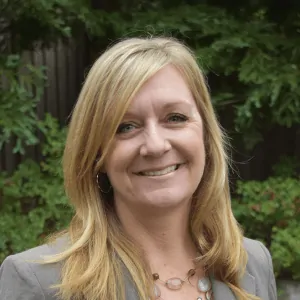
Tracie Bills is SCS’s Sustainable Materials Management Director and is based in our Pleasanton, CA, location. She has been on the CRRA board for 10 years and has served in several leadership positions within the organization, including as its President for three years. Her expertise revolves around commercial recycling technical assistance, environmental purchasing, large venue and event zero waste programs, research and sustainability planning, garbage hauler franchise compliance and review, construction and demolition program / ordinance analysis and writing, climate inventory compilation, research and feasibility studies to help clients with comprehensive waste prevention and zero waste programs.
Leslie Lukacs serves as a Sustainable Materials Management Specialist in our Santa Rosa, CA, office. She has been on the CRRA board for 12 years and also served in a variety of leadership positions. She also founded CRRA’s Green Initiatives for Venues and Events technical council and was an instructor for CRRA’s Resource Management Certification Program for 5 years. Leslie specializes in the design and implementation of sustainable materials management and zero waste programs and is a pioneer in the greening of venues and events throughout the nation. Her extensive expertise in the logistics of zero waste, recycling, and composting programs, such as outreach management, business assistance, master planning, waste audits and characterization studies, extended producer responsibility ordinance preparation and implementation, compliance, grant writing, and administration are all key to successful long-term programs.
Both women were selected by the CRRA Board of Directors to be the 2016 recipients of the Service Award. The awards will be presented at the organization’s Annual Conference Awards Ceremony on August 9 in Sacramento.
CRRA is California’s statewide recycling association. It is the oldest and one of the largest non-profit recycling organizations in the U.S. CRRA is dedicated to achieving environmental sustainability in and beyond the state through Zero Waste strategies including product stewardship, waste prevention, reuse, recycling and composting. The organization provides its members with resources to advance local, regional and statewide waste reduction efforts which result in critical environmental and climate protection outcomes. Members represent all aspects of California’s reduce-reuse-recycle-compost economy and work for cities, counties, municipal districts, and businesses as well as hauling companies, material processors, non-profit organizations, state agencies, and allied professionals.
This innovative sustainable materials management approach involves strategically picking up loads from businesses that generate similar types of discards. The linked article discusses the approach of following simple procedures governing selective routing in the commercial space.
Using a phased methodology, it is possible to turn a high-disposal garbage collection system into a high-diversion recycling system, without incurring additional costs or losing collection revenue. Dumpsters behind shopping plazas and other sites can become opportunities at the center of a thriving materials recovery program.
About the Authors:
Richard Gertman is the owner of For Sustainability Too in San Jose, CA.
Tracie Onstad Bills has been in the Environmental and Resource Material Management Field for over 20 years. Her expertise revolves around commercial recycling technical assistance, environmental purchasing, large venue and event zero waste programs, research and sustainability planning, garbage hauler franchise compliance and review, construction and demolition program / ordinance analysis and writing, climate inventory compilation, research and feasibility studies to help clients with comprehensive waste prevention and zero waste programs. Ms. Bills has a BA in Environmental Science from San Jose State University, is a CRRA Board member and belongs to the SWANA Gold Rush Chapter, National Recycling Coalition and the Northern California Recycling Association. Contact Tracie here.
Glass accounts for almost 5% of the municipal solid waste stream; state and local agencies have set ambitious zero waste goals; many agencies are not ready to give up on glass recycling. How do they manage to keep their programs viable despite the cost of processing, transportation, and the challenge of cross contamination?
Sustainable Solid Waste Managment Planning and Programs
“Our clients enable SCS to build, grow, and sustain an engineering firm dedicated to solving environmental challenges,” said Jim Walsh, President and CEO of SCS. “We sincerely thank our friends, colleagues and, in particular, our clients for helping us achieve a highly regarded ranking each year.”
Firms are ranked in terms of revenue by Engineering News-Record magazine (ENR), as reported in the May 2, 2016, issue of the “ENR Top 500 Design Firms Sourcebook.” SCS has made the Top 500 list since its publication in 2002 and has ranked in the top 100 of that list since 2008.
When sorted by firm type, SCS Engineers is ranked the second largest environmental engineering firm (ENV) and is ranked in the “Top 20 Sewerage and Solid Waste” service firms in the nation. SCS has made this top 20 list since 2002.
Later in the year, ENR will publish additional resources and lists, including the “Top 200 Environmental Firms” issue, typically published in the month of August.
Learn more about our latest innovation, SCSeTools
Penton’s Waste360 Unveils the Next Generation of Leaders in the Waste and Recycling Space Award
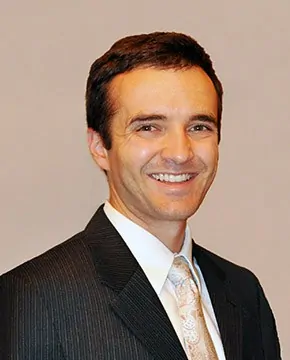
The Waste360 “40 Under 40” awards program recognizes inspiring and innovative professionals under the age of 40 whose work in the waste, recycling, and organics industry has made a significant contribution to the industry. Dave Hostetter focuses on designing landfill gas systems and landfill gas flare systems. Although still considered a young professional himself, he serves as a mentor to other engineers, providing guidance with hands-on design as well as professional guidance.
Dave is a LEED® Accredited Professional (LEED AP) and a Certified Energy Manager (CEM). He brings to SCS Engineers an abundance of expertise and fresh ideas. Dave has a keen eye for troubleshooting and diagnosing control system issues. He serves SCS clients wholeheartedly and goes out of his way to provide assistance as well as the expertise needed to make their day-to-day operations run as smoothly as possible. Dave has participated in a multitude of landfill gas and leachate system designs, including designs for blower and flare stations, wellfields, gas conveyance piping, leachate pumping systems, and groundwater extraction systems. His vast and varying experience, honest and hard-working approach to projects, and his positive attitude make him a respected resource within the firm.
Dave lives the SCS mission, and clients trust him for his honest and comprehensive approach to their challenges. Dave takes ownership of his work and puts in the time and effort to deliver excellent results and maintain a great relationship with his clients. “Dave Hostetter sets the example of how an honorable, dynamic, and experienced engineer should act at SCS,” said Paul Mandeville, Senior Vice President and Director of SCS’s offices on the east coast. “Dave serves as a model of what young professionals and students should strive to become in their professional and personal careers; we are very proud of him.”
Please join SCS in congratulating Dave Hostetter on his recent recognition by Waste360.
The Solid Waste Association of North America (SWANA) Applied Research Foundation released a report concluding that: a significant amount of additional food waste processing capacity will be required to achieve national, state, provincial, and local food waste diversion goals. The report also emphasizes the need for local decision-making in selecting and implementing those food waste diversion programs.
…a significant amount of additional food waste processing capacity will be required to achieve national, state, provincial, and local food waste diversion goals. The report also emphasizes the need for local decision-making in selecting and implementing those food waste diversion programs.
The report goes on to say that interest in recovering food waste from municipal solid waste is growing to meet goals established by the U.S. Environmental Protection Agency and U.S. Department of Agriculture, but many major metropolitan areas lack the infrastructure to manage the ability to meet the established goals. Two examples were cited:
Several states, including Massachusetts and Connecticut, condition their food waste diversion requirements on the ability of generators to access adequate capacity within a certain distance.
Speaking as SWANA’s Executive Director and CEO David Biderman stated:
We believe that Americans need to rethink how food is handled before it is considered waste, to divert it into programs to feed people, and to find other productive uses for food as food. Once it becomes waste, however, municipal decision-makers, working with their processing partners, need to determine how to best manage the material.
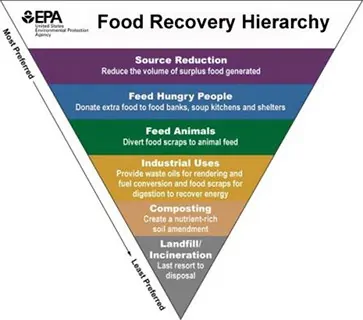
The SWANA report focuses on the effects of food recovery at the two lowest tiers of the hierarchy – composting and landfilling/incineration. The report concludes that food waste diverted from landfill operations has the potential to be processed at composting facilities. Then, going on to say that anaerobic digestion (AD) and co-digestion at wastewater treatment facilities are also likely destinations for diverted food waste.
Jeremy O’Brien, Director of the Applied Research Foundation, noted:
The food recovery hierarchy does not apply universally; an analysis of greenhouse gas impacts based on local data and conditions is needed to identify the best food scraps management options for a specific community.
The report encourages solid waste managers to perform a life cycle analysis of economic and environmental costs and benefits based on local needs, system capabilities, and data to identify the most effective ways to manage food waste at the local level.
SCS Engineers and SWANA are both long-time advocates for local decision-making in establishing programs to collect and manage municipal solid waste.
Related articles:
Operational expenses such as replacing collection vehicles, considering and implementing recycling programs, and the impact of stricter environmental regulatory programs can all affect collection fees and the quality of service. Strategic business planning solves the ongoing process whereby an organization determines where it is going… plus how it will get there, and what tools and resources it will use.
The City of Killeen recently worked with SCS Engineers to create a 20-year master plan with modeling capabilities to determine the optimum scenarios that benefit the surrounding communities and one that helps manage environmental safety and the outlay of capital before the expense of planning, designing, and building begins. Population projections, demographics, cost and historical data, among other resources, make up the information that is then organized and analyzed to prepare projections based on changing scenarios over a period of years. This type of economic study enables the planning team on any proposed project to provide a “what if” analysis for the decision-makers with the potential impact a proposal may have on customer rates and fees.
The collaborative effort between the City and SCS has culminated in a long-term financial roadmap and planning tool, which evaluates the impact of operational expenses and provides a basis for planning capital expenditures. The plan is already in use by the City’s decision-makers to determine the efficiency of investing in equipment and a Material Recovery Facility (MRF) as part of a waste management plan. Key outputs of this study included the justification for the City’s acquiring new collection equipment and further assessment of the feasibility of implementing single-stream recycling.
This type of business analysis requires technical expertise in the many aspects of waste management. You’ve got to dig deep into the conditions that present a financial, environmental, or quality challenge to managing wastes in order to deliver a system that is serviceable for decision-makers to use for many years.
Corporate Headquarters